
📌 Related Guides:
– Building your first safety net: How to Save Your First $1,000 on a Low Income
– Easy tracking: How to Track Spending Without a Spreadsheet
A Quick Note Before We Begin: My goal at Grow Your Money Smart is to share what I’ve learned on my own financial journey to help you feel more confident about yours. Please remember, I am not a licensed financial advisor, and the information in this article is for educational and informational purposes only. Financial situations are unique; what works for one person may not be right for another. While I do my best to ensure all information is accurate and up-to-date, it should not be considered professional financial advice. Always consult with a qualified financial professional before making any major financial decisions. Your financial future is in your hands, and I’m here to help you get started on the right path.
How to Budget When You’re Living Paycheck to Paycheck:
The Survivalist’s Guide to Reclaiming Your Peace
Let’s be honest. When you’re living paycheck to paycheck, the very idea of a “budget” can feel like a cruel joke. The math simply doesn’t seem to add up. You look at your income, you look at your bills, and the space in between is either razor-thin or non-existent. The stress is constant, and a single unexpected expense—a flat tire, a sick child—can feel like a catastrophe.
This is what experts call the “scarcity mindset.” When our brains are overwhelmed by a constant lack of resources, we go into survival mode. We start “tunneling,” focusing only on the most immediate crisis right in front of us, making it nearly impossible to plan for next week, let alone next year. If you’ve ever tried a budget and felt like you “failed” after just a few days, you are not alone. It’s not a personal failure; it’s a cognitive response to immense pressure. That “failed” budget isn’t a report card—it’s just data. And today, we’re going to use that data to build something that actually works.
I know this part can feel overwhelming, but please know you’re not alone in feeling this way.
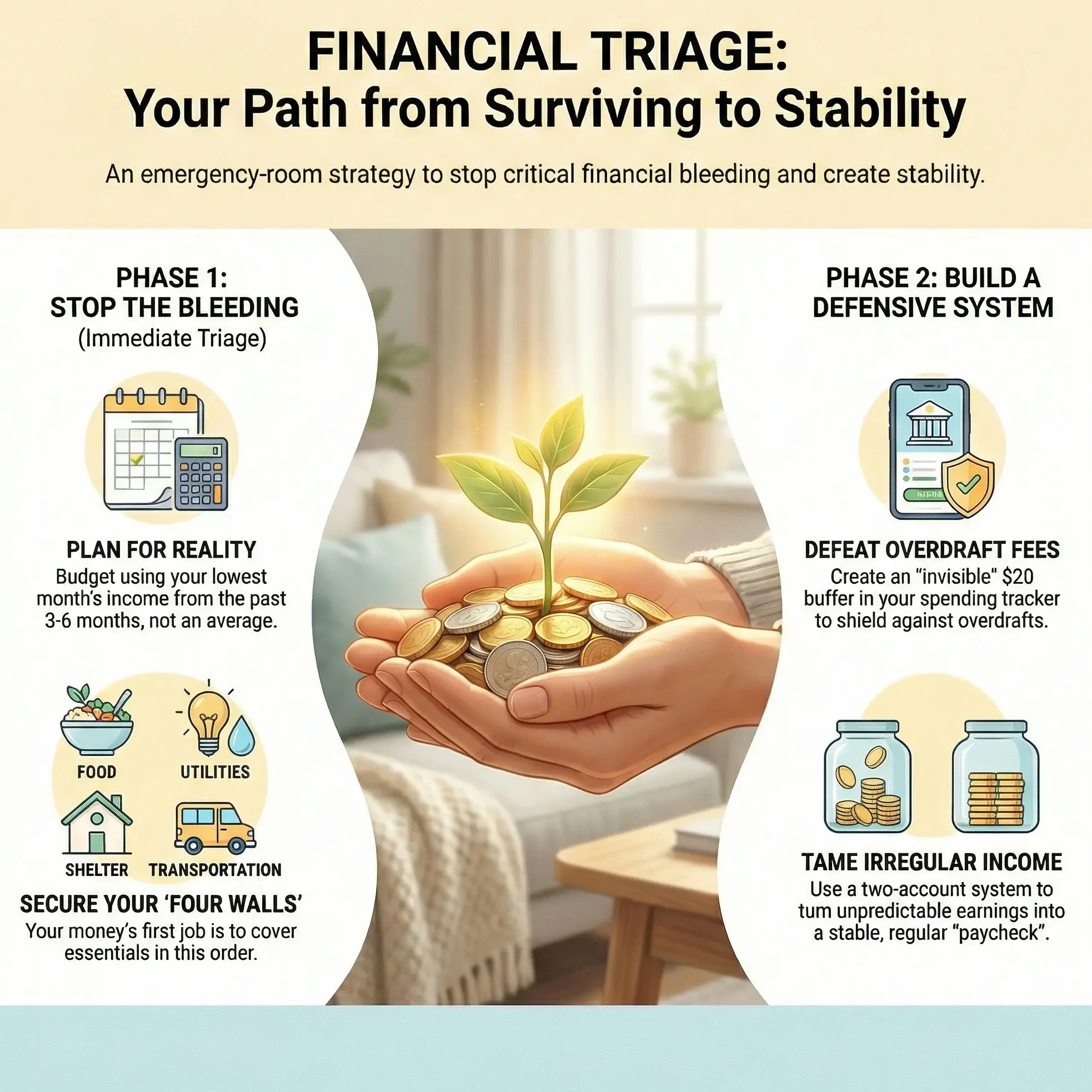
We’re going to stop trying to force a conventional budget into an unconventional situation. Instead, we’re adopting a new strategy: Financial Triage. Think of it like an emergency room. When a patient comes in with multiple injuries, doctors don’t treat everything at once. They stop the most critical bleeding first. We’re going to do the same for your finances. This isn’t about deprivation; it’s about strategic survival and reclaiming your peace of mind.
Listen to the Article: Financial Triage
🎧 An audio version of this guide to help you absorb the strategies.
📌 Quick Start: The Financial Triage Method
If you’re overwhelmed, don’t read everything. Start here.
-
Plan for reality, not hope
Use your lowest income month (or a conservative average) as your budgeting baseline. -
Secure your “Four Walls” first
Food → Utilities → Shelter → Transportation. Everything else waits. -
Create a $20 invisible buffer
In your personal tracker, treat your balance as $20 less to block overdraft fees. -
Stabilize irregular income
Use a two-account system: one for income, one for spending. -
Check in weekly (30 minutes)
Update spending, look ahead, and adjust calmly—no shame, no panic.
Goal: Stop the bleeding, reduce stress, and regain control—one week at a time.
Step 1: The Psychological Reset – From Handcuffs to a GPS
First, we need to reframe what a budget is. It’s not a set of handcuffs designed to restrict you. It’s a Storm GPS. When visibility is low and the financial weather is bad, a budget is the tool that shows you the safe harbors, the clear paths, and the dangers to avoid. It gives you clarity when you need it most.
Every time you feel you’ve “messed up,” remind yourself: this is just new information for your GPS. It’s not a moral failing. It’s a course correction. We are leaving shame at the door.
Step 2: Calculate Your True Baseline (Especially for Irregular Income)
If your income fluctuates, budgeting on your “best month” is a recipe for disaster. We need to plan for the worst-case scenario to ensure we’re always stable. This is the “Lowest-Month” method.
Look back at the last 3-6 months. What was the absolute lowest amount of money you brought in during a single month? That is your new budget number. It’s the income you can reliably count on. Any money you make above that number is a bonus, which we’ll deal with later.
If your income is more regular but still has some variation, you can use the Average Paycheck formula to find a stable planning number:
Average Paycheck = (Paycheck 1 + Paycheck 2 + Paycheck 3 + Paycheck 4) / 4
Using this baseline gives you a realistic foundation, not a hopeful guess.
Step 3: Financial Triage – Securing Your “Four Walls”
This is the heart of our emergency room strategy. Before a single dollar goes to a credit card, an old medical bill, or a subscription service, we must secure our “Four Walls.” This is the non-negotiable hierarchy of survival expenses:
- Wall 1: Food. Not dining out, but essential groceries to keep you and your family fed.
- Wall 2: Utilities. The lights, heat, and water must stay on.
- Wall 3: Shelter. Rent or mortgage. Keeping a roof over your head is paramount.
- Wall 4: Transportation. The essential transportation needed to get to your job and earn an income (e.g., gas, public transport pass).
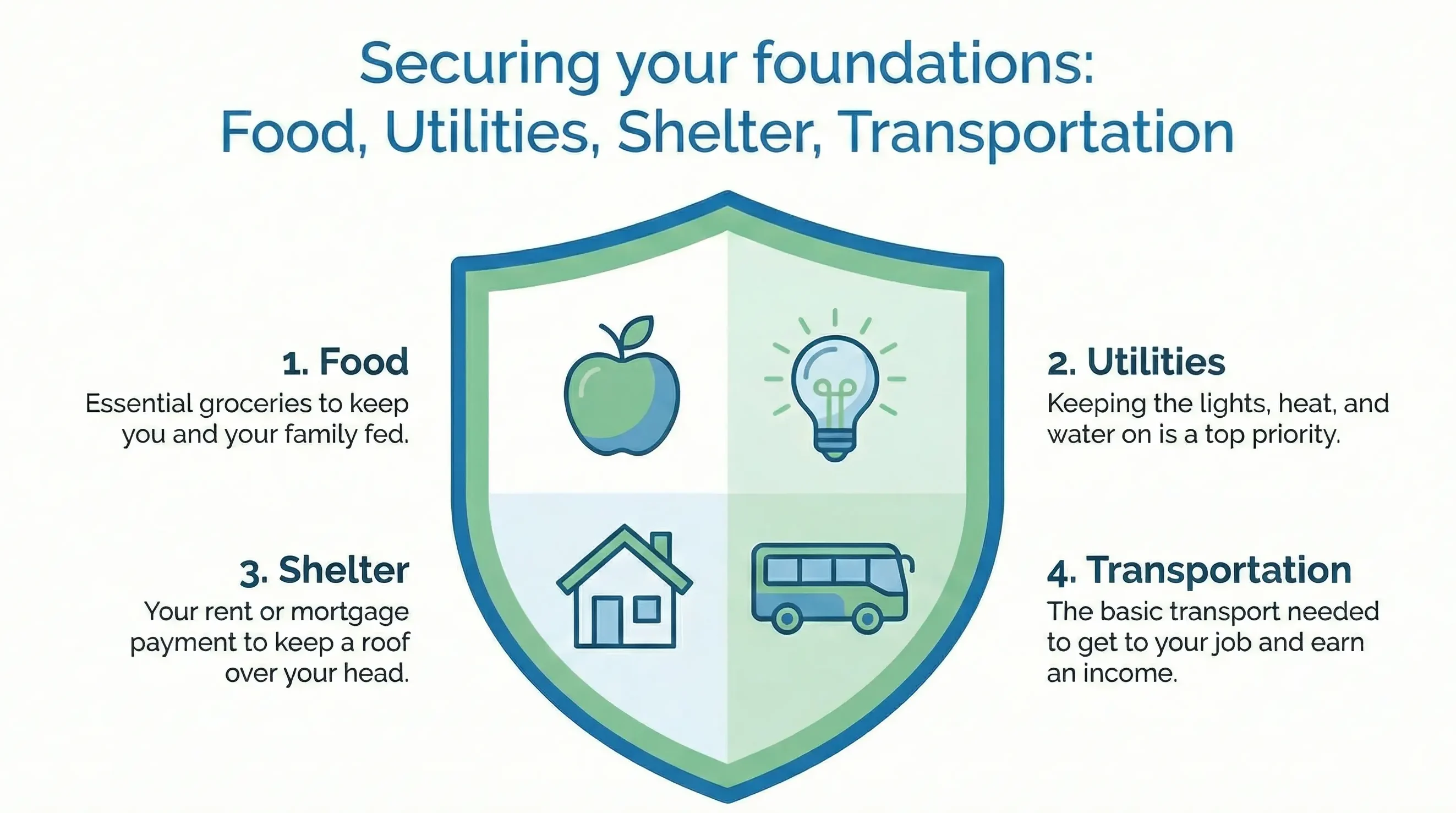
That’s it. In a crisis, these four categories get paid first, in this order. It’s like putting on your own oxygen mask before helping others. You cannot begin to tackle debt or build savings if your basic needs are at risk.
Step 4: The Defensive Play – Defeating the $35 Overdraft Monster
Overdraft fees are a predatory tax on those with the least amount of money. A single $35 fee can trigger a cascade of financial pain. We will end this cycle with two defensive moves.
The Authorized vs. Cleared Trap
One of the biggest reasons people overdraft is by looking at their bank balance and thinking it’s real-time. But there’s a delay between when you authorize a payment (like swiping your debit card) and when the money officially leaves your account (when it “clears”). You must become the CEO of your own small company and track your spending as it happens, not when the bank gets around to it. A simple notebook or a free app can be your ledger.
The Artificial Buffer Hack
This is your secret weapon. We’re going to create an “invisible” buffer in your checking account. Here’s how:
Actionable Micro-Win: In your spending ledger (not your bank account itself), subtract $20 from your actual balance. For example, if your bank says you have $85, your personal ledger says you have $65. This $20 is now your “zero.” You never touch it. It exists for one reason only: to be a Protective Shield that deflects the $35 “financial arrow” of an overdraft fee if you make a small miscalculation. This simple trick can save you hundreds of dollars a year.
Video: The Overdraft Fee Hack You NEED to Know
📺 Watch this short video for a visual explanation of the $20 buffer.
Step 5: The Two-Account System for Gig Workers and Irregular Incomes
If you’re a freelancer or gig worker, managing unpredictable income is a huge challenge. The solution is to become your own payroll department.
Actionable Micro-Win: Set up two checking accounts.
- Account A (The “Income Catcher”): All income from every gig, client, and side hustle gets deposited here. This account is just a holding tank.
- Account B (The “Operating Account”): Once a week or every two weeks, you pay yourself a fixed, reliable “internal paycheck” from Account A into Account B. This amount should be based on the “Lowest-Month” income you calculated earlier. All your bills and spending come out of Account B.
This system turns chaotic, lumpy income into a smooth, predictable “paycheck,” making it infinitely easier to manage your Four Walls budget.
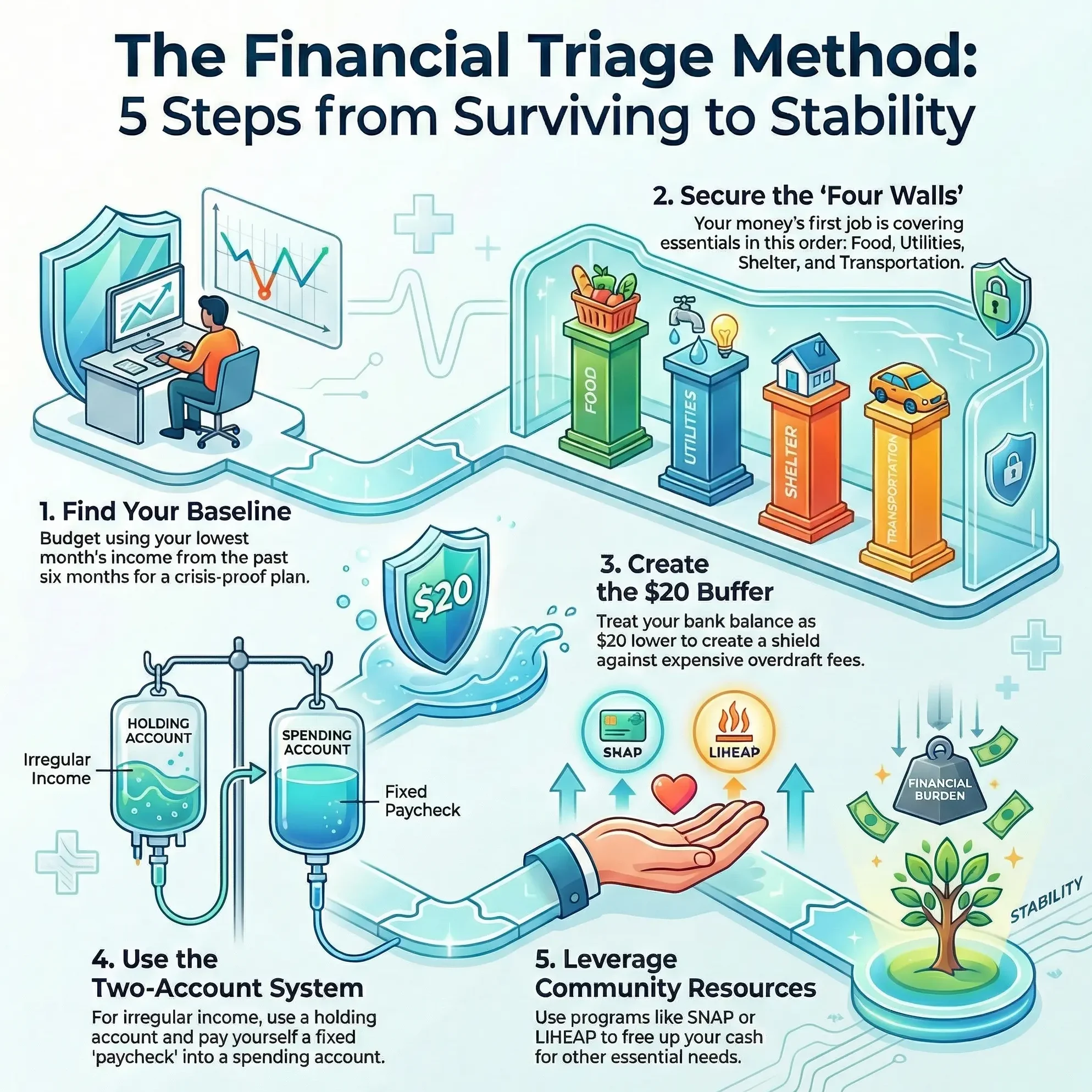
The Financial Triage Method:
5 Steps from Surviving to Stability
Step 1: Find Your Baseline
Budget using your LOWEST month’s income from the past six months, not your average. This creates a realistic, crisis-proof plan.
Step 2: Secure the ‘Four Walls’
Your money’s first job is to cover these in order: 1. Food, 2. Utilities, 3. Shelter, 4. Transportation. Everything else comes after.
Step 3: Create the $20 Buffer
In your personal spending tracker, treat your bank balance as if it’s $20 lower than it is. This ‘invisible’ money acts as a shield to block ~$35 overdraft fees.
Step 4: Use the Two-Account System
For irregular income: All money goes into Account A (Holding). Pay yourself a fixed ‘paycheck’ into Account B (Spending) to create stability.
Step 5: Leverage Community Resources
Treat programs like SNAP, LIHEAP, and 211.org as part of your budget. They free up your cash for other essentials.
Step 6: Expand Your Budget with Community Resources (The “Second Paycheck”)
You are not alone in this. One of the most powerful budgeting tools is leveraging resources designed to help. Treating these programs as line items in your budget frees up your earned cash for other critical needs.
- 211.org: This is the ultimate starting point. Run by the United Way, you can call 211 or visit their website to be connected with local resources for everything from utility assistance to food banks.
- LIHEAP (Low Income Home Energy Assistance Program): A federal program that helps low-income households with their heating and cooling bills.
- SNAP (Supplemental Nutrition Assistance Program): Formerly known as food stamps, SNAP provides benefits to supplement your grocery budget.
Using SNAP to cover $200 in groceries is the same as getting a $200 raise. Actionable Micro-Win: This week, spend 30 minutes on 211.org to see what’s available in your area. Don’t let pride stand in the way of stability.
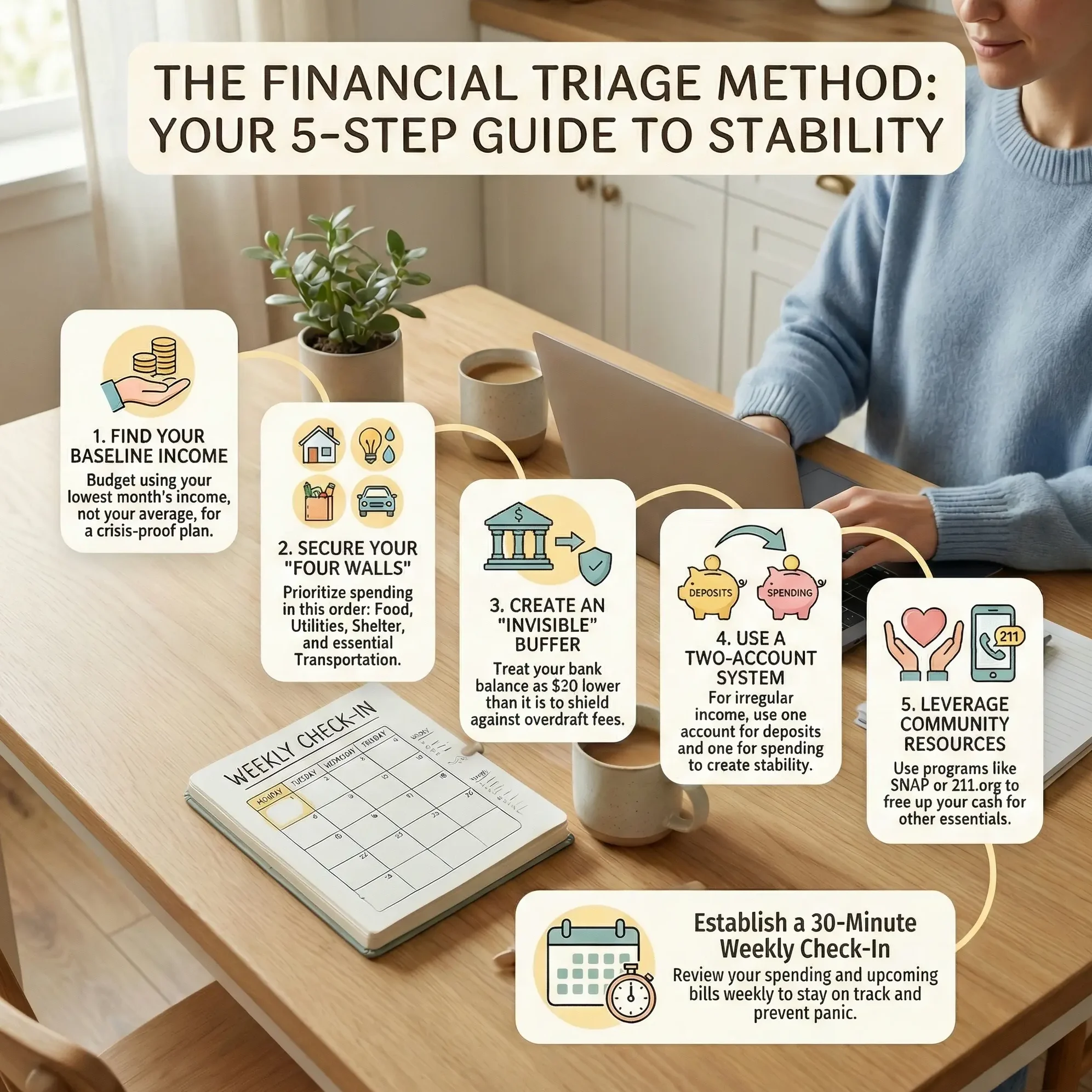
Step 7: The 30-Minute Weekly Rhythm
A budget isn’t a “set it and forget it” document. It’s a living thing. To keep it healthy, you need a quick, weekly check-in. This is your “Weekly Spending Map” session.
Every Sunday evening, take 30 minutes to do the following:
- Update Your Ledger: Log all authorized transactions from the past week. How does your balance look against your plan?
- Look Ahead: What bills are due this coming week? Do you have the funds set aside?
- Check for “Systemic Leakage”: Did you get hit with a late fee? A convenience surcharge? A higher-than-expected utility bill? Identify these leaks so you can plan for them.
- Emotional Check-in: How are you feeling? Stressed? In control? Many of my readers find that acknowledging the emotional side is crucial to sticking with the plan.
This weekly rhythm prevents end-of-month panic and gives you multiple opportunities to course-correct.
A Final Word on Savings: The Power of the $5 Win
When you have no margin, saving 10% of your income is impossible. So let’s forget it. Instead, we’re going to build the habit of saving, no matter how small. Actionable Micro-Win: This week, find one way to save $5. Maybe it’s brewing coffee at home for one day or skipping an impulse buy. Move that $5 into a separate savings account immediately. The amount isn’t the point; the repeated action of putting money aside for your future is. These small wins build momentum and belief.
Building a budget when you’re living paycheck to paycheck is one of the hardest things you can do, but it is also the first, most powerful step toward reclaiming your financial peace. You are the CEO of your life, and this is your Standard Operating Procedure for success. You can do this.
I know this is a lot to take in, but remember that progress, not perfection, is the goal. What is the one step from this guide that you feel you can implement this week? Share your first move in the comments below—declaring it is a powerful way to start!
⚡ Immediate Survival & Cash Flow Stabilization Resources
Break free from the paycheck-to-paycheck cycle using these targeted step-by-step frameworks:
- Zero Overdraft System: Explore our guide on cash envelope budgeting technique to prevent unintended card swipe overdrafts and fee cascades.
- Exact Dollar Roadmap: Explore our guide on step-by-step $3,000 monthly income budget guide with exact dollar categories and bill-timing rules.
- Debt Relief Plan: Explore our guide on paying off debt while living paycheck to paycheck without compromising groceries or emergency medicine.
⚡ Immediate Survival & Cash Flow Stabilization Resources
Break free from the paycheck-to-paycheck cycle using these targeted step-by-step frameworks:
- Zero Overdraft System: Explore our guide on cash envelope budgeting technique to prevent unintended card swipe overdrafts and fee cascades.
- Exact Dollar Roadmap: Explore our guide on step-by-step ,000 monthly income budget guide with exact dollar categories and bill-timing rules.
- Debt Relief Plan: Explore our guide on paying off debt while living paycheck to paycheck without compromising groceries or emergency medicine.
Frequently Asked Questions: Living Paycheck to Paycheck
How do I budget when living paycheck to paycheck?
Start with Financial Triage: Calculate your lowest-month income baseline, pay your Four Walls first (Food, Utilities, Shelter, Transportation), create an invisible $20 checking buffer to stop overdraft fees, and check in weekly for 30 minutes.
What are the Four Walls in budgeting?
The Four Walls are your basic survival expenses: 1. Food (groceries), 2. Utilities (water/power), 3. Shelter (rent/mortgage), and 4. Transportation (getting to work). These are always paid before credit cards or debt.
How do I stop overdraft fees when money is tight?
Subtract $20 from your bank balance in your personal spending tracker. Treating that $20 as ‘zero’ acts as a protective shield against unexpected pending transactions and $35 overdraft fees.
🛠️ Advanced Cash Flow Optimization & Irregular Paychecks
Take control of tight monthly finances with these actionable budgeting blueprints and strategies:
- Systemic Methodologies: smart budgeting strategies for 2026: methods that actually work — transition from survival budgeting to automated wealth accumulation.
- Fluctuating Income: how to budget on an irregular income — budgeting strategies for gig workers, tipped employees, and variable earners.
- No-Spreadsheet Methods: track spending without a spreadsheet — simple ways to monitor daily transactions without tedious spreadsheets.
- Starter Cash Reserve: how to save your first $1,000 on a low income — the foundational step to breaking the paycheck-to-paycheck cycle.
🛠️ Advanced Cash Flow Optimization & Irregular Paychecks
Take control of tight monthly finances with these actionable budgeting blueprints and strategies:
- Systemic Methodologies: smart budgeting strategies for 2026: methods that actually work — transition from survival budgeting to automated wealth accumulation.
- Fluctuating Income: how to budget on an irregular income — budgeting strategies for gig workers, tipped employees, and variable earners.
- No-Spreadsheet Methods: track spending without a spreadsheet — simple ways to monitor daily transactions without tedious spreadsheets.
- Starter Cash Reserve: how to save your first $1,000 on a low income — the foundational step to breaking the paycheck-to-paycheck cycle.

Jaiveer Hooda is the Lead Financial Researcher & Personal Finance Analyst at Grow Your Money Smart. Specializing in personal wealth optimization, index fund compounding, high-yield savings mechanics, and consumer debt elimination strategies. With a background in computer engineering, he applies mathematical modeling, cashflow simulations, and empirical risk analysis to evaluate personal finance vehicles and credit products. Every analysis is backed by verified regulatory disclosures, IRS tax schedules, and empirical APY compounding math.
Areas of Expertise: Personal Finance · High-Yield Savings Accounts (HYSA) · Index Funds & S&P 500 Compounding · Retirement Planning (401k/IRA) · Debt Optimization · Credit Card APR Mechanics.
Transparency & Editorial Policy: Editorial Standards | Report a Correction