If you are wondering what to do after maxing out 401k and roth ira accounts in 2026, you have reached an elite milestone in personal finance. Funneling over $30,500 annually into your 401(k) ($23,500) and Roth IRA ($7,000) builds serious financial security. However, once those primary tax-sheltered buckets are completely filled, high earners and dedicated wealth-builders often encounter an unexpected dilemma: Where should your next investment dollar go?
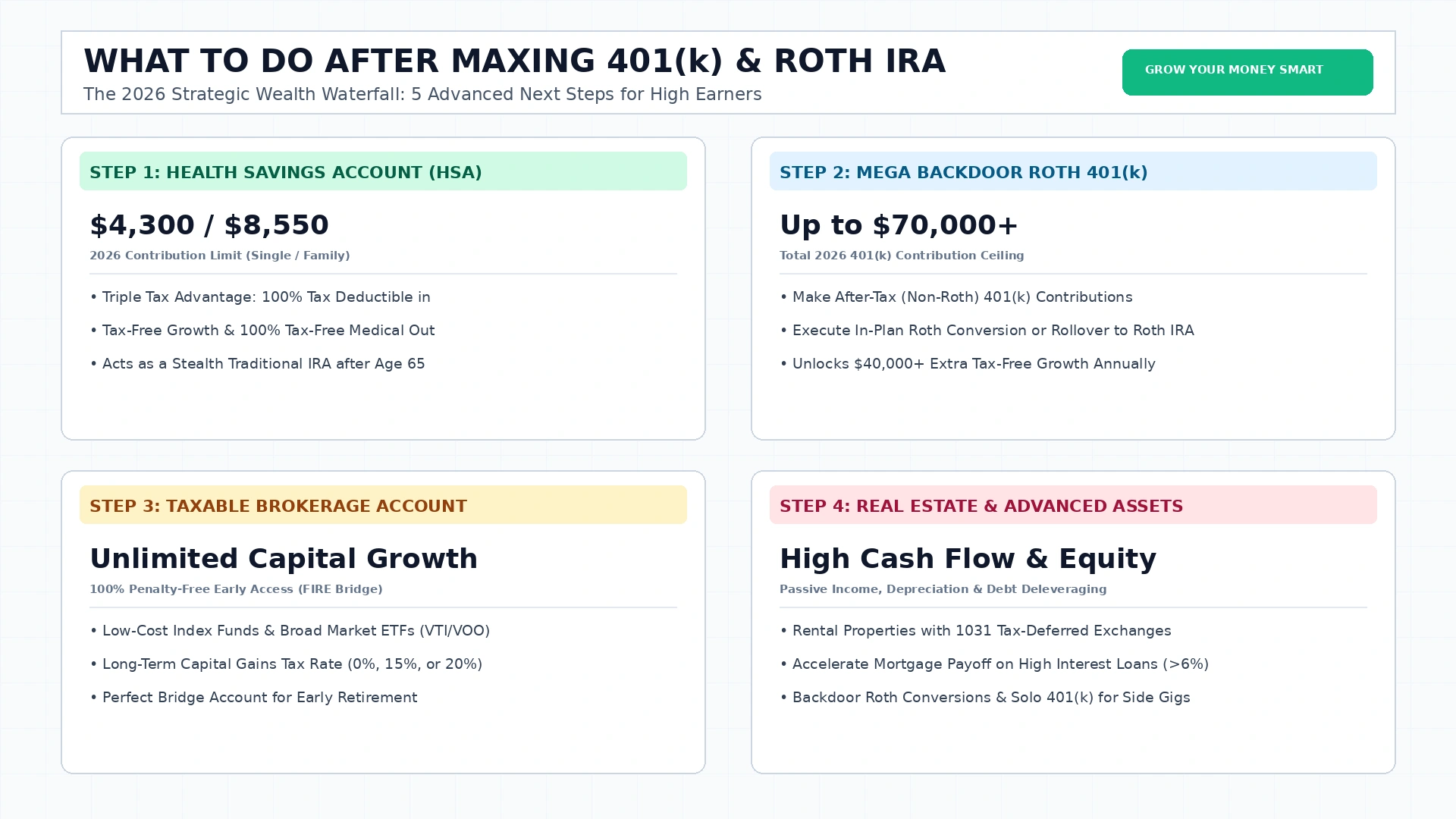
- Step 1 (HSA Max-Out): If enrolled in a high-deductible health plan (HDHP), fully fund your Health Savings Account ($4,300 single / $8,550 family in 2026) for an unmatched Triple Tax Advantage.
- Step 2 (Mega Backdoor Roth): Check if your employer 401(k) supports after-tax non-Roth contributions with in-service rollovers, unlocking up to an additional $40,000+ in annual tax-free growth.
- Step 3 (Taxable Brokerage Account): Fuel a flexible, penalty-free bridge account using broad-market index funds and tax-efficient ETFs (VTI/VOO/VXUS) for early retirement.
- Step 4 (High-Interest & Moderate Debt Elimination): Pay off non-mortgage liabilities and evaluate prepaying mortgage balances if your loan interest rate exceeds 6.0%.
- Step 5 (Real Estate & Tax-Sheltered Niche Accounts): Explore real estate syndications, direct rental properties, 529 college savings plans, or Solo 401(k)s for side gig earnings.
Leaving excess cash sitting in low-yield bank accounts causes rapid purchasing power loss due to inflation and dividend tax drag. Knowing exactly what to do after maxing out 401k and Roth IRA contributions requires shifting your strategy from basic saving to advanced tax-location optimization. In this 2026 master guide, we break down the mathematical hierarchy of where to invest next, how to avoid common tax traps, and how to construct an early financial independence bridge.
What to Do After Maxing Out 401k and Roth IRA: The Strategic Waterfall
When you have already mastered how to max out 401(k) and Roth IRA accounts, financial planning shifts from standard saving to optimizing tax brackets across your entire financial life cycle. Every asset class has a specific tax treatment—tax-deductible, tax-free, or taxable. Following a disciplined wealth waterfall ensures you retain the highest possible compound return while maintaining strategic liquidity.
| Priority Tier | Vehicle / Strategy | 2026 Contribution Limit | Primary Tax Advantage | Liquidity & Early Access |
|---|---|---|---|---|
| 1. Stealth IRA | Health Savings Account (HSA) | $4,300 (Single) / $8,550 (Family) | Triple Tax Advantage (Pre-Tax + Tax-Free Growth + Tax-Free Out) | Penalty-free for medical receipts anytime; standard withdrawal at 65+ |
| 2. Advanced Tax Shelter | Mega Backdoor Roth 401(k) | Up to $70,000 (Section 415(c) Limit) | 100% Tax-Free Growth & Distributions | After-tax conversion principal accessible after rollover to Roth IRA |
| 3. Flexible Bridge | Taxable Brokerage Account | Unlimited | Long-term capital gains rates (0%, 15%, 20%) | 100% Liquid anytime without 10% early withdrawal penalty |
| 4. Tangible Growth | Real Estate & Syndications | Unlimited | Depreciation write-offs, 1031 exchanges, cash flow | Illiquid; produces periodic rental distributions |
| 5. Guaranteed Return | Debt Acceleration / Mortgage Prepayment | Loan Balance | Guaranteed, risk-free effective yield equal to loan APR | Tied up in home equity until sale or refinance |
1. Maximize a Health Savings Account (HSA): The Triple-Tax Super Account
If you are covered under an HSA-eligible High Deductible Health Plan (HDHP), the Health Savings Account (HSA) is arguably the most powerful wealth-accumulation vehicle in the entire United States tax code. While traditional IRAs offer upfront tax deductions and Roth IRAs offer tax-free withdrawals, an HSA uniquely provides all three tax perks simultaneously:
- 1. Tax-Deductible Contributions: Every dollar contributed reduces your adjusted gross income (AGI) for federal income taxes (and FICA taxes if executed through payroll deductions).
- 2. 100% Tax-Free Investment Growth: You can invest your HSA balance into low-cost broad market index funds without paying taxes on dividends, interest, or capital gains.
- 3. Tax-Free Withdrawals for Medical Expenses: Qualified healthcare costs can be paid or reimbursed completely tax-free at any point in your life.
Do not spend your HSA funds on routine medical bills today if you have sufficient cash flow. Instead, pay out-of-pocket, save digital copies of your receipts, and let your invested HSA balance compound over 20 to 30 years. You can reimburse yourself tax-free decades later. Furthermore, once you reach age 65, non-medical withdrawals are treated exactly like a Traditional IRA (taxed at regular income with zero penalty).
2. Execute the Mega Backdoor Roth 401(k) Strategy
For high earners who are phased out of direct Roth IRA contributions due to IRS income limits, the standard Backdoor Roth IRA is step one. However, the Mega Backdoor Roth takes this concept to an industrial scale by utilizing after-tax (non-Roth) contributions within your employer 401(k) plan.
Under IRS Section 415(c), the total maximum annual addition to an employer-sponsored retirement plan in 2026 is capped at $70,000 (or $77,500 for age 50+). This total cap includes three components:
- Your employee pre-tax / Roth elective deferrals ($23,500).
- Your employer matching and profit-sharing contributions (e.g., $6,500).
- After-Tax Employee Contributions: The remaining room up to the $70,000 ceiling (in this example, $40,000).
To successfully execute this strategy, your employer 401(k) plan rules must specifically support two features: After-Tax (Non-Roth) Contributions and either In-Plan Roth Conversions or In-Service Non-Hardship Distributions to a Roth IRA. Once converted, that $40,000+ per year grows completely tax-free forever, shielding you from future tax rate hikes.
3. Fund a Taxable Brokerage Account: The Early Retirement Bridge
A common misconception among intermediate investors is that taxable brokerage accounts should be avoided due to capital gains taxes. In reality, a standard taxable brokerage account is the crown jewel of the Financial Independence, Retire Early (FIRE) movement. It serves as your primary bridge account before reaching the standard retirement age of 59½.
Unlike 401(k)s or IRAs, taxable brokerage accounts have zero contribution limits and zero early withdrawal penalties. You can withdraw $50,000 or $500,000 at age 35, 45, or 55 without paying a 10% IRS early distribution surcharge.
Optimizing Tax-Location inside Brokerage Accounts
To prevent unnecessary annual tax friction, practice strategic asset location inside your taxable account:
- Hold in Taxable Accounts: Broad-market index ETFs (e.g., Vanguard Total Stock Market ETF – VTI or S&P 500 ETF – VOO) and municipal bond funds. ETFs rarely trigger capital gains distributions due to in-kind redemption mechanisms.
- Keep Inside Sheltered Accounts (401k / IRA): Actively managed mutual funds with high portfolio turnover, REITs (which distribute non-qualified ordinary income dividends), and high-yield corporate bond funds.
4. 20-Year Compounding Simulation: Comparing Next-Step Allocations
To illustrate the tangible wealth difference between various post-maxing strategies, let us evaluate an investor who has an extra $1,500 per month ($18,000 per year) to invest beyond their standard 401(k) and Roth IRA limits over a 20-year horizon at an 8.0% average annual return.
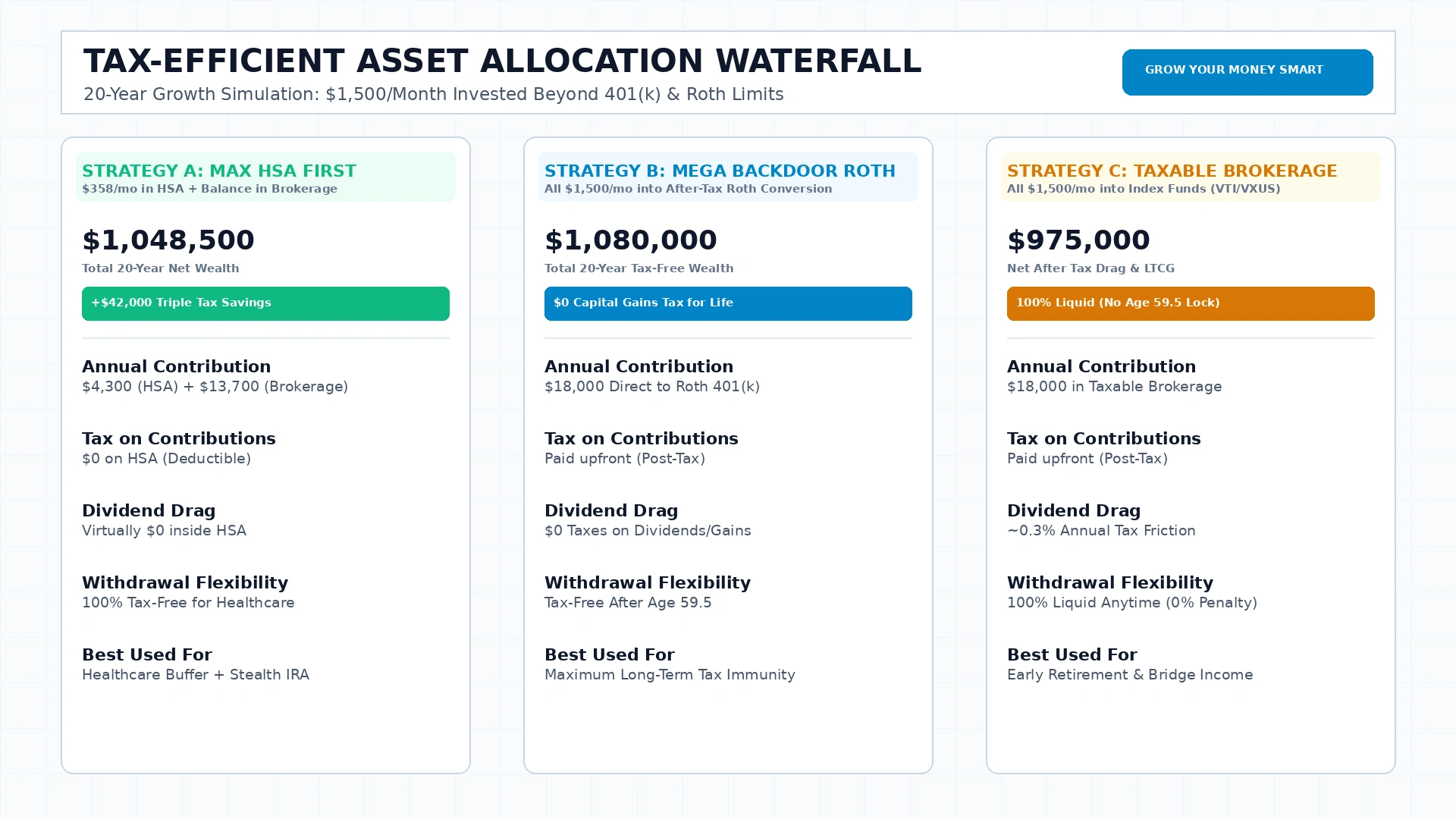
| Strategy Approach | 20-Year Total Invested | Gross Balance (8% Growth) | Estimated Tax Friction | Net Estimated Wealth |
|---|---|---|---|---|
| A. Max HSA + Remainder in Brokerage | $360,000 | $1,063,000 | -$14,500 (Deductible HSA offset) | $1,048,500 |
| B. 100% Mega Backdoor Roth | $360,000 | $1,080,000 | $0 (100% Tax-Free) | $1,080,000 |
| C. 100% Taxable Brokerage (VTI/VOO) | $360,000 | $1,055,000 | -$80,000 (Dividend drag & LTCG) | $975,000 |
5. Paying Off Debt vs. Investing Extra Capital
Once your primary retirement accounts are fully maxed, you must objectively evaluate your balance sheet. Debt payoff is not just an emotional milestone; it is an investment decision with a guaranteed, risk-free after-tax rate of return equal to the interest rate on the debt.
- High-Interest Debt (> 8% APR): Any remaining credit card balances, personal loans, or private student loans must be destroyed immediately using a structured debt payoff strategy. Check our free debt payoff calculator to model rapid elimination.
- Moderate Interest Debt (5% to 7% APR): In an environment with elevated benchmark interest rates, paying off 6% or 7% auto loans or private student debt offers an attractive risk-adjusted return compared to uncertain stock market yields.
- Low-Interest Mortgages (< 4% APR): If you locked in a 3.0% fixed-rate mortgage during historical lows, aggressively prepaying your loan makes less mathematical sense than investing surplus cash into broad-market index funds or cash instruments that generate 4.5% to 5.0% yields. Evaluate your numbers thoroughly with our HYSA vs. stock market guide.
6. Real Estate, 529 College Plans, and Side Business Structures
Beyond traditional paper securities, sophisticated investors diversify across complementary physical and business assets:
A. Direct Real Estate and Syndications
Real estate provides unique tax sheltering mechanisms that paper assets cannot replicate. Through non-cash depreciation deductions, cost segregation studies, and 1031 tax-deferred exchanges, real estate investors can offset rental cash flows and defer capital gains indefinitely until death (benefiting from a stepped-up cost basis for heirs).
B. 529 College Savings Plans
If you have children or plan to pursue higher education yourself, 529 plans offer state income tax deductions (in over 30 states) and 100% tax-free growth and withdrawals for qualified educational expenses. Furthermore, under recent SECURE 2.0 legislation, up to $35,000 of unused 529 plan assets can be rolled over tax-free into a beneficiary’s Roth IRA over a lifetime.
C. Solo 401(k) / SEP IRA for 1099 Side Income
If you generate 1099 consulting, freelancing, or small business income on the side, you can open an individual Solo 401(k). While your total employee elective deferral is shared across all employers ($23,500 limit), your business can contribute up to an additional 25% of net adjusted self-employment profits as the “employer,” unlocking tens of thousands of extra tax write-offs.
7. Aligning Investments with Your Time Horizon
Before deploying surplus capital into any non-retirement account, calibrate your allocation using the investment time horizon framework:
- Short-Term Goals (0 to 3 Years): High-Yield Savings Accounts (HYSA), Treasury Bills (T-Bills), and Certificates of Deposit (CDs). Prioritize 100% capital preservation. Ensure your base is secured using our free emergency fund calculator.
- Medium-Term Goals (3 to 7 Years): Conservative allocation with 40%–60% equities and 40%–60% short/intermediate-term bonds or dividend-focused ETFs.
- Long-Term Wealth (7+ Years / Early Retirement): 80% to 100% global equities via broad-market index funds (e.g., 70% VTI + 30% VXUS) held inside your taxable brokerage account.
Expert Video Walkthrough: What to Do After Maxing Out 401k and Roth IRA
To reinforce these advanced wealth-building principles with clear visual modeling, watch this detailed educational breakdown by authoritative financial planners at The Money Guy Show on “What is the Next Step After Maxing Out My Retirement Accounts?”:
Frequently Asked Questions (FAQs)
Below are clear, actionable answers to the most common questions high earners and investors ask when exploring what to do after maxing out 401k and Roth IRA accounts:
The Health Savings Account (HSA) is widely recognized by financial planners as the single best next vehicle if you are enrolled in an eligible high-deductible health plan. It offers an unmatched triple tax advantage: tax-deductible contributions, tax-free growth, and tax-free withdrawals for medical costs.
A regular Backdoor Roth IRA allows you to contribute up to $7,000 (in 2026) by making a non-deductible Traditional IRA contribution and immediately converting it to Roth. A Mega Backdoor Roth operates inside an employer 401(k) plan, allowing you to contribute up to an additional $40,000+ in after-tax non-Roth dollars and converting them into a Roth 401(k) or Roth IRA.
No. Taxable brokerage accounts are essential for building liquid wealth and early retirement bridges. Long-term capital gains rates (0%, 15%, or 20%) are significantly lower than ordinary income tax brackets, and broad-market index ETFs generate minimal annual dividend drag while offering 100% penalty-free access.
It depends entirely on your mortgage interest rate. If your mortgage rate is above 6.0%, prepaying principal offers a guaranteed, risk-free 6%+ after-tax return. If your mortgage is locked in at 2.5% to 3.5%, investing in broad-market index funds or 5% cash instruments generates superior long-term net returns.
If your modified adjusted gross income (MAGI) exceeds the Roth IRA phaseout limits, you can utilize the standard Backdoor Roth IRA process: contribute non-deductible cash to a Traditional IRA and immediately convert it to a Roth IRA (keeping the IRS pro-rata rule in mind if you have pre-existing traditional IRA balances).
Yes. You can establish a 529 college savings plan naming yourself as the beneficiary today. Once you have children or relatives who pursue qualified education, you can change the beneficiary to them without triggering taxes or penalties.
A Solo 401(k) allows self-employed individuals and side-hustlers to make employer profit-sharing contributions of up to 20% to 25% of net self-employment earnings, providing substantial tax write-offs even if your W-2 elective employee deferrals are already maxed at your day job.
You should maintain 3 to 6 months of essential living expenses (or 6 to 12 months for variable commission-based earners) in a High-Yield Savings Account or money market fund before deploying aggressive capital into illiquid or taxable brokerage investments.
Summary Checklist: Your Next Steps to Financial Independence
Knowing what to do after maxing out 401k and Roth IRA accounts marks the transition from basic saving to strategic capital compounding. As you deploy your next surplus dollar, follow this disciplined checklist:
- Confirm Emergency Reserves: Ensure 3 to 6 months of liquid expenses in a High-Yield Savings Account.
- Fund an HSA to the Legal Max: Secure the triple-tax advantage for future medical and retirement needs.
- Audit Your 401(k) Plan Rules: Call your 401(k) provider to see if after-tax non-Roth contributions and in-plan conversions are supported for a Mega Backdoor Roth.
- Open a Taxable Brokerage Account: Set up automated monthly transfers into broad-market index ETFs (VTI, VOO, VXUS) to construct your early retirement bridge.
- Destroy Lingering High-Interest Debt: Keep your balance sheet lean and optimize your cash flow using our free 50/30/20 budget calculator.

Jaiveer Hooda is a personal finance researcher and the founder of Grow Your Money Smart. With a background in computer engineering, he approaches money the way an engineer approaches any complex system — through data analysis, mathematical modeling, and ruthless optimization.
He built this platform on a single conviction: financial freedom is not a matter of luck. It is a system that can be designed, tested, and executed by anyone willing to follow the right blueprint. Every strategy published here is researched to the numbers, not written to the trend.
Expertise: Debt elimination · Retirement planning · Passive income · Budgeting systems
Connect: Pinterest | growyourmoneysmart.com | Contact Us