- The 0% APR Arbitrage: A 0% introductory APR balance transfer card acts as a total interest freeze for 15 to 21 months, directing 100% of your monthly payment toward reducing principal rather than bank interest.
- Massive Interest Savings: Transferring a $10,000 balance from an average 24.5% APR credit card to an 18-month 0% card saves over $2,640 to $3,200 in net interest, even after factoring in standard 3% to 5% upfront transfer fees.
- Top 2026 Market Leaders: The Wells Fargo Reflect® Card and Citi Simplicity® Card deliver the longest 0% APR windows (up to 21 months), while the BankAmericard® Credit Card provides a competitive low 3% intro fee window.
- The Same-Issuer Rule: You cannot transfer debt between cards issued by the same banking institution (e.g., Chase to Chase or Citi to Citi). Transfers must occur between different lending entities.
- Flawless Payoff Execution: Divide your total transferred balance by the promotional months (e.g., $9,000 / 18 months = $500/mo) and automate fixed monthly payments to hit a zero balance before the promo APR expires.
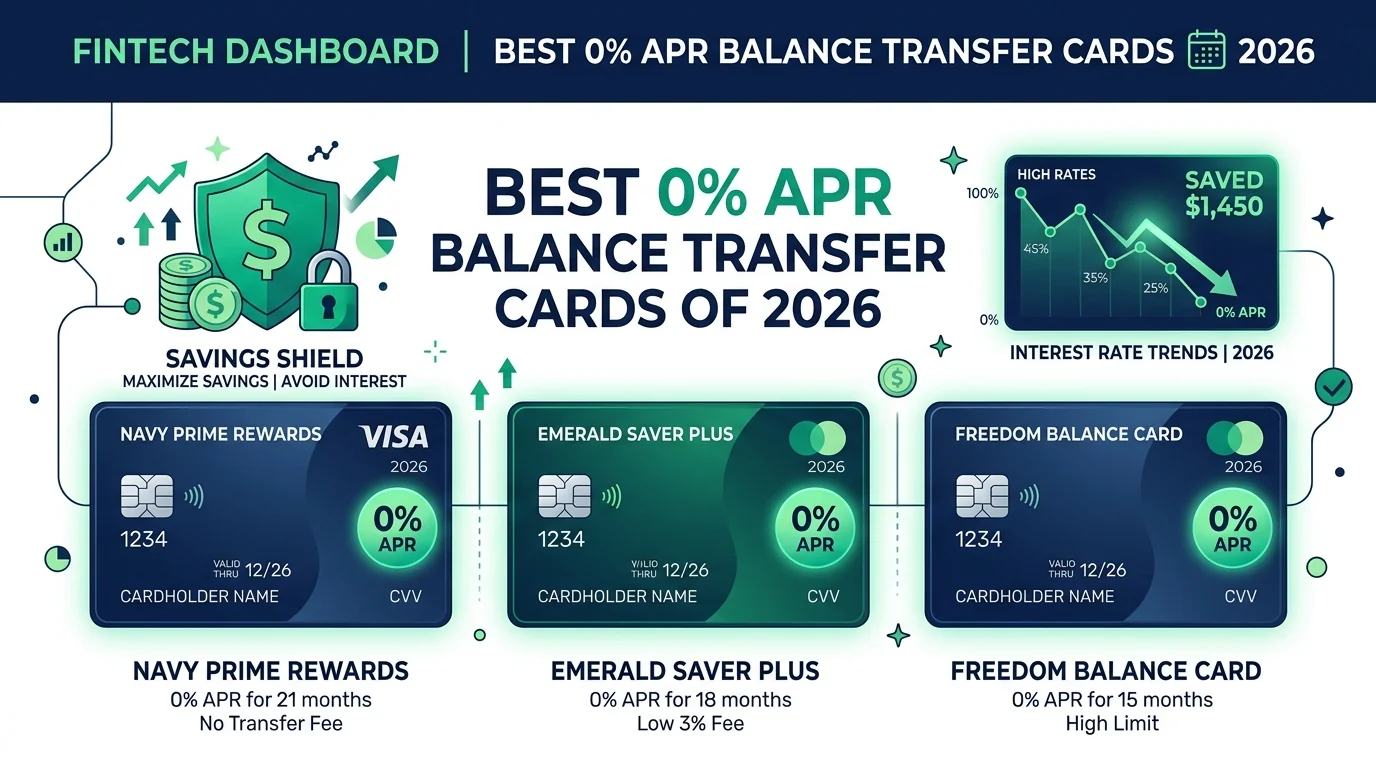
With total American consumer credit card balances surpassing $1.14 trillion and national average credit card interest rates climbing to a staggering 24.5% APR in 2026, carrying revolving card debt has never been more punishing. When you are stuck paying 24% to 29% interest, over 80% of your monthly payment is devoured by finance charges, barely chipping away at the actual debt you owe.
Opening one of the best 0% APR balance transfer cards is the single most powerful mathematical weapon available to pause compounding interest. By migrating your existing high-interest balances to a card offering 0.00% introductory APR for 12, 18, or up to 21 months, you execute a financial circuit breaker. Every single dollar you pay during the promotional window directly eliminates your principal debt balance.
However, balance transfers are not magic—they are precision financial instruments. If you do not understand the upfront transfer fees, promotional time limits, and issuer transfer restrictions, you risk falling right back into costly interest traps. In this comprehensive 2026 guide, we analyze the top balance transfer cards on the market, break down the exact payoff mathematics, evaluate pros and cons, and deliver an actionable 5-step blueprint to wipe out credit card debt for good.
How 0% APR Balance Transfers Work: The Financial Mechanics & Fine Print
A balance transfer is a transaction where a new credit card issuer pays off the existing debt on one or more of your external credit cards or personal loans. The new issuer then adds that total balance to your new card account, charging an introductory 0.00% APR for a predetermined promotional period.
To master this financial maneuver, you must understand the four structural pillars governing balance transfers:
1. The Upfront Balance Transfer Fee: Nearly all prime credit cards charge an upfront balance transfer fee of 3% to 5% of the total amount transferred (with a typical minimum of $5 to $10). For example, transferring $8,000 at a 3% fee adds an immediate $240 to your starting balance ($8,240 total). While nobody likes fees, paying a one-time $240 fee is infinitely cheaper than paying over $1,600 in annual compounding interest on a 24.5% APR card.
2. The Strict Transfer Request Window: Most issuers require you to initiate balance transfers within a specific window after opening the account—typically 45 to 120 days from approval. If you request a transfer after this deadline, the promotional 0% APR will no longer apply, and standard purchase rates will kick in immediately.
3. True 0% Intro APR vs. Predatory Deferred Interest: Major bank cards (like Wells Fargo, Citi, Bank of America, and Discover) offer true 0% intro APR. This means if you still have a $500 balance when the 21-month promo ends, you only pay ongoing interest on that remaining $500. This is fundamentally different from predatory retail store cards offering “deferred interest,” where failing to pay the entire balance by day 1 retroactively charges you interest on the full original balance back to day one!
4. Same-Bank Transfer Restrictions: Card issuers utilize balance transfers as customer acquisition tools to capture balances from rival banks. Consequently, you cannot transfer debt between cards issued by the exact same bank. You cannot transfer a Chase Sapphire balance to a Chase Freedom, nor a Citi Double Cash balance to a Citi Simplicity. You must transfer across unaffiliated banking institutions.
The 6 Best 0% APR Balance Transfer Cards of 2026: Detailed Reviews
After evaluating promotional length, balance transfer fees, annual fees, post-promotional regular APRs, and cardholder terms across dozens of financial institutions, here are the top 6 balance transfer credit cards ranked for 2026:
1. Wells Fargo Reflect® Card – Longest Overall 0% APR Window
The Wells Fargo Reflect® Card stands as the reigning heavyweight champion for consumers who need the longest possible runway to extinguish substantial credit card balances.
- 0% Intro APR Period: Up to 21 months 0% intro APR from account opening on qualifying balance transfers and purchases.
- Balance Transfer Fee: 5% (minimum $5) on transfers made within 120 days of account opening.
- Annual Fee: $0.
- Regular APR: 17.49% to 29.49% Variable APR following the promotional window.
- Standout Perk: Up to $600 of cell phone protection against damage or theft when you pay your monthly wireless bill with the card (subject to a $25 deductible).
- Best For: Borrowers tackling large balances ($10k+) who prioritize maximum time over lower upfront transfer fees.
2. Citi Simplicity® Card – Ultimate No-Fee Safety Net
If you fear unexpected life disruptions or accidental slip-ups during your debt payoff journey, the Citi Simplicity® Card offers unmatched forgiving terms with zero late fees and no penalty APRs.
- 0% Intro APR Period: 21 months 0% intro APR on balance transfers (completed within 4 months of account opening) and 12 months on purchases.
- Balance Transfer Fee: Intro fee of 3% (min $5) on transfers completed within the first 4 months; after that, 5% (min $5).
- Annual Fee: $0.
- Late Payment Penalties: $0 late fees, $0 penalty APR, and zero annual fee—ever.
- Regular APR: 18.49% to 29.24% Variable APR.
- Best For: Anyone seeking extended 21-month debt relief with built-in protection against accidental late fees.
3. BankAmericard® Credit Card – Best Low 3% Intro Transfer Fee
Many 21-month cards charge a steep 5% balance transfer fee. The BankAmericard® Credit Card strikes the perfect balance by offering a generous 18 billing cycle window paired with a lower 3% transfer fee.
- 0% Intro APR Period: 18 billing cycles 0% intro APR on qualifying balance transfers and purchases.
- Balance Transfer Fee: 3% (minimum $10) for transfers completed within the first 60 days of account opening.
- Annual Fee: $0.
- Regular APR: 15.49% to 25.49% Variable APR (notably lower starting baseline than competitors).
- Best For: Borrowers who can comfortably clear their debt in 18 months and want to save 2% upfront on transfer fees ($200 saved per $10,000 transferred).
4. Citi® Diamond Preferred® Card – Consistent Extended Zero-Interest Period
The Citi® Diamond Preferred® Card provides an extended 21-month 0% intro APR window specifically designed for debt consolidation and major planned expenditures.
- 0% Intro APR Period: 21 months on balance transfers (completed within first 4 months) and 12 months on purchases.
- Balance Transfer Fee: 5% ($5 minimum).
- Annual Fee: $0.
- Regular APR: 17.49% to 28.24% Variable APR.
- Standout Perk: Access to Citi Entertainment® for exclusive presale ticket access to concerts and sporting events.
- Best For: Dedicated balance transfer consolidators seeking long-term interest relief.
5. Discover it® Balance Transfer – Generous Intro APR + Cash Back Rewards
Most dedicated balance transfer cards offer zero rewards. The Discover it® Balance Transfer card breaks the mold by pairing an 18-month 0% promo with an aggressive 5% cash back rotating rewards program.
- 0% Intro APR Period: 18 months 0% intro APR on balance transfers; 6 months on purchases.
- Balance Transfer Fee: 3% intro fee up to a specified date, then up to 5% on future transfers.
- Annual Fee: $0.
- Ongoing Rewards: 5% cash back on rotating quarterly categories (up to $1,500 quarterly spend upon enrollment) and 1% unlimited cash back on all other purchases.
- Cashback Match™: Discover automatically matches 100% of all cash back earned at the end of your first year.
- Best For: Consumers who want long-term card utility and cash back rewards after their debt balance is paid off.
6. Chase Freedom Unlimited® – Top Everyday Rewards + 15-Month 0% APR
If your balance is moderate and can be paid off within 15 months, the Chase Freedom Unlimited® is arguably the best long-term wallet keeper in the financial industry.
- 0% Intro APR Period: 15 months 0% intro APR on purchases and balance transfers.
- Balance Transfer Fee: Intro fee of 3% (minimum $5) for transfers made within the first 60 days; after that, 5% ($5 min).
- Annual Fee: $0.
- Ongoing Rewards: 5% on travel booked through Chase Travel, 3% on dining and drugstores, and 1.5% unlimited cash back on all general spending.
- Best For: Borrowers with under $6,000 in debt who want an industry-leading everyday rewards card once debt-free.
Head-to-Head Comparison Matrix: Top 0% Balance Transfer Cards of 2026
Compare the core terms, transfer windows, upfront fees, and standout features of the top balance transfer credit cards side by side in the matrix below:
| Credit Card Name | 0% Intro APR (Transfers) | Balance Transfer Fee | 0% Intro APR (Purchases) | Regular Post-Promo APR | Annual Fee | Primary Advantage |
|---|---|---|---|---|---|---|
| Wells Fargo Reflect® Card | Up to 21 Months | 5% (min $5) | Up to 21 Months | 17.49% – 29.49% | $0 | Maximum 21-month runway + Cell phone insurance |
| Citi Simplicity® Card | 21 Months | 3% intro (first 4 mos), then 5% | 12 Months | 18.49% – 29.24% | $0 | Zero late fees & no penalty APR safety guarantee |
| BankAmericard® Card | 18 Billing Cycles | 3% (min $10, first 60 days) | 18 Billing Cycles | 15.49% – 25.49% | $0 | Lowest upfront 3% fee across 18 billing cycles |
| Citi® Diamond Preferred® | 21 Months | 5% (min $5) | 12 Months | 17.49% – 28.24% | $0 | Extended 21 months + Citi Entertainment® perks |
| Discover it® Balance Transfer | 18 Months | 3% intro, then up to 5% | 6 Months | 16.49% – 27.49% | $0 | 5% rotating cash back + First-year Cashback Match™ |
| Chase Freedom Unlimited® | 15 Months | 3% intro (first 60 days), then 5% | 15 Months | 19.24% – 27.99% | $0 | 3%–5% ongoing cash back for long-term utility |
Mathematical Simulation: $10,000 Balance Transfer vs. Compounding 24.5% APR
To truly understand why a 0% APR balance transfer card is transformative, let’s examine the cold, hard numbers. In this scenario, Sarah carries $10,000 in revolving credit card debt across two cards with an aggregate interest rate of 24.5% APR.
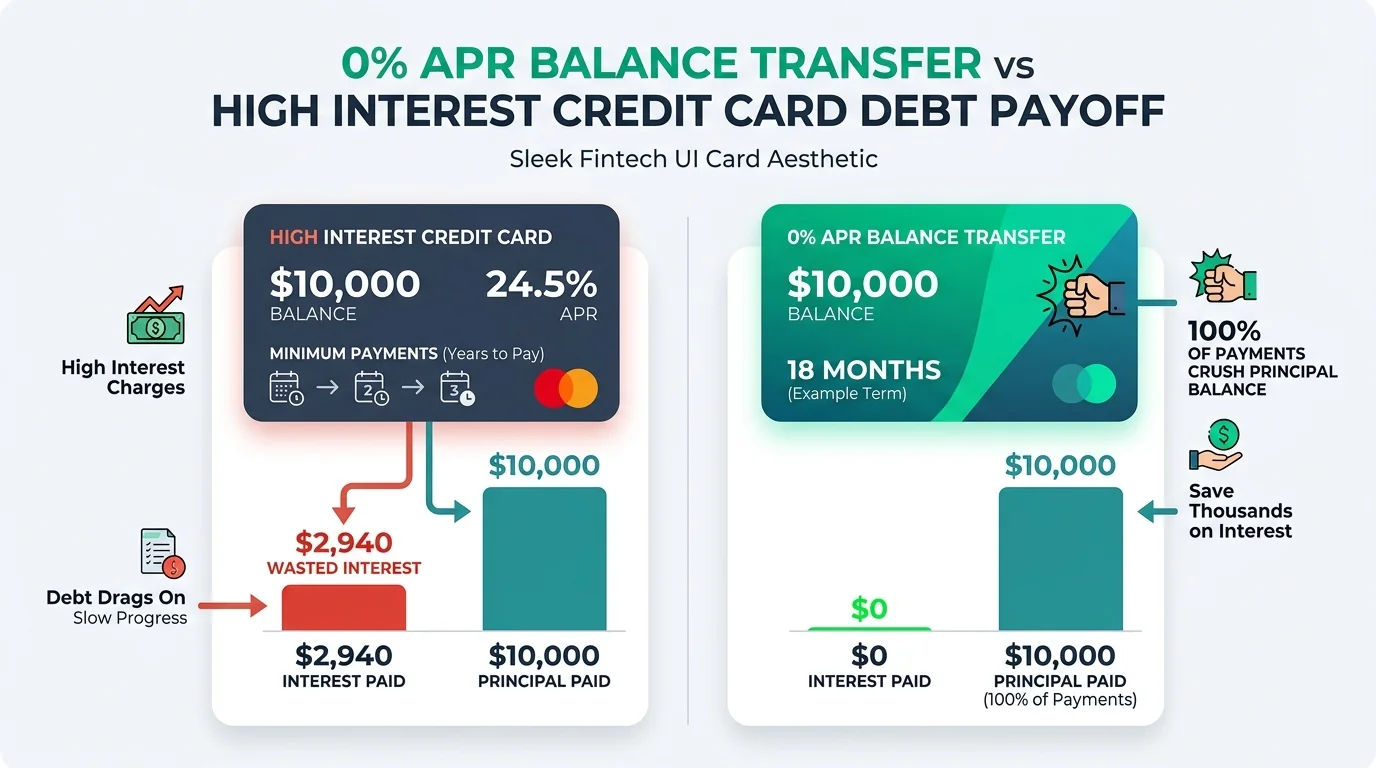
Review the exact financial breakdown comparing three different payoff strategies on her $10,000 debt:
| Payoff Strategy | Monthly Payment | Time to $0 Debt | Total Interest Paid | Upfront Fees | Total Out-of-Pocket Cost |
|---|---|---|---|---|---|
| Scenario A: Minimum Payments (24.5% APR) | ~$250 (declining) | 21.8 Years (262 mos) | $14,380 | $0 | $24,380 |
| Scenario B: Fixed $572/mo (24.5% APR) | $572.22 | 23 Months | $2,642 | $0 | $12,642 |
| Scenario C: 18-Month 0% APR Transfer (3% Fee) | $572.22 | 18 Months | $0.00 | $300 | $10,300 |
The Mathematical Verdict: By transferring her $10,000 balance to an 18-month 0% APR card with a 3% transfer fee ($300 upfront), Sarah commits $572.22 per month. In exactly 18 months, she is 100% debt-free, paying $0 in interest charges and saving $2,342 in pure cash compared to making the exact same monthly payment on her existing card! You can calculate your own customized scenario using our interactive debt payoff calculator.
The 5-Step Balance Transfer Blueprint: How to Execute with Zero Errors
Executing a balance transfer requires strict procedural discipline. Follow this proven 5-step blueprint to ensure seamless approval, zero missed deadlines, and total debt elimination:
Step 1: Audit Balances, Interest Rates & Check Your Credit Score
Gather your recent billing statements for all credit cards carrying balances. Note the exact balance, APR, and issuing bank for each. Check your credit score (via free credit monitoring apps or your current banking app). You will generally need a FICO score of 670 or higher to qualify for top-tier 18- to 21-month balance transfer offers. For more broader recovery techniques, explore our master guide on debt management strategies.
Step 2: Choose an Unaffiliated Card Issuer & Apply
Ensure the target balance transfer card is issued by a different bank than your current debt. If you owe money on a Chase card, apply for a Wells Fargo, Citi, or Bank of America card. During the online application, you will often be given the option to input the account numbers and requested transfer amounts for your existing debts right away.
Step 3: Calculate Your Required Monthly Payoff Target
Once approved and your transfer limit is established, take your total transferred balance (including the 3%–5% transfer fee) and divide it by the number of promotional months minus one month as a safety buffer. For example, if you transfer $7,200 to an 18-month card, divide by 17 months:
Target Monthly Payoff: $7,200 / 17 months = $423.53 per month
This ensures your debt hits $0.00 a full 30 days before the promotional rate expires, completely shielding you from post-promo interest rates. Integrate this payment into your monthly spending plan using our free budgets calculator.
Step 4: Continue Paying Your Old Accounts Until the Transfer Clears
Balance transfers do not happen instantaneously—they typically take 5 to 14 business days to finalize. Do not stop making scheduled minimum payments on your old cards. Missing a payment while waiting for a balance transfer to process will incur late fees and damage your credit report. Only stop payments once you log into the old account and verify a confirmed $0.00 balance.
Step 5: Lock Away the New Card & Build an Emergency Buffer
Do not use your new balance transfer card for everyday spending or dining out. Mixing new purchases with transferred debt complicates payment allocation and risks inflating your debt burden. Simultaneously, channel a modest $1,000 into a liquid account to protect against unexpected repairs—you can test targets with our emergency fund calculator so you never have to swipe a credit card during emergencies again.
Expert Video Walkthrough: How Credit Card Balance Transfers Work
Watch this authoritative video breakdown from NerdWallet explaining the precise mechanics of balance transfers, how to avoid hidden fee traps, and how to maximize your credit score recovery during the payoff window:
0% Balance Transfer vs. Debt Consolidation Loan: Which Should You Choose?
When seeking relief from mounting credit card bills, consumers frequently debate between applying for a 0% APR balance transfer card or securing a fixed-rate debt consolidation personal loan. Review the side-by-side comparison below to choose the right financial path:
| Evaluation Criteria | 0% APR Balance Transfer Card | Fixed-Rate Personal Loan |
|---|---|---|
| Interest Rate (APR) | 0.00% APR for 12–21 months | Fixed 7.99% – 15.99% APR |
| Upfront Costs / Fees | 3% to 5% Balance Transfer Fee | 0% to 6% Origination Fee |
| Repayment Term Structure | Flexible monthly payments (must clear within promo) | Fixed monthly installment over 24 to 60 months |
| Ideal Debt Amount | $2,000 to $15,000 | $15,000 to $50,000+ |
| Credit Score Requirement | 670+ (Good to Excellent FICO) | 600+ (Fair to Excellent) |
| Best Strategic Fit | Aggressive payoff sprints within 18 months | Longer, lower-stress structured multi-year payoffs |
If you have substantial high-interest debt exceeding $20,000, read our in-depth tactical guide on how to pay off $20k credit card debt fast, or compare strategies in our analysis of debt-free living vs leverage strategies. If you are struggling with severe unmanageable balances, you may also review our guide on how to settle credit card debt yourself or consult a certified professional via DIY finance vs hiring a financial advisor.
Frequently Asked Questions (FAQs)
Opening a balance transfer card causes a minor, temporary 3 to 5 point dip due to the hard credit inquiry. However, within 1 to 3 billing cycles, your overall credit score typically surges higher because your aggregate credit limit expands, significantly reducing your total credit utilization ratio—one of the largest factors in your FICO score.
No. Credit card issuers strictly prohibit balance transfers between their own internal accounts (for example, transferring debt from one Chase card to another Chase card, or Citi to Citi). You must transfer debt to a card issued by an unaffiliated lending institution (such as moving a Capital One balance to a Wells Fargo or Citi card).
Unlike retail store cards with predatory ‘deferred interest’, major bank 0% APR balance transfer cards only charge ongoing interest on the remaining unpaid principal balance once the promo window expires. However, the regular post-promotional variable APR (typically 19% to 29.99%) will apply immediately to whatever balance remains.
Yes. Your total balance transfer cannot exceed the credit limit assigned to your new card, minus the required balance transfer fee (typically 3% to 5%). For example, if approved for an $8,000 credit limit with a 3% transfer fee, the maximum debt you can transfer is approximately $7,766.
Unless the card specifically offers a matching 0% introductory APR on new purchases for the exact same timeframe, you should strictly avoid making new purchases. New purchases may immediately accrue interest at the regular variable APR and complicate how monthly payments are allocated across promotional vs non-promotional balances.
Most prime balance transfer cards offering 18 to 21 months of 0% APR require a Good to Excellent FICO credit score (670 to 740+). Applicants with scores in the fair range (580 to 669) may still qualify for balance transfer cards from certain credit unions, but promotional windows are generally shorter (6 to 12 months).
A 0% balance transfer card is vastly superior if you have good credit (670+) and can aggressively pay off the entire balance within 12 to 21 months, yielding a true 0.00% interest cost (aside from the 3%–5% upfront fee). A personal loan is better suited if you owe a massive balance ($25,000+) requiring a longer 36 to 60 month structured payoff runway at a fixed 8% to 14% APR.
Balance transfers typically take between 5 to 14 business days to process and disburse funds to your old creditor. You must continue making on-time minimum payments on your old accounts until you verify that the previous balance reflects exactly $0.00 to avoid late fees and penalty APRs.

Jaiveer Hooda is a personal finance researcher and the founder of Grow Your Money Smart. With a background in computer engineering, he approaches money the way an engineer approaches any complex system — through data analysis, mathematical modeling, and ruthless optimization.
He built this platform on a single conviction: financial freedom is not a matter of luck. It is a system that can be designed, tested, and executed by anyone willing to follow the right blueprint. Every strategy published here is researched to the numbers, not written to the trend.
Expertise: Debt elimination · Retirement planning · Passive income · Budgeting systems
Connect: Pinterest | growyourmoneysmart.com | Contact Us