
Evaluate when debt settlement makes sense versus formal bankruptcy or internal hardship programs:
- Insolvency Comparison: debt settlement vs bankruptcy: when to file — understanding legal fresh starts under Chapter 7 vs negotiated balance settlements.
- Commercial Liabilities: debt consolidation strategies for small business owners — managing commercial personal guarantees alongside consumer cards.
- Formal Hardship: credit card hardship programs to reduce APR to 0% — negotiating workout agreements directly before default or charge-off occurs.
- Priority Sequencing: which debt should I pay off first strategy — triaging unsecured card balances against essential living costs.
- Zero Middleman Fees: You do not need to pay a for-profit debt relief firm 15% to 25% of your total debt balance; you can negotiate directly with bank collections departments for free ($0 fees).
- Realistic Target Settlement: Aim for a lump-sum settlement of 40% to 50% of the total balance. Start your initial anchor offer around 25%–30%.
- The Golden Rule of Settlement: Never send a single dollar or give bank account access until you hold a signed Written Settlement Agreement Letter stating the account will be settled in full with a zero balance.
- The 90–150 Day Window: Original creditors are most aggressive in negotiating concessions right before the 180-day charge-off threshold.
- IRS Tax Protection: Forgiven debt over $600 triggers IRS Form 1099-C, but if your liabilities exceed assets, IRS Form 982 (Insolvency Exemption) shields you from paying taxes on the forgiven amount.
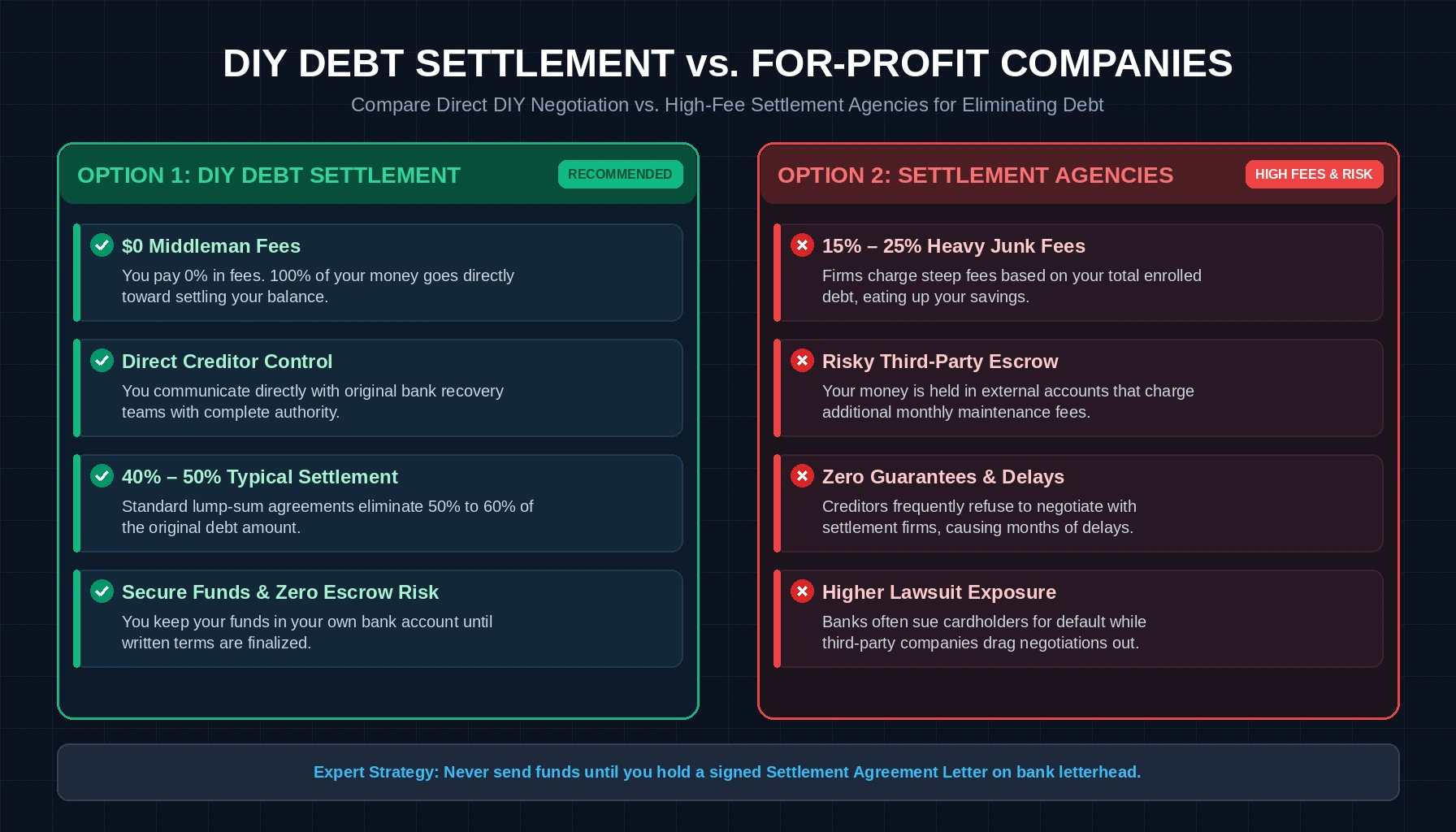
How to settle credit card debt yourself is one of the most critical financial skills you can master when facing insurmountable unsecured debt burdens. When monthly minimum payments become unsustainable and compounding 28%+ APR interest makes principal reduction impossible, debt settlement allows you to negotiate with creditors to permanently eliminate your debt for a fraction of what you owe—typically 40% to 50% of the total balance.
While late-night television ads and internet commercials constantly promote for-profit debt settlement companies promising to “erase your debt for pennies on the dollar,” they conceal a harsh reality: these firms do nothing that you cannot do yourself for free. In fact, hiring a third-party debt settlement company often costs an additional 15% to 25% of your total enrolled debt in predatory fees, forces you into high-risk escrow accounts, and increases your exposure to creditor lawsuits.
In this master step-by-step DIY guide, we break down the exact mechanics of settling credit card debt on your own. You will learn the psychological timing of bank collections, obtain word-for-word negotiation phone scripts, discover how to secure binding written settlement agreements, and navigate IRS tax rules using insolvency exemptions.
How Credit Card Debt Settlement Actually Works Under the Hood
Debt settlement is an agreement between a debtor and a creditor where the creditor accepts a lump-sum payment (or a short series of payments) that is less than the full balance owed, legally releasing the debtor from the remaining liability. Once the agreed-upon amount is paid, the creditor reports the account to credit bureaus as “Settled in Full” or “Paid for Less Than Full Balance” with a $0 balance.
To negotiate effectively, you must understand the financial timeline and institutional incentives of credit card recovery departments:
1. Days 1 to 89 (Early Delinquency):
During the first three billing cycles of missed payments, your account remains with the bank’s customer service and early collection teams. At this stage, banks are primarily interested in bringing the account current through hardship programs, temporary APR reductions, or late fee waivers.
2. Days 90 to 179 (The Prime Settlement Window):
Once an account surpasses 90 days past due, it moves to the bank’s internal Pre-Charge-Off Recovery Department. Under federal banking regulations, banks must write off credit card debt as an uncollectible loss (charge-off) after 180 consecutive days of delinquency. Because a charge-off hurts the bank’s loss reserves, internal recovery specialists are heavily incentivized to accept lump-sum settlement offers of 35% to 50% to recover cash before the 180-day deadline.
3. Days 180+ (Post-Charge-Off & Third-Party Debt Buyers):
After 180 days, the bank charges off the debt and either assigns it to an external collection agency or sells the debt portfolio to a third-party debt buyer for 3 to 7 cents on the dollar. Debt buyers have zero interest in the original principal and will routinely accept aggressive settlements of 20% to 35% of the face value.
DIY Debt Settlement vs. For-Profit Companies vs. Debt Relief Alternatives
Evaluating DIY settlement against for-profit debt settlement firms, nonprofit Debt Management Plans (DMPs), and Chapter 7 bankruptcy (see our detailed guide on debt settlement vs bankruptcy) provides the strategic clarity needed to pick the optimal path for your financial situation:
| Feature / Metric | DIY Debt Settlement | For-Profit Settlement Firm | Nonprofit DMP (Credit Counseling) | Chapter 7 Bankruptcy |
|---|---|---|---|---|
| Program Fees | $0 (Completely Free) | 15% – 25% of total enrolled debt | Small monthly fee ($25 – $50/mo) | Attorney & Court fees ($1,500 – $2,500) |
| Typical Settlement Amount | 40% – 50% of balance | 45% – 55% + company fees | 100% of balance (reduced APR 6%–10%) | 0% (100% Discharged) |
| Negotiation Control | 100% You hold the funds & veto power | Firm controls negotiations & escrow | Counselor manages bank concessions | Federal Bankruptcy Court Trustee |
| Credit Score Impact | Substantial drop (-80 to -140 pts) | Severe drop (-100 to -160 pts) | Minimal impact (Preserves on-time marks) | Catastrophic (-150 to -240 pts for 10 yrs) |
| Tax Implications (IRS 1099-C) | Yes (Excludable via Form 982 Insolvency) | Yes (Excludable via Form 982 Insolvency) | No taxable forgiven debt | 100% Tax-free discharge |
If your accounts are still current and you want to avoid delinquency marks on your credit report, consider applying for a hardship program before settling debt or low-interest balance restructuring via our guide on debt consolidation vs balance transfer.
Mathematical Simulation: Resolving $20,000 in Credit Card Debt
To illustrate the enormous financial savings of settling debt on your own versus other repayment paths, let us examine a real-world mathematical simulation of a cardholder resolving a $20,000 credit card debt balance.
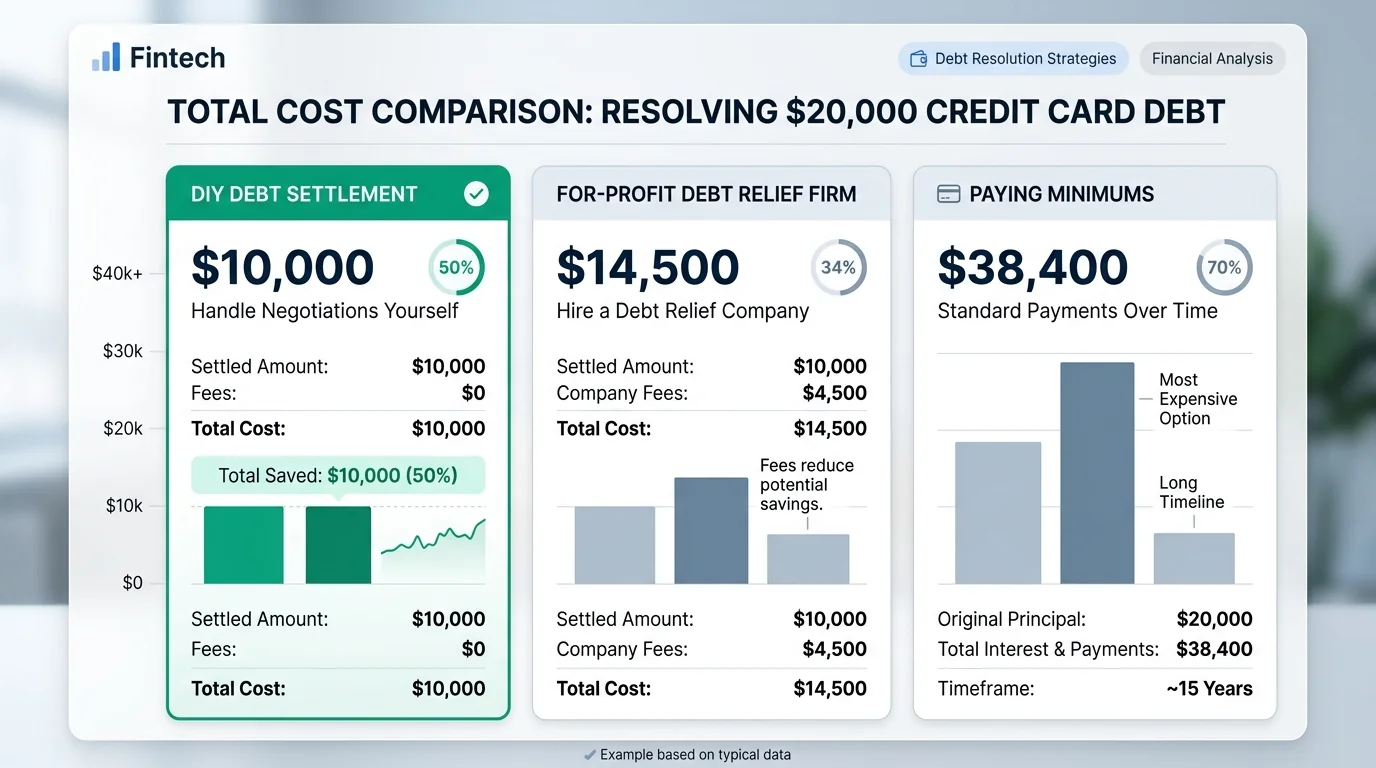
When you hire a for-profit settlement company, they typically charge 20% to 25% of your total enrolled debt as their fee. On a $20,000 balance settled at 50% ($10,000), a debt relief company extracts an additional $4,500 in fees, raising your true cost of settlement to $14,500. By negotiating yourself, that $4,500 remains in your pocket.
| Debt Resolution Path ($20,000 Debt) | Settlement / Payoff Amount | Third-Party Fees | Total Cash Outlay | Total Savings vs Minimums |
|---|---|---|---|---|
| 1. Standard 28.99% Minimum Payments | $38,400.00 (Principal + Interest) | $0.00 | $38,400.00 | $0.00 (Baseline) |
| 2. For-Profit Debt Settlement Company | $10,000.00 (50% settlement) | $4,500.00 (22.5% fee) | $14,500.00 | +$23,900.00 |
| 3. DIY Debt Self-Settlement (Direct) | $10,000.00 (50% settlement) | $0.00 (No fees) | $10,000.00 | +$28,400.00 |
To model how different monthly payments and settlement targets affect your household balance sheet, utilize our free interactive debt payoff calculator. Pair your debt settlement planning with structured monthly budgeting using our budget calculator to determine exactly how fast you can accumulate a settlement cash fund.
Watch: Master Debt Negotiation Strategies with Ramit Sethi
Personal finance author Ramit Sethi breaks down the psychological frameworks, vocal tone, and strategic positioning necessary to negotiate directly with banking institutions and collection departments.
How to Settle Credit Card Debt Yourself: 5-Step Actionable Blueprint
Executing a successful DIY credit card debt settlement requires strict discipline and methodical record-keeping. Follow this 5-step operational blueprint:
Step 1: Accumulate a Dedicated Settlement Cash Reserve
Creditors will only accept deep settlement discounts if you can back up your offer with immediately available cash. Open a separate high-yield savings account or secondary checking account completely disconnected from the banks you owe money to (to prevent internal setoff seizures). Accumulate an amount equal to 35% to 50% of your total balance.
Step 2: Know Your Statute of Limitations & Account Status
Check your state’s Statute of Limitations (SOL) for unsecured credit card debt (typically 3 to 6 years depending on your jurisdiction). If a debt is past the statute of limitations, a collector cannot legally sue you to enforce payment according to federal guidelines from the Consumer Financial Protection Bureau (CFPB). Determine whether your debt is currently held by the original bank recovery team or an external collection agency.
Step 3: Initiate the Negotiation with Word-for-Word Phone Scripts
Call the collection department during standard business hours. Deliver your opening pitch with calm authority:
“Hello, my name is [Your Name]. I am calling regarding account #[Account Number]. I am currently experiencing severe financial hardship due to [job loss / medical emergency] and I am actively evaluating whether to file for Chapter 7 bankruptcy or settle my remaining unsecured debts with available family assistance.
I want to resolve this account today. My outstanding balance is $[Balance Amount]. I have access to a one-time lump sum of $[Offer Amount, e.g., 30% of balance] that I can wire or send via cashier’s check immediately if [Bank/Agency Name] agrees to accept this amount as full settlement of the debt and report the account balance as $0 to all credit bureaus.
If we cannot reach an agreement today, this money will be allocated to my other creditors or court filing costs.”
Step 4: Secure the Written Settlement Agreement Letter (NON-NEGOTIABLE)
If the collector verbally agrees to your offer (e.g., 45% of the balance), DO NOT SEND A PENNY. Demand a formal Settlement Agreement Letter on official company letterhead that explicitly states:
• The exact settlement amount agreed upon (e.g., $4,500.00 on a $10,000 balance).
• The exact due date for payment receipt.
• That upon receipt of this payment, the remaining balance is forgiven, canceled, and considered “Settled in Full” with a $0 balance.
• That the creditor will update all three credit bureaus (Equifax, Experian, TransUnion) to reflect the zero balance and cease all collection activities.
Step 5: Execute Payment Safely & Maintain Permanent Records
Never provide direct electronic access (ACH debit) to your primary checking account. Pay via Cashier’s Check, Certified Bank Draft, or Money Order sent via USPS Certified Mail with Return Receipt Requested. Keep a physical folder containing the signed agreement letter, proof of payment receipt, and post-settlement credit reports permanently.
IRS Taxes on Forgiven Debt: The Insolvency Exemption (Form 982)
When a creditor forgives $600 or more of your credit card debt, the IRS treats the canceled amount as ordinary taxable income. In January following your settlement, the creditor will issue IRS Form 1099-C (Cancellation of Debt), reporting Box 2 (Amount of debt discharged).
However, many cardholders qualify for the IRS Insolvency Exclusion (IRC Section 108). If your total liabilities exceeded your total fair market assets immediately prior to the settlement, you were technically insolvent. By filing IRS Form 982 (Reduction of Tax Attributes Due to Discharge of Indebtedness) (Reduction of Tax Attributes Due to Discharge of Indebtedness) with your tax return, you can exclude up to the entire amount of canceled debt from taxable income.
For more detailed strategies on managing complex debt liabilities, explore our comprehensive guide on debt management strategies and our detailed case study on how to pay off $20k credit card debt fast.
How to Rebuild Your Credit Score After Settling Debt
While debt settlement causes an initial credit score drop due to previous delinquencies, achieving a $0 balance removes the ongoing drag of past-due reporting. Follow these three steps to rebuild your credit back to the 700+ tier within 12 to 24 months:
1. Verify Credit Bureau Updates: 30 to 45 days after payment, pull your credit reports from AnnualCreditReport.com and confirm all settled accounts report a $0 balance with “Settled” status.
2. Open 1–2 Secured Credit Cards: Deposit $300 to $500 on a secured card with a top issuer (such as Discover It Secured or Capital One Platinum Secured) and pay the statement balance in full every single month.
3. Build an Emergency Fund: Ensure you maintain a starter cash reserve using our emergency fund calculator and our blueprint on saving your first $1,000 emergency fund on a low income to guarantee you never rely on high-interest credit cards again.
For more insights on financial freedom and cash allocation, read our comparative guide on debt-free vs having debt strategies and how to structure monthly expenses with our how to budget a $3,000 monthly income guide.
Frequently Asked Questions (FAQs)
Yes, 100%. Credit card companies and third-party collection agencies have dedicated internal recovery departments that negotiate directly with individual cardholders. In fact, banks frequently prefer working directly with consumers because it eliminates third-party settlement fees and miscommunication.
A standard opening negotiation offer should start between 25% and 30% of the total outstanding balance. Most final settlement agreements conclude between 40% and 50% for lump-sum cash payouts, or 55% to 65% for structured term settlement payment plans over 6 to 12 months.
The prime window for negotiating debt settlement is when an account is between 90 and 150 days delinquent, right before the standard 180-day charge-off deadline. During this window, original creditor collections departments are under immense pressure to recover funds before writing off the balance as bad debt.
Under IRS rules, forgiven or canceled debt exceeding $600 is considered taxable income, and the creditor will issue IRS Form 1099-C (Cancellation of Debt). However, if you were financially insolvent (your total liabilities exceeded your total assets) immediately prior to the settlement, you can file IRS Form 982 to exclude the canceled debt from your taxable gross income.
Settling debt does damage your credit score, primarily because accounts must usually be delinquent before banks agree to settle, and the account will report as ‘Settled for less than full balance’. This can drop credit scores by 80 to 140 points. However, once settled, the balance reports $0, halting new delinquency marks and allowing credit rebuilding to begin immediately.
Never give a collector direct electronic debit access to your primary checking account. Always demand a formal written Settlement Agreement Letter on company letterhead first. Once verified, pay using a cashier’s check, prepaid debit card, money order, or a separate dedicated bank account.
A pay-for-delete agreement is an arrangement where a creditor or debt buyer agrees to completely delete negative collection tradelines from credit bureaus in exchange for payment. Major original banks (like Chase, Amex, BoA) strictly refuse pay-for-delete due to credit reporting agreements, but third-party collection agencies and debt buyers frequently agree to delete collection tradelines upon settlement.
Under the FTC’s Telemarketing Sales Rule (TSR), it is strictly illegal for for-profit debt settlement companies to charge upfront fees before settling a debt. Any company demanding upfront enrollment or administrative fees before producing a signed settlement agreement is violating federal law and should be avoided.
Final Verdict: Taking Control of Your Debt Settlement Journey
Settling credit card debt yourself is an empowering, highly effective financial strategy that eliminates thousands of dollars in junk fees and cuts through the predatory practices of third-party debt relief firms. By saving a dedicated cash reserve, maintaining strict negotiation discipline, and demanding written settlement agreements, you can permanently eradicate unsecured debt and build a rock-solid foundation for long-term financial freedom.

Jaiveer Hooda is the Lead Financial Researcher & Personal Finance Analyst at Grow Your Money Smart. Specializing in personal wealth optimization, index fund compounding, high-yield savings mechanics, and consumer debt elimination strategies. With a background in computer engineering, he applies mathematical modeling, cashflow simulations, and empirical risk analysis to evaluate personal finance vehicles and credit products. Every analysis is backed by verified regulatory disclosures, IRS tax schedules, and empirical APY compounding math.
Areas of Expertise: Personal Finance · High-Yield Savings Accounts (HYSA) · Index Funds & S&P 500 Compounding · Retirement Planning (401k/IRA) · Debt Optimization · Credit Card APR Mechanics.
Transparency & Editorial Policy: Editorial Standards | Report a Correction