
Tackling substantial revolving balances requires understanding compound interest traps and statutory minimum payment disclosure rules. Consult the official Consumer Financial Protection Bureau (CFPB) Managing Credit Card Debt for statutory guidelines and consumer protections.
- The $20k Daily Bleed: At a standard 24.5% APR, $20,000 in credit card debt accumulates $408 per month ($13.42 daily) in pure compounding interest before a single cent touches your principal.
- The Minimum Payment Trap: Making minimum payments on $20,000 keeps you enslaved for 27.3 years (328 months) and costs an astonishing $38,820 in cumulative interest.
- Avalanche vs. Snowball: The Debt Avalanche saves you between $1,500 and $4,200 in hard cash by targeting highest-APR balances first, while the Debt Snowball provides behavioral wins by eliminating small balances rapidly.
- Rate Arbitrage Weaponry: Using a 0% APR balance transfer card (15–21 month promo) or a low-rate fixed consolidation loan (9–13% APR) redirects hundreds of dollars from bank interest directly toward debt principal.
- The 12-to-36 Month Sprint: Committing $1,895/month kills the debt in 12 months ($2,740 total interest), while $790/month pays it off in 36 months ($8,440 total interest).
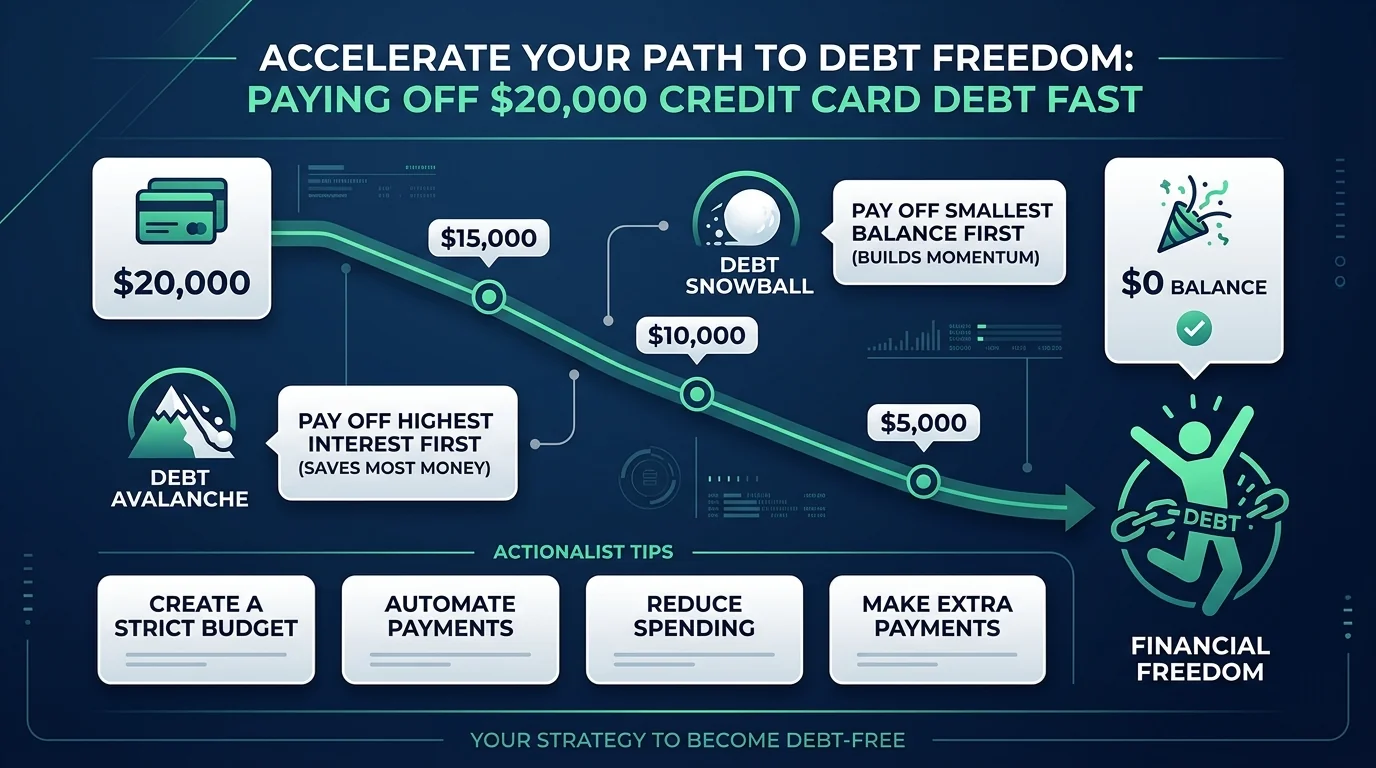
Carrying $20,000 in revolving credit card debt is one of the most toxic, wealth-destroying financial burdens in modern personal finance. With average consumer credit card interest rates hovering between 21.5% and 27.9% APR in 2026, a $20k balance is not merely an emotional strain—it is an active mathematical emergency that silently drains over $400 every single month into banking institution profits without reducing what you owe.
Whether this balance accumulated through unexpected medical emergencies, temporary employment gaps, inflation pressures, or lifestyle creep, you are not alone. More importantly, eliminating this balance is entirely achievable with a disciplined, mathematically optimized framework. In this exhaustive master guide, we break down the forensic anatomy of credit card interest, evaluate head-to-head payoff strategies, outline exact monthly payment timeline models, and provide an actionable 5-step blueprint to permanently conquer $20,000 of high-interest debt.
The Brutal Anatomy of $20,000 Credit Card Debt: Why Minimum Payments Are a Trap
To defeat $20,000 in debt, you must first understand the predatory mechanics of revolving consumer credit. Unlike mortgages or auto loans, credit cards calculate interest on a Daily Periodic Rate (DPR) and capitalize it monthly. Here is how the exact financial equation operates behind the scenes:
If you hold $20,000 across multiple cards at an aggregate APR of 24.5%, your daily interest rate is:
Daily Periodic Rate (DPR) = 24.5% / 365 days = 0.06712% per day
Daily Interest Charge = $20,000 × 0.0006712 = $13.42 / day
Monthly Interest Bleed (30 Days) = $13.42 × 30 = $402.60 per month
When you send your credit card company a standard minimum monthly payment of $500 (typically calculated as 1% of the principal balance plus accrued monthly interest, or 2.5% to 3% of the total balance), over 80% of your hard-earned money ($402.60) is incinerated on interest charges. Only a miserable $97.40 actually touches the principal balance.
As your balance barely declines, the minimum payment required next month drops proportionally. This creates the infamous “Minimum Payment Death Spiral”: by paying only the minimum, you will spend 27.3 years (328 months) attempting to clear the debt, transferring an unfathomable $38,820 in pure interest to your creditors on top of the original $20,000 borrowed!
Payoff Strategy Comparison Matrix: Avalanche vs. Snowball vs. 0% Balance Transfer vs. Personal Loans
There is no single “one-size-fits-all” route to eliminating $20k in credit card balances. Depending on your credit score, cash flow stability, and psychological temperament, different tactical vehicles produce distinct advantages. Review the comprehensive head-to-head comparison matrix below to determine your ideal debt payoff vehicle:
| Strategy / Method | Target Mechanism | Effective APR | Total Interest on $20k | Psychological Friction | Ideal Candidate Profile |
|---|---|---|---|---|---|
| Debt Avalanche | Pay minimums on all; channel surplus cash to highest APR card | 21% – 29% (Decreasing) | $2,740 – $8,440 | Moderate (Requires sustained discipline) | Analytical minds seeking mathematical optimality and maximum cash savings |
| Debt Snowball | Pay minimums on all; channel surplus cash to smallest balance | 21% – 29% | $3,200 – $9,800 | Lowest (Frequent motivational wins) | Borrowers who need early emotional momentum to prevent burnout |
| 0% APR Balance Transfer | Shift debt to new card with 0% promo APR for 15–21 months | 0% (+ 3%–5% transfer fee) | $600 – $1,000 (Fee only) | Low to Moderate (Strict deadline) | Credit score 680+, capable of paying ~$1,000–$1,400/mo before promo expires |
| Unsecured Consolidation Loan | Refinance cards into fixed 3–5 year personal loan | 8.5% – 14.5% (Fixed) | $2,400 – $4,600 | Low (Single automated payment) | Credit score 660+, desiring fixed monthly predictability without promo traps |
| Debt Management Plan (DMP) | Non-profit credit counseling agency negotiates lowered APRs | 6.0% – 10.0% | $1,800 – $3,200 | Low (Cards closed during plan) | Credit score under 640, feeling overwhelmed, unable to qualify for prime loans |
To evaluate your customized payoff timeline and interest trade-offs across these specific methods, run your exact balances through our interactive Debt Payoff Calculator and map out your broader debt management strategies guide.
Mathematical Simulation: Exact Payoff Timelines for $20,000 at 24.5% APR
Let’s evaluate hard data. The table below illustrates the exact monthly payments, total interest accrued, total cash outlay, and net savings achieved by paying off $20,000 at an average 24.5% APR across fixed timeline benchmarks versus the minimum payment baseline:
| Repayment Horizon | Required Monthly Payment | Total Interest Paid | Total Out-of-Pocket Cost | Net Interest Saved vs Minimum |
|---|---|---|---|---|
| 12-Month Blitz Plan | $1,895 / month | $2,740 | $22,740 | Save $36,080 |
| 24-Month Aggressive Plan | $1,065 / month | $5,560 | $25,560 | Save $33,260 |
| 36-Month Balanced Plan | $790 / month | $8,440 | $28,440 | Save $30,380 |
| 48-Month Extended Plan | $655 / month | $11,440 | $31,440 | Save $27,380 |
| Minimum Payment Only | $600 (Decaying down) | $38,820 | $58,820 | $0 (Baseline Trap) |
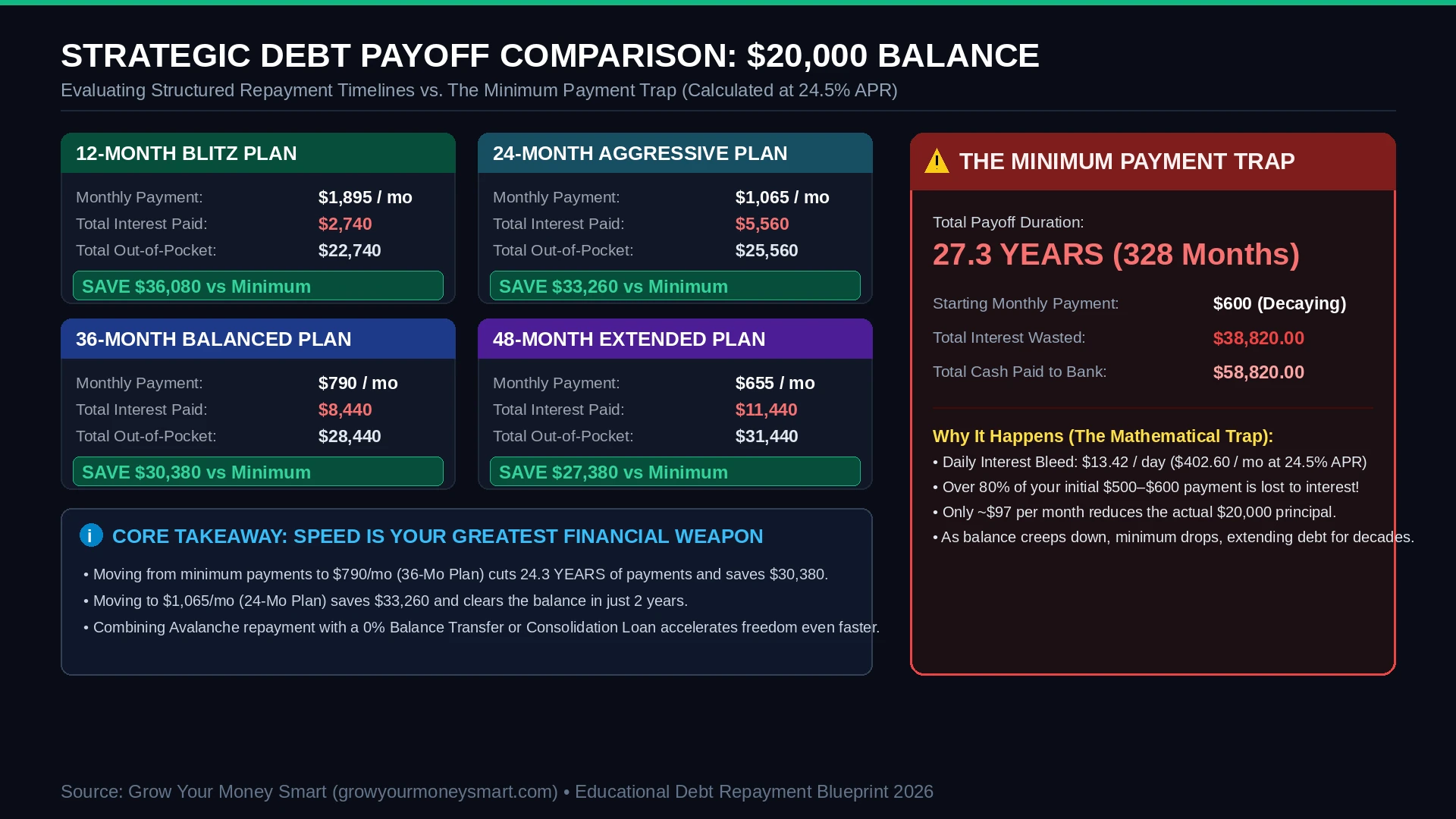
Notice the massive leverage of velocity: by increasing your monthly commitment from the $600 decaying minimum payment to $790 per month (just $190 more), you slash your repayment time from 27.3 years down to exactly 3 years and save more than $30,380 in cash!
Video Masterclass: Debt Avalanche vs. Debt Snowball Breakdown
To see a visual, step-by-step breakdown of how real borrowers execute the debt avalanche and debt snowball methods in practice, watch this comprehensive walkthrough by personal finance educator Humphrey Yang:
The Actionable 5-Step Blueprint to Pay Off $20k Credit Card Debt
Eliminating $20,000 of high-interest debt requires a structured, multi-phase operational attack. Follow these five sequential phases to systematically dismantle your balances:
Step 1: Conduct a Forensic Debt Audit & Freeze New Charges
You cannot conquer what you refuse to measure. Gather your credit card statements and compile a granular spreadsheet listing:
- Creditor / Card Name (e.g., Chase Sapphire, Amex Blue Cash, Citi Double Cash, Capital One).
- Current Principal Balance (e.g., Card A: $8,500 | Card B: $6,200 | Card C: $3,800 | Card D: $1,500 = $20,000 total).
- Annual Percentage Rate (APR) (e.g., 28.99%, 24.24%, 22.49%, 19.99%).
- Minimum Monthly Payment Due.
- Statement Cycle Due Dates.
Crucial Rule: Remove your credit card credentials from Apple Pay, Google Pay, Amazon, and food delivery apps immediately. Store physical cards in a lockbox. Any continued spending while attempting a debt payoff creates financial friction that invalidates your mathematical projections. Model your baseline living expenses with our Budgets Calculator.
Step 2: Slash Your APR via Direct Negotiation or Rate Arbitrage
Before throwing extra capital at high-APR balances, aggressively reduce the interest rate through these three tactical maneuvers:
- Call Retention / Hardship Departments: Call the number on the back of each card and say: “I have been a loyal cardholder for X years. Due to current financial restructuring, my 26% APR is untenable. I am evaluating balance transfer offers from competitors. Can you reduce my APR or enroll me in an internal payment relief program?” Issuers often lower rates to 9%–14% for 12 months.
- Deploy a 0% APR Balance Transfer: If your credit score is 680+, open a 0% introductory APR balance transfer card (e.g., 0% for 18–21 months). Transferring $10,000 to $20,000 halts interest accumulation completely, saving you up to $4,500 in interest. Ensure you pay a one-time 3% to 5% balance transfer fee and set up auto-pay to liquidate the entire balance before the promo window closes.
- Consolidate via Fixed-Rate Personal Loan: If you prefer fixed predictability, take out a $20,000 personal consolidation loan at 9% to 13% APR. This immediately cuts your monthly interest burden in half and establishes a strict 36 or 48-month payoff finish line.
Step 3: Deploy the Avalanche or Snowball Execution Order
Choose your debt payoff engine and automate it:
- The Avalanche Engine (Mathematical Best): Set up automated minimum payments on Cards B, C, and D. Channel 100% of your remaining surplus debt budget (e.g., $1,000/mo) into Card A (highest APR at 28.99%). Once Card A hits $0, roll its entire monthly allocation into Card B (24.24% APR). This compound payment snowball accelerates with every eliminated account.
- The Snowball Engine (Behavioral Best): Set minimums on Cards A, B, and C. Attack Card D ($1,500 balance) with everything you have. Within 60 days, Card D is completely wiped out, delivering an immense dopamine boost and psychological proof that your plan works.
Step 4: Execute High-Yield Income Sprints & Aggressive Budget Restructuring
Mathematical optimization only works if you fuel the engine with surplus cash flow. To shave 12 to 24 months off your payoff journey, implement aggressive dual-front tactics:
- Trim the Fat: Audit bank statements for recurring subscriptions, gym memberships, streaming bundles, and dining out. Shift temporarily to zero-based budgeting—see our blueprint on how to budget a $3,000 monthly income.
- Asset Liquidation: Sell unused electronics, designer apparel, sports gear, or surplus furniture on Facebook Marketplace and eBay. A single weekend garage sale or decluttering sprint can generate $800 to $2,500 in instant debt reduction capital.
- Short-Term Income Sprints: Dedicate 10–15 hours weekly to high-velocity freelance work, consulting, tutoring, or gig economy shifts (DoorDash, Uber, TaskRabbit). Generating an additional $600 to $1,000 monthly dedicated strictly to your credit card principal can cut your debt timeline by more than 50%.
Step 5: Build a Defensive Cash Moat & Transition to Wealth Creation
As you near the final stages of eliminating your $20,000 balance, protect yourself against financial relapse:
- Maintain a $1,000–$2,000 Starter Buffer: Never throw literally every cent at debt if it leaves your checking account at zero. Review our guide on how to save your first $1,000 on low income.
- Expand to a 3–6 Month Emergency Fund: Once the final credit card balance reaches $0, celebrate your massive victory, but do not inflate your lifestyle. Redirect the $800–$1,500 monthly payment you were making into a high-yield savings account using our Emergency Fund Calculator.
- Pivot to Compounding Wealth: Once your emergency fund is fully funded, pivot your monthly cash flow into index funds (S&P 500 / total market funds) inside a Roth IRA or 401(k). Understand your investment time horizon, evaluate debt-free vs having strategic debt, explore DIY investing vs hiring a financial advisor, and map your long-term stages of retirement plan lifecycle.
⚡ Related Credit Card Debt Elimination Blueprints
Explore alternative payoff mechanisms and legal relief paths to slash high-interest balances:
- Minimum Payment Trap: Explore our guide on credit card minimum payment calculator to compute your true amortization cost at 24%+ APR.
- Legal Relief Options: Explore our guide on debt settlement vs bankruptcy legal guide if your total unmanageable debt exceeds 50% of annual take-home income.
- Direct Creditor Settlement: Explore our guide on how to settle credit card debt yourself to negotiate lump-sum principal reductions directly with banks.
Frequently Asked Questions (FAQ)
The time required to eliminate $20,000 in credit card debt depends strictly on your monthly payment velocity and interest rate. Paying $1,895 per month eliminates the balance in 12 months with $2,740 in total interest (at 24.5% APR). Paying $790 monthly takes 36 months ($8,440 interest). However, paying only the minimum payment (averaging 3% of balance) will trap you for over 27 years (328 months) and cost more than $38,800 in interest alone.
If your primary goal is minimizing total cash outflow and you are disciplined, choose the Debt Avalanche (paying highest interest rate card first), which saves $1,500 to $4,000+ in interest on a $20k balance. If you struggle with motivation or feeling overwhelmed, choose the Debt Snowball (knocking out smallest balances first) for rapid psychological wins that build behavioral momentum.
Yes, if you have a credit score of 670+ and can aggressively pay down the balance within the 12 to 21 month promotional window. A 0% APR transfer pauses interest accumulation, redirecting 100% of your payments to principal. Note that balance transfer cards typically charge a 3% to 5% upfront transfer fee ($600 to $1,000 on $20,000), which is still drastically cheaper than paying $400+ per month in ongoing compounding interest.
At today’s average credit card APR of 24.5%, a $20,000 balance accrues approximately $408 per month in pure interest charges alone ($13.42 per day). This means an initial $500 monthly payment only reduces the actual principal balance by roughly $92.
Generally, no. Liquidating a 401(k) incurs ordinary income taxes plus a 10% early withdrawal penalty if under age 59½, requiring you to withdraw nearly $28,000 to net $20,000. Furthermore, you sacrifice decades of compounding market growth and employee protection under ERISA law. A 401(k) loan is less destructive than an early withdrawal but carries risks if you leave your employer.
To qualify for a competitive unsecured personal loan of $20,000 with a low interest rate (8% to 14% APR), lenders typically require a FICO credit score of 670 to 720+. Borrowers with scores between 600 and 660 may still qualify, but higher interest rates (18% to 26%) diminish the financial advantage.
Yes. Call your credit card issuer’s retention or customer assistance department and request a permanent APR reduction or enrollment in an internal Hardship Program. Issuers frequently lower rates from 25%+ down to 6% to 12% for 12 to 60 months in exchange for closing or freezing the card account.
Yes, you should maintain a starter emergency fund of $1,000 to $2,000 in a high-yield savings account before channeling all surplus cash into debt elimination. Without this liquidity buffer, any minor unexpected expense (car repair, medical copay) will force you right back into revolving credit card debt.
Looking for an easy way to automate your snowball or avalanche repayment plan? Download our unlocked free debt payoff Excel & Google Sheets template with pre-built formulas, KPI dashboard, and 60-month payment tracker.

Jaiveer Hooda is the Lead Financial Researcher & Personal Finance Analyst at Grow Your Money Smart. Specializing in personal wealth optimization, index fund compounding, high-yield savings mechanics, and consumer debt elimination strategies. With a background in computer engineering, he applies mathematical modeling, cashflow simulations, and empirical risk analysis to evaluate personal finance vehicles and credit products. Every analysis is backed by verified regulatory disclosures, IRS tax schedules, and empirical APY compounding math.
Areas of Expertise: Personal Finance · High-Yield Savings Accounts (HYSA) · Index Funds & S&P 500 Compounding · Retirement Planning (401k/IRA) · Debt Optimization · Credit Card APR Mechanics.
Transparency & Editorial Policy: Editorial Standards | Report a Correction