
Retirement benefits, spousal options, and survivor benefits for married couples vs individuals are administered by federal social insurance programs. Consult the official Social Security Administration (SSA) Benefits Planner for Families for statutory guidelines and consumer protections.
Optimize tax brackets, survivor protections, and legal designations with these companion guides:
- Spousal Maximization: Social Security spousal benefits: maximize payouts — coordinate claiming ages to boost lifetime guaranteed household checks.
- Asset Transfers: beneficiary designation vs will: costly traps — protecting spouses and surviving partners from unintended probate freezes.
- Comprehensive Roadmap: 5 stages of retirement planning lifecycle — tailoring savings milestones to dual-income vs single-earner households.
- Estate Architecture: will vs living trust: what you need for retirement — establishing joint revocable living trusts for marital asset protection.
- Caregiving Realities: sandwich generation financial planning guide — balancing couple retirement goals with parental caregiving responsibilities.
Retirement planning is not one-size-fits-all. While married couples benefit from shared living overhead, dual Social Security safety nets, and spousal caregiving, solo retirees face the “Singles Penalty”—requiring 70% of a couple’s budget, compressed tax brackets, and self-funded long-term care architecture.
- The 70% Spending Reality: A single retiree needs ~70% of a couple’s annual spending ($48,000/yr vs $72,000/yr) because housing, utilities, property taxes, and maintenance do not divide in half.
- Portfolio Targets (4% SWR): A solo retiree requires a $1.20M core portfolio vs a married couple’s $1.80M combined nest egg ($600k vs $900k per individual).
- The Single Tax Friction: Singles receive only a $15,000 standard deduction (vs $30,000 for MFJ) and enter higher tax brackets at half the income, making proactive Roth conversions vital.
- The Solo Longevity Defense: Solo savers must maintain a 6–12 month liquidity buffer, secure asset-based Long-Term Care (LTC) insurance by age 55, and execute ironclad Healthcare Directives.
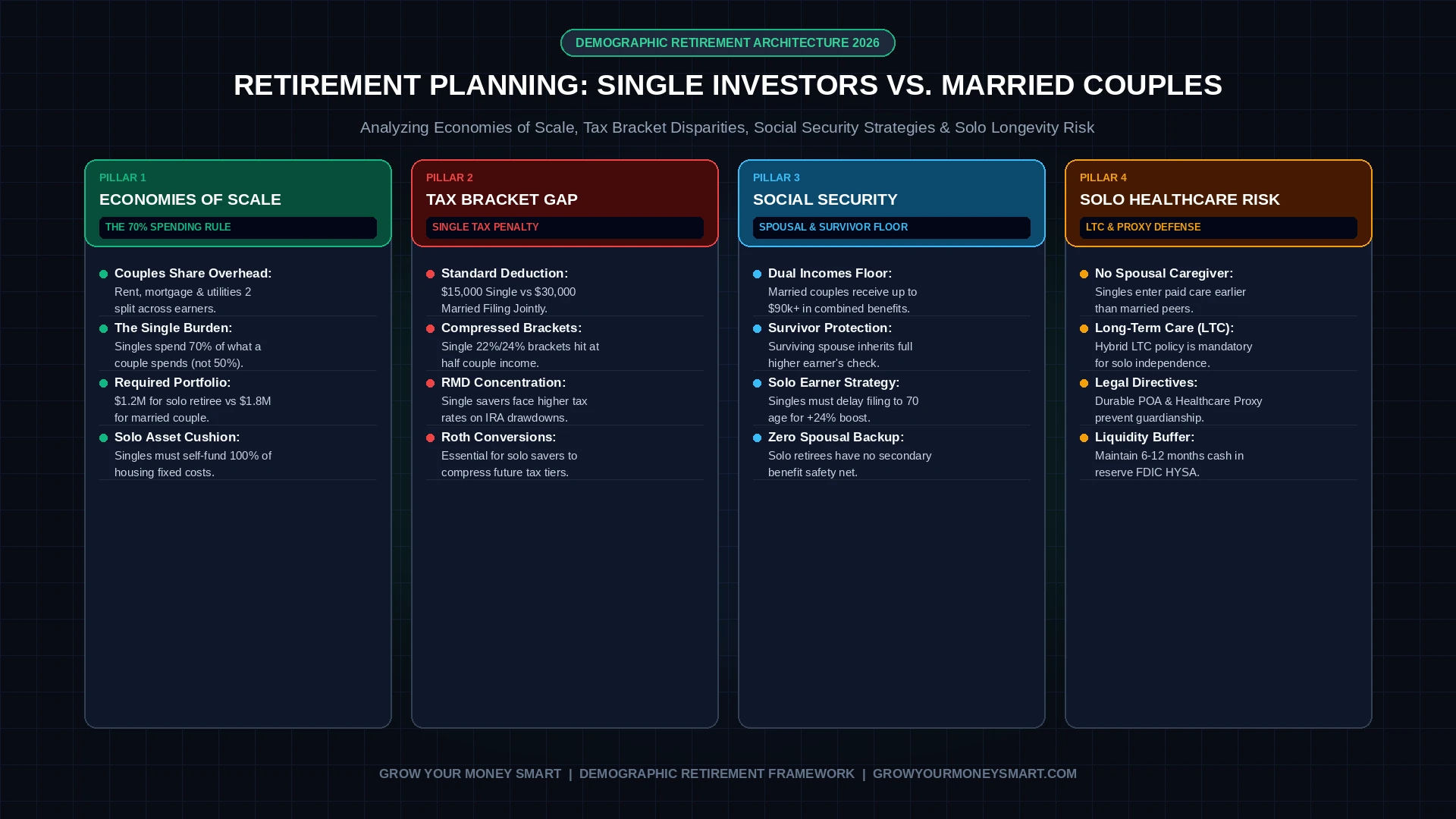
The Single vs. Married Financial Dichotomy: The “Singles Penalty” & Economies of Scale
In conventional retirement discourse, financial rules of thumb are almost universally calibrated for dual-income married households. Mainstream advice assumes two incomes during accumulation, two 401(k) matching programs, combined Social Security benefits, and built-in spousal support during illness. For the growing demographic of single professionals, divorcees, and solo retirees, applying generic married benchmarks can introduce massive structural errors into your financial runway.
The primary macroeconomic force separating single and married retirement is economies of scale. When two people live together, their fixed living overhead—such as mortgage or rent, property taxes, home insurance, internet, heating/cooling, and subscription services—is shared across two individuals. A married couple living comfortably on $72,000 a year does not require twice the square footage or twice the electricity of a solo resident.
Consequently, actuarial studies confirm the “70% Rule of Solo Retirement”: a single person living alone requires approximately 70% of the total budget of a married couple (e.g., $48,000 to $52,000 annually) to maintain the exact same standard of living. Per capita, a single person faces significantly higher living costs and tax drag—an economic reality often described as the Singles Penalty.
To see how your timeline influences your required portfolio accumulation, explore our guide on Investment Time Horizons and audit your lifestyle targets using the 5 Stages of Retirement Planning.
Quantitative Breakdown: Annual Living Costs & 4% SWR Portfolio Targets
To establish concrete benchmarks for financial independence, let us analyze two typical middle-class retirement profiles: Single Earner (Solo Planner) and Married Couple (Tag Team Planners), both targeting a comfortable lifestyle in a moderate-cost-of-living metro area:
- Solo Retiree Baseline ($48,000/yr spending): Housing ($18,000), Utilities/Connectivity ($3,600), Food/Groceries ($6,000), Healthcare & Medicare ($7,200), Transportation ($4,800), Discretionary/Travel ($8,400). Under the classic 4% Safe Withdrawal Rule (SWR), a $48,000 annual spending need requires a gross nest egg of $1,200,000.
- Married Couple Baseline ($72,000/yr spending): Housing ($21,600), Utilities/Connectivity ($4,200), Food/Groceries ($10,200), Healthcare & Medicare ($14,400), Transportation ($7,200), Discretionary/Travel ($14,400). Under the 4% SWR, a $72,000 annual spending need requires a combined gross nest egg of $1,800,000 ($900,000 per spouse).
While the married couple requires $1.80M in total capital, their per-person savings requirement ($900k) is 25% lower than the single saver’s individual requirement ($1.20M). Single savers must shoulder 100% of the accumulation burden solo, without the buffer of a second earner’s savings velocity or workplace matching benefits. Model your personalized budget cash flows with our interactive Household Budget Calculator.
Actuarial Comparison Matrix: Solo Planners vs. Married Tag Teams
The comparative matrix below contrasts the core financial, tax, and longevity risk vectors governing single retirees versus dual-income married couples:
| Planning Dimension | Single Retiree (Solo Flight) | Married Couple (Tag Team) | Strategic Advantage |
|---|---|---|---|
| Annual Living Cost Ratio | ~70% of Couple Budget ($48,000/yr) | 100% Baseline ($72,000/yr) | Married: 30% savings via shared housing & utilities |
| Core Portfolio (4% SWR) | $1,200,000 required | $1,800,000 required ($900k/person) | Married: Lower per-capita savings hurdle |
| IRS Standard Deduction (2025/26) | $15,000 (Single) | $30,000 (MFJ) | Married: 2x tax deduction against taxable income |
| Tax Bracket Compression | 22% bracket starts at $47,150 | 22% bracket starts at $94,300 | Married: Wider lower-rate tax runways |
| Social Security Safety Net | Single earnings record ($22,800 avg) | Dual earnings records ($45,600 avg) + Survivor Floor | Married: Spousal top-ups & lifelong survivor benefit |
| Emergency Liquidity Need | 6 to 12 Months in HYSA | 3 to 6 Months in HYSA | Married: Income diversification reduces reserve size |
| Long-Term Care Vulnerability | HIGH: No built-in spousal caregiver | MODERATE: Informal spousal care buffer | Married: Couples delay paid nursing entry by years |
| Decision Autonomy & Speed | 100% Complete Freedom | Requires spousal alignment & compromise | Single: Total lifestyle & geographical agility |
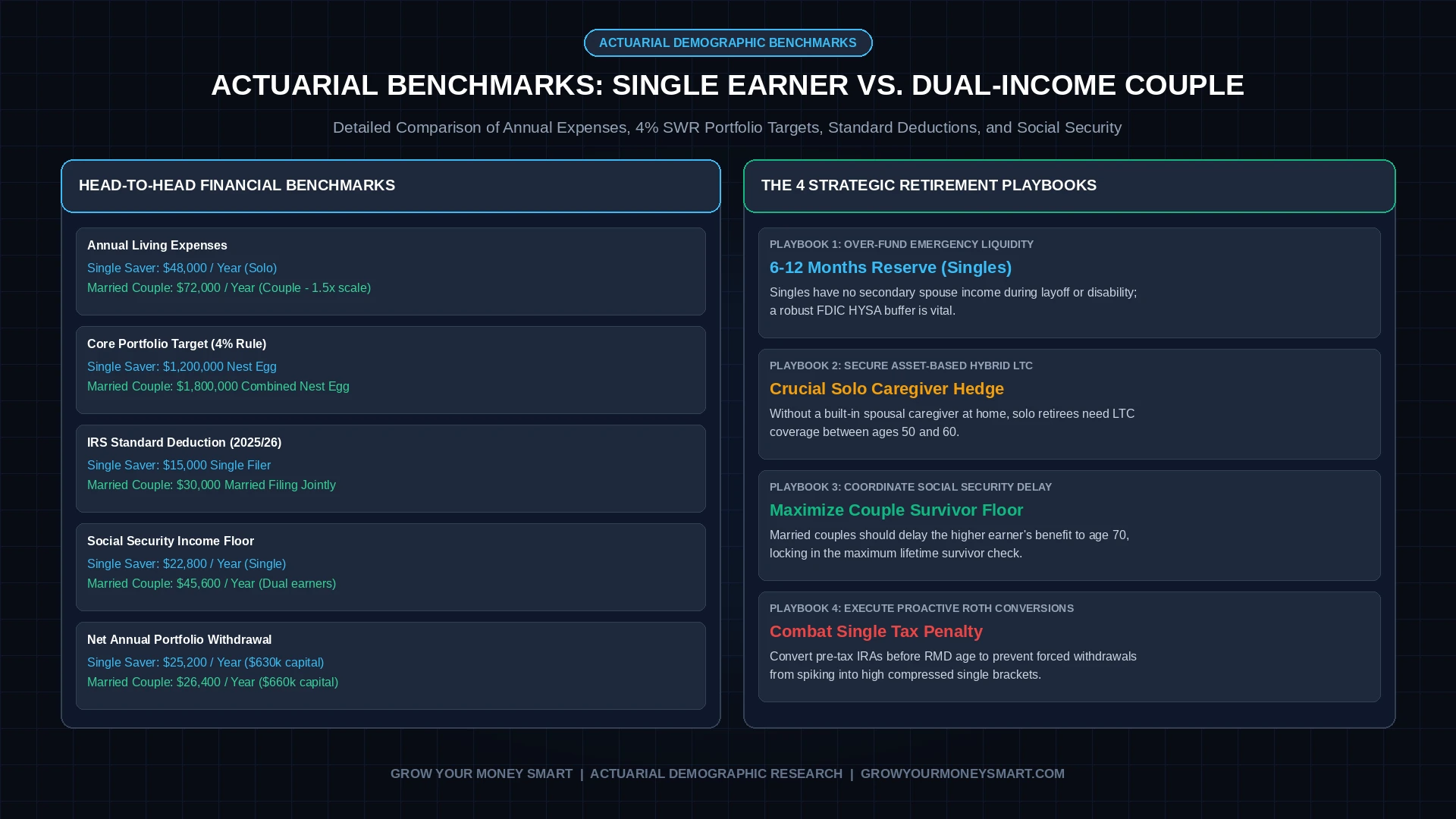
One of the most consequential yet overlooked disparities between singles and married couples is the IRS tax structure in retirement. Under current statutory brackets, married couples filing jointly (MFJ) enjoy brackets that are exactly twice as wide as single brackets up to the 35% tier, alongside double the standard deduction ($30,000 for MFJ vs. $15,000 for Singles in 2025/2026).
For a solo retiree with substantial pre-tax savings in Traditional 401(k)s and IRAs, this tax compression creates a severe Required Minimum Distribution (RMD) tax trap starting at ages 73 and 75. When forced RMDs kick in, a single retiree’s income quickly breaches the compressed single 22% and 24% tax thresholds, triggering steep income tax rates and triggering punitive Medicare IRMAA premium surcharges at just $106,000 of MAGI (compared to $212,000 for couples).
The Solo Roth Conversion Playbook: Between career retirement and age 65 (or age 73), single retirees must execute aggressive, systematic Roth conversions up to the top of the 12% or 22% single federal tax bracket. Shifting pre-tax dollars into a Roth IRA insulates your future distributions from bracket spikes, eliminates future RMDs, and guarantees tax-free withdrawals for life.
Social Security Strategies: Solo Delay Optimization vs. Spousal & Survivor Tactics
Social Security represents the non-negotiable guaranteed income floor of American retirement. However, the claiming strategy differs drastically based on your relationship status:
- The Solo Retiree Strategy (The Power of Delaying to 70): Because singles have no second spouse’s income, spousal top-up, or survivor benefit to fall back on, their primary objective must be maximizing their single check. Claiming Social Security at age 62 permanently reduces your monthly check by 30%, whereas delaying to age 70 increases your monthly benefit by 8% per year (a guaranteed 24% boost above Full Retirement Age). This creates an unshakeable, inflation-adjusted longevity annuity that you can never outlive.
- The Married Couple “Split Filing” Strategy: Married couples have access to spousal benefits (up to 50% of the higher earner’s FRA amount) and survivor benefits (see our tactical guide on Social Security spousal benefits and payout strategies). The optimal strategy is often for the lower-earning spouse to claim at FRA (age 67) to provide baseline living cash flow, while the higher-earning spouse delays claiming until age 70. When the first spouse passes away, the surviving spouse automatically steps up to the higher earner’s 100% boosted check, permanently preserving household purchasing power.
Solo Longevity & Healthcare Defense: Overcoming the Lack of a Built-In Caregiver
The single greatest structural risk confronting solo retirees is healthcare and long-term care management. In married households, spouses provide hundreds of hours of unpaid in-home caregiving during initial health declines—assisting with meals, medications, mobility, and transportation. This informal care delays or prevents expensive institutional care.
Solo retirees do not have this built-in safety net. When health impairments arise, singles must immediately hire outside professional assistance or enter assisted living facilities ($64,200/year) or private nursing homes ($108,405+/year), which are 0% covered by Original Medicare.
To defend your independence and protect your estate, solo retirees must execute a three-part defense firewall:
- Secure Hybrid Asset-Based Long-Term Care (LTC) Insurance: Apply between ages 50 and 60. A hybrid life/LTC policy provides dedicated tax-free monthly care benefits, and if care is never needed, the full death benefit passes to your chosen beneficiaries.
- Establish Ironclad Legal Governance Documents: Execute a Durable Financial Power of Attorney, Healthcare Proxy (Advance Directive), and HIPAA Release, naming a trusted professional fiduciary, family member, or corporate trustee. Without these, state courts will appoint an outside conservator to control your affairs during incapacity.
- Build an Extended 6–12 Month Liquidity Buffer: Maintain 6 to 12 months of survival budget in an FDIC-insured High-Yield Savings Account to absorb medical surprises without selling equities during market corrections. Calculate your cash reserve targets with our Emergency Fund Calculator.
Expert Video Masterclass: FIRE Pathways Ranked for Singles & Couples
To see real-world financial independence models, lifestyle expense breakdowns, and savings benchmarks for both solo earners and couples, watch this comprehensive tutorial by personal finance educator Erin Talks Money:
5-Phase Actionable Implementation Roadmap: Tailored for Singles & Couples
Whether you are planning solo or executing as a couple, follow this 5-phase strategic implementation protocol:
Phase 1: Determine Your True Lifestyle Spending Benchmark
Singles should target ~70% of local couple benchmarks (e.g., $48,000/yr), while couples should audit joint spending against the $72,000/yr baseline. Categorize non-discretionary fixed obligations from variable leisure spending.
Phase 2: Eliminate High-Interest Consumer Liabilities
Aggressively pay off revolving credit cards and high-interest consumer debt. Single savers cannot afford fee drag eating away at their single cash flow. Track your debt freedom date using our Debt Payoff Calculator.
Phase 3: Maximize Tax-Advantaged Account Cascades
Singles should max out their 401(k) ($23,500–$24,500) and Roth IRA ($7,000–$7,500). Dual-earner couples should coordinate to max out both spouses’ 401(k)s ($47,000–$49,000 combined) and both Roth IRAs ($14,000–$15,000 combined) to capture maximum tax deductions.
Phase 4: Design Your Social Security & Healthcare Firewall
Singles: Lock in plans to delay Social Security claiming toward age 70 and secure hybrid LTC insurance by age 55. Couples: Establish the split-filing strategy, delaying the higher earner’s benefit to age 70 to maximize the survivor protection floor.
Phase 5: Execute Fiduciary Estate Governance
Establish Revocable Living Trusts, Healthcare Powers of Attorney, and beneficiary designations across all accounts. Solo savers should consider professional fiduciary trustees, while couples must align on mutual successor provisions. If you are deciding whether to self-manage or hire professional counsel, read our guide on DIY vs Financial Advisor.
Frequently Asked Questions (FAQs)
Below are clear, actionable answers to the most critical questions savers ask about single versus married retirement planning:
No. Actuarial data shows that a single retiree typically needs about 70% of a married couple’s budget (not 50%). Major living expenses—such as housing, utilities, home maintenance, property taxes, and subscriptions—do not divide in half when living alone.
The single tax penalty refers to the compression of IRS tax brackets and deductions for single filers. A single filer receives only a $15,000 standard deduction compared to $30,000 for Married Filing Jointly (MFJ), and higher tax brackets (22%, 24%, 32%) hit single filers at half the taxable income of couples.
Married couples benefit from two separate earnings records, spousal top-up benefits (up to 50%), and survivor benefits where the surviving spouse inherits the larger benefit for life. Singles must rely entirely on their own work history and should strategically delay claiming until age 70 for maximum benefit growth.
Married retirees often receive informal in-home caregiving from their spouse during early stages of physical decline. Solo retirees lack a built-in caregiver and must rely immediately on paid professional assistance, making hybrid LTC insurance and healthcare directives essential to protect portfolio principal.
Based on a $48,000 annual spending baseline, a single retiree requires a core portfolio of approximately $1,100,000 to $1,250,000 under the 4% Safe Withdrawal Rule (or approximately $600,000 to $700,000 if accounting for an average $22,800 annual Social Security benefit).
Single retirees must prioritize a Durable Financial Power of Attorney, Medical Healthcare Proxy (Advance Directive), HIPAA Release, and a Revocable Living Trust. Without these documents, state probate courts will appoint an outside conservator to manage financial and healthcare decisions during incapacity.
The proven split-filing strategy is for the lower-earning spouse to claim earlier (at Full Retirement Age) to provide baseline household cash flow, while the higher-earning spouse delays claiming until age 70 to lock in the 24% delayed retirement bonus, maximizing the lifelong survivor benefit floor.
Dual-income couples possess built-in diversification: if one spouse experiences job loss or health issues, the other spouse’s income covers basic needs. Singles bear 100% of financial risks alone and should maintain 6 to 12 months of living expenses in an FDIC High-Yield Savings Account.
Final Expert Verdict: Mastering Your Individual Path to Freedom
Whether you are piloting your retirement journey as a solo flyer or navigating as a married tag team, financial independence is achieved by engineering a plan tailored specifically to your demographic realities. By understanding economies of scale, neutralizing tax bracket traps through strategic Roth conversions, optimizing your Social Security claiming runway, and fortifying your healthcare defense, you can ensure lifelong financial security and total peace of mind.

Jaiveer Hooda is the Lead Financial Researcher & Personal Finance Analyst at Grow Your Money Smart. Specializing in personal wealth optimization, index fund compounding, high-yield savings mechanics, and consumer debt elimination strategies. With a background in computer engineering, he applies mathematical modeling, cashflow simulations, and empirical risk analysis to evaluate personal finance vehicles and credit products. Every analysis is backed by verified regulatory disclosures, IRS tax schedules, and empirical APY compounding math.
Areas of Expertise: Personal Finance · High-Yield Savings Accounts (HYSA) · Index Funds & S&P 500 Compounding · Retirement Planning (401k/IRA) · Debt Optimization · Credit Card APR Mechanics.
Transparency & Editorial Policy: Editorial Standards | Report a Correction