
- The Core Purpose: Retirement planning is the multi-decade engineering process of turning current earned income into an enduring, self-sustaining financial engine that pays you for life without working.
- The Power of the 25x Rule: Target saving 25 times your annual living expenses (based on the 4% Safe Withdrawal Rule) to achieve complete financial independence.
- The $1,000/Month Compounding Multiplier: Investing $1,000 monthly over 30 years accumulates into $1,490,359 at an 8% index return—where $1.13 million (75.8%) is pure compound growth!
- The 3-Bucket Tax Shield: Diversifying assets across Pre-Tax (401k), Post-Tax (Roth IRA/HSA), and Taxable Brokerage accounts shields you from future IRS tax hikes.
- SECURE 2.0 Super Catch-Up: Late-career savers ages 60–63 can contribute up to $11,250 in catch-up contributions for an accelerated pre-retirement compounding runway.
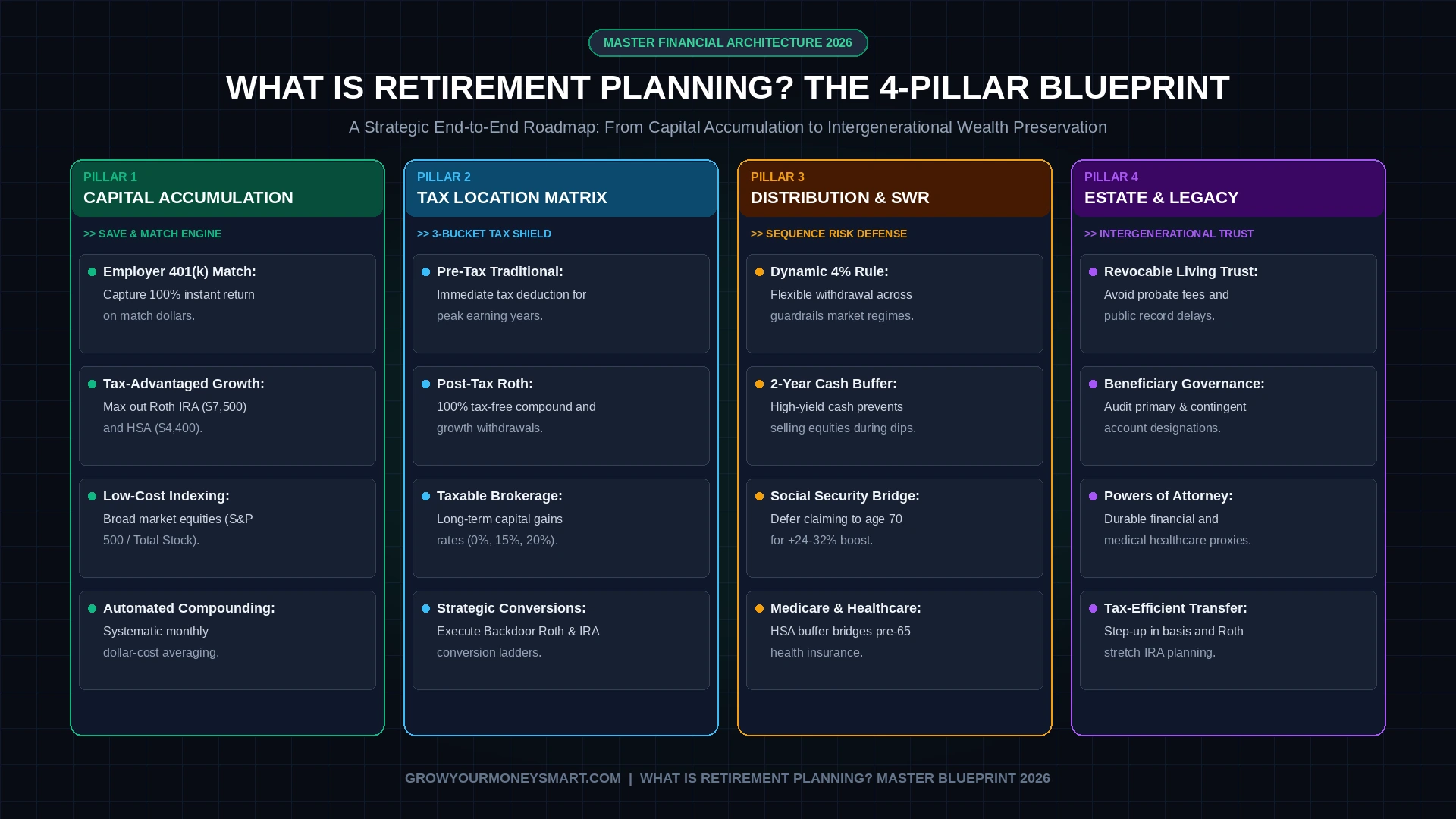
What is retirement planning? At its foundational core, retirement planning is not merely picking a few mutual funds or opening a bank savings account. It is the comprehensive, mathematically sound process of designing, building, and protecting a multi-decade financial architecture that ensures you maintain total lifestyle autonomy, freedom, and purchasing power long after you cease full-time employment.
In modern macroeconomics—shaped by fluctuating interest rate cycles, persistent inflation, escalating healthcare costs, and demographic shifts in Social Security—relying on guesswork or passive savings is a recipe for shortfall. A robust retirement strategy integrates five distinct disciplines: disciplined capital accumulation, systematic tax-location diversification, risk-adjusted asset allocation, dynamic distribution guardrails, and intergenerational estate governance.
Whether you are in your 20s capturing your first employer 401(k) match, navigating peak earnings in your 40s, or approaching distributions in your 60s, mastering retirement planning transforms wealth building from random speculation into an engineered certainty. Calculate your debt elimination with our Debt Payoff Calculator and audit your spending with our Household Budget Calculator.
Macroeconomic Realities: Inflation, Longevity & Sequence Risk
Over a century of empirical capital market data proves that the two greatest silent destroyers of retirement security are purchasing power erosion (inflation) and longevity risk (outliving your money). A modest 3.0% annual inflation rate halves your purchasing power in just 24 years. Meanwhile, a 65-year-old married couple today has a 50% probability that at least one spouse will live past age 92.
According to academic research and institutional data from the Internal Revenue Service (IRS), Securities and Exchange Commission (SEC), and the Social Security Administration (SSA), over 90% of long-term investment return variance is driven by asset allocation policy rather than market timing or stock picking. Balancing growth engines (broad-market equities and real estate) with stability anchors (short-term fixed income and cash equivalents) ensures your capital outpaces inflation across all market regimes.
For an in-depth breakdown of how your timeline dictates risk capacity, read our comprehensive analysis on Investment Time Horizons.
Retirement Planning Paradigms: Conventional vs. Institutional Master Strategy
The comparative matrix below outlines how conventional, unoptimized retirement planning approaches differ from an institutional wealth master architecture:
| Strategic Metric | Conventional Retail Approach | Institutional Master Strategy | High-Net-Worth Optimized Path |
|---|---|---|---|
| Asset Allocation Strategy | Static 60/40 Equity/Bond Ratio | Dynamic Lifecycle & Factor Allocation | Alternative Assets & Direct Real Estate |
| Tax Efficiency Framework | 100% Pre-Tax Traditional 401(k) | 3-Bucket Strategy (Pre-Tax, Roth, Taxable) | Mega-Backdoor Roth & HSA Maxing |
| Inflation Hedging | Cash Savings & Fixed Annuities | TIPS, Dividend Growth & Broad Indices | Private Infrastructure & Real Assets |
| Withdrawal Protocol | Rigid 4% Constant Dollar Rule | Variable-Percentage Dynamic Guardrails | Asset-Liability Matching (Floor & Upside) |
| Social Security Strategy | Claim Early at Age 62 (Penalized) | Strategic Delay to Age 70 (+24-32% Boost) | Delayed Filing to Age 70 + Private Trusts |
| Healthcare Planning | Relying solely on standard Medicare | Dedicated HSA Buffer + IRMAA Optimization | Hybrid LTC Trusts & Private Health Buffers |
Quantitative Modeling: The $1,000/Month Compounding Multiplier
The defining power of retirement planning is compound interest—what Albert Einstein famously called the eighth wonder of the world. Consider a rigorous 30-year accumulation simulation investing $1,000 per month ($12,000 annually) into broad-market low-cost index funds:
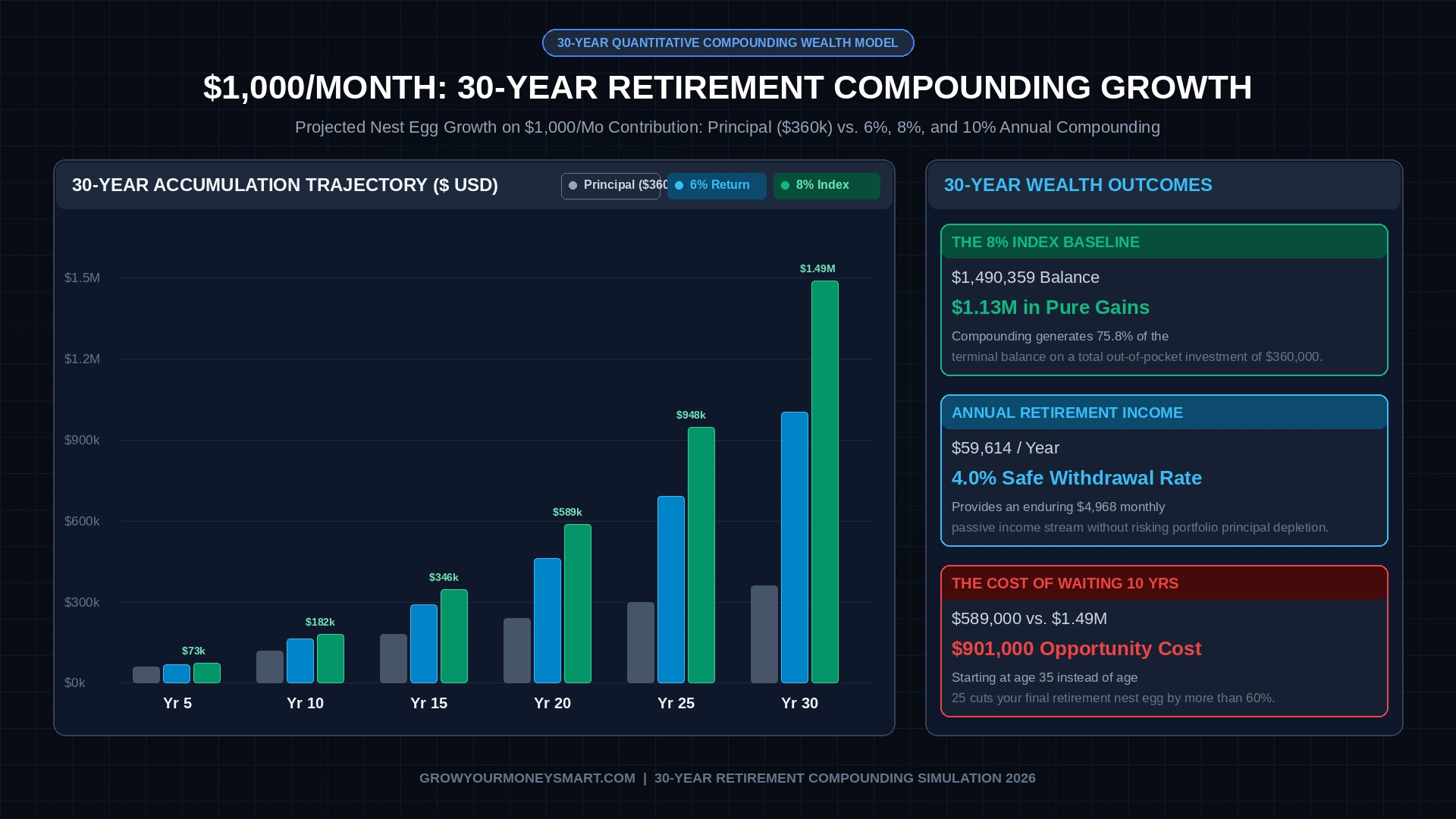
30-Year Compounding Breakdown:
- Total Out-of-Pocket Principal Contributed: $360,000 ($1,000/mo x 360 months).
- Terminal Wealth @ 6.0% Return (Conservative): $1,004,515 ($644,515 in compound growth).
- Terminal Wealth @ 8.0% Return (Balanced Index): $1,490,359 ($1,130,359 in compound growth).
- Terminal Wealth @ 10.0% Return (Equity Growth): $2,260,488 ($1,900,488 in compound growth).
- The Compound Multiplier: At the 8% benchmark, 75.8% of your final wealth is generated entirely by compounding returns rather than out-of-pocket savings.
Progress through each phase of the wealth journey with our comprehensive guide to the 5 Stages of Retirement Planning.
Expert Video Masterclass: Retirement Accounts for Beginners
To master the mechanics of 401(k) plans, Traditional IRAs, Roth accounts, and contribution ordering, watch this top-rated educational breakdown by respected personal finance educator Humphrey Yang:
The 3-Bucket Tax Diversification Strategy
Tax code legislation evolves constantly. To shield yourself from future statutory income tax rate increases, modern retirement planning requires building assets across all three core tax buckets:
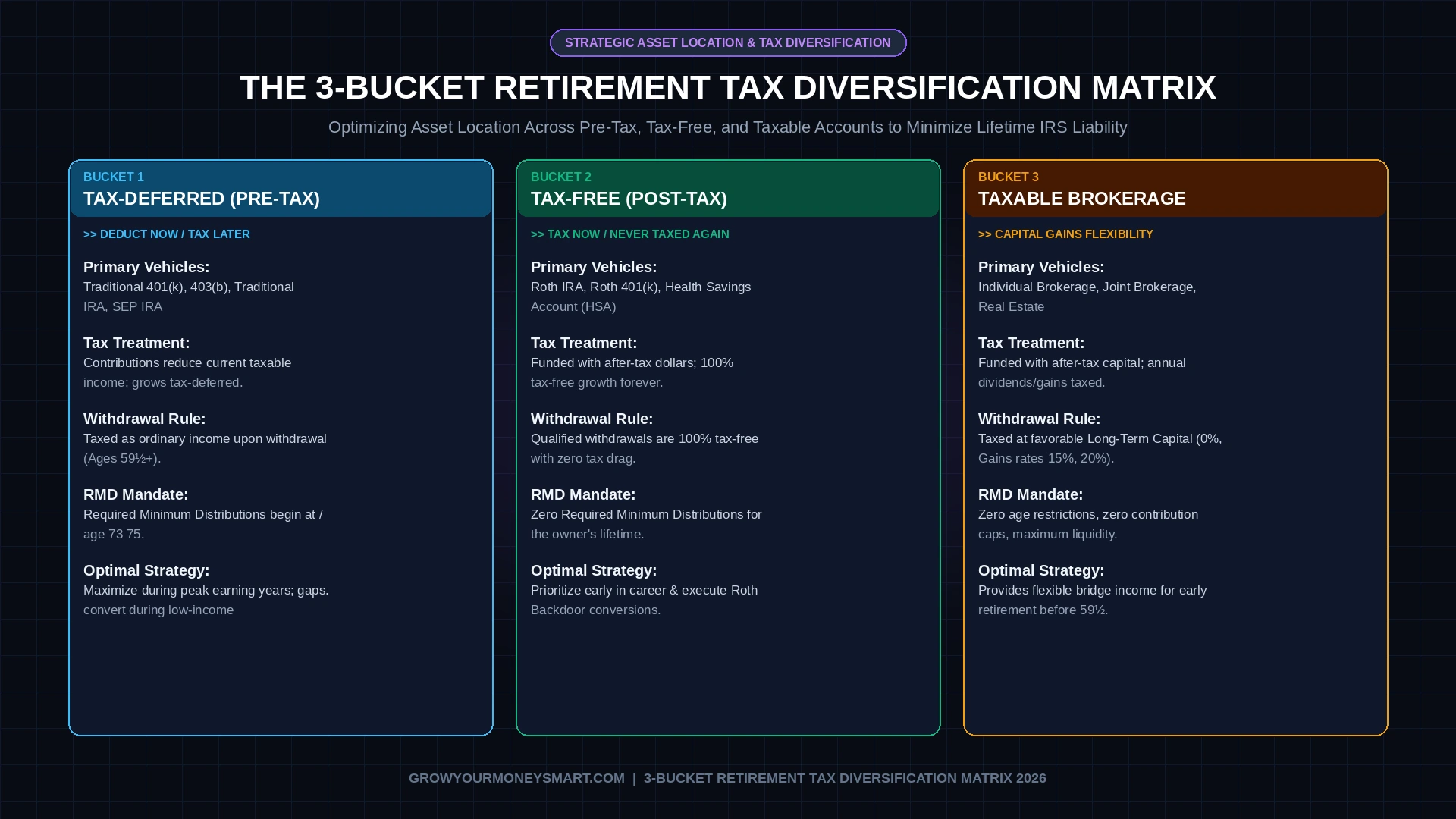
The 3 Buckets Detailed:
- Bucket 1: Tax-Deferred (Pre-Tax Traditional 401k / Traditional IRA): Contributions reduce your taxable income during peak earning years. Growth compounds tax-deferred, and distributions are taxed as ordinary income after age 59½. Required Minimum Distributions (RMDs) begin at age 73 (moving to 75 under SECURE 2.0).
- Bucket 2: Tax-Free (Roth IRA / Roth 401k / Health Savings Account): Contributions are made with after-tax dollars, but all future investment growth and qualified distributions are 100% tax-free. Zero RMDs for the owner’s lifetime. HSAs offer triple tax advantages (deductible contributions, tax-free growth, tax-free medical withdrawals).
- Bucket 3: Taxable Brokerage Accounts: Funded with after-tax capital with zero annual contribution caps and maximum liquidity. Capital gains and qualified dividends are taxed at favorable Long-Term Capital Gains rates (0%, 15%, or 20%), providing an indispensable bridge for early retirees prior to age 59½.
Deciding between managing your own portfolio or hiring a professional? Compare both paths in our guide to DIY Investing vs. Financial Advisor.
2025/2026 Regulatory Updates: SECURE 2.0 & IRS Statutory Limits
Maximizing your retirement runway requires keeping pace with the latest IRS statutory thresholds enacted under the SECURE 2.0 Act:
- Workplace 401(k), 403(b) & 457 Elective Deferrals: $23,500 for 2025 (escalating to $24,500 in 2026). Standard catch-up contributions for savers aged 50+ remain at $7,500 ($8,000 in 2026).
- SECURE 2.0 ‘Super Catch-Up’ (Ages 60–63): Workers reaching ages 60, 61, 62, or 63 qualify for an elevated catch-up threshold of $11,250, providing an accelerated pre-retirement compounding window.
- High-Earner Mandatory Roth Catch-Up (2026 Rule): Starting January 1, 2026, wage earners with prior-year FICA compensation exceeding $150,000 must direct all catch-up contributions into after-tax Roth accounts.
- Individual Retirement Accounts (IRAs): $7,000 annual limit ($7,500 in 2026) with a $1,000 catch-up allowance for individuals age 50+.
- Health Savings Accounts (HSAs): $4,300 for self-only and $8,550 for family coverage ($4,400 and $8,750 in 2026), plus an extra $1,000 catch-up for savers age 55+.
- 529-to-Roth Rollover Flexibility: Unused 529 college savings funds maintained for 15+ years can be rolled directly into a beneficiary’s Roth IRA up to a lifetime aggregate limit of $35,000.
Protect your liquid safety nets before investing with our Emergency Fund Calculator.
5-Phase Actionable Implementation Blueprint
To execute retirement planning with institutional rigor, follow this structured five-phase implementation protocol:
- Phase 1: Baseline Net Worth & Spending Audit: Tally all assets and liabilities. Calculate your baseline annual living expenses and determine your target nest egg using the 25x Rule ($Exp x 25).
- Phase 2: Establish Emergency Liquidity Firewall: Build a 3-to-6-month liquid emergency fund in a high-yield savings account to prevent premature liquidations of retirement assets.
- Phase 3: Execute Tax-Advantaged Contribution Waterfall: Capture 100% of 401(k) matching funds first > Maximize HSA > Maximize Roth IRA > Maximize remaining 401(k) > Allocate surplus to taxable brokerage index funds.
- Phase 4: Systematic Rebalancing & Glide-Path Alignment: Establish an annual rules-based rebalancing trigger. As you approach retirement, gradually adjust asset allocation to include a 2-year cash and short-duration bond buffer to shield against sequence of returns risk.
- Phase 5: Estate Governance & Healthcare Directives: Update account beneficiary designations, execute durable financial and medical powers of attorney, and establish revocable living trusts to preserve wealth for future generations.
Starting from scratch? Learn the foundational steps in our guide on How to Save Your First $1,000 Fast.
Actionable 10-Point Pre-Execution Checklist
Before finalizing your retirement strategy, confirm that you have completed each of the following 10 essential milestones:
- Audited trailing 12-month bank and credit statements to confirm true annual living expenses.
- Established an emergency liquidity buffer of 3 to 12 months in an FDIC-insured high-yield savings account.
- Maxed out employer 401(k) company matching contributions (zero free money left on the table).
- Contributed to a Health Savings Account (HSA) if enrolled in an eligible high-deductible health plan.
- Fully funded annual Roth IRA or Backdoor Roth IRA contribution limits.
- Verified portfolio weighted average expense ratio is below 0.15% (eliminating active fee drag).
- Calculated target retirement nest egg using the 25x Rule and Safe Withdrawal Rate models.
- Established a Social Security claiming strategy targeting age 70 for primary earners.
- Verified primary and contingent beneficiary designations across all financial accounts.
- Drafted durable power of attorney, healthcare proxy, and primary estate documents.
⚡ Foundational Retirement Concepts & Risk Mitigation Guides
Strengthen your retirement knowledge base with these core strategic guides:
- The Cost of Inaction: Explore our guide on what happens if you have no retirement plan and the financial realities of depending solely on government safety nets.
- Procrastination Dangers: Explore our guide on catastrophic risks of skipping retirement planning illustrating the mathematical cost of delaying by even 5 years.
- Terminology Decoded: Explore our guide on simple retirement planning glossary for beginners explaining 401(k), IRA, RMD, and asset allocation terms clearly.
- Day-to-Day Financial Impact: Explore our guide on how retirement planning shapes daily financial decisions aligning short-term spending choices with future freedom.
- Inheritance Windfall Realities: Explore our guide on why expecting an inheritance does not replace retirement savings and the risks of assuming future inheritances.
- Income Stream Stool: Explore our guide on the classic three-legged stool of retirement income to diversify your post-career cash flow streams.
- Modern Pension Reality: Explore our guide on why modern pensions require personal retirement savings to protect against inflation and corporate plan freezes.
- Retirement Portfolio Realities: Explore our guide on do you really need millions to retire myth with practical benchmarks for financial security.
Frequently Asked Questions (FAQs)
Below are clear, actionable answers to the most common questions individuals ask about retirement planning, investment ordering, and wealth preservation:
Retirement planning is the multi-decade strategic process of defining your future lifestyle income goals, estimating post-career living expenses, systematically accumulating capital across tax-advantaged accounts (401k, IRA, HSA), managing investment asset allocation, and structuring tax-efficient withdrawal protocols so your money lasts throughout your entire lifetime.
A standard financial rule of thumb is the 25x Rule (based on the 4% Safe Withdrawal Rule). Multiply your expected annual retirement living expenses (minus guaranteed income like Social Security or pensions) by 25. For example, if you need $60,000 annually from your portfolio, you need a target nest egg of $1,500,000 ($60,000 x 25).
The mathematically optimized contribution sequence is: 1) Contribute to your employer 401(k) up to the full company match (100% instant return); 2) Max out a Health Savings Account (HSA) for triple tax advantages; 3) Max out a Roth IRA or Backdoor Roth IRA; 4) Return to max the remaining balance of your workplace 401(k); and 5) Direct surplus cash flow into a low-cost taxable brokerage index portfolio.
A Traditional 401(k) is an employer-sponsored plan funded with pre-tax dollars, lowering your current taxable income, with withdrawals taxed as ordinary income in retirement. A Roth IRA is an individual account funded with after-tax dollars, allowing your investments to grow 100% tax-free, and all qualified withdrawals after age 59½ are completely exempt from federal and state income taxes.
For 2025/2026, the 401(k) elective deferral limit is $23,500 ($24,500 in 2026) with an $8,000 standard catch-up for ages 50+. Under SECURE 2.0, savers aged 60 to 63 qualify for an elevated ‘Super Catch-Up’ limit of $11,250. IRA limits stand at $7,000 ($7,500 in 2026) with a $1,000 catch-up. HSA limits are $4,300 self-only and $8,550 family coverage ($4,400 and $8,750 in 2026).
The 4% Rule, originated by William Bengen in the Trinity Study, posits that a retiree can withdraw 4.0% of their initial portfolio balance in year one, adjusting subsequent annual withdrawals upward for inflation, with an extremely high historical probability of the portfolio surviving a 30-year retirement across all historical market cycles.
Sequence of Returns Risk is the danger of experiencing severe market drawdowns during the first 3 to 5 years of retirement withdrawals, forcing the liquidation of shares at market lows. You can shield against this risk by maintaining a 2-year liquid cash and short-term bond buffer, adopting dynamic variable withdrawal guardrails, or supplementing living costs with part-time consulting income.
You can claim Social Security as early as age 62 (at a permanent 25% to 30% benefit reduction) or delay up to age 70. For every year you delay claiming past your Full Retirement Age (age 67 for those born in 1960+), your monthly benefit increases by 8.0% per year in guaranteed, inflation-protected delayed retirement credits.
Comprehensive retirement planning coordinates tax-sheltered accounts, Social Security safety nets, and estate preservation. Consult the official Internal Revenue Service (IRS) Retirement Topics and Employee Plans for statutory guidelines and consumer protections.
🏛️ Master Retirement Frameworks, Estate Defense & Withdrawal Rules
Take the next step in securing your financial independence with these foundational pillar guides:
- Flagship Lifecycle Guide: 5 stages of retirement planning: the complete guide — master every milestone from career accumulation to legacy distribution.
- Elder & Family Care: sandwich generation financial planning guide — balancing children’s expenses with parental medical care.
- Long-Term Care Defense: is long-term care insurance worth it in 2026? — evaluating coverage to shield assets from healthcare inflation.
- Asset Transfers: beneficiary designation vs will: costly traps — safeguarding accounts so they bypass stressful probate proceedings.
- Safe Withdrawal Math: the 4% rule safe withdrawal rate in 2026 — calculating your portfolio sustainability over a multi-decade retirement.
🛡️ Long-Term Healthcare, Longevity & Global Retirement Systems
Comprehensive financial planning requires accounting for healthcare inflation and changing work dynamics:
- Healthcare Reality: managing healthcare costs and Medicare in retirement to safeguard against the single largest unexpected retirement expense.
- Longevity Protection: planning for 30+ year retirement longevity risk ensuring your portfolio outlives you without depletion.
- Social Security Timing: claiming Social Security early vs delayed strategy maximizing lifetime guaranteed monthly payments.
- Legal Frameworks: essential legal documents for estate and retirement planning securing wills, powers of attorney, and healthcare directives.

Jaiveer Hooda is the Lead Financial Researcher & Personal Finance Analyst at Grow Your Money Smart. Specializing in personal wealth optimization, index fund compounding, high-yield savings mechanics, and consumer debt elimination strategies. With a background in computer engineering, he applies mathematical modeling, cashflow simulations, and empirical risk analysis to evaluate personal finance vehicles and credit products. Every analysis is backed by verified regulatory disclosures, IRS tax schedules, and empirical APY compounding math.
Areas of Expertise: Personal Finance · High-Yield Savings Accounts (HYSA) · Index Funds & S&P 500 Compounding · Retirement Planning (401k/IRA) · Debt Optimization · Credit Card APR Mechanics.
Transparency & Editorial Policy: Editorial Standards | Report a Correction
16 thoughts on “What is Retirement Planning? Your Essential Guide to Securing Your Future”