
Starting early harnesses exponential compounding math, allowing small regular contributions to outpace large late-career contributions. Consult the official SEC Investor.gov Compound Interest and Wealth Building Tools for statutory guidelines and consumer protections.
Capitalize on the unbeatable power of time and compounding with these strategic personal finance roadmaps:
- Twentysomething Guide: retirement planning in your 20s: the 88x wealth guide — mathematical proof of how early compounding outperforms late high-income investing.
- Net Worth Targets: how much to save by age 30, 40, 50, 60 benchmarks — check your milestone savings multiples against national financial standards.
- Account Maximization: how to max out 401(k) and Roth IRA simultaneously — step-by-step contribution playbook for compounding growth.
- Tax Optimization: Traditional IRA vs Roth IRA: which is best in 2026 — locking in decades of tax-free growth with early Roth accounts.
- Purchasing Power Defense: how inflation erodes retirement savings — why beginning early is your primary insurance against long-term monetary inflation.
The single most powerful wealth-building lever in personal finance is not picking winning stocks or earning a six-figure salary—it is time in the market. Because compound growth is exponential rather than linear, dollars invested in your 20s and 30s carry up to 88x more wealth-generating power than dollars invested later in life.
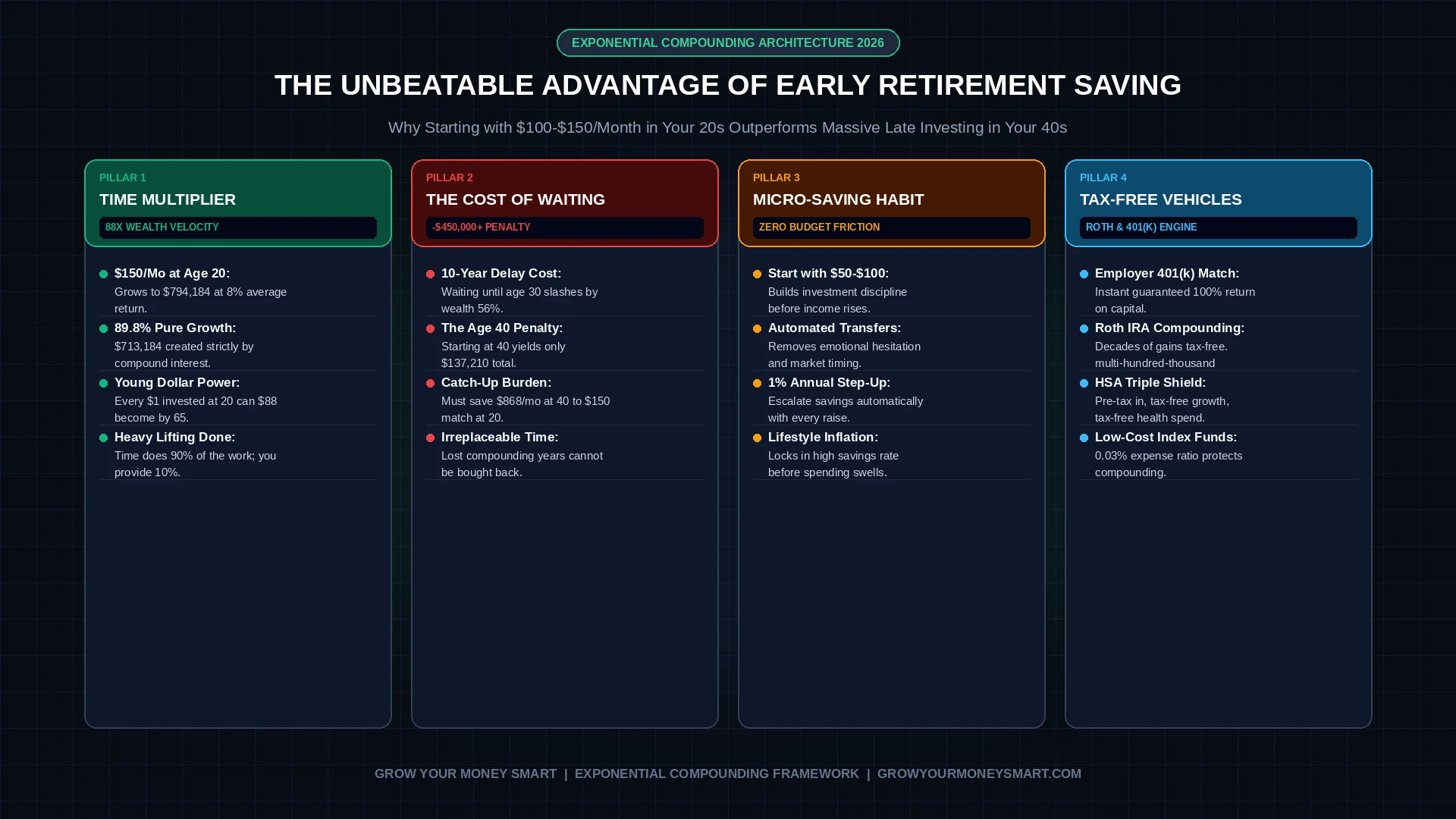
- The $150/Month Miracle: Investing just $150/month starting at age 20 (at an 8% return) builds $794,184 by age 65. Pure compound growth accounts for $713,184 (89.8%) of that fortune.
- The $450,000 Cost of Waiting: Delaying that exact same $150/month investment from age 20 to age 30 cuts your final retirement balance to $344,082—a devastating $450,102 penalty for a 10-year pause.
- Starting at 40 Requires 6x Effort: To match the $794,000 nest egg of the 20-year-old starter, an individual waiting until age 40 must invest $868/month ($260,000+ out of pocket).
- The Starter Order of Operations: Capture your employer’s 401(k) match first, establish a starter cash buffer, automate a Roth IRA in low-cost broad-market index funds, and execute an automated 1% annual step-up.
The Mathematics of Time: Why Time Beats Timing Every Single Time
One of the most dangerous myths in personal finance is the belief that you cannot start saving for retirement until you earn a large income or have thousands of dollars in disposable capital. Young workers frequently tell themselves: “I’ll wait until my 30s when my salary is higher to get serious about investing.”
This cognitive trap costs everyday savers hundreds of thousands of dollars in lost compounding potential. Compound interest is governed by an exponential mathematical curve: A = P(1 + r/n)^(nt). In this equation, the variable that exerts the most dramatic influence on your terminal wealth is not P (the amount of principal you contribute), nor is it r (the rate of return). It is t—the time horizon your money is allowed to compound uninterrupted.
When you invest in your 20s, each dollar has a 40-to-45 year compounding runway. Based on the historical ~10% nominal annual return of the S&P 500 (~7.5%–8% real return after inflation adjustments), a single dollar invested at age 20 can grow to approximately $88 by age 65. By contrast, a dollar invested at age 40 has only 25 years to compound, growing to roughly $6.80. The 20-year-old’s dollar is 13 times more powerful simply because of the passage of time.
To see how your investment runway dictates your optimal portfolio risk allocation, review our master analysis on Investment Time Horizons and track your retirement progression across the 5 Stages of Retirement Planning.
The Cost of Waiting: The $450,000+ Ten-Year Procrastination Penalty
To understand the brutal mathematical penalty of procrastination, consider three investors—Ava (Start at Age 20; tracking institutional retirement savings benchmarks by age), Ben (Start at Age 30), and Chloe (Start at Age 40). Each investor commits to investing exactly $150 per month ($1,800 annually or just $5 a day) into a low-cost S&P 500 index fund earning an average 8.0% annualized compound return until retiring at age 65.
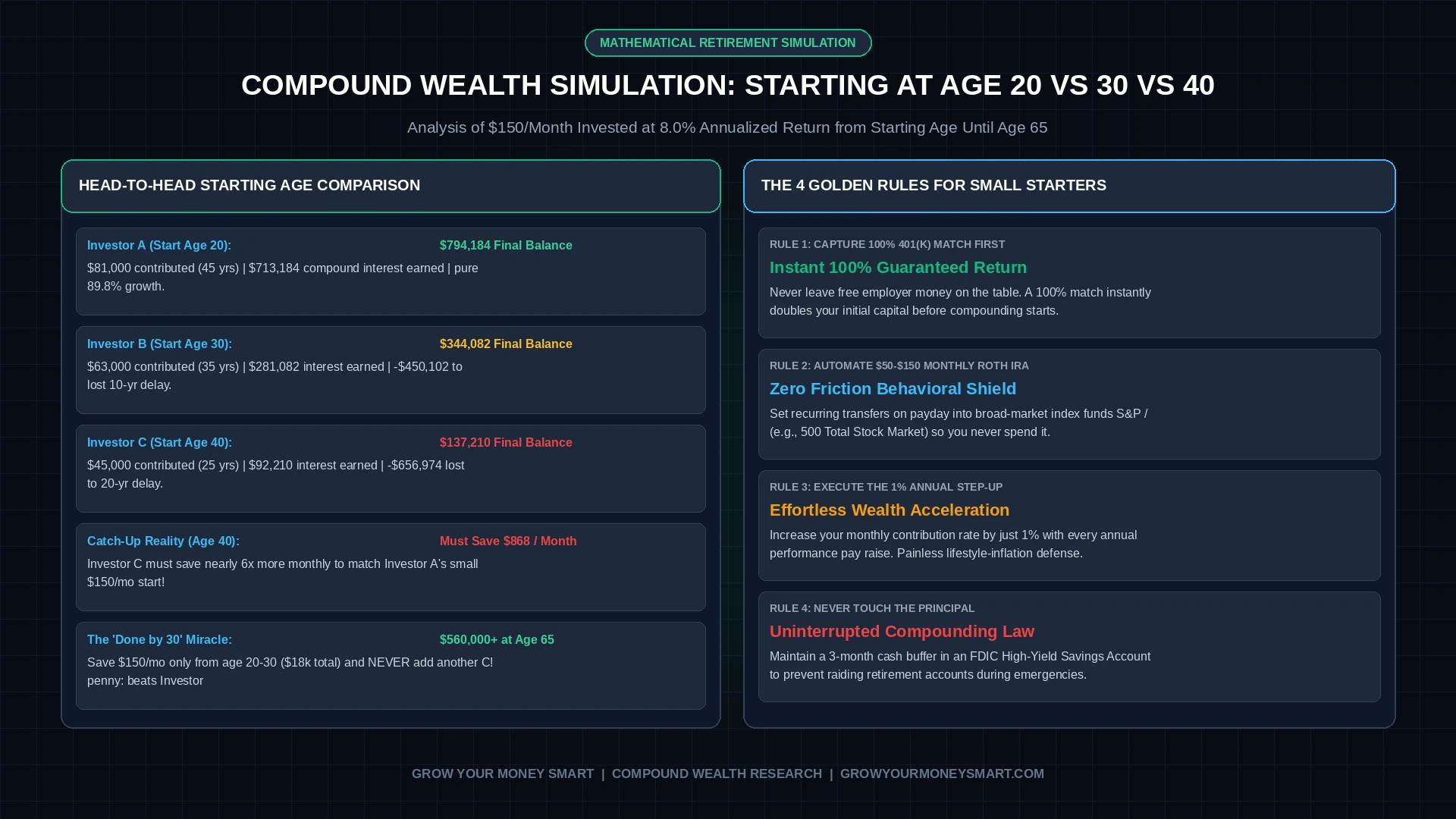
- Investor Ava (Starts at 20): Invests $150/mo for 45 years. Her total out-of-pocket contributions equal $81,000. At age 65, her portfolio reaches $794,184. A staggering $713,184 (89.8%) of her total wealth was generated entirely by compound interest—money working for her while she slept.
- Investor Ben (Waits until 30): Invests $150/mo for 35 years. His total out-of-pocket contributions equal $63,000. At age 65, his portfolio reaches $344,082. By waiting just 10 years, Ben loses $450,102 in potential wealth, despite saving only $18,000 less out of pocket!
- Investor Chloe (Waits until 40): Invests $150/mo for 25 years. Her total out-of-pocket contributions equal $45,000. At age 65, her portfolio reaches $137,210. Chloe sacrificed $656,974 in compound growth compared to Ava.
The Catch-Up Burden: For Chloe (starting at 40) to accumulate the exact same $794,000 nest egg that Ava built with a modest $150/month, Chloe must invest $868 every single month for 25 continuous years—contributing over $260,000 out of pocket! Starting early is the ultimate financial shortcut: you contribute far less out-of-pocket cash while achieving vastly superior terminal wealth.
Actuarial Compounding Matrix: Starting Age vs. Lifetime Wealth Accumulation
The comparative simulation table below illustrates the exact mathematical mechanics of compound interest across different starting ages, showcasing total contributions, total compound interest earned, and the catch-up monthly burden required to hit a $1,000,000 retirement goal:
| Investor Starting Age | Years Compounding (to Age 65) | Total Out-of-Pocket Contributed ($150/mo) | Total Interest Earned (at 8% Return) | Final Portfolio Value at Age 65 | Monthly Needed to Reach $1,000,000 |
|---|---|---|---|---|---|
| Age 20 (Early Mover) | 45 Years | $81,000 | $713,184 (89.8%) | $794,184 | $189 / mo |
| Age 25 (Young Pro) | 40 Years | $72,000 | $464,151 (86.6%) | $536,151 | $280 / mo |
| Age 30 (10-Yr Delay) | 35 Years | $63,000 | $281,082 (81.7%) | $344,082 | $436 / mo |
| Age 35 (15-Yr Delay) | 30 Years | $54,000 | $165,189 (75.4%) | $219,189 | $690 / mo |
| Age 40 (Mid-Career Start) | 25 Years | $45,000 | $92,210 (67.2%) | $137,210 | $1,093 / mo |
| Age 45 (Late Starter) | 20 Years | $36,000 | $47,947 (57.1%) | $83,947 | $1,787 / mo |
The 4-Step Order of Operations for Small Starters: Maximizing Every Dollar
When you are beginning your financial journey with a modest monthly sum ($50 to $200), capital allocation efficiency is paramount. To squeeze the maximum mathematical return from every dollar, follow this proven financial priority waterfall:
- Step 1: Capture 100% of Employer 401(k) Matching Funds: If your employer offers a 50% or 100% match on your 401(k) contributions up to 3%–6% of your salary, contributing enough to capture this full match is non-negotiable. An employer match represents an instant, guaranteed 50%–100% return on your money before market compounding even begins. Leaving an employer match unclaimed is literally turning down free compensation.
- Step 2: Build a $1,000 Emergency Cash Firewall: Before aggressive investing, stash $1,000 to 1 month of essential expenses in a high-yield savings account (HYSA). This cash buffer protects your early investments from being prematurely raided or sold during minor emergencies (such as a car repair or medical bill). Calculate your baseline reserve targets with our Emergency Fund Calculator.
- Step 3: Open and Automate a Roth IRA: For young and early-career earners, the Roth IRA is the premier wealth-building weapon. Because your current income is likely in lower tax brackets, paying taxes on your contributions today allows four decades of dividends and capital gains to compound and be withdrawn 100% tax-free in retirement. Automate a recurring transfer of $50–$150 on every payday directly into a low-cost, broad-market index fund (such as VOO, VTI, or an S&P 500 fund with an expense ratio under 0.04%).
- Step 4: Maximize a Health Savings Account (HSA): If enrolled in a qualifying High Deductible Health Plan (HDHP), an HSA offers a unique triple-tax advantage: contributions are 100% tax-deductible, investment growth is completely tax-free, and withdrawals for qualified medical expenses are 100% tax-free. At age 65, non-medical withdrawals function exactly like a traditional IRA.
Behavioral Psychology: Overcoming the “I Need More Money First” Fallacy
Behavioral finance research demonstrates that the greatest impediment to retirement wealth is not a lack of financial knowledge, but the cognitive friction of getting started. Novice investors frequently succumb to three common psychological traps:
- 1. The Perfectionist Fallacy: Believing you must wait until you can invest $500 or $1,000 a month. In reality, starting with $25 or $50 a month builds the neurological habit of automated investing. Once the automated pipeline is constructed, scaling contributions as your income grows requires zero additional mental friction. If your income fluctuates, review our strategies for saving your first $1,000 on a low income.
- 2. The Market Timing Illusion: Waiting for the “perfect time” or a market crash before investing your first dollar. Empirical studies by Charles Schwab and Morningstar prove that dollar-cost averaging into index funds consistently beats trying to time market bottoms. Over a 40-year horizon, the entry point of your first $100 is virtually irrelevant compared to the decades of dividends reinvested.
- 3. Lifestyle Creep (Hedonic Adaptation): When young earners receive a salary increase or bonus, spending naturally expands to consume the entire raise. By automating a small percentage of your paycheck into investment accounts on day one, you “pay yourself first” and seamlessly adapt your living standards to the remaining net income. Use our Household Budget Calculator to audit your cash flows.
Expert Video Masterclass: How to Invest in Your 20s & Maximize Compound Growth
To see a visual walkthrough on structuring your early accounts, automating contributions, and avoiding beginner traps, watch this acclaimed tutorial by personal finance educator Daniel Braun:
The Automated 1% Step-Up Hack: How to Painlessly Scale Your Wealth Engine
The secret to transforming a small monthly starter investment into a multi-million-dollar portfolio without feeling financial deprivation is the Automated 1% Step-Up Protocol. Here is how it works in practice:
When you enroll in your employer’s 401(k) or set up your Roth IRA, begin with an easily manageable contribution rate—for example, 3% of your gross pay. Most major brokerage platforms and 401(k) administrators feature an “Auto-Escalate” or “Annual Step-Up” toggle. By enabling this feature, your savings rate automatically increases by 1% per year on a set date (or aligned with your annual performance review).
Because a 1% change amounts to only $30 to $50 a month for most entry-level workers, your take-home pay remains virtually unaffected. However, over the span of 10 years, your savings rate effortlessly scales from 3% to 13%–15% of your income. Combined with standard salary raises and compounding equity returns, this single automated setting can add $300,000 to $600,000+ to your terminal retirement balance.
5-Phase Actionable Blueprint: Launching Your Early Retirement Engine Today
To put the power of early compounding into motion immediately, follow this 5-phase execution roadmap:
Phase 1: Complete a 60-Minute Cash Flow Audit
Log into your bank accounts and categorize your last 30 days of expenses. Identify subscription leaks, dining out friction, and recurring discretionary charges. Carve out a guaranteed $50 to $150 per month of dedicated investment capital.
Phase 2: Eliminate Toxic High-Interest Consumer Debt
If you carry credit card balances charging 18%–29% APR, eradicate these toxic liabilities first. Paying off credit card debt delivers a guaranteed 20%+ risk-free return on capital. Map out your debt elimination timeline using our Debt Payoff Calculator.
Phase 3: Secure Your 401(k) Employer Match
Contact your HR department or log into your employer portal. Ensure your payroll deferral is set to at least the minimum percentage required to capture 100% of your company’s matching contribution.
Phase 4: Open and Fund a Low-Cost Roth IRA
Open a Roth IRA with a premier low-cost brokerage (Fidelity, Vanguard, or Charles Schwab). Set up an automatic recurring bank transfer for the day after each paycheck arrives. Select a diversified, broad-market index fund (such as an S&P 500 or Total Stock Market Index Fund) with an expense ratio below 0.05%.
Phase 5: Turn on Auto-Reinvestment and Auto-Escalation
Verify that your dividend reinvestment setting (DRIP) is turned ON so all dividends automatically buy more fractional shares. Activate the 1% annual auto-escalation feature to ensure continuous exponential wealth acceleration. If you are debating between self-directed investing or hiring professional management, consult our guide on DIY vs Financial Advisor.
⚡ Early Investing & Compounding Acceleration Resources
Supercharge your early-career wealth building with these targeted blueprints:
- 20s Compounding Guide: Explore our guide on retirement planning in your 20s and compounding advantages to make every dollar invested early worth up to 88x in retirement.
- Real Early Retiree Models: Explore our guide on positive early retirement planning examples with detailed timelines and allocation strategies.
- FIRE Movement Principles: Explore our guide on retirement planning vs financial independence highlighting high savings rate milestones.
- The Real Cost of Waiting: Explore our guide on hidden dangers of postponing retirement contributions and why catching up in your 40s requires quadruple the monthly savings.
Frequently Asked Questions (FAQs)
Below are clear, authoritative answers to the most common questions young savers and beginner investors ask about early retirement planning:
Starting early harnesses the exponential power of compound interest, where your investment returns generate their own returns over decades. A 20-year-old investing just $150 monthly at an 8% average return will accumulate over $794,000 by age 65, with nearly 90% ($713,000+) coming purely from compound growth.
Delaying retirement investing by just 10 years (from age 20 to age 30) reduces your terminal nest egg by over 56%—a loss of more than $450,000 under a modest $150/month contribution strategy. To match the 20-year-old starter, the 30-year-old must save nearly 2.5x more monthly.
Yes, absolutely. Investing $100 per month starting at age 22 at an 8% return compounds into more than $430,000 by age 65. Starting with small amounts establishes automated investing discipline before lifestyle inflation sets in.
The priority order is: 1. Capture 100% of employer 401(k) match (free money); 2. Build a starter $1,000 cash emergency buffer in a High-Yield Savings Account; 3. Automate Roth IRA contributions in broad index funds; 4. Fund a Health Savings Account (HSA) if eligible.
Young earners are typically in their lowest lifetime tax brackets today. Contributing after-tax dollars to a Roth IRA allows four decades of exponential dividend and capital growth to accumulate and be withdrawn completely 100% tax-free in retirement.
If an investor contributes $150/month from age 20 to age 30 ($18,000 total) and then stops adding new money, allowing that balance to compound at 8% until age 65, the portfolio grows to over $560,000—beating someone who starts at 40 and saves $150/month for 25 continuous years ($45,000 contributed).
The 1% step-up is an automated technique where you increase your retirement savings rate by just 1% each year (or when receiving a raise). This painlessly scales your savings rate from 3% to 15%+ over a decade without impacting your lifestyle.
Not necessarily. While high-interest credit card debt (18%+) must be eliminated first, low-to-moderate interest debt (student loans under 6%) should be paid down in tandem with retirement investing to avoid forfeiting irreplaceable compounding years.
Final Expert Verdict: Start Small, Start Today, Let Compounding Do the Rest
The single greatest financial advantage you will ever possess is the time horizon in front of you today. Waiting for the “right time” or waiting until you earn a six-figure salary is a mathematical trap that permanently destroys hundreds of thousands of dollars in compound growth. By starting with whatever small amount you have right now—even $50 or $150 a month—and locking in automated index investing, you unleash the unstoppable wealth-building physics of compound interest and guarantee your lifelong financial independence.

Jaiveer Hooda is the Lead Financial Researcher & Personal Finance Analyst at Grow Your Money Smart. Specializing in personal wealth optimization, index fund compounding, high-yield savings mechanics, and consumer debt elimination strategies. With a background in computer engineering, he applies mathematical modeling, cashflow simulations, and empirical risk analysis to evaluate personal finance vehicles and credit products. Every analysis is backed by verified regulatory disclosures, IRS tax schedules, and empirical APY compounding math.
Areas of Expertise: Personal Finance · High-Yield Savings Accounts (HYSA) · Index Funds & S&P 500 Compounding · Retirement Planning (401k/IRA) · Debt Optimization · Credit Card APR Mechanics.
Transparency & Editorial Policy: Editorial Standards | Report a Correction
2 thoughts on “Start Early Retirement Saving: The Unbeatable Advantage”