
Credit card minimum payments are calculated as monthly interest plus just 1% of principal. On a $10,000 balance at 24% APR, paying only the minimum takes 28.5 years and costs $19,450 in interest. Switching to a fixed $400/month payment cuts payoff time to 3.1 years, saving over $15,000.
- The Math Trap: Banks deliberately design minimums to barely cover accumulated interest plus a sliver (1%) of principal, keeping you indebted for decades.
- The 3x Payoff Shock: Paying minimums on $10,000 forces you to repay nearly $30,000 in total cash—giving the credit card issuer a 200% profit on your debt.
- The CARD Act Legal Rule: Any payment made above the minimum must legally be applied to your highest interest balance first under consumer protection laws.
- Fix Your Payment: Never pay the declining minimum. Lock in a fixed monthly payment (e.g., $400 or $500) to crush the amortization curve.
- Zero-Cost Balance Transfer: Use our vetted 0% APR balance transfer cards to eliminate interest for up to 21 months.
When your monthly credit card statement arrives in the mail or pinging your mobile banking app, the most prominent number displayed in bold text is never your full balance. It is the deceptively harmless “Minimum Payment Due.”
Seeing a $250 minimum payment on a $10,000 balance creates a dangerous psychological illusion of affordability. You pay the $250, congratulate yourself on staying current, and assume your debt is slowly shrinking. But in reality, you have stepped directly into the most profitable mathematical trap ever devised by the banking industry.
Whether you are following our blueprint to pay off $10k debt in 1 year, tackling multiple cards with our debt priority guide, or negotiating with issuers in our credit card hardship guide, this guide reveals the exact math behind minimum payments and how to break free forever. You can also calculate your payoff trajectory directly with our interactive free debt payoff calculator.
Interactive Credit Card Minimum Payment & Payoff Calculator
Use our real-time debt acceleration tool below to calculate your exact payoff timeline. Adjust your credit card balance, APR, and monthly payments to see how thousands of dollars in compound interest vanish when you break the minimum payment trap:
The Mathematical Formula: How Banks Calculate Minimums
Federal regulations enforced by the Consumer Financial Protection Bureau (CFPB) require credit card issuers to calculate minimum payments using one of two standard formulas:
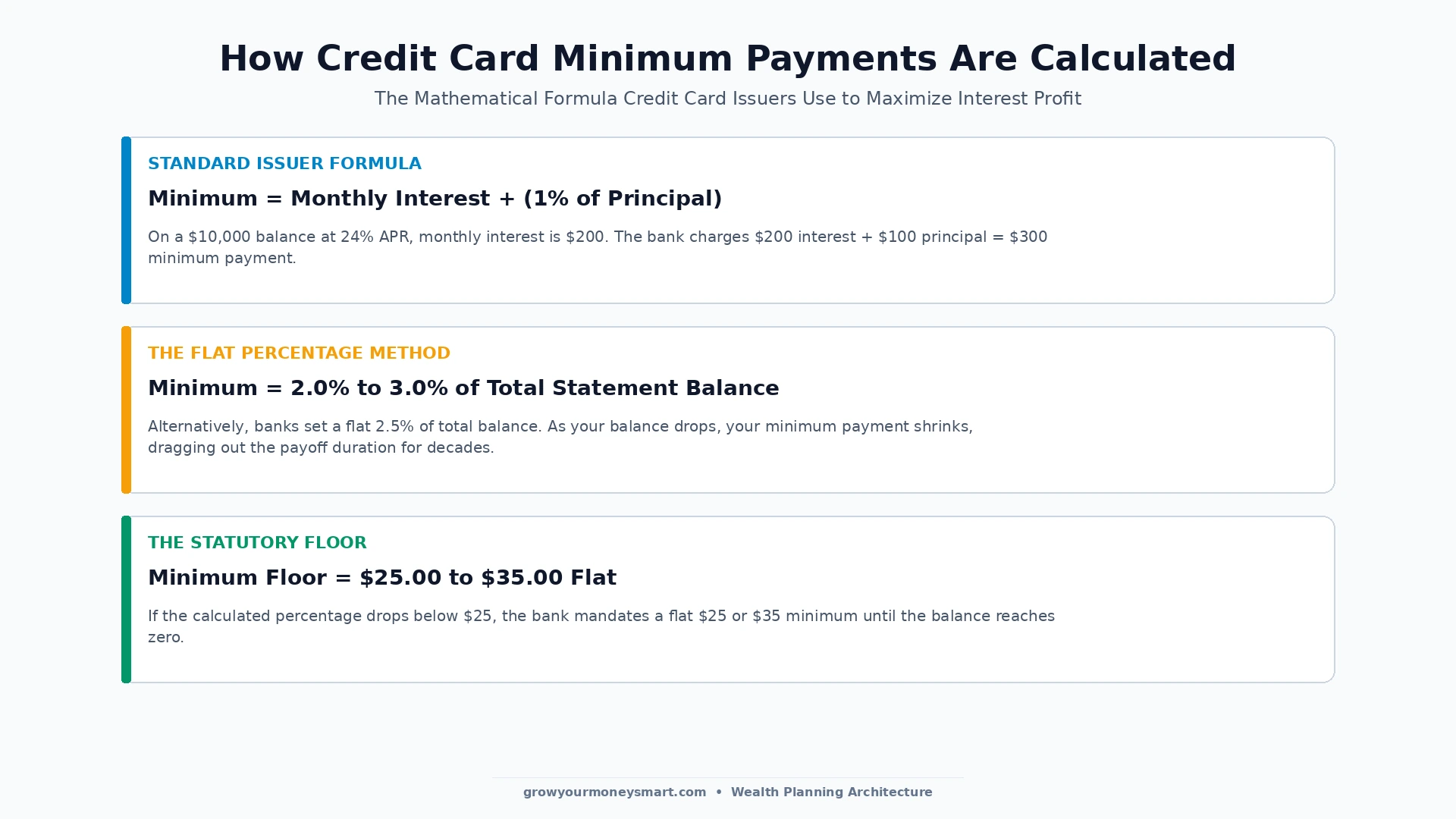
Under the standard formula (Interest + 1% of Principal), on a $10,000 balance at 24% APR, your monthly interest charge is approximately $200. The bank adds 1% of principal ($100), resulting in a $300 minimum payment. Out of your $300 check, two-thirds disappears into the bank’s profit margins, leaving only $100 to reduce your balance.
The $10,000 Credit Card Showdown: Minimums vs. Fixed Payments
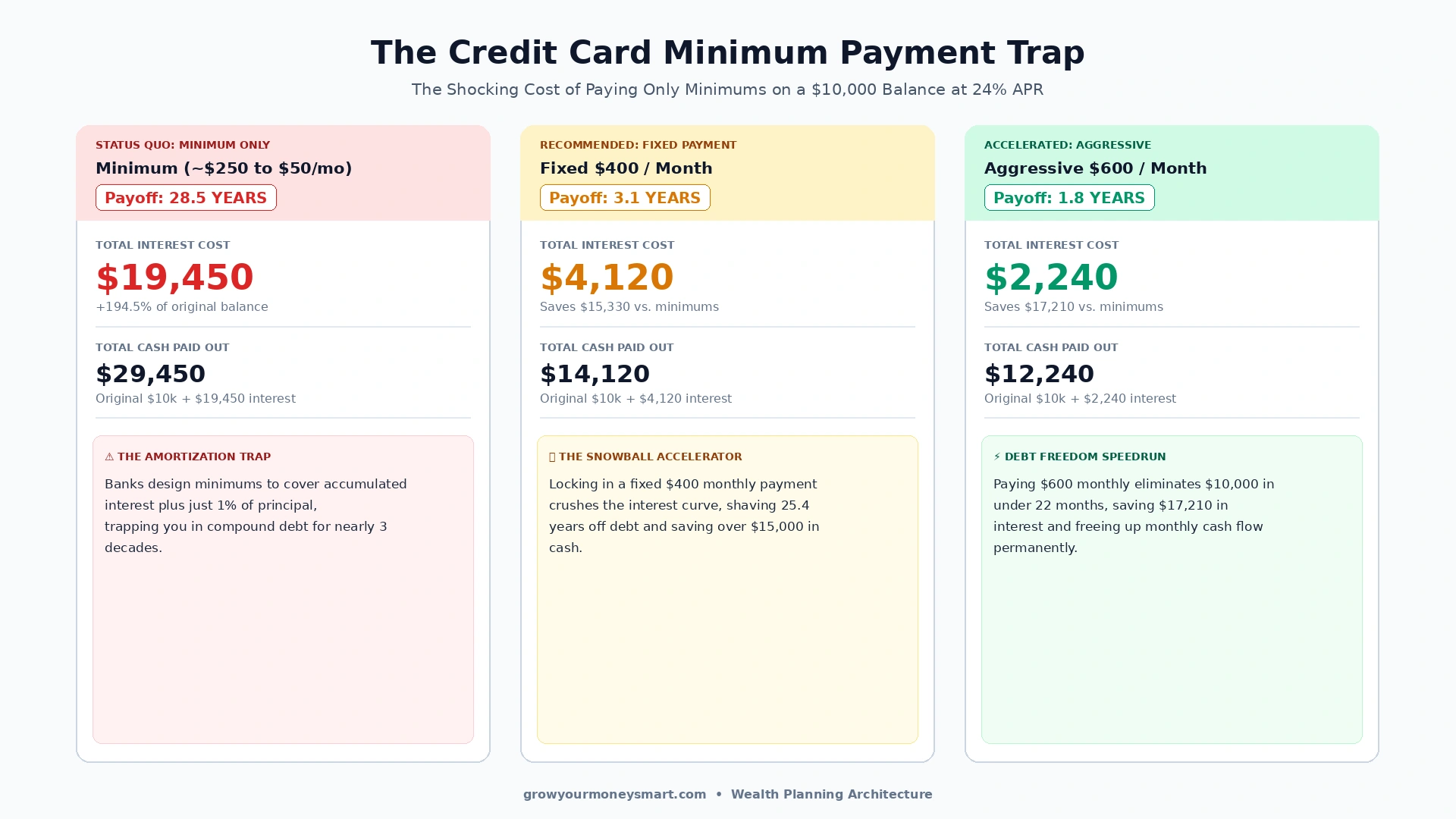
Let’s examine the mathematical reality of a $10,000 balance at 24% APR across three repayment strategies:
Notice the power of fixing your payment: by simply committing to a fixed $400 per month instead of letting the minimum payment decline, you shave over 25 years off your debt and save an astounding $15,330 in cash. That is over $15,000 you keep in your own pocket instead of gifting to credit card executives.
4 Actionable Steps to Escape the Minimum Payment Trap Today
- 1. Fix Your Payment: Never allow your monthly contribution to shrink as your balance drops. If your initial minimum was $300, keep paying $300 (or more) every month until the balance hits zero.
- 2. Transfer to a 0% APR Balance Transfer Card: Move high-interest balances to a card offering 0% APR for 15 to 21 months. Every dollar paid goes 100% to principal. (See our top picks in the Best 0% APR Balance Transfer Cards Guide).
- 3. Negotiate Your Interest Rate: Call your card’s customer service number and cite your on-time payment history to request an APR reduction. (Follow our script in Can You Negotiate Credit Card Interest Rates?).
- 4. Use the Debt Avalanche Method: Direct all extra debt payoff cash to the card carrying the highest APR (e.g., 26% store card) while paying minimums on the rest, mathematically minimizing interest expense. (See our comparison on Debt Avalanche vs. Snowball).
Expert Video Breakdown: The Credit Card Minimum Payment Trap Explained
To understand the exact mathematical compounding formula credit card companies use to keep borrowers in decades of high-interest debt, watch Humphrey Yang’s breakdown:
Frequently Asked Questions (FAQs)
Most credit card issuers calculate minimum payments as the monthly interest charges plus 1% of the principal balance, or a flat 2.0% to 2.5% of the total statement balance (whichever is greater), subject to a minimum floor of $25 to $35.
Because minimum payments cover mostly interest and barely touch the underlying principal balance. On a $10,000 balance at 24% APR, paying only the minimum takes over 28 years and costs nearly $20,000 in interest alone.
Paying the minimum on time protects your payment history, but it keeps your Credit Utilization Ratio dangerously high (above 30% to 50%), which severely lowers your overall credit score.
Under the Credit CARD Act of 2009, any payment amount made above the minimum must legally be applied directly to the balance carrying the highest interest rate, dramatically reducing your total interest fees and payoff time.
Yes. Calling your credit card issuer and asking for a promotional interest rate reduction or requesting a hardship program can lower your APR from 25% down to 0% to 9%.
Switch from a declining minimum payment to a fixed monthly payment (e.g., $400/month), transfer balances to a 0% APR balance transfer credit card, or consolidate using the Debt Avalanche method.
Federal law requires all credit card issuers to print a ‘Minimum Payment Warning’ box on page 1 or 2 of your monthly billing statement, showing exactly how long payoff takes and total interest cost if paying only minimums.
A 0% APR balance transfer pauses interest accrual for 15 to 21 months, allowing 100% of your monthly payments to attack the principal balance.

Jaiveer Hooda is a personal finance researcher and the founder of Grow Your Money Smart. With a background in computer engineering, he approaches money the way an engineer approaches any complex system — through data analysis, mathematical modeling, and ruthless optimization.
He built this platform on a single conviction: financial freedom is not a matter of luck. It is a system that can be designed, tested, and executed by anyone willing to follow the right blueprint. Every strategy published here is researched to the numbers, not written to the trend.
Expertise: Debt elimination · Retirement planning · Passive income · Budgeting systems
Connect: Pinterest | growyourmoneysmart.com | Contact Us