
Understanding consumer rights under the Fair Debt Collection Practices Act (FDCPA) prevents predatory collection tactics while executing an aggressive debt payoff. Consult the official Consumer Financial Protection Bureau (CFPB) Debt Relief Guidance for statutory guidelines and consumer protections.
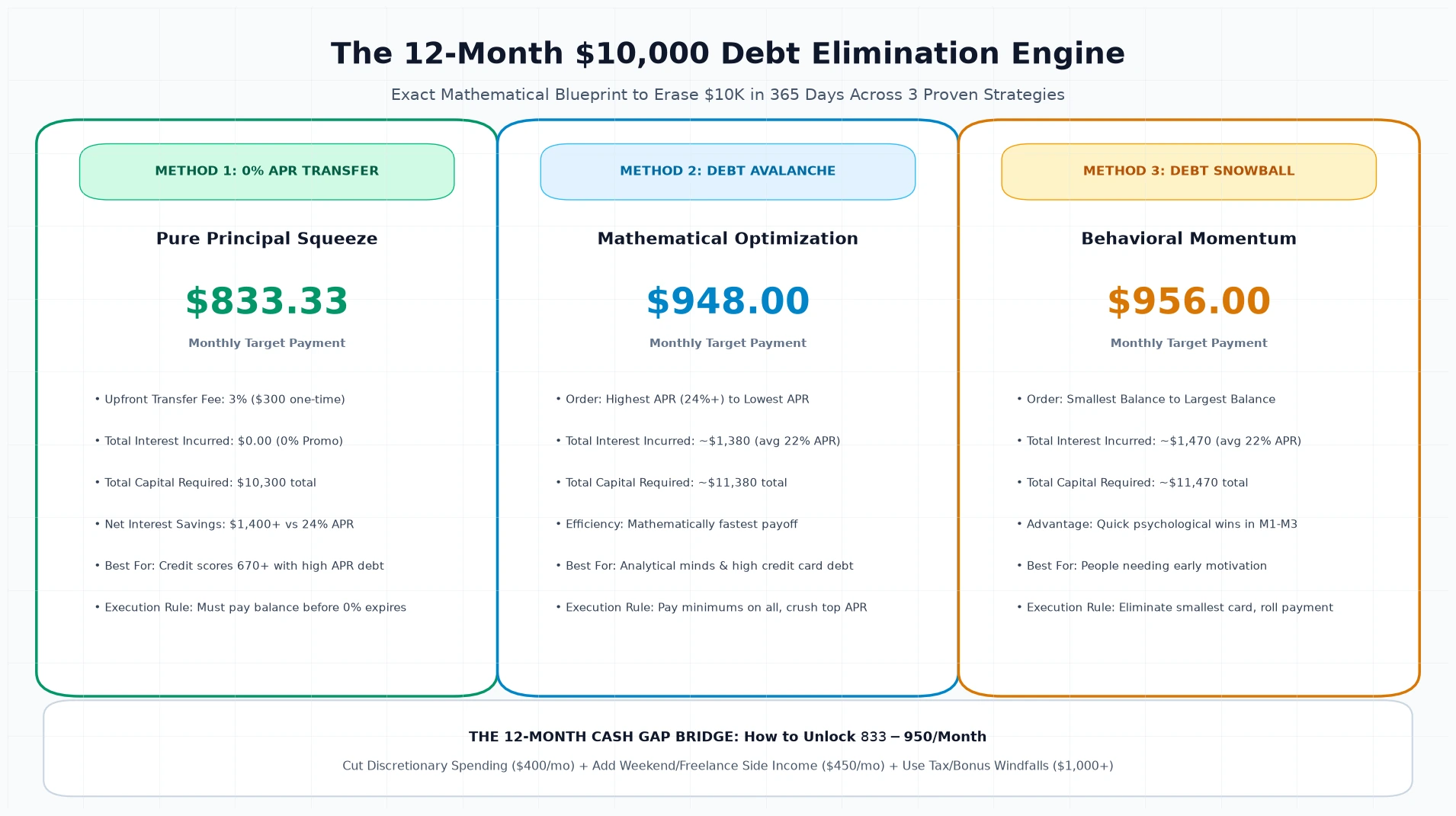
- The Baseline Math: Eliminating $10,000 in 12 months requires $833.33 per month at 0% APR, or $948.33 per month on average credit cards (24.99% APR).
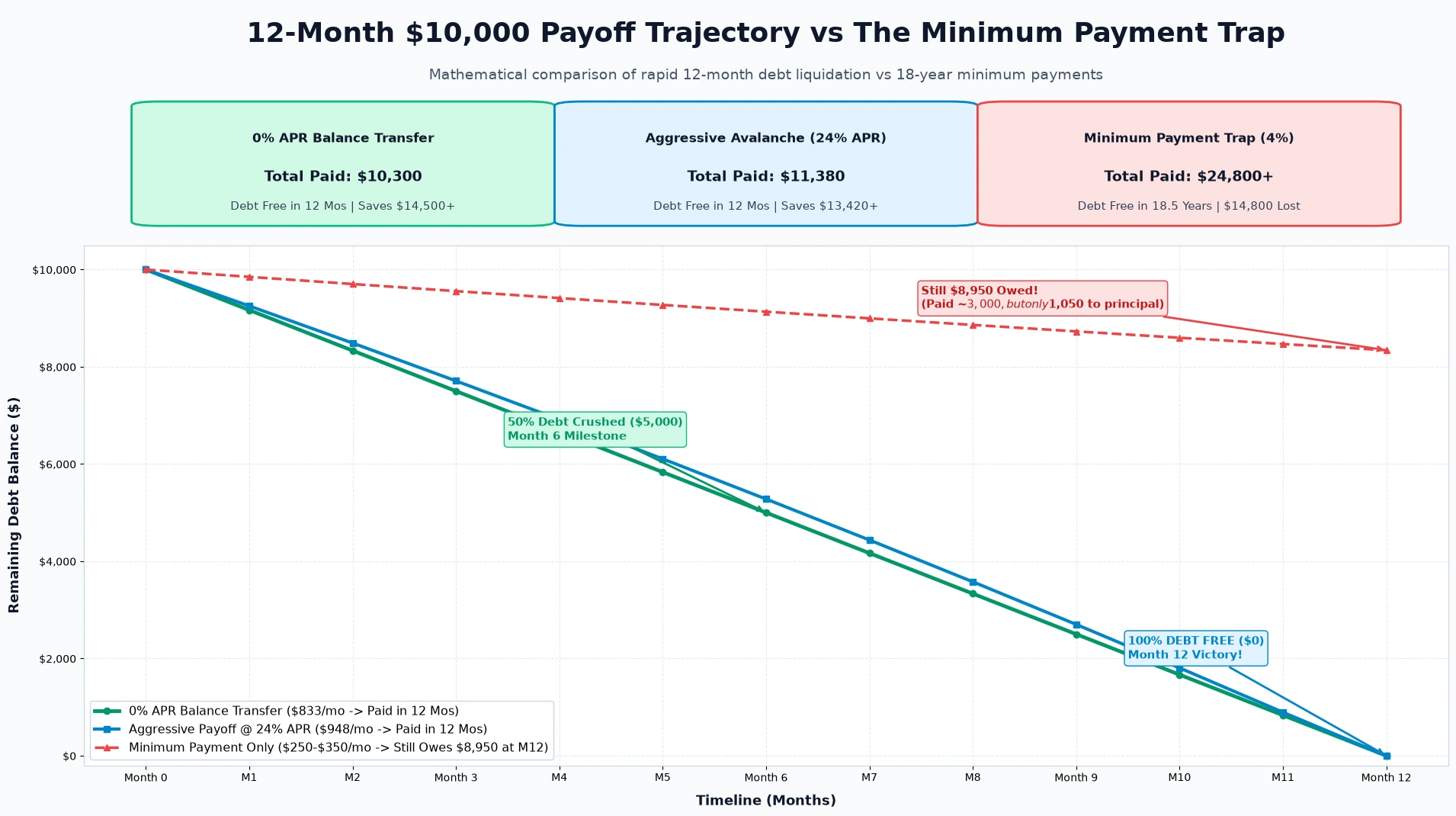
- The $14,000+ Penalty Avoided: Paying minimums on $10,000 at 24.99% APR traps you for 18.5 years and costs $14,800+ in pure interest. Finishing in 1 year saves over 90% of those fees.
- The Golden Strategy: Transfer balance to a 0% intro APR balance transfer card (18–21 months) to freeze all interest charges, locking your payment to exactly $833.33/month + a 3% transfer fee ($300).
- The Gap-Funding Formula: Split the monthly target by slashing $400/month in discretionary spending and generating $450/month in targeted side hustle or overtime income.
- Emergency Fund Rule: Keep a $1,000 starter buffer in a high-yield savings account before throwing all extra cash at debt to avoid relapsing into credit cards.
Carrying $10,000 in consumer debt can feel like an insurmountable financial weight. When minimum monthly payments barely cover monthly finance charges, your balances stagnate while lenders quietly extract thousands of dollars in compounding interest fees. However, eliminating a full $10,000 balance within a strict 365-day calendar year is entirely achievable when you replace emotional stress with mathematical precision.
Whether your debt is spread across high-rate credit cards, personal unsecured loans, or medical bills, this comprehensive guide delivers the exact month-by-month financial mechanics, repayment schedules, interest mitigation maneuvers, and income generation blueprints required to reach 100% debt freedom in exactly 12 months.
The Core Mathematical Breakdown: What Does It Take to Pay Off $10,000 in 12 Months?
At its purest mathematical level, the principal requirement to pay off a $10,000 debt in 12 months is straightforward:
However, real-world consumer debt rarely carries a 0% interest rate. In today’s economic environment, average credit card interest rates hover near 24.5% to 28.0% APR. Because credit card interest compounds on a daily balance basis, your actual monthly capital outlay depends directly on the annual percentage rate (APR) tied to your balances.
The table below breaks down the true monthly payment and total interest cost required to wipe out a $10,000 balance across different interest rates in exactly 12 months:
| Interest Rate (APR) | Debt Category / Vehicle | Required Monthly Payment | Total Interest Paid (12 Mo) | Total Capital Required |
|---|---|---|---|---|
| 0.00% APR | 0% Intro Balance Transfer Card | $833.33 / mo | $0.00 (+$300 fee) | $10,300.00 |
| 10.00% APR | Low-Rate Debt Consolidation Loan | $879.16 / mo | $549.92 | $10,549.92 |
| 16.50% APR | Fair-Credit Unsecured Personal Loan | $909.84 / mo | $918.08 | $10,918.08 |
| 24.99% APR | Average Commercial Credit Card | $948.33 / mo | $1,380.00 | $11,380.00 |
| 29.99% APR | Retail Store Card / Penalty APR | $971.86 / mo | $1,662.32 | $11,662.32 |
You can run your exact custom balance, APR, and payment scenarios using our interactive free debt payoff calculator to see your exact amortization schedule.
12-Month Payoff vs. The Minimum Payment Trap: The $14,000 Reality Check
Why is committing to a 12-month payoff schedule so critical? When you carry a $10,000 credit card balance and make only the issuer’s required “minimum payment” (typically calculated as 1% of the principal balance plus accrued monthly interest, or roughly 3.5% total), credit card companies maximize their profit at your expense.
Let us examine what happens to $10,000 at a standard 24.99% APR under both approaches:
| Metric & Outcome | 12-Month Aggressive Payoff Plan | Standard Minimum Payment (3.5%) | Your Net Savings / Advantage |
|---|---|---|---|
| Time to Reach $0 Balance | 1.0 Year (12 Months) | 18.5 Years (222 Months) | 17.5 Years Saved |
| Starting Monthly Payment | $948.33 / month | $350.00 / month (declining) | +$598.33 initial discipline |
| Total Interest Paid | $1,380.00 | $14,834.12 | $13,454.12 in Cash Saved |
| Total Out-of-Pocket Cost | $11,380.00 | $24,834.12 | 54.2% Lower Lifetime Cost |
| Impact on Credit Score | Utilization drops to 0% in 12 mos | Keeps credit utilization high for years | +50 to +100 Point FICO Surge |
By executing an aggressive 1-year payoff plan, you pocket over $13,450 in avoided interest payments—money that can immediately be redirected toward building a 3-to-6 month safety net using our emergency fund calculator or long-term compound investing.
Comparing the 4 Proven Strategies to Eliminate $10K in 12 Months
Not all debt payoff methods are created equal. Depending on your credit score, cash flow consistency, and psychological temperament, choose one of the four battle-tested repayment strategies below:
| Repayment Strategy | Monthly Cost | Total 12-Mo Cost | Primary Advantage | Main Risk / Downside | Best Suited For |
|---|---|---|---|---|---|
| 0% APR Balance Transfer | $833.33 / mo | $10,300 (incl. 3% fee) | Zero interest; 100% of payment crushes principal | Requires 670+ credit score; high APR if unpaid | Good-to-excellent credit with high card APRs |
| Debt Avalanche Method | $948.33 / mo | ~$11,380 | Mathematically optimal; minimizes total interest fees | Can take longer to see first account closed | Analytical thinkers with multiple high-rate debts |
| Debt Snowball Method | $956.00 / mo | ~$11,470 | Rapid early psychological wins build strong habits | Costs ~$90 more in interest over 12 months | People needing quick motivation & behavioral wins |
| Consolidation Personal Loan | $879.16 / mo | ~$10,550 (at 10% APR) | Single fixed monthly payment and fixed interest rate | Origination fees (1%-6%); strict underwriting | Borrowers with steady income wanting fixed terms |
To dive deeper into the mathematical nuances between highest-interest and lowest-balance prioritizations, review our full breakdown on the debt avalanche vs debt snowball strategy.
The Exact 12-Month Month-by-Month Amortization Schedule
To visualize how your balance decreases over the 365-day journey, review the month-by-month amortization schedule below for a $10,000 balance at 24.99% APR with a fixed target payment of $948.33 per month:
| Month | Starting Balance | Monthly Payment | Interest Accrued (24.99% APR) | Principal Paid | Ending Balance |
|---|---|---|---|---|---|
| Month 1 | $10,000.00 | $948.33 | $208.25 | $740.08 | $9,259.92 |
| Month 2 | $9,259.92 | $948.33 | $192.84 | $755.49 | $8,504.43 |
| Month 3 | $8,504.43 | $948.33 | $177.10 | $771.23 | $7,733.20 |
| Month 4 | $7,733.20 | $948.33 | $161.04 | $787.29 | $6,945.91 |
| Month 5 | $6,945.91 | $948.33 | $144.65 | $803.68 | $6,142.23 |
| Month 6 | $6,142.23 | $948.33 | $127.91 | $820.42 | $5,321.81 (Halfway!) |
| Month 7 | $5,321.81 | $948.33 | $110.82 | $837.51 | $4,484.30 |
| Month 8 | $4,484.30 | $948.33 | $93.38 | $854.95 | $3,629.35 |
| Month 9 | $3,629.35 | $948.33 | $75.58 | $872.75 | $2,756.60 |
| Month 10 | $2,756.60 | $948.33 | $57.41 | $890.92 | $1,865.68 |
| Month 11 | $1,865.68 | $948.33 | $38.85 | $909.48 | $956.20 |
| Month 12 | $956.20 | $976.10 | $19.90 | $956.20 | $0.00 (100% DEBT FREE) |
Notice the compounding shift in efficiency: in Month 1, over $208 went toward interest charges alone. By Month 10, monthly interest dropped below $58, allowing nearly 94% of your monthly payment to strike directly at the remaining principal balance.
5-Step Actionable Blueprint to Execute Your 1-Year $10K Payoff
Knowing the math is only half the battle; disciplined execution is what eliminates the debt. Follow this structured 5-step operational playbook:
Step 1: Conduct a Comprehensive Debt & APR Inventory
Gather your most recent statements for every credit card and unsecured loan. Build an exact inventory listing: 1) Account Name, 2) Current Balance, 3) Minimum Monthly Payment, 4) Current APR, and 5) Monthly Statement Closing Date. Knowing your exact weighted average APR allows you to determine whether a balance transfer or avalanche order yields maximum cash savings.
Step 2: Neutralize Interest via 0% Balance Transfer or Rate Negotiation
Every dollar that does not go to interest goes straight to principal. If your credit score is 670 or higher, apply for one of the top-rated 0% APR balance transfer credit cards offering 15 to 21 months of 0% promotional APR. Even with a standard 3% to 5% transfer fee ($300–$500), you immediately halt $1,400+ in interest accumulation.
If your credit profile does not qualify for a new card, call your existing card issuers directly. Use our verified scripts for negotiating lower credit card interest rates or ask to enroll in their internal hardship program to slash your APR down to 0%–9.99% for 12 months.
Step 3: Slash $400/Month from Baseline Discretionary Spending
To free up the required $833–$948 per month without extreme deprivation, implement a temporary bare-bones budget. Review our framework for budgeting a $4,000 monthly salary or calculate your limits on our monthly budget calculator. Practical expense reductions include:
- Grocery & Meal Prep Optimization: Shift from dining out and delivery apps to bulk meal prepping (saves $200–$250/mo).
- Subscription & Recurring Service Audit: Cancel unused streaming platforms, premium app tiers, and gym memberships (saves $50–$80/mo).
- Insurance & Utility Reshopping: Re-quote auto insurance and negotiate internet/phone plans (saves $70–$100/mo).
Step 4: Bridge the Remaining $450/Month Gap with Targeted Income Injections
Cutting expenses only gets you halfway to the $833–$948 monthly target. The fastest way to guarantee victory is to increase your income by $450 per month ($112.50 per week):
- Freelance & Skill Monetization: Offer copywriting, bookkeeping, graphic design, or tutoring for 4–5 hours weekly.
- Flexible Gig Economy Shifts: Work 6–8 hours of weekend rideshare, grocery delivery, or pet sitting.
- Sell Unused Household Items: Liquidate old electronics, musical instruments, tools, and designer clothing on local marketplaces to generate an immediate $500–$1,500 lump-sum payment in Month 1.
- Direct Tax Refunds and Work Bonuses: Funnel 100% of unexpected windfalls, tax refunds, and overtime pay directly onto your highest-interest balance.
Step 5: Automate Bi-Weekly Split Payments
Instead of making one large monthly payment of $948, set up automated bi-weekly payments of $474 every two weeks synchronized with your paychecks. Because there are 52 weeks in a year, you will make 26 half-payments—the mathematical equivalent of 13 full monthly payments instead of 12. This extra payment accelerates your debt payoff timeline by nearly a full month without straining your weekly cash flow.
Essential Safety Guardrails: Protecting Your Financial Foundation
While aggression is key, avoiding critical financial missteps ensures you do not derail your progress:
- Never Drain Your Starter Emergency Fund to Zero: Before dedicating every spare penny to debt, save a $1,000 to $1,500 liquid safety buffer. Follow our guide on saving your first $1,000 on a low income so a blown tire or emergency dental visit does not force you to swipe high-interest cards again.
- Remove Stored Credit Cards from Online Retailers: Delete saved payment methods from Amazon, food delivery apps, and digital wallets to add friction to impulse purchases.
- Handle Unmanageable Debt Loads Responsibly: If your total debt exceeds 50% of your gross annual income and you cannot realistically afford the monthly payments, explore structured relief options via our guide on debt settlement vs bankruptcy options or learn about paying off debt while living paycheck to paycheck. If you have larger balances, check our blueprint for paying off $20k in credit card debt fast.
Expert Video Walkthrough: Fast Way to Pay Off $10K in Debt
To reinforce these budgeting principles and hear practical real-world strategies for accelerating your debt payoff on a modest income, watch this in-depth guide by financial educator Nick Invests on “Fast Way to Pay Off $10K in Debt on a Small Salary — Step by Step”:
Frequently Asked Questions (FAQs)
Below are clear, mathematically grounded answers to the most common questions individuals ask when working toward eliminating $10,000 in debt within one year:
If you have a 0% APR balance transfer card, your required payment is exactly $833.33 per month ($10,000 ÷ 12). If your debt carries an average credit card interest rate of 24.99% APR, your required payment is approximately $948.33 per month to cover both principal and accrued interest across the 12 billing cycles.
Mathematically, the Debt Avalanche method saves the most money by targeting high-APR debts first (saving $90 to $200+ in interest over 12 months). However, the Debt Snowball method provides quick psychological momentum by eliminating small balances first, which helps many people maintain the behavioral discipline needed to finish the full 365-day plan.
Yes. On a $40,000–$50,000 gross annual salary ($2,700–$3,400 monthly take-home pay), dedicating $833–$950/month requires a tight baseline budget (allocating 25%–30% of take-home income toward debt) combined with $300–$500/month from a secondary side hustle, overtime hours, or selling unused household assets.
Yes, provided your credit score is 670 or higher and you qualify for an 18-to-21 month promotional 0% intro APR card. A 3% balance transfer fee on $10,000 costs $300 upfront, but prevents roughly $1,400 in interest charges, delivering over $1,100 in net cash savings and locking your monthly payment to $833.33.
No. Never deplete your emergency savings to zero. Maintain a starter emergency fund of $1,000 to $1,500 in an FDIC-insured high-yield savings account so an unexpected emergency expense does not force you to swipe high-interest credit cards and restart the debt cycle.
Making only minimum payments (roughly 3.5% of the balance) on a $10,000 balance at 24.99% APR takes approximately 18.5 years to repay and generates over $14,800 in interest charges ($24,800+ total paid). Paying it off in 1 year saves you more than $13,400 in hard cash.
Execute a 3-part acceleration strategy: 1) Call your credit card issuers to request lower interest rates or enroll in a hardship program, 2) Earn $400–$500/month through high-demand gig work or freelancing, and 3) Sell unused high-value assets (electronics, jewelry, tools) for an immediate $1,000–$2,000 principal lump sum.
Yes, dramatically. Paying off $10,000 in credit card debt eliminates your credit utilization ratio (which accounts for 30% of your overall FICO score), often resulting in a score boost of 40 to 100+ points within 60 to 90 days as card issuers report zero balances to the credit bureaus.

Jaiveer Hooda is the Lead Financial Researcher & Personal Finance Analyst at Grow Your Money Smart. Specializing in personal wealth optimization, index fund compounding, high-yield savings mechanics, and consumer debt elimination strategies. With a background in computer engineering, he applies mathematical modeling, cashflow simulations, and empirical risk analysis to evaluate personal finance vehicles and credit products. Every analysis is backed by verified regulatory disclosures, IRS tax schedules, and empirical APY compounding math.
Areas of Expertise: Personal Finance · High-Yield Savings Accounts (HYSA) · Index Funds & S&P 500 Compounding · Retirement Planning (401k/IRA) · Debt Optimization · Credit Card APR Mechanics.
Transparency & Editorial Policy: Editorial Standards | Report a Correction