
Coast FIRE is a variation of Financial Independence where you front-load your investments in your 20s or 30s until your current nest egg is mathematically guaranteed to compound into your full retirement goal by traditional retirement age (age 60–65)—without ever contributing another penny. Once you reach your Coast FIRE number, you can downshift your career, eliminate aggressive saving, and work only enough to pay for your immediate day-to-day living expenses.
For most working professionals, traditional retirement planning feels like an endless 40-year treadmill. The conventional corporate script instructs you to work 50 hours a week, maximize your 401(k), cut coupons, and delay true happiness until your hair is gray and your energy is depleted at age 65. Even within the broader financial independence community, pursuing a 60% savings rate for decades can cause severe career burnout and lifestyle deprivation.
Enter Coast FIRE—the ultimate psychological and financial breakthrough for modern wealth builders. Rather than grinding for decades to accumulate 25 times your annual living expenses all at once, Coast FIRE leverages the unstoppable mathematical force of exponential compound interest over a 20-to-35-year time horizon. By aggressively front-loading your investment portfolio during the first decade of your career, you reach an inflection point where investment compounding does 100% of the remaining heavy lifting.
Below is the definitive 2026 architectural guide to understanding Coast FIRE, calculating your exact milestone number by age, mastering the present value mathematical formula, choosing optimal asset allocations, and executing a seamless career downshift.
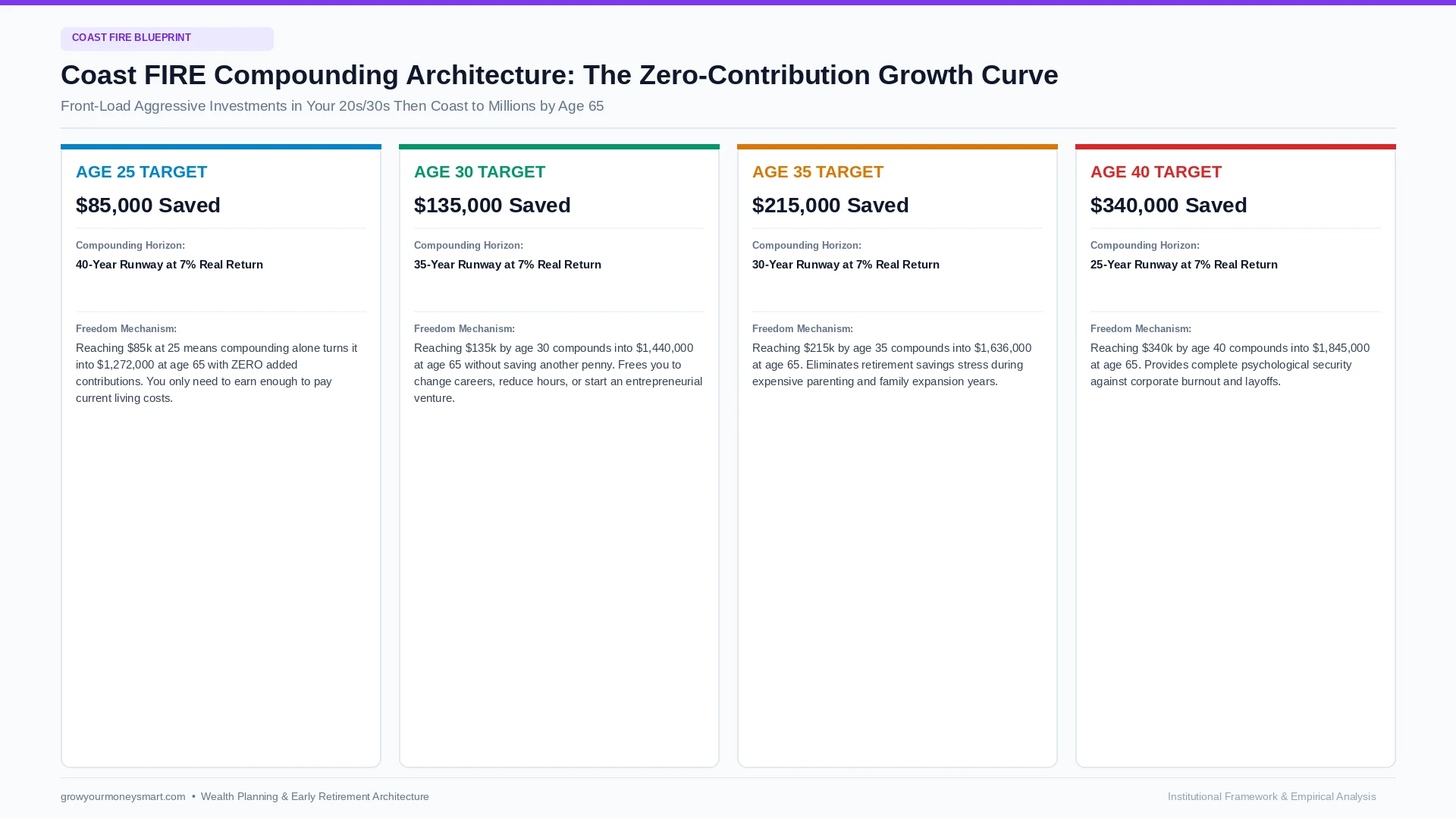
The Mathematical Blueprint: The Coast FIRE Present Value Equation
Calculating your Coast FIRE milestone is not guesswork; it is grounded in the time value of money present value formula. To determine how much capital you need in your investment accounts today to reach your target retirement nest egg in the future without adding another dollar, use the standard discounting formula:
Where:
• Target Nest Egg: Future portfolio required at traditional retirement (Annual Expenses × 25).
• r: Real, inflation-adjusted annual rate of return (historically 6% to 7% for equities).
• n: Number of years between your current age and your planned traditional retirement age.
Consider a practical example: Suppose your target annual spending at age 65 is $60,000 in today’s purchasing power. Applying the 4% rule safe withdrawal rate, your required Target Nest Egg at age 65 is $1,500,000 ($60,000 × 25). If you are currently 30 years old, your compounding runway (n) is 35 years (65 – 30). Assuming a historical 7% real compound return, your calculation becomes:
$1,500,000 / (1 + 0.07)^35 = $1,500,000 / 10.6766 = $140,494
This means if a 30-year-old accumulates approximately $140,500 in low-cost index funds today, they have mathematically solved their retirement forever. They can permanently reduce their ongoing retirement contributions to exactly $0 for the next 35 years and still arrive at age 65 with a $1.5 million portfolio.
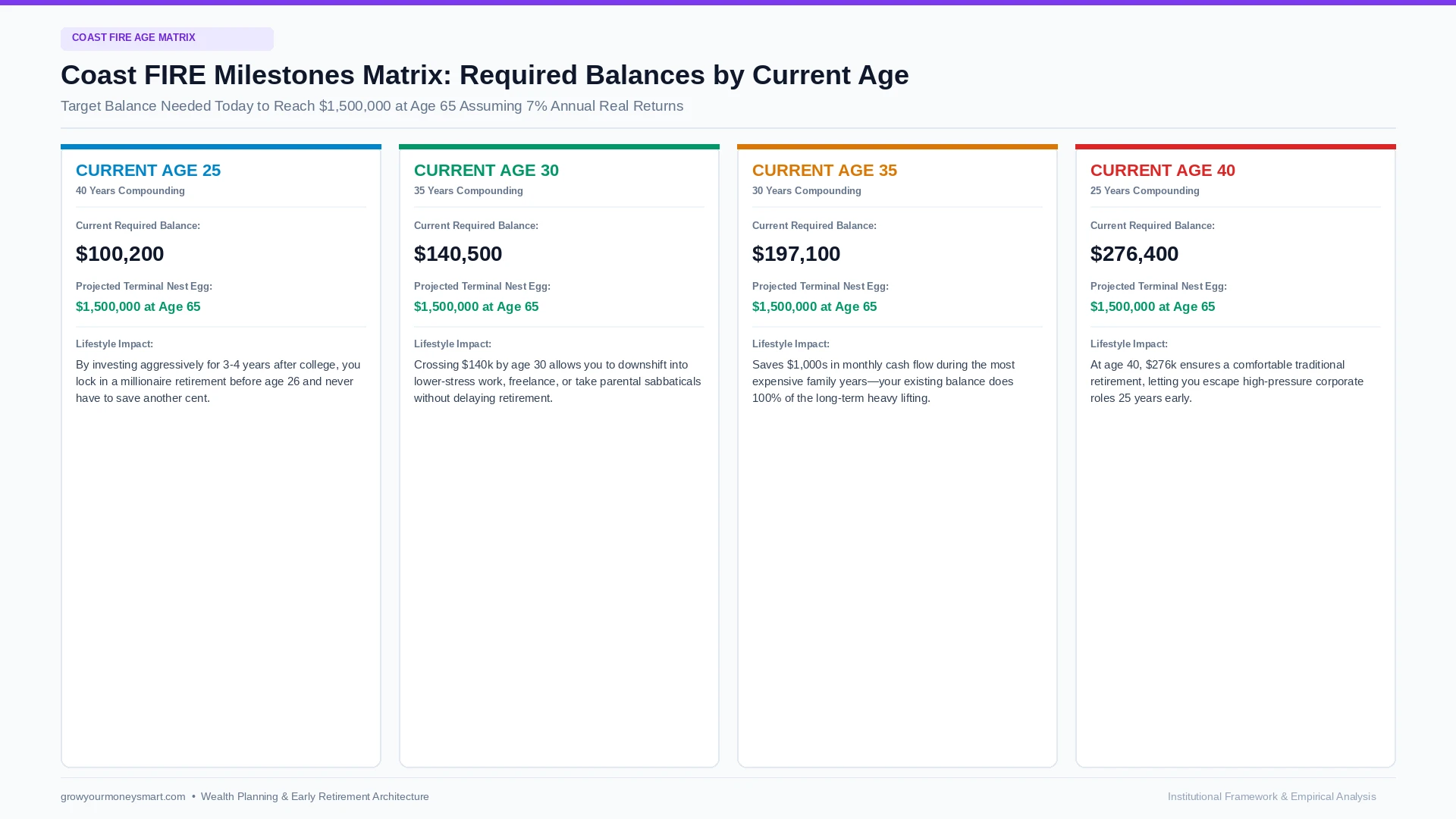
Coast FIRE Milestones Matrix: Target Savings by Age (22 to 45)
To demonstrate the incredible leverage of starting early, examine the table below. It models the required Coast FIRE balance needed at various current ages to reach a $1,500,000 nest egg at age 65, assuming a conservative 7% real compound annual return:
| Current Age | Compounding Runway (n) | Required Coast FIRE Balance (7% Real) | Future Value at Age 65 ($0 Added) | Annual Safe Income at Age 65 (4%) |
|---|---|---|---|---|
| Age 22 | 43 Years | $82,300 | $1,500,000 | $60,000 / year |
| Age 25 | 40 Years | $100,200 | $1,500,000 | $60,000 / year |
| Age 30 | 35 Years | $140,500 | $1,500,000 | $60,000 / year |
| Age 35 | 30 Years | $197,100 | $1,500,000 | $60,000 / year |
| Age 40 | 25 Years | $276,400 | $1,500,000 | $60,000 / year |
| Age 45 | 20 Years | $387,600 | $1,500,000 | $60,000 / year |
Real Inflation-Adjusted Returns vs Nominal Returns: Preserving Purchasing Power
One of the most common mistakes novice investors make when calculating Coast FIRE numbers is confusing nominal returns with real returns. Over the past century, the S&P 500 has produced an annualized nominal return of approximately 10.2%. However, inflation over that same century averaged roughly 3.1% annually.
If you calculate your future retirement portfolio using a 10% nominal return, you will arrive at a large future dollar figure that buys significantly less food, housing, and healthcare in 2060. By subtracting expected inflation and utilizing a 6.5% to 7.0% real return, every dollar modeled in your Coast FIRE roadmap reflects today’s real purchasing power. This guarantees that your calculated lifestyle quality remains intact decades into the future.
Coast FIRE vs Barista FIRE vs Flamingo FIRE: The Essential Distinctions
Many wealth seekers confuse the variations of semi-retirement within the different types of FIRE. Here is how Coast FIRE compares against its closest sibling frameworks:
- Coast FIRE: You do not withdraw a single dollar from your investment accounts today. The portfolio is left 100% untouched to compound until traditional retirement age. Your job must cover 100% of your day-to-day living costs today, but 0% for future retirement savings.
- Barista FIRE: You do actively withdraw from your portfolio today to supplement part-time income. Your portfolio covers 40% to 60% of living expenses right now, while part-time work covers the rest.
- Flamingo FIRE: You save 50% of your full FIRE number (e.g., $750,000 toward a $1.5M target), and then work part-time to cover 100% of your expenses for 7 to 10 years until the portfolio doubles to your full number, at which point you enter complete retirement early.
Asset Allocation During the Coast Phase: Why 100% Equities Wins
One of the most dangerous errors Coast FIRE adherents make is blindly adopting traditional Target Date Funds that allocate 30% to 40% of the portfolio into low-yielding bonds. During your Coasting phase, your portfolio possesses a 20- to 35-year time horizon with ZERO decumulation demands.
Because you are not taking withdrawals, you face zero sequence of returns risk during this phase. If the stock market crashes by 40%, you do not need to liquidate shares to pay rent. You have decades for equities to recover. Holding excessive fixed-income assets severely suppresses compound growth, extending your Coasting duration by 5 to 10 years.
Optimal Coast portfolios remain heavily tilted toward broad-market equities:
- 80% to 100% in low-cost total stock market index funds (e.g., Vanguard Total Stock Market VTSAX/VTI or S&P 500 VOO).
- 0% to 20% in international equities (VTIAX/VXUS).
- Cash buffer: Maintained separately outside the Coast portfolio in an emergency fund. Check our guide on the best high-yield savings accounts.
5 Popular Downshifting Career Models for Coasting
Once your Coast FIRE number is safely locked in, what does life look like? You can transition from high-stress corporate roles into fulfilling lifestyle careers:
- The Passion Consultant / Freelancer: Trade 50-hour corporate weeks for 15-to-20 billable hours per week consulting directly with select clients on your own terms.
- The Seasonal Adventurer: Work intensive project contracts or seasonal roles for 6 to 8 months of the year, taking 4 consecutive months off for international travel or creative pursuits.
- The Non-Profit / Education Shift: Transition into lower-paying but deeply meaningful roles in education, community development, animal rescue, or non-profit foundations without worrying about the lower salary.
- The Entrepreneurial Passion Business: Launch a specialty bakery, woodworking studio, coaching practice, or e-commerce brand without the existential panic of needing the business to replace a $150,000 salary immediately.
- The Part-Time Corporate Role: Negotiate a 3-day workweek or job share with your existing employer, preserving healthcare benefits while unlocking 4-day weekends indefinitely.
Employer 401(k) Match: The One Exception to the Zero-Savings Rule
Even though Coast FIRE mathematically proves you never need to save another dollar, you should never turn down a dollar-for-dollar employer 401(k) match. If your employer provides a 100% match on the first 4% of your salary, contributing that 4% represents an immediate 100% risk-free return on capital. Capturing that match simply acts as an extra safety multiplier that allows you to retire even earlier or enjoy a wealthier retirement.
To evaluate how Coast FIRE fits into broader milestones, compare your balances against our retirement savings benchmarks by age 30, 40, 50, and 60, and explore our master guide on Lean FIRE vs Fat FIRE vs Barista FIRE.
The Coast FIRE Sequencing Trap: What Happens If Markets Crash Right After Coasting?
One of the most profound psychological fears for aspiring Coast FIRE adherents is the ‘Sequencing Trap.’ What happens if you celebrate reaching your Coast FIRE milestone of 40,500 at age 30, resign from your lucrative 60-hour-per-week corporate job, transition into a 25-hour passion gig that covers only your immediate rent and groceries, and then the S&P 500 plunges 35% into an extended two-year bear market?
In traditional early retirement (where you actively withdraw 4% each year), an early bear market can permanently destroy your portfolio through severe sequence of returns risk. However, under Coast FIRE, a bear market does NOT destroy your capital. Why? Because you are taking exactly bash in net withdrawals. You are not forced to liquidate a single share of stock at depressed valuations.
Historical stock market data confirms that equity drawdowns are temporary phenomena. Between 1928 and 2026, every single bear market in US history was eventually superseded by a powerful bull market expansion. Because a 30-year-old Coast FIRE adherent possesses a 35-year compounding runway, short-term market crashes simply function as paper volatility. When equities inevitably recover over the subsequent 3 to 7 years, your untouched shares capture the full upside momentum without permanent principal loss.
Coast FIRE vs Traditional Retirement vs Early FIRE: 3-Way Lifecycle Simulation
To witness how Coast FIRE creates superior work-life balance compared to conventional wealth accumulation models, examine this head-to-head 40-year simulation across three identical professionals:
| Retirement Framework | Weekly Work Hours (Ages 30–65) | Ongoing Monthly Savings Required | Career Burnout Risk | Final Portfolio at Age 65 |
|---|---|---|---|---|
| Traditional Retirement | 40–50 hrs/week for 40 straight years | 00 – ,200 / month continuously | High (Prolonged corporate grind) | ,500,000 |
| Full Early FIRE (At Age 35) | 60+ hrs/week until age 35, then 0 hrs | ,000 – ,000 / month aggressively | Extreme (Brutal early deprivation) | ,500,000 |
| Coast FIRE (At Age 30) | 20–30 hrs/week flexible passion work | bash / month for 35 years | Near Zero (Total lifestyle autonomy) | ,500,000+ |
Coast FIRE uniquely eliminates the extremes of both worlds: It avoids the exhausting 40-year slog of traditional corporate employment while bypassing the brutal, monastic deprivation required to hit full early FIRE by age 35. You front-load your sacrifices in your 20s when you have peak energy and minimal family obligations, unlocking thirty years of lifestyle freedom in your 30s, 40s, and 50s.
Frequently Asked Questions: Coast FIRE
1. What is the difference between Coast FIRE and regular FIRE?
Under regular FIRE, you accumulate 25x your annual expenses and stop working completely. Under Coast FIRE, you accumulate a smaller initial sum early in life that compounds untouched until age 65, while you continue working just enough to cover current living expenses.
2. What real rate of return should I use for Coast FIRE?
Most financial planners recommend using a conservative real (inflation-adjusted) return of 6% to 7% for a portfolio invested predominantly in broad-market index funds like the S&P 500 or total stock market.
3. Does Coast FIRE include Social Security in the calculation?
Most Coast FIRE calculators conservatively exclude Social Security entirely. This provides a massive safety cushion. Any future Social Security checks you receive will simply increase your discretionary retirement spending or accelerate your exit.
4. What happens if the market crashes during my Coasting years?
Because you are not taking withdrawals during the Coasting phase, market crashes do not permanently damage your capital. You have 20 to 30 years for equities to recover. Historically, the U.S. stock market has recovered 100% of all major drawdowns within 5 to 7 years.
5. Can you achieve Coast FIRE in your 40s?
Yes. At age 40, reaching Coast FIRE for a $1.5M retirement at age 65 requires approximately $276,400 invested in broad-market equities. While the required sum is larger than at age 25, 25 years of remaining compounding still provides massive leverage.
6. Do I still need an emergency fund once I reach Coast FIRE?
Yes. An emergency fund of 3 to 6 months of living expenses in a high-yield savings account is essential to protect your Coast portfolio. If unexpected expenses occur, your emergency fund absorbs the shock so you never have to liquidate investments.
7. How does healthcare work when Coasting?
Many Coast FIRE adherents choose part-time roles that qualify for employer-sponsored health insurance (such as 20–30 hours/week at corporate retailers or institutions). Others purchase ACA plans on state exchanges, often qualifying for premium tax credits due to lower wage income.
8. Can I switch from Coast FIRE to full early retirement later?
Absolutely. If your Coast portfolio outperforms expectations or your part-time ventures generate excess income, your net worth may reach 25x your living expenses well before age 65, allowing you to transition into full early retirement whenever you choose.

Jaiveer Hooda is a personal finance researcher and the founder of Grow Your Money Smart. With a background in computer engineering, he approaches money the way an engineer approaches any complex system — through data analysis, mathematical modeling, and ruthless optimization.
He built this platform on a single conviction: financial freedom is not a matter of luck. It is a system that can be designed, tested, and executed by anyone willing to follow the right blueprint. Every strategy published here is researched to the numbers, not written to the trend.
Expertise: Debt elimination · Retirement planning · Passive income · Budgeting systems
Connect: Pinterest | growyourmoneysmart.com | Contact Us