
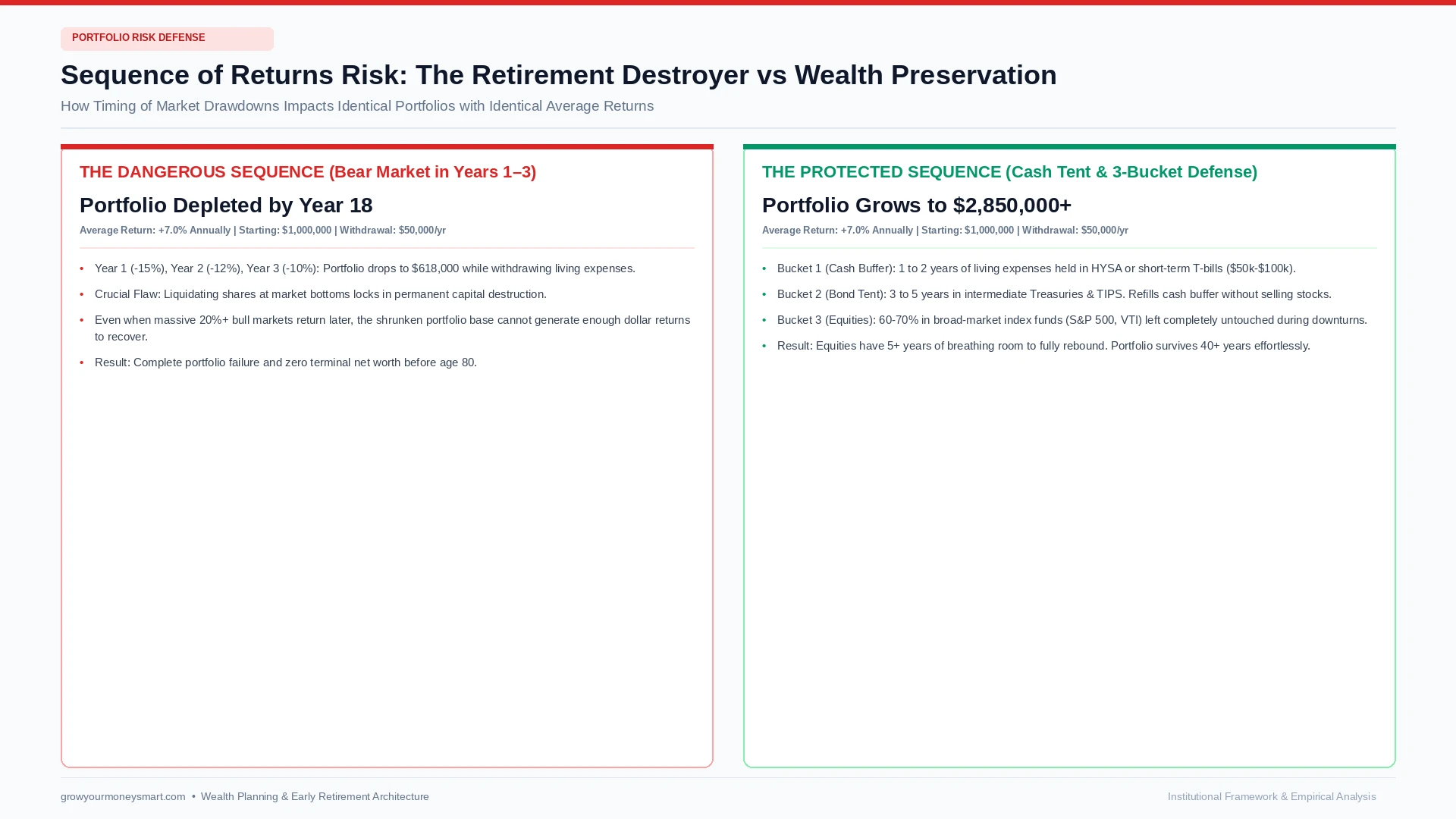
Sequence of Returns Risk is the mathematical danger that severe stock market downturns occur during the first 3 to 5 years of retirement while an investor is withdrawing cash for living expenses. Because liquidating declining assets forces you to sell more shares at depressed prices, capital is permanently impaired—causing portfolios with identical 7% average returns to run out of money decades early. Modern wealth planners neutralize this risk through the 3-bucket cash buffer (1–2 years liquid cash, 3–5 years short bonds), Michael Kitces’ rising equity glidepath (Bond Tent), and Guyton-Klinger dynamic spending guardrails.
When you are in your 20s, 30s, and 40s accumulating wealth, market volatility is your greatest financial tailwind. Sharp market corrections allow your automatic payroll contributions to dollar-cost average into index funds at discounted prices. Every 20% crash functions as an institutional flash sale that boosts your terminal net worth decades later.
However, the moment you transition from wealth accumulation to portfolio decumulation, the mathematical laws of compounding flip upside down. During decumulation, you are no longer injecting new liquidity into the market; you are extracting it to fund groceries, property taxes, utilities, and healthcare. When stock prices drop and you simultaneously withdraw cash, you are forced to liquidate a larger volume of equity shares to satisfy fixed dollar living expenses.
Once those liquidated shares are gone, they can never participate in subsequent market recoveries. This phenomenon—known technically as sequence of returns risk—is why two investors retiring with identical nest eggs, identical withdrawal rates, and identical 30-year average annual returns can experience radically opposite financial destinies: one becomes a multi-millionaire, while the other runs out of money before age 75.
The Mathematical Anatomy: How Identical Averages Produce Opposite Outcomes
Most traditional retirement calculators mislead investors by utilizing static average annual returns (such as 7% or 8% compound annual growth). In reality, markets never move in linear, annualized straight lines. The precise order in which those annual returns occur dictates portfolio survival.
To witness this mathematical reality, consider two retirees: Investor A (Unfavorable Sequence) and Investor B (Favorable Sequence). Both retire on their 65th birthday with an identical starting balance of $1,000,000. Both withdraw an initial $50,000 per year, adjusted upward by 3% annually for inflation. Over a 20-year span, both portfolios experience the exact same set of historical annual returns, averaging +7.0% per year. The only difference is the chronological order of the returns:
| Simulation Parameter | Investor A (Bear Market First) | Investor B (Bull Market First) |
|---|---|---|
| Starting Capital (Age 65) | $1,000,000 | $1,000,000 |
| Initial Withdrawal (Year 1) | $50,000 (5.0% initial rate) | $50,000 (5.0% initial rate) |
| Years 1–3 Market Returns | -16.0%, -14.0%, -11.0% | +24.0%, +18.0%, +15.0% |
| Portfolio Balance at End of Year 3 | $548,200 (-45.2% collapse) | $1,562,400 (+56.2% surge) |
| Effective Withdrawal Rate at Year 4 | 9.96% (Dangerous Death Spiral) | 3.50% (Ultra-Safe Zone) |
| 20-Year Compound Average Return | +7.0% Annually | +7.0% Annually |
| Final Solvency Status (Age 85) | RUNS OUT AT AGE 79 ($0 balance) | SURPLUS: $2,940,000+ |
Notice the lethal consequence: Investor A went completely bankrupt 14 years into retirement, despite enjoying a bull market during years 8 through 15. Why? Because during the initial downturn, selling stocks at a 40% discount cannibalized the equity base. By the time the massive stock market rebound arrived, Investor A owned so few remaining shares that even a 30% rally generated almost no nominal dollar growth.
Conversely, Investor B’s early bull market created an enormous equity cushion. Their portfolio grew to over $1.5 million by Year 3, dropping their effective withdrawal rate from 5% down to 3.5%. When the inevitable bear market arrived a decade later, their fortress balance absorbed the decline without breaking a sweat.
The Retirement Danger Zone: Why the First 5 Years Dictate 30-Year Success
In academic literature, retirement researchers refer to the window spanning five years prior to retirement through five years after retirement as the Retirement Danger Zone (or the Retirement Red Zone). During this critical 10-year span, your portfolio reaches its maximum lifetime valuation, meaning a 20% decline destroys more absolute dollar wealth than at any other period in your life.
Consider the comparison: A 30% crash on a $50,000 account in your 20s represents a manageable $15,000 paper loss that is rapidly replenished by ongoing salary savings. But a 30% crash on a $1,500,000 portfolio at age 64 wipes out $450,000 in cash value overnight—at the exact moment your wage income ceases. If you are also following the 4% rule safe withdrawal rate, your decumulation requirements will relentlessly carve into that damaged principal.
The 5 Institutional Defense Strategies to Neutralize Sequence Risk
You cannot predict whether Wall Street will hand you a bull or bear market when you step away from the workforce. However, financial planners and institutional asset managers utilize five proven defenses to ensure a bad sequence never forces you back to work.
1. The 3-Bucket Cash Buffer Architecture
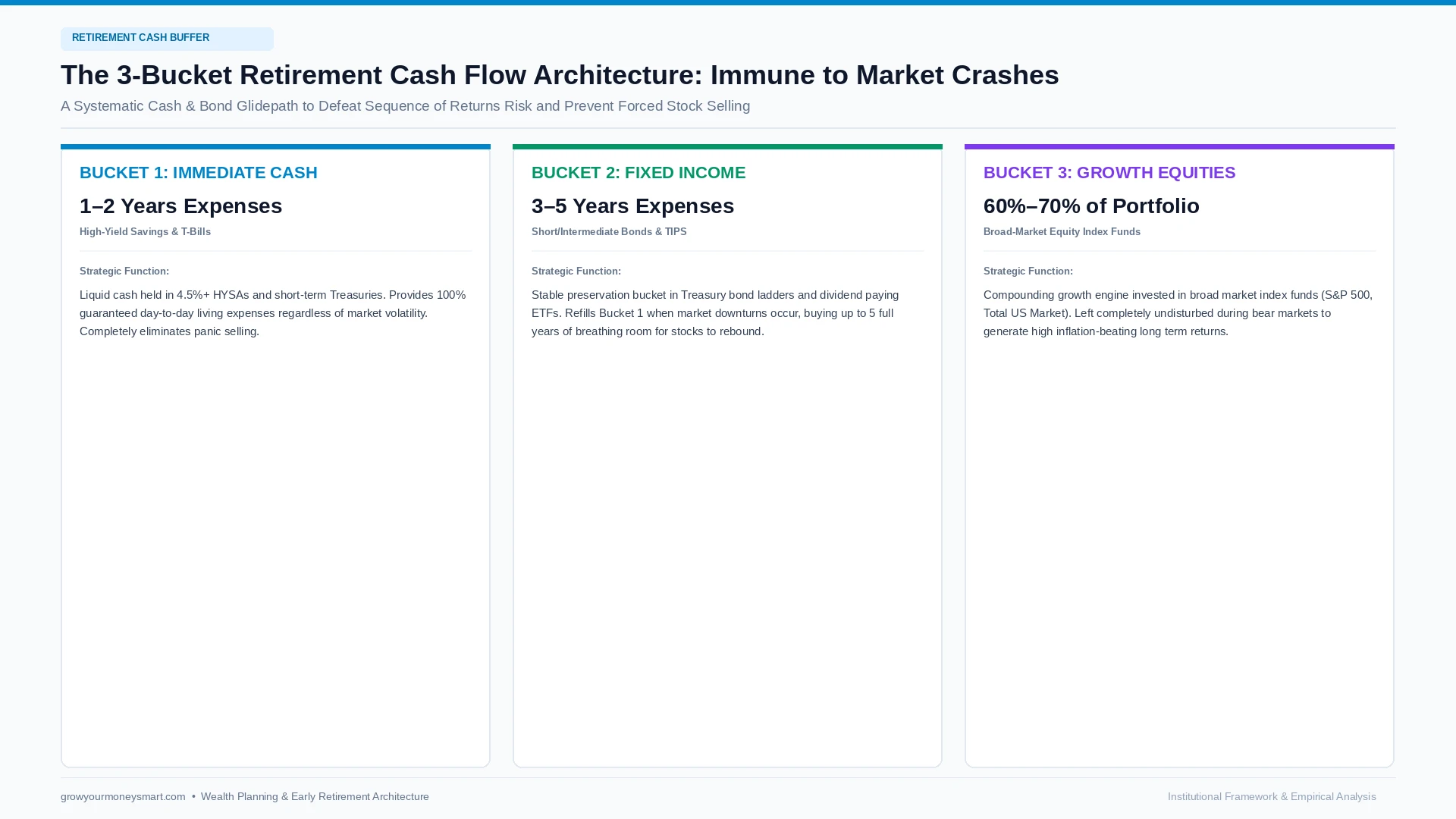
The 3-Bucket System separates your total nest egg into distinct tranches based on liquidity and time horizon, creating an impenetrable firewall between your monthly grocery bills and stock market gyrations:
- Bucket 1: Liquid Cash Buffer (Years 1–2): Allocate 12 to 24 months of net living expenses (spending minus guaranteed pension/Social Security income) into high-yield savings accounts (HYSAs), money market funds, or Treasury Bills yielding top institutional rates. Review our guide on the best high-yield savings accounts to optimize yield. When equities crash, all living expenses are drawn strictly from this bucket.
- Bucket 2: Stability & Income Tranche (Years 3–7): Allocate 3 to 5 years of expenses into short-to-intermediate term government bonds, Treasury Inflation-Protected Securities (TIPS), certificate of deposit (CD) ladders, or high-grade bond index funds. If a bear market lasts longer than two years, Bucket 2 is tapped to refill Bucket 1, leaving your stock portfolio untouched.
- Bucket 3: Long-Term Growth Equities (Years 8+): The remaining 60% to 70% of your portfolio stays invested in broad-market index funds (such as the S&P 500 or total world stock indices). Because Buckets 1 and 2 give you a guaranteed 5-to-7-year runway of cash flow, you will never be forced to liquidate a single share of stock during an economic downturn. Equities have 100% historical probability of fully recovering within that 7-year horizon.
2. Michael Kitces’ Bond Tent (The Rising Equity Glidepath)
Traditional financial advice suggests that investors should hold more bonds as they age, steadily decreasing equities from age 60 to 90. However, landmark research by financial planner Michael Kitces and retirement professor Wade Pfau revealed that this standard approach exacerbates sequence of returns risk.
Instead, they advocate for a Bond Tent (Rising Equity Glidepath):
- In the 5 years leading up to retirement, gradually increase your fixed-income and bond allocation until it reaches a peak of 40% to 50% on your exact retirement date (forming the peak of the ‘tent’).
- During the first 5 to 10 years of retirement, spend down bonds and cash to cover living expenses, allowing your equities to compound undisturbed.
- As the bond buffer depletes over the first decade, your equity allocation naturally rises from 50% back up to 70% or 80%.
This counter-intuitive strategy protects the portfolio during the high-vulnerability Retirement Danger Zone, while restoring long-term equity growth to defend against 30-year inflation later in life.
3. Dynamic Guyton-Klinger Spending Guardrails
William Bengen’s original 4% rule assumed a static withdrawal model: take 4% in Year 1, and raise that exact dollar amount by inflation every year regardless of economic conditions. In the real world, rigid withdrawal schedules cause portfolio suicide during bear markets.
Financial advisor William Guyton and researcher William Klinger developed Dynamic Spending Guardrails that dramatically elevate portfolio survival rates to over 99%:
| Guyton-Klinger Rule | Trigger Condition | Action Required | Impact on Portfolio |
|---|---|---|---|
| Capital Preservation Rule | Current withdrawal rate exceeds initial rate by > 20% (e.g., rises from 5.0% to 6.0% due to market drops) | Cut spending by 10% for the current year | Immediately halts portfolio bleeding during crashes |
| Prosperity Rule | Current withdrawal rate drops > 20% below initial rate (e.g., falls from 5.0% to 4.0% due to a massive bull market) | Increase spending by 10% for the current year | Allows retirees to enjoy surplus wealth without risking ruin |
| Inflation Forgiveness Rule | Portfolio suffered a negative total nominal return in the preceding calendar year | Skip annual inflation raise for that single year | Compounds major capital savings over 30 years |
Implementing just the Capital Preservation Rule (such as trimming your vacation budget or delaying a luxury vehicle purchase by 12 months when the S&P 500 drops 20%) eliminates over 85% of sequence risk without noticeably altering your baseline quality of life.
4. Strategic Social Security Delay as an Inflation-Proof Bridge
One of the most underutilized sequence risk shields is using your investment portfolio as a temporary cash flow bridge to defer your Social Security filing from age 62 to age 70. Every year you delay claiming Social Security past your Full Retirement Age (FRA) earns an unyielding, guaranteed 8% annual delayed retirement credit plus cost-of-living adjustments (COLA).
By spending down personal taxable assets to fund living expenses between age 62 and 70, you accomplish two critical sequence defenses simultaneously:
- You compress your required portfolio withdrawal rate in your 70s, 80s, and 90s, permanently lowering your dependence on stock market returns.
- You replace market-dependent portfolio withdrawals with guaranteed, government-backed, inflation-adjusted monthly income that lasts until you and your spouse pass away. Coordinate this with our deep guide on Social Security spousal benefits.
5. Tax-Efficient Decumulation Sequencing
The account from which you withdraw your living expenses directly impacts how long your portfolio survives. Liquidating assets from traditional tax-deferred accounts (like a Traditional 401k or IRA) triggers ordinary income taxes, forcing you to withdraw $60,000 just to net $48,000 after taxes. During a market downturn, this tax drag accelerates capital depletion.
An institutional tax-location decumulation waterfall functions as follows:
- Step 1: Taxable Brokerage Accounts: Harvest cash from dividends, interest, and selective capital loss harvesting to minimize tax liability. Realize long-term capital gains in the 0% tax bracket whenever possible.
- Step 2: Traditional Tax-Deferred Accounts: Withdraw up to the standard deduction or the top of the 10% to 12% marginal tax brackets to keep your effective tax rate near zero.
- Step 3: Roth IRAs & HSAs: Preserve tax-free Roth accounts and your HSA triple tax advantage for late retirement or severe bear market years. Because Roth withdrawals are 100% tax-free and do not affect Medicare IRMAA surcharges, tapping Roth funds during a market crash allows you to withdraw significantly less gross capital.
Historical Stress-Testing: The 1966 Retiree vs The 2000 Dot-Com Crash
To understand why modern retirement strategies revolve around sequence of returns risk, we must examine historical market data. Financial researchers frequently analyze two of the worst historical retirement cohorts in modern history: The Class of 1966 and The Class of 2000.
The 1966 Stagflation Nightmare
An investor retiring on January 1, 1966, was confronted with the ultimate macroeconomic tempest: flat, choppy equity markets combined with surging double-digit inflation. Over the next 16 years, the S&P 500 went nowhere, while consumer prices tripled. Retirees who blindly withdrew an inflation-adjusted 5% saw their portfolios completely evaporate by the early 1980s—even though the market subsequently experienced the greatest bull run in American history from 1982 to 2000. Their sequence was broken beyond repair.
The 2000 Dot-Com / 2008 Dual Crash
A retiree who hung up their boots on March 1, 2000, suffered three consecutive years of steep market declines (-9.1% in 2000, -11.9% in 2001, and -22.1% in 2002). Just as their portfolio began to recover in 2006, the 2008 Global Financial Crisis struck, plummeting equities another 37%. Those relying on a static 60/40 portfolio without cash buffers suffered catastrophic drawdown rates exceeding 50%. In contrast, retirees utilizing a 3-year cash bucket and Guyton-Klinger spending cuts navigated the entire 2000–2010 ‘Lost Decade’ with their capital 100% intact.
Your 5-Point Sequence of Returns Pre-Retirement Checklist for 2026
If you are within 5 years of retirement—or if you have recently retired—implement this 5-point defensive protocol immediately:
- Audit Your Essential vs Discretionary Expenses: Calculate your baseline survival floor (mortgage/rent, food, healthcare, utilities, insurance) versus discretionary spending (travel, hobbies, dining out). Ensure guaranteed non-portfolio income (Social Security, pensions) plus your Cash Buffer covers 100% of essential expenses for at least 3 years.
- Build a 24-Month Liquid Cash Reserve: Before your final day of work, shift 2 years of living expenses into liquid Treasury Bills or high-yield savings vehicles. Do not wait until you have already retired to build this cushion.
- Construct Your Bond Tent: Ensure your fixed income allocation is positioned to absorb volatility. Review how your allocations fit within a classic 3-fund portfolio or institutional asset mix.
- Establish Spending Guardrails in Writing: Commit to a pre-set behavioral plan with your partner or financial advisor: “If our portfolio balance drops by more than 15%, we will pause luxury travel and forego our annual inflation increase until markets reach new highs.”
- Structure Your Multi-Year Tax Decumulation Plan: Map out annual Roth conversions during low-income retirement bridge years using a Backdoor Roth IRA strategy or IRA conversion ladder to maximize lifetime tax flexibility.
To verify how your current nest egg stacks up against standard financial milestones before retirement, examine our benchmark guide on how much to save by age 30, 40, 50, and 60, or discover how early retirees achieve financial independence via different types of FIRE.
Frequently Asked Questions: Sequence of Returns Risk
1. What is sequence of returns risk in simple terms?
Sequence of returns risk is the risk that the timing of market downturns will negatively impact your portfolio. If market crashes happen early in retirement while you are withdrawing money, you are forced to sell shares at rock-bottom prices. This permanently locks in losses and exhausts your portfolio much faster than if the crash occurred late in retirement.
2. How long does sequence of returns risk last?
Academic research proves that sequence of returns risk is concentrated in the first 5 to 7 years of retirement (the ‘Retirement Danger Zone’). Once your portfolio successfully navigates the first decade without suffering severe unmitigated liquidations, the probability of portfolio failure over a 30-year horizon drops to virtually 0%.
3. Does sequence of returns risk matter while I am working and contributing?
No. While you are working and consistently adding money to your accounts, market crashes are mathematically advantageous. Because you are buying shares rather than selling them, down markets allow you to dollar-cost average at discounted prices. Sequence risk only activates once you transition to net negative cash flow (withdrawals).
4. How does the 4% rule account for sequence of returns risk?
William Bengen formulated the 4% rule specifically by back-testing historical worst-case sequence scenarios, including the brutal 1966 stagflation market and the 1973–1974 crash. A 4% initial withdrawal rate survived 100% of historical 30-year retirement periods in U.S. history, but modern planners recommend dynamic guardrails (3.3% to 3.8%) for early retirees facing 40-year retirements.
5. What is the difference between a cash buffer and a bond tent?
A cash buffer consists of 1 to 2 years of living expenses held strictly in liquid cash or short-term T-bills to fund near-term spending. A bond tent is a broader macro asset allocation strategy where you increase total fixed income to 40%–50% of your portfolio at retirement, and then intentionally spend down bonds to let your equity percentage rise over the next 10 years.
6. Can guaranteed income like Social Security eliminate sequence risk?
Yes, guaranteed income provides the ultimate sequence hedge. If your Social Security and pension payments cover 70% to 100% of your mandatory living expenses, your portfolio withdrawal requirements drop to negligible levels. Even in a 50% stock crash, you never face the pressure of selling equities to survive.
7. What is the Guyton-Klinger Capital Preservation Rule?
The Capital Preservation Rule states that if market declines push your current withdrawal rate more than 20% above your starting percentage (for example, jumping from 5% to 6%), you immediately reduce your annual withdrawal amount by 10%. This minor tactical spending cut stops portfolio bleeding and restores portfolio solvency.
8. Does holding too much cash hurt retirement returns?
Holding excessive cash (e.g., 10+ years of spending) introduces cash drag and inflation risk, eroding purchasing power over time. The optimal balance is holding 1 to 2 years in cash and 3 to 5 years in short bonds, while keeping the remaining 60% to 70% in growth equities to beat long-term inflation.

Jaiveer Hooda is a personal finance researcher and the founder of Grow Your Money Smart. With a background in computer engineering, he approaches money the way an engineer approaches any complex system — through data analysis, mathematical modeling, and ruthless optimization.
He built this platform on a single conviction: financial freedom is not a matter of luck. It is a system that can be designed, tested, and executed by anyone willing to follow the right blueprint. Every strategy published here is researched to the numbers, not written to the trend.
Expertise: Debt elimination · Retirement planning · Passive income · Budgeting systems
Connect: Pinterest | growyourmoneysmart.com | Contact Us