
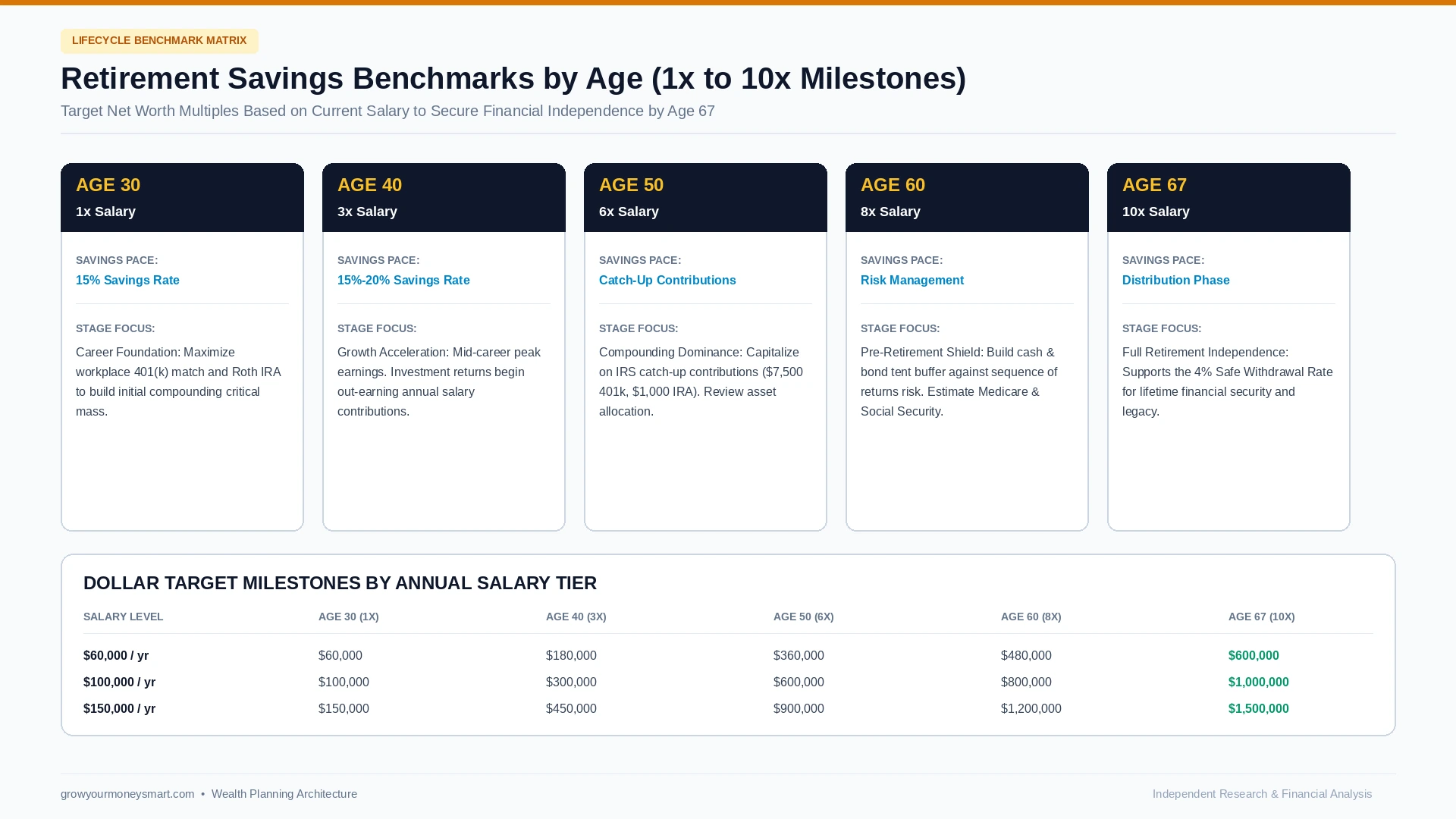
To determine How Much to Save by Age, leading institutional asset managers (Fidelity, J.P. Morgan, and T. Rowe Price) recommend accumulating target multiples of your gross annual salary: 1× your salary by age 30, 3× by age 40, 6× by age 50, 8× by age 60, and 10× by age 67. Sustaining an annual savings rate of 15% in a diversified compounding portfolio allows you to successfully replace 45% to 50% of your pre-retirement income alongside Social Security under the 4% safe withdrawal rule.
Planning for retirement often triggers anxiety because traditional financial advice throws around massive arbitrary targets like $1,000,000 or $2,000,000 without considering your individual standard of living. An individual earning $60,000 annually requires a radically different nest egg than someone earning $250,000. That is precisely why institutional wealth managers rely on salary multiples rather than static dollar sums to establish personalized benchmarks.
Understanding how much to save by age provides a practical measuring stick throughout your career. Whether you are in your 20s laying the groundwork for compound interest, navigating family expenses in your 40s, or approaching your peak earnings years in your 50s, tracking these milestones ensures you remain on the trajectory toward financial independence. Below is the comprehensive institutional roadmap, complete with income brackets, catch-up acceleration strategies, and Federal Reserve reality checks for 2026.
The Institutional Framework: Understanding Salary Multiples
The concept of measuring retirement readiness through gross salary multiples was pioneered by retirement economists at Fidelity Investments and refined by J.P. Morgan Asset Management. The underlying economic model is built on three foundational assumptions:
- Continuous Contribution Rate: You begin saving roughly 15% of your gross annual income starting at age 25 (including any workplace employer matching contributions).
- Asset Allocation & Real Growth: Your portfolio maintains an age-appropriate asset allocation (predominantly broad-market equities in early decades transitioning toward fixed income near retirement) generating an average annual real return of 5% to 5.5% after inflation.
- Income Replacement Target: In retirement, your living expenses will drop to approximately 75% to 80% of your peak career salary (as payroll taxes end, commuting costs vanish, and retirement savings contributions stop). Social Security benefits will replace approximately 30% to 35% of your income, leaving your personal portfolio to cover the remaining 45% via the 4% safe withdrawal rate.
By scaling the target to your salary, the benchmark automatically adapts as your compensation expands through promotions, career shifts, and cost-of-living adjustments.
| Age Milestone | Salary Multiple Target | Primary Career Life Stage | Core Strategic Objective |
|---|---|---|---|
| Age 30 | 1× Annual Salary | Early Career Foundation | Capture 401(k) match, eliminate high-interest debt, launch Roth IRA |
| Age 35 | 2× Annual Salary | Career Acceleration | Automate 15% savings rate, prevent lifestyle creep, fund HSA |
| Age 40 | 3× Annual Salary | Mid-Career Peak Expansion | Balance mortgage & college savings; ensure retirement remains priority #1 |
| Age 45 | 4× Annual Salary | Compounding Lift-Off | Portfolio gains begin generating more dollar growth than annual contributions |
| Age 50 | 6× Annual Salary | Peak Earnings Era | Trigger SECURE 2.0 catch-up contributions ($7,500 401k / $1,000 IRA) |
| Age 55 | 7× Annual Salary | Pre-Retirement Runway | Assess Rule of 55 for penalty-free access; begin de-risking equity concentration |
| Age 60 | 8× Annual Salary | Preservation & Transition | Utilize SECURE 2.0 Super Catch-Up ($11,250 for ages 60-63); build cash buffer |
| Age 67 | 10× Annual Salary | Full Retirement Independence | Claim full Social Security, implement dynamic withdrawal guardrails |
Retirement Savings Milestones by Decade: The Definitive Breakdown
Every decade of your working life introduces unique financial challenges and compounding opportunities. Let us examine how the math plays out at each critical stage.
1. In Your 20s: The Compounding Foundation (Target: 0.5× to 1× by 30)
In your twenties, your greatest financial superpower is time. A single dollar invested at age 22 has a wealth multiplier of roughly 20x to 40x by age 65, according to compounding tables from The Money Guy Show. Even if your entry-level salary feels modest, establishing healthy automated financial habits is vital:
- First Priority: Build a 3- to 6-month liquid emergency fund so unexpected auto repairs or medical bills do not force you into high-interest debt.
- Capture Free Money: Always contribute enough to your employer’s 401(k) to secure the 100% employer match. Leaving an employer match on the table is turning down an instant 50% or 100% guaranteed return.
- Maximize a Roth IRA: Early career workers are typically in their lowest lifetime tax bracket. Funding a Roth IRA with low-cost broad market index funds (such as an S&P 500 ETF or Total US Stock Market fund) locks in tax-free growth forever.
2. By Age 30: Milestone 1× Annual Salary
By the time you turn 30, having 1× your current annual salary accumulated across all retirement accounts signifies that your compounding flywheel has officially engaged. If your salary is $65,000, your retirement portfolio target is $65,000.
Reaching this first milestone is mathematically the hardest because 100% of the balance must come from your own manual contributions and frugal discipline. However, once you cross 1x salary, market appreciation begins doing heavy lifting. If you are behind at age 30 due to student loans or starting your career later, do not panic: increasing your savings rate to 18% to 20% over the next five years will quickly realign your trajectory.
3. By Age 40: Milestone 3× Annual Salary
At age 40, the institutional benchmark targets 3× your annual salary. If you earn $100,000, you should aim for $300,000 saved. The 30s and early 40s represent the “messy middle” of personal finance—you may be purchasing a home, paying for childcare, or managing escalating family expenses.
During this stage, lifestyle creep is the biggest danger. As your salary expands from entry-level to managerial levels, commit at least 50% of every bonus and pay raise directly into retirement savings before upgrading your lifestyle. Furthermore, high earners whose income exceeds standard Roth limits should implement a Backdoor Roth IRA and utilize an HSA triple tax advantage strategy to bypass contribution walls.
4. By Age 50: Milestone 6× Annual Salary (The Compounding Tipping Point)
By age 50, the benchmark jumps to 6× your annual salary ($600,000 on a $100,000 income; $900,000 on a $150,000 income). Notice how the curve accelerates: it took 30 years to accumulate your first 1x salary, but only 10 years to expand from 3x to 6x.
At this tipping point, your portfolio’s annual compound returns in an average market year will frequently exceed your entire annual salary! Age 50 also unlocks a massive regulatory advantage: IRS Catch-Up Contributions. In 2026, workers aged 50 and older can contribute an extra $7,500 to their workplace 401(k) / 403(b) (on top of the $23,500 standard limit) and an additional $1,000 to an IRA.
5. By Age 60: Milestone 8× Annual Salary (Super Catch-Ups & Risk Mitigation)
At age 60, target 8× your salary. If your earnings are $120,000, your retirement accounts should hold approximately $960,000. With retirement just 5 to 7 years away, your primary financial focus shifts from aggressive wealth accumulation to capital preservation and sequence of returns risk management.
Under the SECURE 2.0 Act, workers aged 60, 61, 62, and 63 qualify for a special “Super Catch-Up” contribution of $11,250 (or 150% of the standard catch-up limit) to their 401(k). This allows near-retirees to inject over $34,750 annually into tax-sheltered accounts to close any remaining savings gap.
6. By Age 67: Milestone 10× Annual Salary (Full Retirement Independence)
At age 67—the Full Retirement Age (FRA) for anyone born in 1960 or later—the institutional benchmark reaches 10× your final career salary ($1,200,000 on a $120,000 salary). Reaching 10x salary combined with full Social Security benefits provides complete financial security.
Under the standard 4% withdrawal rate, a $1.2M portfolio provides $48,000 per year in inflation-adjusted withdrawals. Coupled with estimated Social Security benefits of $32,000 to $38,000 for a typical household, your total retirement income equals $80,000 to $86,000 annually—replacing roughly 70% of gross pre-retirement pay and 100% of your actual take-home lifestyle need.
Dollar Targets by Annual Salary Bracket ($50k to $200k)
Because salary multiples can feel theoretical, the table below translates institutional multiples into exact dollar benchmarks across five common American household income tiers:
| Annual Salary | Age 30 (1×) | Age 40 (3×) | Age 50 (6×) | Age 60 (8×) | Age 67 (10×) |
|---|---|---|---|---|---|
| $50,000 | $50,000 | $150,000 | $300,000 | $400,000 | $500,000 |
| $75,000 | $75,000 | $225,000 | $450,000 | $600,000 | $750,000 |
| $100,000 | $100,000 | $300,000 | $600,000 | $800,000 | $1,000,000 |
| $150,000 | $150,000 | $450,000 | $900,000 | $1,200,000 | $1,500,000 |
| $200,000 | $200,000 | $600,000 | $1,200,000 | $1,600,000 | $2,000,000 |
The Reality Check: Median vs. Average American Savings (Federal Reserve Data)
If looking at these institutional benchmarks makes you feel overwhelmed or discouraged, you are certainly not alone. There is a massive chasm between theoretical institutional targets and what everyday Americans actually have saved in the real world.
According to the latest Survey of Consumer Finances (SCF) published by the Federal Reserve Board, retirement savings distribution in the United States is heavily skewed. In financial statistics, the mean (average) is dramatically inflated by ultra-high-net-worth individuals in the top 1% to 5%. The median represents the true midpoint where 50% of households have more and 50% have less.
| Age Group | Federal Reserve Median Savings | Federal Reserve Average Savings | Institutional Target ($80k Salary) |
|---|---|---|---|
| Under 35 | $18,880 | $49,130 | $80,000 (1×) |
| Ages 35–44 | $45,000 | $141,520 | $240,000 (3×) |
| Ages 45–54 | $115,000 | $313,220 | $480,000 (6×) |
| Ages 55–64 | $185,000 | $537,560 | $640,000 (8×) |
| Ages 65–74 | $200,000 | $609,230 | $800,000 (10×) |
As the Federal Reserve data proves, the typical American household falls significantly below institutional targets. Knowing this should provide relief: being behind does not mean failure; it simply highlights that the standard American savings rate of 3% to 6% is mathematically insufficient, and a proactive catch-up strategy is necessary.
The Late-Starter Catch-Up Acceleration Playbook
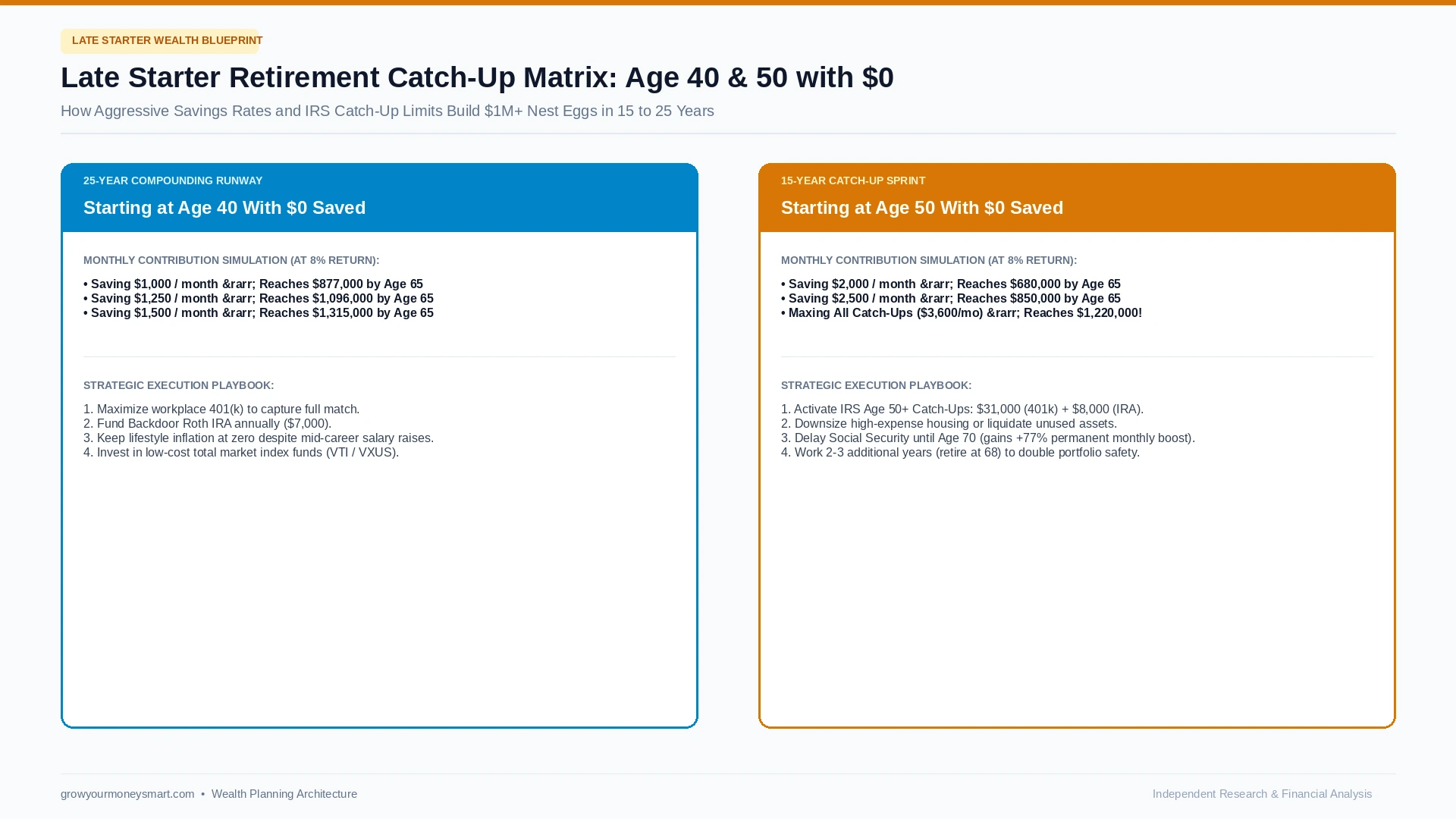
If you are 35, 45, or 50 years old and your current portfolio is far below the salary multiple benchmarks, despair is unproductive. Math is indifferent to when you start. While starting early allows small monthly contributions to do the work, starting later simply requires an aggressive, front-loaded acceleration framework.
1. Supercharge Your Savings Rate (The Speed Formula)
Your ultimate retirement date is dictated not by the dollar amount of your salary, but by your savings rate percentage. If you save 10% of your income, it takes approximately 9 years of working to fund 1 year of retirement. However, if you increase your savings rate to 25% or 30%, you fund 1 year of retirement for every 2.5 to 3 years of work.
Late starters who aggressively save 25% to 35% of their gross income can build a fully sustainable retirement nest egg from scratch in approximately 18 to 22 years—even starting at zero at age 40.
2. Maximize the SECURE 2.0 Act Catch-Up Windows
Federal tax legislation explicitly aids late savers by dramatically elevating contribution ceilings:
- Age 50+ 401(k) Catch-Up: Once you reach age 50, you can deposit an extra $7,500 per year into your workplace 401(k), 403(b), or government 457 plan.
- Ages 60–63 Super Catch-Up: Under SECURE 2.0, individuals aged 60 through 63 can deposit $11,250 (or 150% of the standard catch-up), unlocking combined annual employee deferrals exceeding $34,750.
- IRA Catch-Up: Individuals aged 50+ can contribute an additional $1,000 annually to a Traditional or Roth IRA.
- HSA Catch-Up at 55: If enrolled in a qualifying High-Deductible Health Plan, account holders aged 55+ can contribute an extra $1,000 per year to their Health Savings Account.
3. Execute the Direct Rollover Clean-Up
Over a multi-decade career, workers frequently leave orphan 401(k) accounts scattered across previous employers, often burdened with high administrative fees (0.50% to 1.20%) and poor proprietary fund selections. Executing a direct, trustee-to-trustee 401(k) rollover to a low-cost IRA consolidates your assets, eliminates hidden plan fees, and unlocks broad-market index funds with expense ratios below 0.03%.
Target Asset Allocation and Portfolio Mix by Age
Hitting your age benchmarks requires balancing capital growth with volatility protection. As you age, your human capital (future earning years) decreases while your financial capital increases. The table below outlines an institutional glidepath across career stages:
| Decade | US Equities | International Equities | Bonds & Fixed Income | Cash / Short-Term Buffer |
|---|---|---|---|---|
| 20s & 30s | 65% – 70% | 20% – 25% | 5% – 10% | Emergency Fund Only |
| 40s | 55% – 60% | 20% | 15% – 20% | 3–6 Months Liquidity |
| 50s | 45% – 50% | 15% | 25% – 30% | 6 Months Liquidity |
| 60s (Near Retirement) | 35% – 40% | 10% – 15% | 35% – 40% | 1–2 Years Cash Tent Buffer |
Which Accounts Count Toward Your Savings Benchmark?
A common point of confusion when evaluating how much to save by age is deciding what assets to include in your net worth tally. To maintain an accurate assessment, follow these institutional classification rules:
- Included Assets: All dedicated retirement vehicles—Workplace 401(k) / 403(b) / 457 plans, Traditional IRAs, Roth IRAs, SEP-IRAs, Solo 401(k)s, Health Savings Accounts (invested portions dedicated to retirement), and taxable brokerage accounts designated for long-term independence.
- Pension Lump-Sum Value: If you are fortunate to have a defined-benefit pension, divide your anticipated annual pension payout by 0.04 (the 4% rule) to calculate its equivalent portfolio value. An annual pension of $30,000 equals roughly $750,000 of retirement portfolio equivalent!
- Excluded Assets: Do not count your primary residence equity unless you possess a concrete, written plan to downsize, relocate to a lower-cost region, or execute a reverse mortgage upon retirement. Your house provides shelter, not liquid portfolio withdrawals to purchase groceries and healthcare. Also exclude personal vehicles, jewelry, and short-term emergency savings accounts.
Frequently Asked Questions: How Much to Save by Age
1. Does primary home equity count toward my retirement savings benchmark?
Generally no. Your primary residence provides necessary shelter and carries ongoing maintenance, insurance, and property taxes. Home equity only counts toward your liquid retirement benchmarks if you plan to downsize, sell and relocate to a lower-cost area, or tap equity via a reverse mortgage upon entering retirement.
2. What if I earn a high salary ($200k+) and started saving late?
High earners who start late face a unique hurdle because institutional salary multiples assume a 15% savings rate over 35 years. However, high earners also enjoy higher discretionary margins. By aggressively saving 35% to 45% of income, maximizing Mega-Backdoor Roth conversions, and controlling fixed living expenses, high earners can achieve 8x to 10x salary replacement within 15 to 18 years.
3. How does Social Security impact my savings multiple?
Standard institutional benchmarks (like Fidelity’s 10x by 67) already integrate full Social Security retirement benefits into their models. For lower- and middle-income earners, Social Security replaces roughly 35% to 45% of pre-retirement pay. For higher earners, Social Security replaces a smaller fraction (25% to 30%), requiring a slightly higher portfolio multiple.
4. What if I want to retire early at age 50 or 55 (FIRE movement)?
If you plan to retire early, the traditional age benchmarks do not apply. Because you must fund a 40- to 50-year retirement without immediate access to Medicare or Social Security, your target multiple must be 25x to 33x your annual living expenses (translating to a conservative 3% to 3.5% safe withdrawal rate) rather than 8x to 10x salary.
5. How do SECURE 2.0 catch-up limits help older savers in 2026?
The SECURE 2.0 Act provides two powerful tailwinds: savers aged 50+ can contribute an additional $7,500 catch-up to their 401(k), and those aged 60 through 63 receive a Super Catch-Up limit of $11,250. This enables near-retirees to shelter up to $34,750+ annually from taxes to rapidly compress their savings deficits.
6. Does my employer 401(k) match count toward my savings target?
Yes, absolutely. Both your employee contributions and employer matching dollars accumulate inside your portfolio and compound together. When calculating your annual 15% savings rate, include both your personal payroll deduction and the employer match.
7. Should married couples calculate benchmarks individually or jointly?
Married couples sharing financial households should calculate benchmarks jointly using combined household gross income and combined liquid retirement balances. This provides a unified roadmap and accommodates single-earner households where one spouse builds a Spousal IRA.
8. What is the single best action to take if I am severely behind on savings?
Conduct a comprehensive lifestyle cash-flow audit to immediately eliminate high-interest revolving debt, automate a minimum 20% to 25% savings rate, and redirect every future raise into broad-market index funds. Increasing your savings rate produces an immediate double benefit: it accelerates portfolio compounding while systematically training you to live comfortably on less.

Jaiveer Hooda is a personal finance researcher and the founder of Grow Your Money Smart. With a background in computer engineering, he approaches money the way an engineer approaches any complex system — through data analysis, mathematical modeling, and ruthless optimization.
He built this platform on a single conviction: financial freedom is not a matter of luck. It is a system that can be designed, tested, and executed by anyone willing to follow the right blueprint. Every strategy published here is researched to the numbers, not written to the trend.
Expertise: Debt elimination · Retirement planning · Passive income · Budgeting systems
Connect: Pinterest | growyourmoneysmart.com | Contact Us