
The fundamental distinction in Will vs Living Trust centers on probate court: A Last Will & Testament must pass through public probate court—taking 9 to 24 months, costing 3% to 7% of gross estate value in statutory attorney/court fees, and placing all asset records into the public domain. A Revocable Living Trust bypasses probate court entirely, distributing wealth to beneficiaries immediately and 100% privately. Furthermore, a living trust protects against mental or physical incapacity during your lifetime, whereas a will offers zero lifetime protection and only activates after death.
You spend thirty to forty years diligently building wealth—maximizing employer matches in your 401(k), contributing to Roth IRAs, investing in taxable brokerage accounts, and paying off your family home. Yet, without proper estate legal architecture, a massive portion of that lifetime achievement can be devoured by court filing fees, statutory probate attorney charges, and administrative delays, all while exposing your family’s personal finances to public scrutiny.
One of the most persistent and costly myths in personal finance is the belief that having a Last Will and Testament keeps your estate out of court. It does not. A will does not avoid probate; a will is literally your legal admission ticket to probate court. In contrast, examining a will vs living trust reveals why affluent families and retirement planners rely on revocable living trusts as the foundational fortress of modern estate defense.
Below is the definitive 2026 legal and financial blueprint comparing wills versus living trusts, detailing statutory probate expense schedules, privacy protections, the incapacity blindspot, multi-state real estate traps, the fatal “unfunded trust” error, and the essential four-pillar estate protection package.
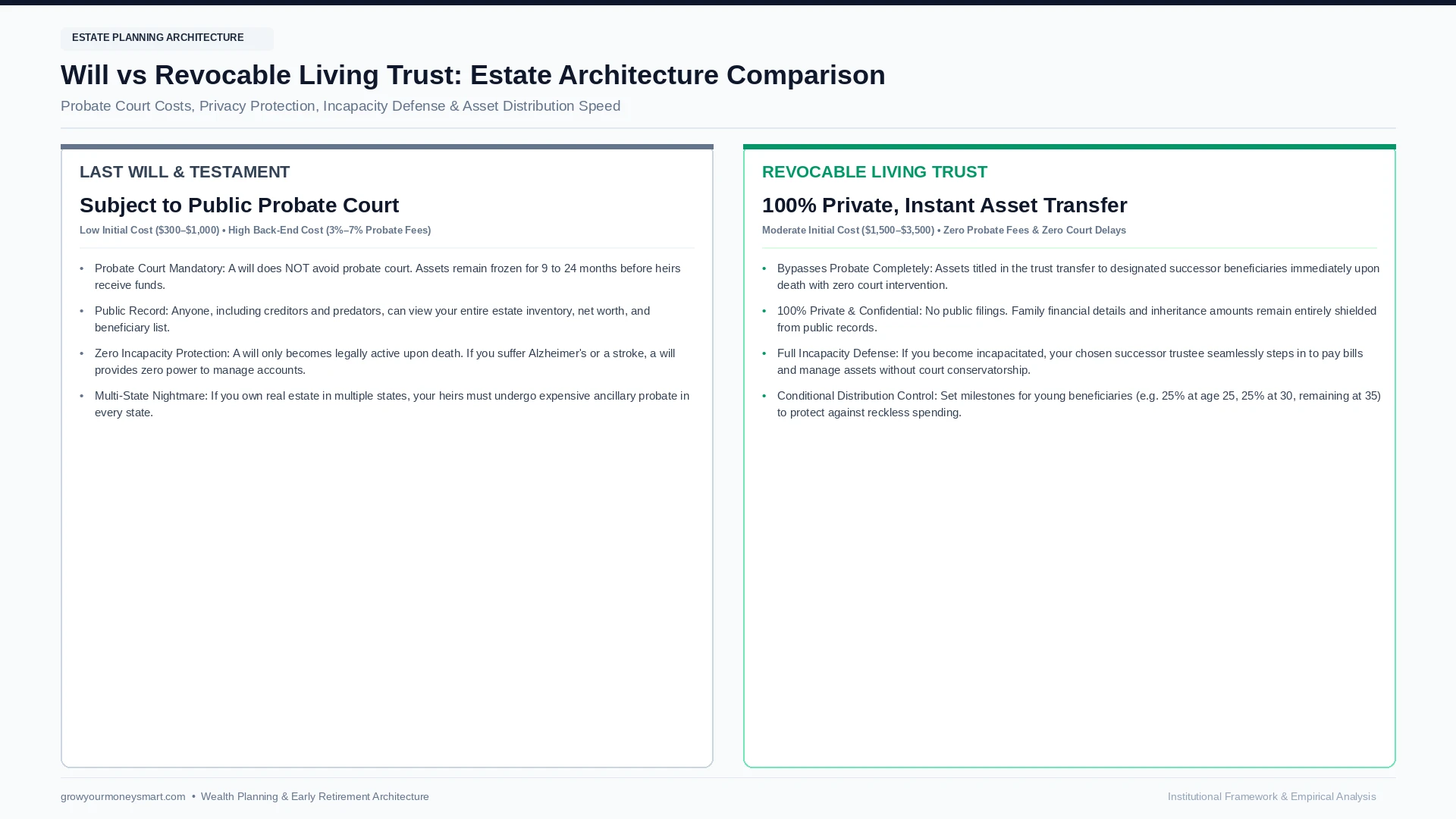
Will vs Living Trust: Head-to-Head Comparison Matrix
To determine which estate structure aligns with your net worth, real estate holdings, and family dynamic, examine the direct operational differences across these eight legal pillars:
| Legal Dimension | Last Will & Testament | Revocable Living Trust |
|---|---|---|
| Probate Court Mandate | Mandatory (9 to 24 Months) | Bypasses Probate Completely (Immediate) |
| Privacy & Public Records | 100% Public Record (Searchable by anyone) | 100% Private (Kept strictly within family) |
| Incapacity Protection | Zero (Requires Court Conservatorship) | Full Protection (Successor Trustee takes over) |
| Front-End Setup Cost | Inexpensive ($300 – $1,000) | Moderate ($1,500 – $3,500) |
| Back-End Legal & Court Fees | Expensive (3% to 7% of gross estate) | Near Zero (No court or statutory percentages) |
| Multi-State Real Estate | Triggers Multiple Ancillary Probates | Unified Transfer Across All 50 States |
| Asset Distribution Control | Lump-sum transfer at probate close | Staggered payouts by age or milestone |
| Vulnerability to Legal Contests | High (Probate invites disgruntled heirs) | Very Low (Treated as private contractual agreement) |
The Brutal Realities of Probate Court: Why Wealth Bleeds Away
When an individual passes away with only a Last Will and Testament (or with no estate documents at all, dying intestate), their estate must be submitted to the local county probate court. Probate is the legal judicial process of proving the validity of a will, cataloging all assets, settling claims with outstanding creditors, and officially ordering the distribution of remaining property.
While probate was conceived to protect heirs, in practice it has become a slow, bureaucratic, and highly expensive ordeal characterized by three fatal flaws:
1. Statutory Attorney and Executor Fees (The 3% to 7% Drain)
In many major states—including California, New York, and Florida—probate attorney and executor compensation is dictated by statutory fee schedules calculated on the gross value of the estate, regardless of debt or mortgages. Under California Probate Code § 10810, for example, the statutory attorney fee schedule is set as follows:
| Estate Asset Tier | Statutory Attorney Fee Rate | Statutory Executor Fee Rate | Combined Legal Cost Tier |
|---|---|---|---|
| First $100,000 | 4.0% ($4,000) | 4.0% ($4,000) | $8,000 |
| Next $100,000 | 3.0% ($3,000) | 3.0% ($3,000) | $6,000 |
| Next $800,000 | 2.0% ($16,000) | 2.0% ($16,000) | $32,000 |
| Next $9,000,000 | 1.0% ($90,000) | 1.0% ($90,000) | $180,000 |
| Sample $1,000,000 Home Case | $23,000 Attorney Fee | $23,000 Executor Fee | $46,000+ TOTAL STATUTORY FEES |
Consider the real-world impact: If you own an ordinary single-family house valued at $1,000,000 with an $800,000 mortgage (meaning you have only $200,000 in net home equity), probate statutory fees are calculated on the gross $1,000,000 valuation. Your heirs will owe $46,000 in statutory fees, consuming nearly 25% of your actual home equity just to clear court bureaucracy!
2. Severe Asset Freezes and Timeline Delays (9 to 24 Months)
During probate, bank accounts, brokerage assets, and real estate are effectively locked under court supervision. Heirs cannot sell the decedent’s home, rebalance investment portfolios, or distribute inheritance cash until creditors are notified, mandatory newspaper notices expire, and the probate judge signs a final decree. If market volatility strikes during that 18-month delay, your family is powerless to prevent losses.
3. Total Loss of Privacy (Public Court Records)
The moment a will is admitted to probate, it becomes a public record accessible to anyone on the internet. Anyone can view your asset inventory, bank balances, real estate holdings, family disputes, and exact names and addresses of your beneficiaries. Predatory creditors, disinherited relatives, and scam artists routinely scrape county probate dockets to target newly grieving heirs.

The Critical Incapacity Blindspot: Why Wills Offer Zero Lifetime Protection
Perhaps the most hazardous limitation of a Last Will and Testament is that a will is legally inert while you are alive. A will has zero legal authority to act until you have passed away.
What happens if you suffer a severe stroke, develop Alzheimer’s or dementia, or enter a medically induced coma following an accident? If your assets are held solely in your personal name, your family cannot legally access your bank accounts, pay your mortgage, manage your investment portfolio, or pay your medical bills without petitioning the court for a Living Probate (Court Conservatorship or Adult Guardianship).
Court conservatorship is emotionally devastating, adversarial, and exceptionally costly. A judge appoints a financial conservator who must submit annual accountings and receipts to the court for every dollar spent on your care.
With a Revocable Living Trust, this entire nightmare is completely avoided:
- You serve as the Initial Trustee during your healthy lifetime, maintaining 100% full control to buy, sell, spend, and manage all your property exactly as before.
- If two licensed physicians certify that you have become incapacitated, your pre-designated Successor Trustee immediately steps in to take the wheel.
- The successor trustee manages trust accounts, pays nursing care expenses, and handles all family finances privately, seamlessly, and without setting foot inside a courtroom.
The Multi-State Real Estate Trap: Ancillary Probate Explained
If you own real estate in more than one state—such as a primary residence in Illinois and a vacation condo in Florida or Colorado—relying on a will creates an administrative disaster known as Ancillary Probate.
Because state probate courts lack jurisdictional authority over real property located outside their physical borders, your executor must open a primary probate proceeding in your home state, and then retain separate probate attorneys to open secondary “ancillary probate” court cases in every single state where you own real estate. Each state’s probate court requires separate filing fees, separate attorney retainers, separate statutory schedules, and separate judicial timelines.
When you deed out-of-state properties into a Revocable Living Trust, ancillary probate is eradicated. Because the trust (a private legal entity) owns the title to the real estate, property ownership transfers instantly to your beneficiaries across all 50 states without a single court filing.
The Fatal Mistake: The “Unfunded Trust” Disaster
Estate attorneys estimate that over 60% of people who pay thousands of dollars for a living trust end up in probate court anyway. Why? Because of the fatal error known as the Unfunded Trust.
Signing a trust agreement is merely creating the empty legal vessel. In order for the trust to protect your wealth, you must execute Trust Funding—the formal process of transferring legal title of your assets out of your individual name and into the name of your trust:
- Real Estate: You must execute and record a Quitclaim Deed or Grant Deed with the county recorder’s office transferring title from “John Doe” to “John Doe, Trustee of the John Doe Revocable Living Trust dated [Date]”.
- Taxable Brokerage Accounts: You must contact Vanguard, Charles Schwab, or Fidelity to retitle your taxable investment accounts into the name of your trust.
- Bank Accounts: Open trust-titled checking and savings accounts, or execute Transfer on Death (TOD) designations naming your trust as beneficiary.
If you purchase a new home five years after signing your trust and take title in your individual name without deeding it into your trust, that home must pass through public probate court regardless of what your trust document says.
The Legal Hierarchy: Beneficiary Designations vs Living Trust
Understanding the strict legal hierarchy of asset distribution is vital to prevent accidental disinheritance or tax penalties:
- Tier 1 (Highest Priority): Statutory Contractual Beneficiary Designations: Payable on Death (POD), Transfer on Death (TOD), 401(k), 403(b), Traditional IRA, Roth IRA, and life insurance beneficiary forms take absolute precedence over everything else. If your will or trust leaves your 401(k) to your daughter, but your 401(k) beneficiary form on file at Fidelity names your ex-spouse, Fidelity is legally mandated to hand 100% of the money to your ex-spouse.
- Tier 2: Trust-Titled Assets: Any asset whose legal title is held in the name of your Revocable Living Trust passes privately and immediately under the terms of your trust agreement.
- Tier 3 (Lowest Priority): Probate Estate (Covered by Last Will): Any asset held in your sole individual name without a designated beneficiary or joint tenant is governed by your Last Will and must pass through probate court.
Warning on IRAs & The SECURE Act 2.0: Never name a standard living trust as the primary beneficiary of a Traditional IRA or 401(k) without specialized legal guidance. Under the SECURE Act 2.0, non-spouse beneficiaries must empty inherited IRAs within 10 years. Naming a trust incorrectly can force the IRA into the maximum compressed trust income tax bracket (37% federal tax kicking in at just $15,200 of income in 2026)! In most cases, naming individuals directly as primary beneficiaries on retirement accounts is far superior.
The Complete 4-Pillars Estate Defense Package for Retirees
A comprehensive estate plan is never just a single document. Institutional wealth advisors structure a coordinated four-part legal fortress:
| Pillar | Legal Instrument | Core Operational Role |
|---|---|---|
| Pillar 1 | Revocable Living Trust | Bypasses probate, guarantees total asset privacy, manages lifetime incapacity, and governs asset distribution. |
| Pillar 2 | “Pour-Over” Will | Acts as a legal safety net. Any asset accidentally left outside the trust during your life is automatically ‘poured over’ into the trust upon death. Also names legal guardians for minor children. |
| Pillar 3 | Durable Financial Power of Attorney (POA) | Authorizes your trusted agent to manage non-trust assets, file IRS/state tax returns, sign legal documents, and handle government benefits (Social Security, Medicare, Veterans Affairs). |
| Pillar 4 | Advance Healthcare Directive & HIPAA Waiver | Appoints a Healthcare Proxy to make medical decisions if you cannot, specifies end-of-life life support wishes (Living Will), and authorizes doctors to share medical records with family. |
DIY Online Services vs Estate Attorneys: What Should You Pay?
When implementing your estate plan, you have two primary avenues:
Option 1: Modern Digital Platforms (Trust & Will, LegalZoom)
- Price Point: $400 to $800 for a comprehensive trust and estate package.
- Best Suited For: Straightforward estates with net worth under $1,000,000, zero multi-state real estate, straightforward family situations (no blended families or special needs beneficiaries), and standard liquid accounts.
Option 2: Specialized Estate Planning Attorneys
- Price Point: $1,800 to $4,500 for a married couple.
- Best Suited For: Homeowners with net worth exceeding $1,000,000, owners of commercial real estate or multi-state properties, small business owners, blended families with stepchildren, or parents leaving assets to beneficiaries with addiction issues or special needs receiving Medicaid/SSI.
Remember: Spending $2,500 on an attorney-drafted trust today is a minor insurance premium compared to the $46,000+ in statutory fees probate court will extract from your grieving family later.
Strategic Integration with Your Broader Retirement Architecture
Your estate plan serves as the final protective wrapper around your entire lifetime accumulation. Seamlessly connect this legal fortress with your overall financial roadmap:
- Preserve capital decumulation rates using the 4% rule safe withdrawal rate.
- Shield your retirement withdrawals from early market crashes via modern sequence of returns risk defense strategies.
- Maximize government entitlements for your partner through optimized Social Security spousal benefits.
- Audit your milestone net worth targets by age using institutional savings benchmarks by age 30, 40, 50, and 60.
Frequently Asked Questions: Will vs Living Trust
1. Does having a Last Will and Testament avoid probate court?
No. This is the single most common estate planning misconception. A will does not avoid probate; a will is the exact document submitted to probate court to begin legal proceedings. Only assets held in a living trust, owned jointly with survivorship rights, or passing via contractual beneficiary designations bypass probate.
2. Do I lose control of my assets once I put them into a living trust?
No. Under a Revocable Living Trust, you are the Initial Trustee and the primary beneficiary during your life. You have 100% unrestricted legal control to buy, sell, refinance, spend, modify, or completely dissolve the trust at any time. Your taxes and daily financial life remain completely unchanged.
3. Does a living trust protect my assets from personal lawsuits or creditors?
No. Because a revocable living trust allows you total control to withdraw or alter assets at will, the law treats trust assets as your personal property. Creditors and lawsuits can still reach revocable trust assets. For lawsuit asset protection, specialized Irrevocable Trusts or umbrella insurance policies are required.
4. Can a living trust name legal guardians for minor children?
No. In all 50 states, legal guardians for minor children can only be nominated through a Last Will and Testament. This is why every living trust package includes a supporting ‘Pour-Over Will’ that nominates legal guardians and serves as a safety net.
5. Does a living trust have to file separate income tax returns during my life?
No. While you are alive, a revocable living trust is classified as a ‘grantor trust’ by the IRS. It uses your personal Social Security Number, requires no separate tax ID (EIN), and files no separate tax returns. All income and capital gains are reported on your standard Form 1040.
6. What happens if I forget to put an asset into my living trust before I die?
Your supporting Pour-Over Will catches that omitted asset and directs it into your trust. However, if the omitted asset exceeds your state’s small estate probate threshold (e.g., $184,500 in California), that single asset must still go through probate court before being poured into your trust.
7. Is a living trust necessary if I have Transfer on Death (TOD) on all my accounts?
While TOD designations avoid probate upon death, they offer zero protection if you become mentally or physically incapacitated during your lifetime. Furthermore, TOD designations cannot handle complex distribution scenarios (such as staggered payouts, minor children, or contingent beneficiaries).
8. Can a living trust be contested like a will?
Living trusts are substantially harder to contest than wills. Wills are submitted to open court where disgruntled heirs are formally invited to file objections. In contrast, trusts operate privately under contract law. A challenger must file an expensive, separate lawsuit and prove mental incompetence or undue influence against heavy legal burdens of proof.

Jaiveer Hooda is a personal finance researcher and the founder of Grow Your Money Smart. With a background in computer engineering, he approaches money the way an engineer approaches any complex system — through data analysis, mathematical modeling, and ruthless optimization.
He built this platform on a single conviction: financial freedom is not a matter of luck. It is a system that can be designed, tested, and executed by anyone willing to follow the right blueprint. Every strategy published here is researched to the numbers, not written to the trend.
Expertise: Debt elimination · Retirement planning · Passive income · Budgeting systems
Connect: Pinterest | growyourmoneysmart.com | Contact Us