
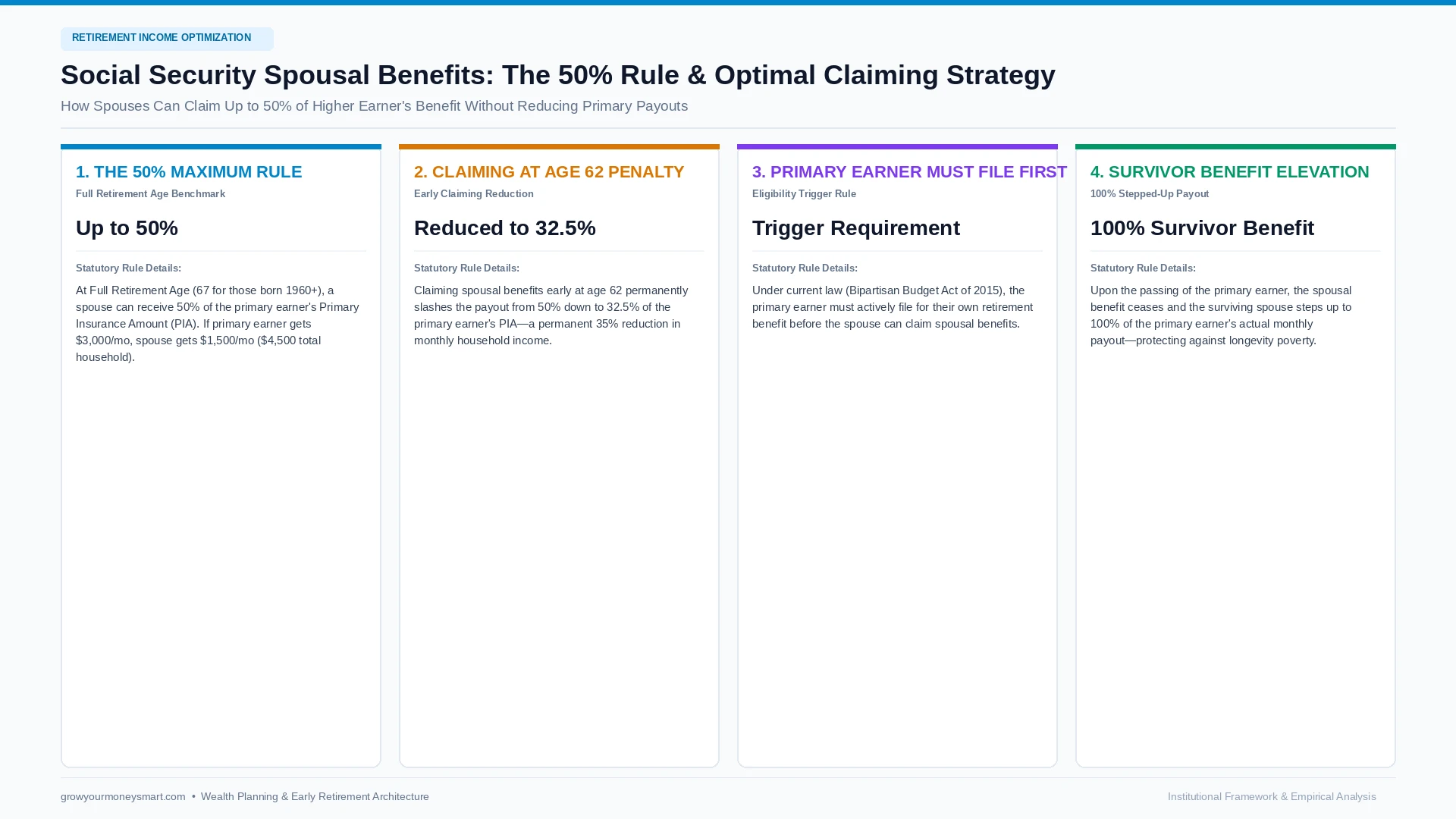
Under federal law, Social Security Spousal Benefits allow a married individual to receive up to 50% of their spouse’s Primary Insurance Amount (PIA) once they reach their Full Retirement Age (FRA, age 67 for those born in 1960 or later). Claiming early at age 62 permanently slashes this spousal check down to 32.5%. Receiving spousal benefits does not reduce the primary worker’s check by a single penny. Furthermore, upon the primary earner’s death, the surviving spouse steps up to receive 100% of the deceased spouse’s actual monthly payout.
For the overwhelming majority of American households, Social Security forms the bedrock of retirement income. It is the only income source that provides government-backed, inflation-adjusted cash flow guaranteed for life. Yet, every single year, millions of married couples leave hundreds of thousands of dollars in lifetime benefits on the table because they do not understand the complex statutory mechanics governing spousal entitlements.
Whether one spouse took time out of the paid workforce to raise children, spent years caring for aging parents, worked part-time, or earned significantly less than their partner, the Social Security system was explicitly engineered to protect dual-earner and single-earner households alike. By understanding how Social Security spousal benefits interact with individual retirement benefits, Full Retirement Age (FRA), and survivor provisions, couples can coordinate their claiming timelines to extract maximum lifetime wealth.
Below is the definitive 2026 architectural guide to Social Security spousal benefits, covering the 50% calculation rule, claiming age reduction tables, the Bipartisan Budget Act changes, divorced spousal rules, public employee offsets, and coordinated filing strategies.
The Mathematical Core: The 50% Statutory Rule Explained
The spousal benefit calculation is anchored entirely to the primary earner’s Primary Insurance Amount (PIA). The PIA represents the monthly dollar amount that the primary worker is legally entitled to collect at their exact Full Retirement Age (FRA).
Under statutory guidelines, a spouse who claims benefits at their own FRA is entitled to receive 50% of the primary earner’s PIA. Here is how this operates in a practical retirement scenario:
| Benefit Component | Primary Worker (Spouse A) | Secondary Earner (Spouse B) | Household Combined Total |
|---|---|---|---|
| Own Worker PIA (at FRA 67) | $3,400 / month | $600 / month | $4,000 / month |
| Spousal Top-Up Eligibility | N/A | +$1,100 / month (Top-up to 50% of $3,400) | +$1,100 / month |
| Final Monthly Payout (at FRA) | $3,400 / month | $1,700 / month | $5,100 / month ($61,200/yr) |
| Impact on Spouse A’s Check | $0 Reduction | N/A | 100% Pure Added Value |
Three critical mathematical facts must be understood regarding this 50% statutory rule:
- It Does Not Cut the Primary Earner’s Check: There is a common misconception that paying spousal benefits somehow divides or shrinks the working spouse’s entitlement. In truth, the spousal benefit is an auxiliary entitlement funded entirely by the Social Security Trust Fund. Spouse A receives 100% of their earned benefit regardless of whether Spouse B files.
- The “Top-Up” Mechanism: Social Security always pays your own earned worker benefit first. If 50% of your spouse’s PIA is larger than your own benefit, the SSA adds a “spousal excess top-up” to bring your total check up to the 50% threshold.
- Delayed Retirement Credits Do NOT Increase Spousal Benefits: If the primary worker delays claiming their own benefit past FRA until age 70, their own monthly check grows by 24% (8% per year). However, the spousal benefit is strictly anchored to the primary worker’s PIA at FRA. It never receives an 8% boost from the primary earner’s delay.
Claiming Age Penalties: Why Claiming at 62 Cuts Your Payout by 35%
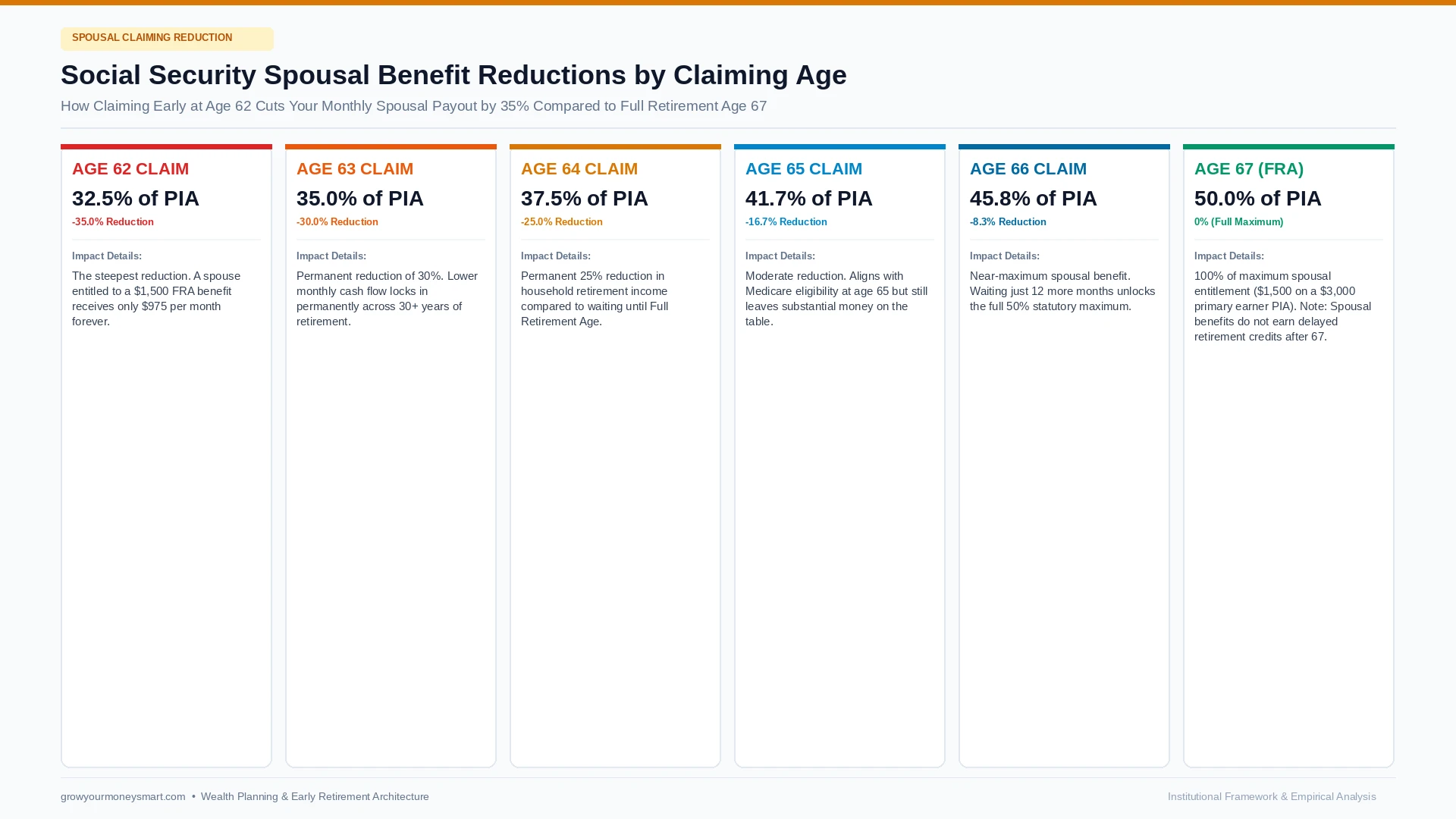
While an individual is legally eligible to claim spousal benefits starting at age 62, doing so triggers steep, permanent early-filing actuarial reductions. The statutory reduction schedule for spousal benefits is significantly harsher than the reduction for personal worker benefits.
For personal worker benefits, filing at age 62 results in a 30% lifetime reduction. But for spousal benefits, filing at age 62 results in a massive 35% lifetime reduction. The table below outlines exact monthly payouts across each claiming age for an individual whose spouse has an FRA PIA of $3,000:
| Claiming Age (FRA 67) | Percentage of Primary PIA | Lifetime Actuarial Penalty | Monthly Check ($3k Primary PIA) | 20-Year Cumulative Cash Flow |
|---|---|---|---|---|
| Age 62 | 32.50% | -35.0% Cut | $975 / month | $234,000 (Over 20 Years) |
| Age 63 | 35.00% | -30.0% Cut | $1,050 / month | $239,400 (Over 19 Years) |
| Age 64 | 37.50% | -25.0% Cut | $1,125 / month | $243,000 (Over 18 Years) |
| Age 65 | 41.67% | -16.67% Cut | $1,250 / month | $255,000 (Over 17 Years) |
| Age 66 | 45.83% | -8.33% Cut | $1,375 / month | $264,000 (Over 16 Years) |
| Age 67 (FRA) | 50.00% | 0.0% (Full Statutory Max) | $1,500 / month | $270,000 (Over 15 Years) |
| Age 70 (Delayed) | 50.00% (Capped) | 0% (No Delayed Credits) | $1,500 / month | $216,000 (Forfeited $54k) |
Crucial Takeaway: Notice what happens at age 70: spousal benefits never increase beyond 50% of the primary earner’s FRA amount. If an individual waits past age 67 to claim a spousal benefit, they are simply throwing away monthly cash with zero financial reward. Always file for spousal benefits no later than your Full Retirement Age.
The Bipartisan Budget Act Changes: Deemed Filing Explained
Prior to May 2016, affluent retirees utilized two aggressive claiming strategies known as “File and Suspend” and “Restricted Application.” A primary worker could file for benefits at FRA to unlock spousal benefits for their partner, and then immediately suspend their own benefit to earn 8% annual delayed credits up to age 70. Simultaneously, a spouse could file a “restricted application” for spousal benefits only, collecting 50% of their partner’s check while letting their own personal benefit grow to the maximum at age 70.
Congress permanently abolished these loopholes under the Bipartisan Budget Act of 2015 by introducing universal Deemed Filing:
- Universal Application Rule: When you file an application for Social Security at any age, you are legally deemed to have applied for both your own worker benefit and your spousal benefit simultaneously.
- Automatic Payout Hierarchy: You cannot pick and choose which benefit to receive. The Social Security Administration will calculate your own benefit first. If your spousal entitlement is greater, you will receive your own benefit plus the spousal difference.
- The Primary Trigger Requirement: You cannot receive a spousal benefit until the primary worker has actually begun receiving their own monthly benefit. If the higher-earning spouse delays filing until age 70 to maximize their check, the lower-earning spouse cannot collect spousal benefits during those deferral years (though they can collect their own personal worker benefit in the interim).
Spousal Benefits vs Survivor Benefits: The Essential Distinction
Many married couples confuse spousal benefits with survivor benefits, but the legal and financial rules governing them are completely separate:
| Feature | Spousal Benefit (Both Spouses Alive) | Survivor Benefit (Primary Earner Deceased) |
|---|---|---|
| Maximum Payout | 50% of Primary Worker’s PIA | 100% of Primary Worker’s Actual Check |
| Delayed Credits Included? | NO (Capped at Primary’s FRA PIA) | YES (Includes 8%/yr delayed credits to age 70) |
| Earliest Claiming Age | Age 62 (Slashing to 32.5%) | Age 60 (or Age 50 if disabled) |
| Deemed Filing Restrictions | Applies strictly (forced simultaneous filing) | DOES NOT APPLY (Can switch between benefits) |
This distinction is profound: While spousal benefits never exceed 50% of FRA PIA, survivor benefits inherit 100% of the primary earner’s delayed retirement credits. If the higher-earning spouse delays claiming until age 70 and accumulates a $4,200 monthly check, upon their passing, the surviving spouse’s check immediately steps up to that entire $4,200 for the remainder of their lifetime.
This reality underpins the premier claiming strategy used by wealth managers across the country.
The Master Coordinated Claiming Strategy: The Split-Filing Blueprint
For married couples with unequal earnings histories, the optimal claiming strategy almost never involves both spouses filing at the exact same age. Instead, wealth advisors employ the Coordinated Split-Filing Strategy:
1. Higher Earner Delays to Age 70
The higher-earning spouse delays their personal retirement application until age 70. Doing so maximizes the household’s largest check by an extra 24% to 32% (plus compound COLA increases). Most importantly, this creates the highest possible guaranteed lifetime survivor benefit for whichever spouse lives longer.
2. Lower Earner Claims Early or at FRA
In the interim, the lower-earning spouse claims their own personal retirement benefit at age 62 or FRA. This immediately injects guaranteed cash flow into the household to bridge living expenses and ease portfolio decumulation pressure—directly mitigating sequence of returns risk during early retirement.
3. Step-Up to Spousal Top-Up at Age 70
Once the higher-earning spouse turns 70 and files their application, the lower-earning spouse immediately contacts the Social Security Administration to claim their spousal excess top-up (bringing their check up to 50% of the primary earner’s PIA).
This coordinated execution captures guaranteed cash flow upfront while locking in maximum inflation-protected income for widowhood.
Divorced Spousal Benefits: 5 Rules to Claim on an Ex-Spouse
Millions of divorced Americans are completely unaware that they can collect Social Security spousal benefits based on their ex-spouse’s earnings record. You are eligible to claim divorced spousal benefits if you meet five statutory requirements:
- The 10-Year Rule: Your prior marriage must have lasted for at least 10 continuous years prior to final divorce decree.
- Unmarried Status: You must currently be unmarried. If you remarry, your right to claim on your first spouse’s record is immediately extinguished (unless your subsequent marriage ends via death or divorce).
- Age Requirement: You must be at least 62 years of age.
- Benefit Comparison: The benefit you are entitled to receive on your own work record must be less than the benefit you would receive on your ex-spouse’s record.
- The 2-Year Independence Rule: If your ex-spouse has not yet filed for their own benefits, you can still claim on their record provided you have been divorced for at least 2 continuous years and both of you are at least age 62.
Complete Confidentiality: The Social Security Administration will never contact or notify your ex-spouse that you have filed on their record. Furthermore, your claim does not reduce your ex-spouse’s benefit, nor does it impact what their current spouse can collect.
The Government Traps: WEP & GPO for Public Sector Workers
If you or your spouse worked in public education, state government, law enforcement, or municipal services where you earned a pension from work not covered by Social Security taxes (no FICA payroll deductions), federal offset rules will dramatically alter your benefits:
The Government Pension Offset (GPO)
The GPO impacts spouses who receive a non-covered government pension and seek to collect Social Security spousal or survivor benefits. Under the GPO formula, your spousal benefit is reduced by two-thirds (66.7%) of your monthly government pension.
Example: If you receive a teacher’s pension of $2,400 per month, two-thirds of that pension is $1,600. If your potential Social Security spousal benefit is $1,400 per month, the $1,600 offset completely eliminates your spousal check to $0.
The Windfall Elimination Provision (WEP)
The WEP reduces your own earned Social Security benefit if you receive a pension from non-covered employment. However, the WEP never reduces your benefit to zero and is capped at a maximum reduction ($587/month in 2024–2026). If you have 30 or more years of “substantial earnings” under Social Security covered employment, you are completely exempt from WEP.
The Retirement Earnings Test: Working While Claiming Before FRA
If you claim spousal benefits before reaching your Full Retirement Age and continue to work in the paid labor force, the Social Security Retirement Earnings Test applies:
- Years Prior to FRA: If you are under FRA for the entire calendar year, the SSA withholds $1 in benefits for every $2 earned above the annual earnings limit ($22,320 in 2024; indexed upward for 2026).
- The Year You Reach FRA: In the calendar year you reach FRA, the earnings limit increases significantly ($59,520), and the SSA withholds $1 for every $3 earned above the limit—counting only earnings in months prior to your birth month.
- The Month You Reach FRA: The earnings limit vanishes completely. You can earn unlimited wages with zero benefit withholdings.
The Money Is Not Lost Forever: If the SSA withholds spousal benefits due to excess wages, they recalculate your benefit at FRA. Your monthly check is adjusted upward to credit you for the months benefits were withheld, effectively removing early filing penalties.
Strategic Integration with Your Overall Estate & Retirement Architecture
Maximizing Social Security spousal benefits should not occur in a vacuum. Coordinate your claiming strategy with other key wealth pillars:
- Shield your retirement nest egg from early decumulation crashes by adopting the 4% rule safe withdrawal rate.
- Ensure your accumulated wealth transfers smoothly to your spouse without probate delays by comparing a will vs living trust.
- Audit your savings targets by age using institutional retirement savings benchmarks by age 30, 40, 50, and 60.
Frequently Asked Questions: Social Security Spousal Benefits
1. Can a stay-at-home spouse with zero work credits collect Social Security?
Yes. A spouse who never worked outside the home or paid FICA taxes is legally entitled to up to 50% of the working spouse’s Primary Insurance Amount (PIA) at Full Retirement Age, provided the marriage lasted at least one continuous year and the working spouse has filed.
2. Does claiming spousal benefits reduce my husband’s or wife’s check?
No. Claiming spousal benefits does not reduce the primary earner’s monthly payment by a single dollar. Spousal benefits are auxiliary payments provided by the Social Security Administration as an additional household entitlement.
3. Can I collect spousal benefits if my spouse hasn’t filed yet?
No. Under current law, married individuals cannot collect spousal benefits until the primary worker has actively applied for their own retirement benefits. The only exception applies to divorced spouses who have been divorced for at least two consecutive years.
4. Do spousal benefits increase if I wait until age 70 to file?
No. Delayed retirement credits (which increase personal benefits by 8% per year between FRA and age 70) do not apply to spousal benefits. Spousal benefits reach their absolute maximum at Full Retirement Age (age 67). Delaying past FRA results in forfeited payments.
5. How do spousal benefits work if both spouses had high earnings?
If both spouses worked and their own worker benefit exceeds 50% of the other spouse’s PIA, no spousal benefit is paid. Each spouse simply collects their own higher worker benefit. Spousal top-ups only trigger when 50% of the partner’s PIA exceeds your own earned benefit.
6. Can I switch from spousal benefits to survivor benefits if my spouse passes away?
Yes. If your spouse passes away, your spousal benefit terminates and is automatically converted into a survivor benefit. At that point, you step up to receive 100% of the benefit your spouse was collecting at the time of death, including any delayed retirement credits earned.
7. What happens to divorced spousal benefits if I remarry?
If you remarry, you immediately lose the right to claim spousal benefits on your ex-spouse’s earnings record. However, if your second marriage subsequently ends through divorce, death, or annulment, your eligibility to claim on your first spouse’s record is restored.
8. Can same-sex married couples collect Social Security spousal benefits?
Yes. Same-sex married couples are entitled to the exact same federal spousal, survivor, and divorced spousal benefits as opposite-sex married couples in all 50 states, following the Supreme Court’s Obergefell and Windsor decisions.

Jaiveer Hooda is a personal finance researcher and the founder of Grow Your Money Smart. With a background in computer engineering, he approaches money the way an engineer approaches any complex system — through data analysis, mathematical modeling, and ruthless optimization.
He built this platform on a single conviction: financial freedom is not a matter of luck. It is a system that can be designed, tested, and executed by anyone willing to follow the right blueprint. Every strategy published here is researched to the numbers, not written to the trend.
Expertise: Debt elimination · Retirement planning · Passive income · Budgeting systems
Connect: Pinterest | growyourmoneysmart.com | Contact Us