- Core Difference: A High-Yield Savings Account (HYSA) is built for capital preservation and liquidity, while the stock market is engineered for long-term compounding wealth creation.
- Risk & Protection: HYSAs are FDIC-insured up to $250,000 per depositor with zero market volatility. The stock market fluctuates in the short term but historically delivers an average annual nominal return of ~10% over decades.
- Time Horizon Rule: Money needed in under 3 to 5 years belongs in an HYSA. Capital with a horizon of 5+ to 30 years should be invested in diversified broad-market index funds.
- Inflation & Tax Impact: HYSA interest is taxed at ordinary income rates and struggles to beat long-term inflation. Stocks offer tax-efficient long-term capital gains and strong purchasing power expansion.
- The Winning Strategy: Don’t choose just one. Build a 3–6 month emergency fund in an HYSA, then systematically dollar-cost average excess cash into index funds.
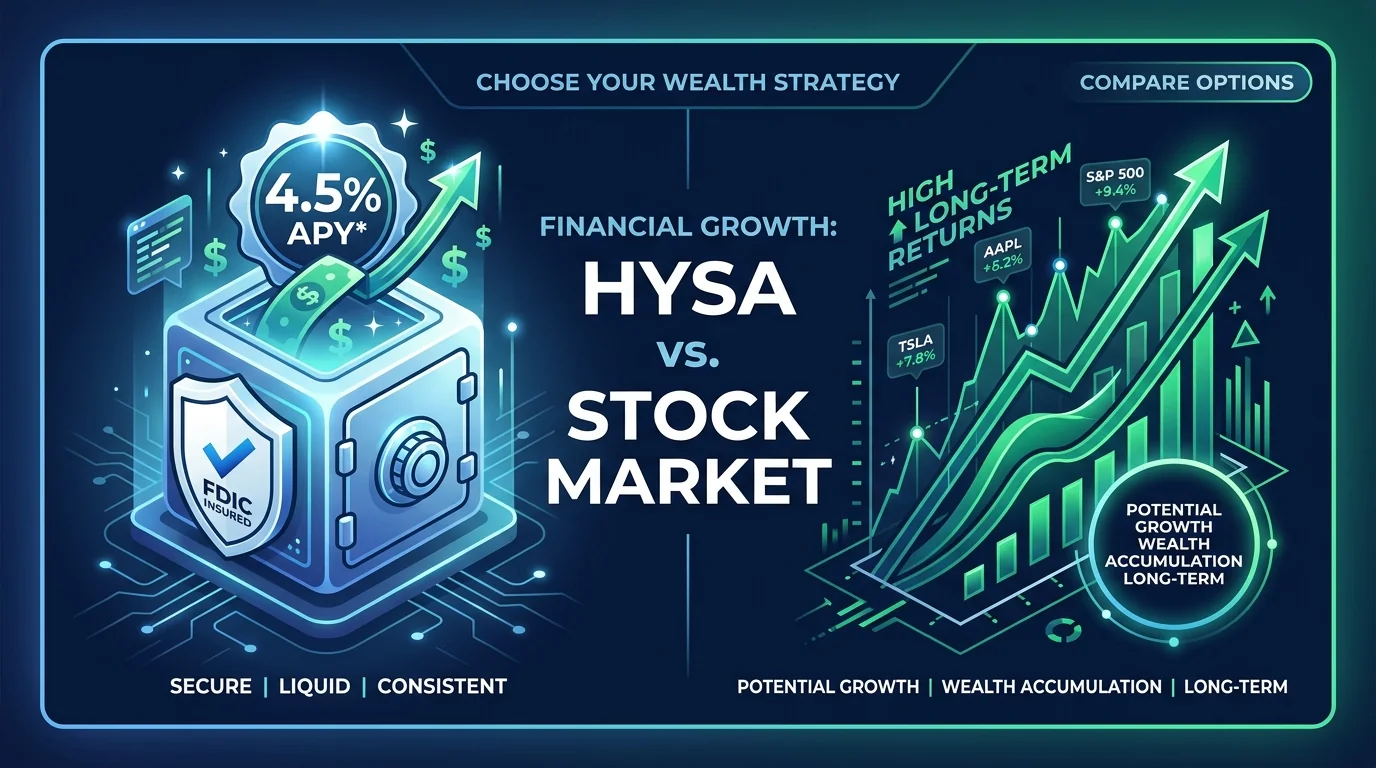
The Core Financial Dilemma: Safe Cash vs. Market Growth
One of the most defining financial decisions you will make is choosing where your hard-earned dollars sleep at night. Should you stash your cash in a secure High-Yield Savings Account (HYSA) earning a guaranteed yield, or should you put your capital to work in the stock market to capture the compounding growth of global enterprise?
With macroeconomic cycles shifting, interest rate environments evolving, and inflation eroding purchasing power, understanding the mathematical and structural mechanics of HYSA vs Stock Market investing is essential. Storing too much money in cash guarantees safety but sacrifices millions in potential compound interest. Conversely, pouring short-term funds into volatile equities can force you to liquidate assets at steep losses during a sudden personal emergency or economic downturn.
In this comprehensive guide, we will analyze the risk-return profiles, taxation nuances, mathematical simulations, and exact allocation blueprints so you know precisely how to position your portfolio for both total peace of mind and aggressive wealth building.
What is a High-Yield Savings Account (HYSA)?
A High-Yield Savings Account (HYSA) is a specialized deposit account offered primarily by online banks and fintech institutions that pays an Annual Percentage Yield (APY) significantly higher than traditional brick-and-mortar savings accounts—often 10x to 15x the national average.
Online banks can offer these competitive rates because they do not carry the massive real estate, maintenance, and branch staffing overhead of legacy commercial banks. They pass these operational savings directly back to account holders in the form of higher interest rates.
Key Advantages of an HYSA:
- 100% FDIC / NCUA Insurance: Deposits are federally insured up to $250,000 per depositor, per insured bank, for each account ownership category. Even in the event of institutional insolvency, your principal is completely safe.
- Zero Capital Volatility: Your account balance never declines due to market crashes, geopolitical turbulence, or economic recessions.
- High Liquidity: Funds can be transferred to your connected checking account within 1 to 3 business days, making it the ideal home for your emergency reserves. Before finalizing your target cash buffer, run your numbers through our interactive Emergency Fund Calculator.
- Daily or Monthly Compound Interest: Interest accrues continuously, creating steady, predictable cash accumulation.
Key Drawbacks of an HYSA:
- Variable Interest Rates: HYSA rates are not locked. When the Federal Reserve adjusts the federal funds target rate downward, bank APYs drop accordingly.
- Inflation Vulnerability: While an HYSA helps buffer inflation, long-term consumer price inflation (CPI) and asset inflation frequently outpace cash interest rates after taxes.
- Ordinary Income Taxation: Every dollar of interest earned is taxed at your highest marginal tax bracket rather than preferential capital gains rates.
What is Stock Market Investing?
Stock market investing involves purchasing fractional ownership shares of publicly traded corporations. When you invest in index funds or exchange-traded funds (ETFs) that track major benchmarks like the S&P 500 or the Total US Stock Market (VTI), you are participating directly in the revenue, profit growth, and dividend distributions of the world’s most productive enterprises.
Over the past century, equity investing has served as the single most accessible engine for individual wealth creation, turning modest monthly contributions into multi-million-dollar retirement portfolios through the mathematical marvel of compound growth.
Key Advantages of Stock Market Investing:
- Superior Historical Returns: Over 20-to-30-year rolling periods, the S&P 500 has generated an annualized nominal return of approximately 10% (around 7% after adjusting for historical inflation).
- Inflation Outperformance: Equities represent ownership in companies that can raise prices, innovate, and grow revenue during inflationary periods, expanding your real purchasing power.
- Favorable Tax Treatment: Equities held in taxable accounts for over a year qualify for long-term capital gains tax rates (0%, 15%, or 20%), which are significantly lower than ordinary income rates. Moreover, investments inside Roth IRAs and 401(k)s can grow completely tax-free.
- Dividend Reinvestment: Reinvesting quarterly dividends accelerates share accumulation without requiring additional out-of-pocket capital.
Key Drawbacks of Stock Market Investing:
- Short-Term Volatility & Downside Risk: Equity markets experience regular corrections (-10%) and bear markets (-20% to -50%). If you need money within a short window, market downturns can force realized losses.
- Zero Federal Insurance on Investment Value: While SIPC protects against brokerage failure, it does not insure against market losses.
- Requires Emotional Discipline: Panic selling during market downturns is the primary reason individual retail investors underperform index benchmarks. If you prefer professional guidance, check our breakdown on DIY vs. Financial Advisor.
Head-to-Head Comparison Matrix: HYSA vs. Stock Market
To clearly contrast how these two financial instruments operate across essential criteria, explore the detailed comparison matrix below:
| Feature / Metric | High-Yield Savings Account (HYSA) | Stock Market (S&P 500 / Index Funds) |
|---|---|---|
| Primary Purpose | Capital preservation, liquidity, safety | Long-term wealth accumulation & growth |
| Average Annual Return | 3.5% – 4.5% APY (rate-dependent) | ~10% historical nominal (~7% real) |
| Risk of Principal Loss | Zero (up to FDIC limits) | Moderate to High in short term; Low over 20+ yrs |
| Federal Protection | FDIC / NCUA insured up to $250,000 | SIPC covers brokerage failure, not market loss |
| Liquidity & Access | Immediate to 1–2 business days | Liquid (T+1 settlement), but selling risks losses |
| Tax Treatment | Ordinary income tax on all interest | Capital gains rates (0/15/20%) or tax-free (IRAs) |
| Inflation Resistance | Poor to Neutral (lags real inflation post-tax) | High (companies expand earnings and pricing) |
| Optimal Time Horizon | 0 to 3 years (Short Horizon) | 5 to 30+ years (Long-Term Lifecycle) |
Mathematical Simulation: The True Cost of Playing It Too Safe
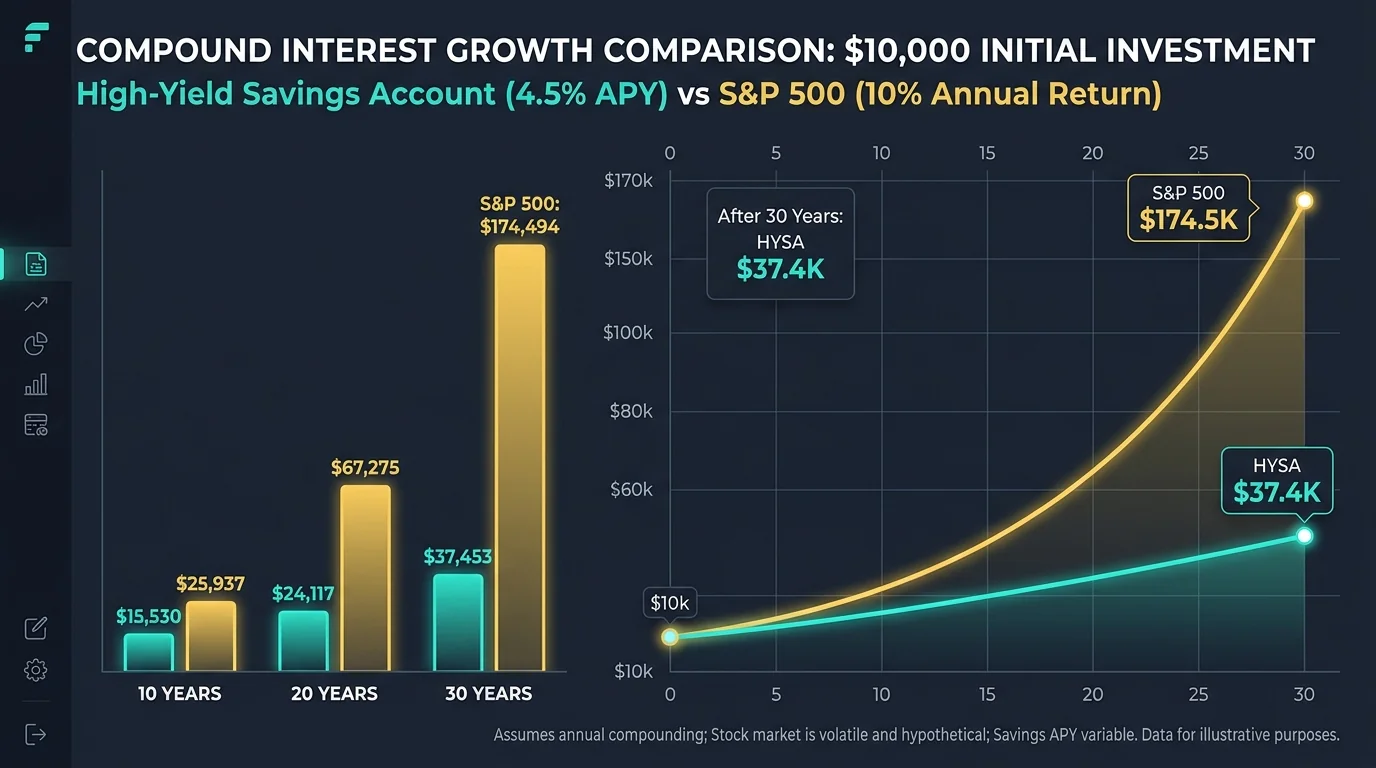
To understand the true divergence between cash savings and stock market investing, let’s examine the mathematical reality of compound interest over time. Suppose you start with a $10,000 initial balance and contribute $500 per month into both options:
- Option A (HYSA): Compounding at a consistent 4.5% APY.
- Option B (Stock Market / S&P 500): Compounding at a historical average of 10.0% annual return.
| Timeframe | Total Contributed | HYSA Balance (4.5% APY) | Stock Market (10.0% Return) | The Wealth Gap |
|---|---|---|---|---|
| 5 Years | $40,000 | $46,558 | $54,849 | +$8,291 |
| 10 Years | $70,000 | $92,624 | $129,566 | +$36,942 |
| 20 Years | $130,000 | $223,380 | $458,574 | +$235,194 |
| 30 Years | $190,000 | $430,303 | $1,330,119 | +$899,816 |
As demonstrated in the simulation above, while both accounts start relatively close in Year 5 ($46k vs $54k), the compounding curve of equity returns goes exponential over 20 and 30 years. Over three decades, keeping long-term money solely in an HYSA results in a wealth gap of nearly $900,000 on identical cash contributions.
Video Breakdown: Saving vs. Investing: Which Makes You $100K Faster?
To see the exact mathematical differences and asset allocation strategies explained visually, watch this breakdown by personal finance author Ramit Sethi:
The Barbell Strategy: How to Use Both for Maximum Wealth
The smartest financial strategy is not picking between an HYSA or the stock market—it is combining them into a resilient “Barbell Allocation Strategy”. The HYSA serves as your ironclad defense, while the stock market serves as your aggressive offense.
Step 1: Build Your 3 to 6-Month Emergency Moat in an HYSA
Before investing a single dollar in equities, calculate your bare-bones monthly living expenses (rent/mortgage, utilities, groceries, insurance, debt minimums). Keep 3 to 6 months of this total in an HYSA. If you are starting from zero, follow our actionable guide on how to save your first $1,000.
Step 2: Eliminate High-Interest Consumer Debt
If you carry credit card balances or personal loans charging 18% to 28% APR, paying off that debt delivers a guaranteed, risk-free return of 18% to 28%—far exceeding any HYSA or stock market return. Use our Debt Payoff Calculator and review the debate on debt-free vs. having debt strategies to eliminate high-interest liabilities quickly.
Step 3: Capture Full Employer 401(k) Matching
An employer 401(k) match represents an instant 50% to 100% return on your money. Always contribute enough to capture the full match before allocating money anywhere else.
Step 4: Maximize Tax-Advantaged Growth (Roth IRA & HSA)
Open a Roth IRA and invest in low-cost, broad-market index funds (such as VOO, VTI, or FXAIX). By contributing after-tax dollars today, all future capital gains and dividend distributions will be 100% tax-free in retirement.
Step 5: Automate Dollar-Cost Averaging for Excess Cashflow
Structure your monthly budget using our Interactive Budget Calculator. Route every surplus dollar into automated weekly or monthly index fund investments. By automating your contributions, you eliminate emotional market timing and harness long-term compounding.
The Decision Framework: Where to Put Your Money Today
Use this straightforward decision tree to determine the right home for any sum of money:
- Put Money in an HYSA if:
- You need the cash within the next 0 to 3 years (e.g., home down payment, wedding, new car, tuition).
- It constitutes your emergency fund (3–6 months of essential expenses).
- You are saving for upcoming annual property taxes or insurance premiums.
- You have zero risk tolerance for temporary paper losses.
- Put Money in the Stock Market if:
- Your investment timeline is 5 years or longer (e.g., retirement, generational wealth, 10-year financial independence).
- Your emergency fund and short-term liabilities are 100% covered.
- You want to beat inflation and compound your wealth exponentially.
- You can remain calm and continue buying during market pullbacks.
Frequently Asked Questions (FAQs)
Yes. High-Yield Savings Accounts (HYSAs) held at FDIC-insured banks are backed by the U.S. federal government up to $250,000 per depositor, per account category. The stock market carries market risk and price volatility, meaning your account balance can drop during economic recessions.
In nominal dollar terms, no, provided your balance is within FDIC/NCUA insurance limits ($250,000). However, in real terms (purchasing power), you can lose value if your after-tax APY interest yield is lower than the prevailing annual inflation rate.
Historically, the S&P 500 has averaged roughly 10% annualized nominal returns over rolling 20-to-30-year periods (~7% after inflation). Top HYSAs yield between 3.5% and 4.5% APY during periods of elevated interest rates and historically average 1.5% to 2.5% across full monetary cycles.
Financial experts recommend keeping 3 to 6 months of core living expenses in an HYSA as an emergency fund before allocating aggressive capital to the stock market. Any planned capital purchases required within the next 1 to 3 years should also remain in an HYSA.
HYSA interest is treated as ordinary income and taxed at your marginal federal and state income tax brackets (up to 37%+). Stocks held in taxable brokerage accounts for more than a year benefit from preferential long-term capital gains tax rates (0%, 15%, or 20%), while retirement accounts like Roth IRAs allow investments to grow completely tax-free.
If you already have a fully funded emergency reserve and an investment horizon greater than 5 years, dollar-cost averaging (DCA) into broad-market index funds (like VOO or VTI) historically creates substantially greater long-term wealth than holding excess cash in an HYSA.
HYSA yields are variable. When the Federal Reserve lowers the benchmark federal funds rate, commercial banks lower their savings APYs. Conversely, stock market valuations often receive a boost from lower borrowing costs and macroeconomic stimulus.
Yes, using a dual-engine Barbell strategy is the gold standard of personal finance: use an HYSA for your liquid financial defense (emergency fund and near-term savings) and broad-market stock index funds for your long-term wealth accumulation offense.
Final Verdict: Choosing Your Optimal Wealth Engine
The choice between an HYSA vs. the stock market is not an all-or-nothing debate. In fact, relying solely on one leaves your financial life exposed: holding only cash guarantees that inflation will erode your purchasing power over time, while placing all your funds in equities leaves you vulnerable to forced selling during unexpected emergencies.
By securing 3 to 6 months of expenses in a high-yield savings account and systematically funneling all remaining surplus cash into diversified index funds, you achieve the ultimate balance of bulletproof short-term liquidity and explosive long-term wealth compounding.

Jaiveer Hooda is a personal finance researcher and the founder of Grow Your Money Smart. With a background in computer engineering, he approaches money the way an engineer approaches any complex system — through data analysis, mathematical modeling, and ruthless optimization.
He built this platform on a single conviction: financial freedom is not a matter of luck. It is a system that can be designed, tested, and executed by anyone willing to follow the right blueprint. Every strategy published here is researched to the numbers, not written to the trend.
Expertise: Debt elimination · Retirement planning · Passive income · Budgeting systems
Connect: Pinterest | growyourmoneysmart.com | Contact Us