
- Zero Minimums Revolution: Thanks to fractional shares and $0-commission brokerages (Fidelity, Charles Schwab, Vanguard), $100/month unlocks the exact same institutional-grade index funds held by top wealth managers.
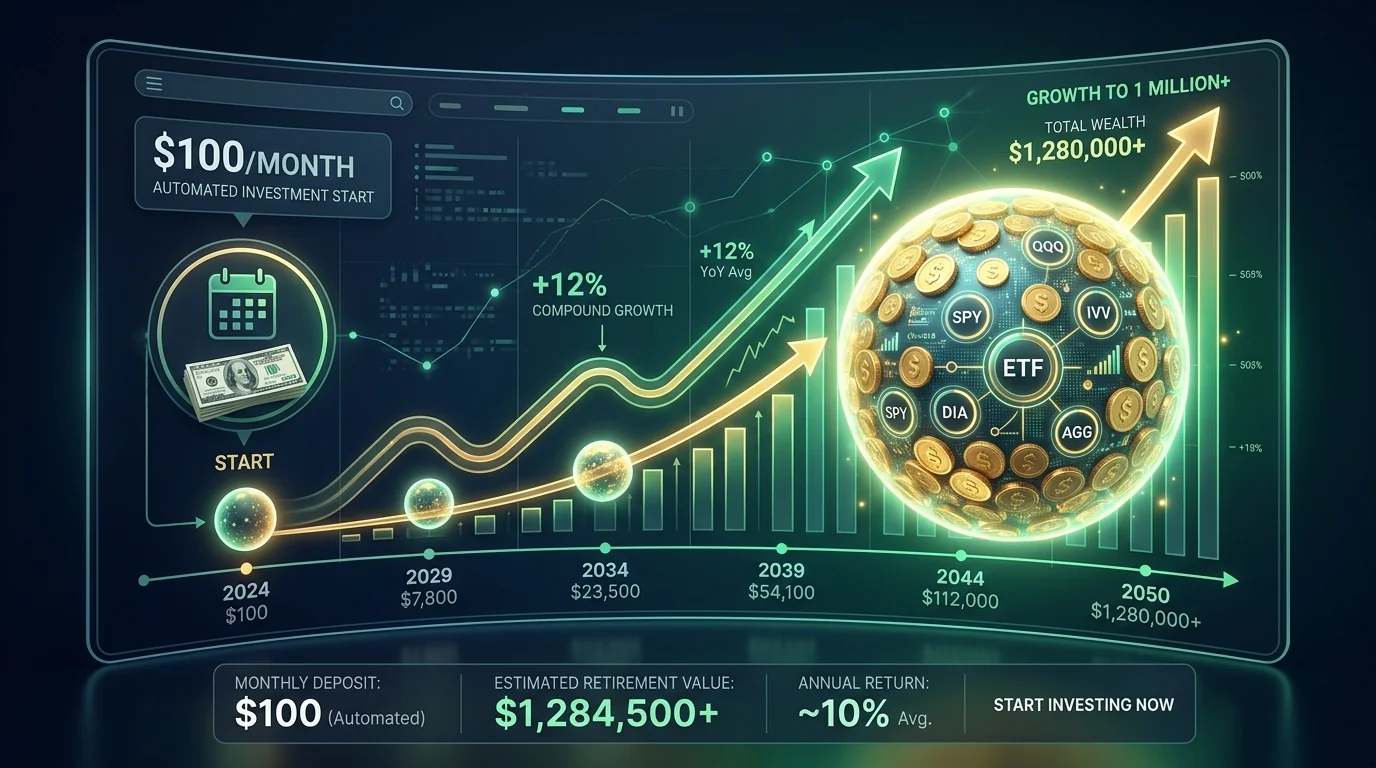
- Compounding Snowball: Investing $100/month ($1,200/year) at a historical 10% S&P 500 average return grows into $20,655 in 10 years, $75,937 in 20 years, and over $227,933 in 30 years ($36,000 contributed vs $191,933 in compound growth).
- Pillar Asset Class: Low-cost broad-market index ETFs (like VOO or VTI) outperform 90%+ of actively managed funds over 15-year horizons with rock-bottom fees (0.03%).
- Prerequisite Checklist: Wipe out toxic high-interest credit card debt using a debt payoff calculator and secure a $1,000 emergency reserve before allocating capital into equities.
A pervasive myth in personal finance insists that building meaningful wealth requires thousands of dollars in upfront capital. In reality, the mathematics of modern wealth creation rewards consistency, automated discipline, and time in the market far more than initial deposit size.
If you have $100 left over each month, you are holding the fundamental seed of a six-figure investment portfolio. Thanks to regulatory shifts, zero-fee index trading, and fractional share brokerage engines, retail investors in 2026 possess institutional leverage previously reserved for Wall Street institutions. Whether you are budgeting on a low income, following our guide to saving your first $1,000, or balancing cash flows using our interactive monthly budget calculator, this master blueprint delivers the exact step-by-step roadmap to turn $100 a month into lasting financial independence.
Foundational Pre-Requisites: Protect Your $100 Investment Engine
Before executing your first market order, disciplined asset allocators follow a strict financial risk filter. Capital allocation is an interconnected system: deploying $100 into equities while paying 24% APR on credit cards is the mathematical equivalent of carrying water in a bucket riddled with holes.
An unexpected expense (car repair, medical copay) shouldn’t force you to liquidate stocks during a temporary market dip. Size your baseline liquidity using our emergency fund calculator and store it in a High-Yield Savings Account (HYSA) earning 4.0% to 5.0% APY.
The broad stock market averages ~10% annual historical returns before inflation. If you hold unsecured debt at 18%–29% APR, paying off that balance delivers an instant, guaranteed return. Review our forensic debt management strategies guide or evaluate debt-free vs strategic leverage comparisons.
The 3 Primary Vehicles for $100/Month: Comparison Matrix
When investing $100 every 30 days, choosing the right asset vehicle dictates your net return after management expense ratios (MER) and tax drag. Here is how the top three beginner pathways compare:
| Strategy / Vehicle | Expense Ratio | Diversification | Time Required | Best Suited For |
|---|---|---|---|---|
| Broad-Market Index ETFs (VOO / VTI) | 0.03% ($0.30/yr per $1,000) | 500 to 3,500+ global companies | 5 mins/month (Automated) | Maximum long-term wealth compounding with near-zero overhead. |
| Automated Robo-Advisors (Betterment / Wealthfront) | 0.25% + underlying ETF fees (~0.33%) | Global equities & bonds | 100% Automated | Hands-off investors wanting automated rebalancing and tax-loss harvesting. |
| Active Individual Stock Picking | $0 Commission (Spread friction) | Very Low (1–5 stocks) | High (10+ hrs/wk) | Experienced market analysts comfortable with single-stock downside volatility. |
For an exhaustive breakdown between mutual funds and passive tracking baskets, explore our definitive analysis on Index Funds vs Mutual Funds for Beginners or compare professional management in our DIY Investing vs Financial Advisor audit.
Compounding Math Simulation: The Multi-Decade Snowball
What does depositing exactly $100 per month generate over 5 to 30 years? The table below illustrates the mathematical power of compound interest assuming an 8% conservative return versus the long-term historical 10% nominal return of the S&P 500 (with dividends reinvested):
| Horizon | Total Cash Invested ($100/mo) | Value at 8% Return | Value at 10% Return | Net Compound Profit (at 10%) |
|---|---|---|---|---|
| 5 Years (60 Mo) | $6,000 | $7,348 | $7,808 | +$1,808 (23% gain) |
| 10 Years (120 Mo) | $12,000 | $18,294 | $20,655 | +$8,655 (72% gain) |
| 20 Years (240 Mo) | $24,000 | $58,902 | $75,937 | +$51,937 (216% gain) |
| 30 Years (360 Mo) | $36,000 | $149,036 | $227,933 | +$191,933 (533% pure profit!) |
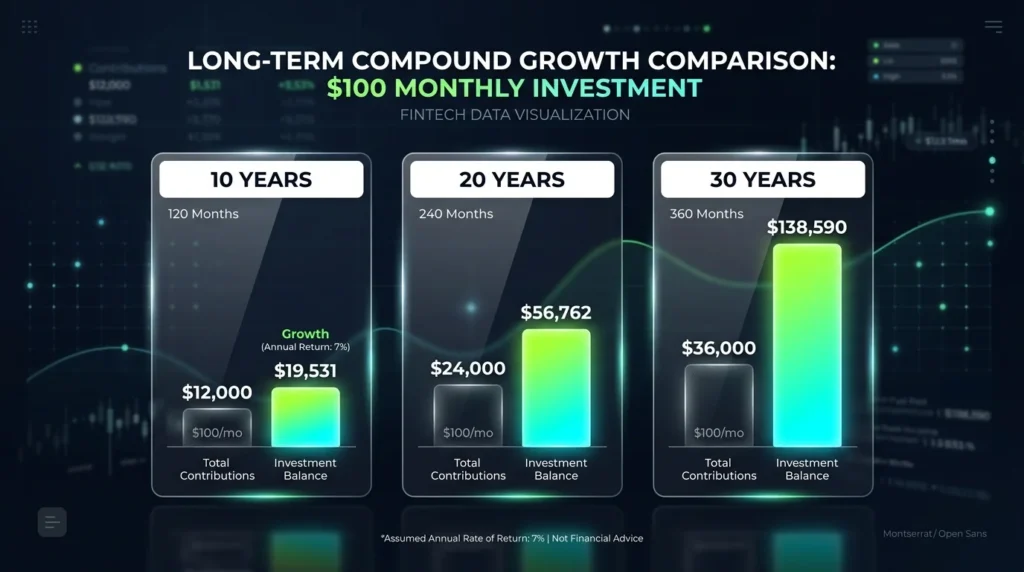
By Year 30, your own out-of-pocket deposits account for only $36,000 (15.8%) of your total balance, while compound growth generated $191,933 (84.2%). To calibrate these milestones across different phases of your career, study our breakdown on the Stages of the Retirement Planning Lifecycle and determine your custom asset allocation using our guide on Understanding Your Investment Time Horizon.
The 4-Step Actionable Execution Blueprint
If your employer offers a 401(k) match, allocate your $100 there first—a 100% match is an instant guaranteed 100% return on investment. If no match is available, open a Roth IRA (Individual Retirement Account). Contributions into a Roth IRA grow 100% tax-free, and all qualified withdrawals in retirement are exempt from capital gains tax.
Select established discount brokerages that offer zero trade commissions, $0 account maintenance fees, and real-time fractional share purchases. Top industry choices include:
- Fidelity Investments: Zero account minimums, zero-fee index funds (FZROX with 0.00% expense ratio), and dollar-based fractional trading.
- Charles Schwab: Renowned customer support, Schwab Stock Slices, and low-cost ETF suites (SCHX / SCHD).
- Vanguard: The gold standard pioneer of passive index funds (VOO, VTI, VXUS).
With $100/month, broad-market simplicity wins over complex multi-stock portfolios:
- The 100% Total Market Portfolio: Put 100% ($100/mo) into VTI (Total US Market) or VOO (S&P 500). This immediately buys you ownership in Apple, Microsoft, Amazon, Nvidia, Alphabet, Berkshire Hathaway, and thousands of top enterprises.
- The Global 2-Fund Portfolio: Allocate 80% ($80/mo) into US Equities (VTI) and 20% ($20/mo) into International Equities (VXUS) for worldwide geographical diversification.
The single highest predictor of investing success is behavioral automation. Link your checking account and schedule an automatic recurring transfer of $100 on the 1st or 15th of every month. By practicing automated Dollar-Cost Averaging (DCA), you automatically buy more shares when markets drop and fewer shares when prices peak, eliminating emotional market timing entirely.
Authority Video Breakdown: How Capital Compounding Works
To visually grasp how capital markets circulate liquidity, price equities, and distribute corporate profits to retail shareholders, watch this acclaimed masterclass from TED-Ed:
⚡ Beginner Portfolio Construction & Compounding Guides
Level up your beginner investing journey with these essential foundation guides:
- Automated Investment Vehicles: Explore our guide on robo-advisors vs target date funds for beginners to automate your portfolio without picking individual tickers.
- Starting Early in Your 20s: Explore our guide on 88x wealth building power in your 20s demonstrating why starting with just $100 in your 20s beats $500 in your 40s.
Frequently Asked Questions
Yes, absolutely. With modern fractional share capabilities and zero trading commissions, $100 per month buys the exact same proportional basket of global equities as an institutional investor with $10 million. Over 30 years at 10% average annual returns, $100/month compounds into more than $227,900.
The consensus best vehicle for beginners is a low-cost, broad-market index fund or ETF, such as the Vanguard S&P 500 ETF (VOO) or Vanguard Total Stock Market ETF (VTI). These funds carry negligible expense ratios (0.03%) and eliminate single-company bankruptcy risk by distributing your $100 across hundreds of top companies.
If your investment horizon is long-term (retirement), a Roth IRA is superior because all capital gains and qualified withdrawals after age 59½ are 100% tax-free. If you anticipate needing to withdraw your investment gains before age 59½ for a house down payment or business venture, a standard taxable brokerage account provides unrestricted liquidity without early withdrawal penalties.
Yes. Brokerages like Fidelity, Charles Schwab, and Robinhood support fractional share trading. If a single share of stock costs $400, your $100 purchase will simply acquire exactly 0.25 shares, earning full proportional dividend payouts and share price appreciation.
Dollar-Cost Averaging is an investment strategy where you invest a fixed dollar amount ($100) on a regular schedule regardless of share price. When the market dips, your $100 automatically buys more shares at a discount; when the market rises, your $100 buys fewer shares. Over time, this smooths out purchase costs and eliminates the psychological risk of trying to time market tops and bottoms.
If you have high-interest debt (such as credit cards with 18% to 29% APR), pay that off first. Paying off a 24% interest debt is equivalent to earning a guaranteed, risk-free 24% return. However, if your debt consists of low-interest fixed debt (such as a 3%–4% mortgage or student loan), investing your $100 monthly into historical 10% market indices often generates greater net mathematical wealth.
Watch out for monthly subscription fees (e.g., micro-investing apps charging $3–$5/month, which represents an enormous 3%–5% drag on a $100 monthly deposit), trading commission fees, account inactivity charges, and high expense ratios in actively managed mutual funds (often 1.0%+). Always choose $0-commission brokerages and passive index ETFs with expense ratios under 0.10%.
You can free up $100/month through targeted micro-budgeting: audit recurring digital subscriptions, renegotiate mobile and auto insurance rates, batch-cook meals 2 days per week, or allocate side-gig income directly to your brokerage account. Check our step-by-step guide on budgeting on a $3,000 monthly income for specific category breakdowns.
Beginning investors should focus on broad-based index funds and low-expense asset allocation strategies backed by federal investor education. Consult the official U.S. Securities and Exchange Commission (SEC) Investor.gov Learning Portal for statutory guidelines and consumer protections.
📈 Low-Cost Indexing & Long-Term Compounding Engines
Scale your $100 monthly contributions into a multi-asset wealth compounding machine with these guides:
- Flagship Index Guide: how to invest in the S&P 500 for beginners — step-by-step account opening, fund selection, and auto-invest setup.
- Vehicle Comparison: ETFs vs index funds for beginners: differences and taxes — choose between fractional-share ETF trading and automated mutual funds.
- Lazy Portfolio Model: the Bogleheads 3-fund portfolio guide — construct a globally diversified equities and fixed income portfolio.
- Deployment Math: dollar-cost averaging vs lump-sum investing math — discover what decades of data prove about regular monthly contributions.
- Tax Shelter Choice: Traditional IRA vs Roth IRA: which is best — shelter your $100/month investments from federal and state dividend taxes.

Jaiveer Hooda is the Lead Financial Researcher & Personal Finance Analyst at Grow Your Money Smart. Specializing in personal wealth optimization, index fund compounding, high-yield savings mechanics, and consumer debt elimination strategies. With a background in computer engineering, he applies mathematical modeling, cashflow simulations, and empirical risk analysis to evaluate personal finance vehicles and credit products. Every analysis is backed by verified regulatory disclosures, IRS tax schedules, and empirical APY compounding math.
Areas of Expertise: Personal Finance · High-Yield Savings Accounts (HYSA) · Index Funds & S&P 500 Compounding · Retirement Planning (401k/IRA) · Debt Optimization · Credit Card APR Mechanics.
Transparency & Editorial Policy: Editorial Standards | Report a Correction