
Comparing mortgage recasts against refinancing requires auditing closing fee disclosures and evaluating break-even amortization schedules. Consult the official Consumer Financial Protection Bureau (CFPB) Mortgage Loan Resources for statutory guidelines and consumer protections.
Make informed housing finance decisions with these companion real estate and liquidity guides:
- Early Payoff Math: paying off mortgage early in 2026 — evaluating return on investment for mortgage lump-sum paydowns.
- 15-Year Timeline: how to pay off a 30-year mortgage in 15 years — cutting 15 years of interest with disciplined principal additions.
- High-Yield Parking: best high-yield savings accounts (HYSA) of 2026 — earning top APY on liquid capital while waiting for mortgage recast triggers.
- Down Payment Guide: how to save for a house down payment fast — budgeting strategies to build your primary home equity fund.
Navigating homeownership in 2026 presents a unique economic dilemma. Millions of homeowners locked in historic 2.75% to 4.0% mortgage rates between 2020 and 2022, while buyers in recent years secured loans at 6.0% to 7.5%. When you receive a financial windfall—such as an inheritance, bonus, or proceeds from selling an asset—you face a high-stakes decision: should you execute a mortgage recast or refinance your loan?
Both strategies lower your monthly housing expenditure, but they operate through fundamentally opposite financial mechanisms. Choosing the wrong route can cost you tens of thousands of dollars in unnecessary closing fees or cause you to surrender an irreplaceable low-interest rate. In this comprehensive 2026 financial guide, we dissect the math, break-even timelines, lender guidelines, and strategic playbooks to reveal precisely which path maximizes your net worth.
- Mortgage Recast: Keeps your existing loan, maturity date, and interest rate intact. You pay a lump sum toward the principal ($5,000+), and the lender re-amortizes your balance for a tiny administrative fee ($150–$500). Zero closing costs, zero credit checks, and zero appraisals.
- Mortgage Refinance: Replaces your old mortgage with a completely new loan, reset term (e.g., 30 or 15 years), and a new interest rate. Requires 2%–5% in closing costs ($6,000–$15,000+), full underwriting, and home appraisal.
- The Golden Rule for 2026: If your current rate is under 5.0%, Recasting is the undisputed winner. If your current rate is 6.5%+ and market rates drop by 0.75%–1.50%+, Refinancing yields superior multi-decade savings if you remain in the home past the break-even horizon.
- Government Loan Restriction: FHA, VA, and USDA loans do not permit recasting; conventional Fannie Mae and Freddie Mac loans do.
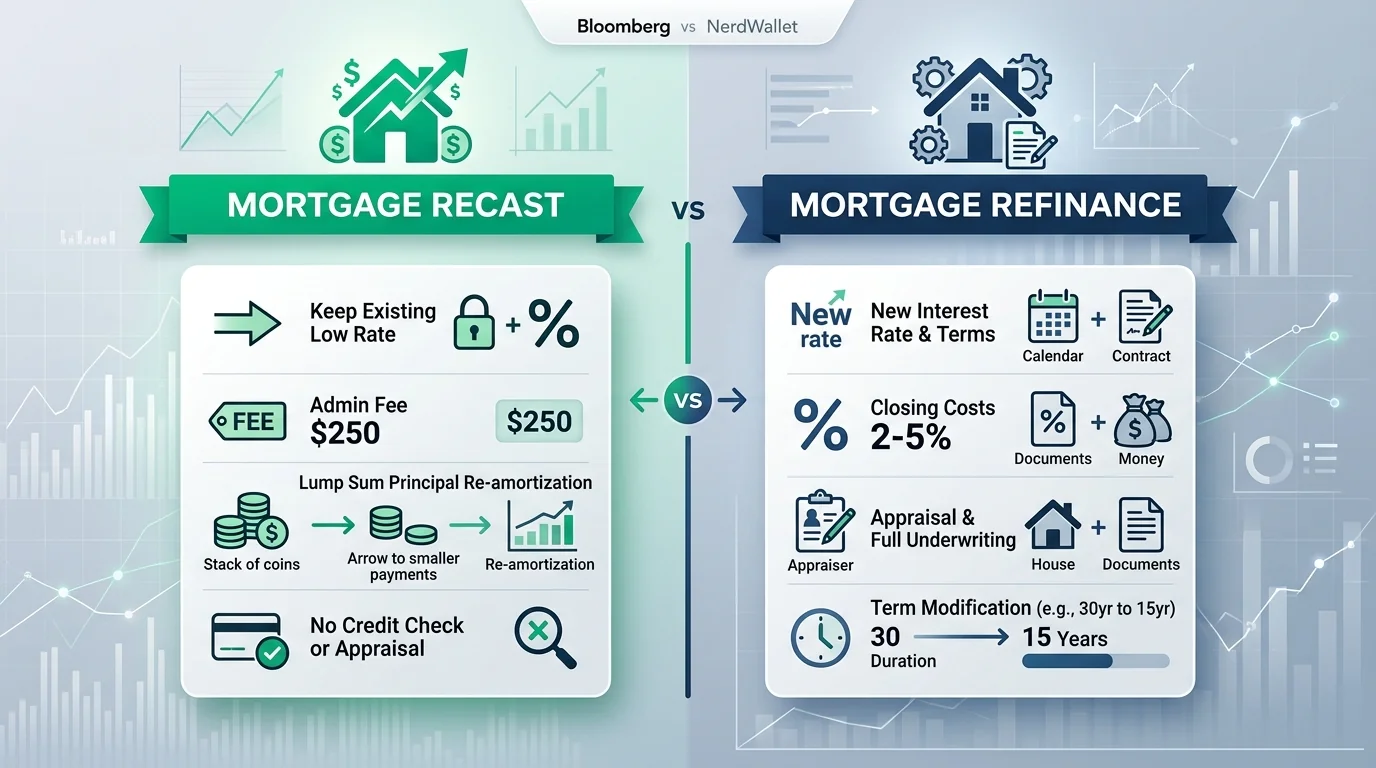
Understanding the Mechanics: What is a Mortgage Recast?
A mortgage recast (also called loan re-amortization) is an administrative adjustment to your existing home loan. When you make a substantial lump-sum payment toward your mortgage principal—typically $5,000, $10,000, or more—your loan balance drops instantly. However, standard mortgage servicing does not automatically lower your scheduled monthly payment; instead, extra payments merely shorten your loan payoff date.
When you formally request a recast, your loan servicer recalculates your monthly principal and interest payment based on the new, reduced balance while keeping your original interest rate and original maturity date unchanged. Because you are not taking out a new loan, you avoid the entire lending bureaucracy. To understand how lump-sum repayments fit into your broader liability strategy, explore our debt management strategies guide.
Key Structural Features of a Mortgage Recast
- Low Administrative Fee: Lenders typically charge a flat fee of $150 to $500 to process the recalculation.
- No Underwriting Friction: No income documentation, tax returns, credit score pulls, or debt-to-income (DTI) recalculations are required.
- No Property Appraisal: You do not need to pay $500–$900 for an appraiser to visit your home.
- Rate Preservation: Perfect for homeowners holding sub-4% mortgage rates who want immediate monthly budget relief without losing their low-cost borrowing.
- Eligibility Constraints: Available on most conventional conforming and jumbo loans, but strictly prohibited on FHA, VA, and USDA mortgages.
What is a Mortgage Refinance and How Does It Work?
A mortgage refinance is the complete replacement of your current mortgage with an entirely new debt contract. You can execute a rate-and-term refinance to secure a lower interest rate or shorten your loan duration (e.g., converting a 30-year mortgage into a 15-year fixed loan), or execute a cash-out refinance to tap accumulated home equity.
Because refinancing originates a brand-new loan, you must go through full mortgage underwriting. This involves submitting W-2s, paystubs, asset statements, paying for a certified home appraisal, purchasing lender’s title insurance, and paying origination and recording fees. Before undertaking substantial new debt commitments, evaluating your overall cash cushions using our emergency fund calculator ensures you don’t deplete essential liquid reserves for closing costs.
Head-to-Head Comparison Matrix: Recast vs. Refinance
To clearly see how these two mortgage restructuring tools stack up across every critical financial metric, review the side-by-side matrix below:
| Feature / Parameter | Mortgage Recast | Mortgage Refinance |
|---|---|---|
| Primary Objective | Lower monthly payment without changing loan terms | Lower interest rate, change term length, or cash out equity |
| Upfront Costs & Fees | $150 to $500 flat processing fee | 2% to 5% of loan balance ($6,000–$15,000+) |
| Interest Rate Impact | Stays 100% identical to current note rate | Changes to prevailing market rate |
| Remaining Loan Term | Unchanged (e.g., 24 years left stays 24 years) | Resets (new 30-year, 20-year, or 15-year term) |
| Lump-Sum Cash Required | Yes ($5,000 to $10,000+ minimum principal paydown) | Optional (can roll closing costs into loan or pay cash) |
| Credit Check & Income Verification | None (Zero credit score impact) | Full Underwriting (Hard credit inquiry, DTI checks) |
| Home Appraisal Required | No | Yes (costs $500–$900; rare waiver exceptions) |
| Processing Timeline | 1 to 3 weeks | 30 to 60 days |
| Eligible Loan Types | Conventional & Jumbo loans | Conventional, FHA, VA, USDA, & Jumbo loans |
| Break-Even Period | Immediate (Month 1) | 24 to 48+ months depending on fees |
Mathematical Simulations: Real-Dollar Scenarios on a $400,000 Loan
Financial decisions must be grounded in exact mathematics. Let’s model three practical scenarios on a homeowner with an existing $400,000 mortgage balance with 25 years (300 months) remaining on their original 30-year fixed loan.
Scenario A: The 6.5% Rate Homeowner with $50,000 Windfall (Recast vs. 5.25% Refinance)
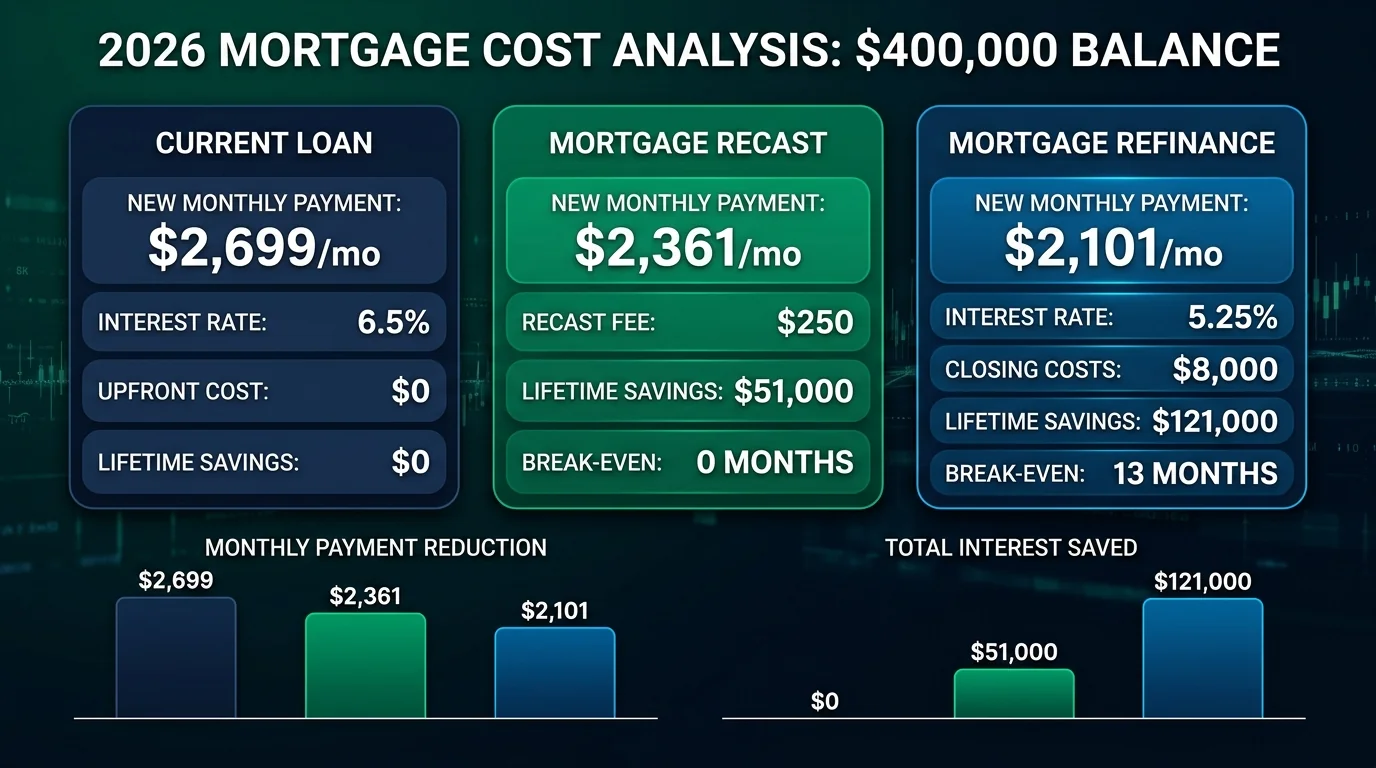
Suppose you bought your home during recent peak rates at 6.50%. Your current monthly Principal & Interest (P&I) payment is $2,698.83. You receive a $50,000 corporate bonus or inheritance. You compare recasting the $50,000 vs. refinancing to a new 25-year fixed loan at 5.25% with $8,000 closing costs.
| Metric | Current Baseline | Option 1: Recast ($50k Lump Sum) | Option 2: Refinance (5.25% New Loan) |
|---|---|---|---|
| New Principal Balance | $400,000 | $350,000 | $400,000 (or $350k if $50k applied) |
| Interest Rate | 6.50% | 6.50% | 5.25% |
| Upfront Closing Costs | $0 | $250 | $8,000 |
| New Monthly P&I Payment | $2,698.83 | $2,361.48 | $2,100.91 (with $50k paydown) |
| Monthly Cash Flow Relief | $0 | +$337.35 / mo | +$597.92 / mo |
| Break-Even Horizon | N/A | 0.7 months (under 1 month) | 13.4 months ($8,000 / $597.92) |
| Total 25-Year Interest Cost | $409,649 | $358,443 | $280,273 |
| Net Lifetime Interest Savings | $0 | +$50,956 net savings | +$121,376 net savings |
The Strategic Takeaway: Because the interest rate dropped by 1.25% (from 6.50% to 5.25%), refinancing yields an extra $70,420 in lifetime net savings over the recast, even after paying $8,000 in closing costs. The break-even period is just 13.4 months. If you plan to remain in the property for more than 2 years, refinancing is mathematically superior.
Scenario B: The 3.25% “Golden Handcuffs” Rate (Why Refinancing is a Costly Mistake)
Now consider a homeowner who locked in a 3.25% interest rate in 2021 with a remaining balance of $350,000. They have $40,000 in cash and desire lower monthly payments to free up cash flow for their children’s college tuition.
- If they Refinance in 2026 (at prevailing 6.00% market rate): Refinancing to a higher rate makes zero financial sense. Their monthly payment would skyrocket, and lifetime interest costs would surge by over $160,000.
- If they Recast with $40,000 (at existing 3.25% rate): They pay a flat $250 fee. Their monthly P&I payment drops from $1,673.28 to $1,482.05, generating an instant $191.23/month in permanent budget savings while preserving their sub-market asset.
For individuals managing multiple liability streams, pairing mortgage recasting with structured amortization acceleration is a cornerstone of smart wealth building. See our analysis on debt-free vs. having debt strategies to optimize your capital deployment.
Video Walkthrough: Recasting vs. Refinancing Cost Breakdown
To visualize the step-by-step math and avoid common lender traps when contacting your loan servicer, watch this deep-dive walkthrough:
How to Calculate Your Refinance Break-Even Point in 2026
The decisive factor when deciding whether to refinance is your Break-Even Period. This is the exact number of months required for your monthly interest savings to surpass your upfront closing costs.
Use this simple formula:
Break-Even Horizon (Months) = Total Out-of-Pocket Closing Costs ÷ Monthly Payment Savings
Example: If your refinance closing costs total $7,500 and your new monthly payment is $250 lower:
- $7,500 ÷ $250 = 30 Months (2.5 Years) to break even.
- Decision Rule: If you plan to sell the property or move within 2 years, you will lose money on the refinance. If you plan to remain in the home for 5 to 10+ years, refinancing is a lucrative wealth-building maneuver.
To run comprehensive simulations on your overall debt payoffs and interest reduction trajectories, utilize our free interactive debt payoff calculator.
Step-by-Step 5-Stage Decision Framework: Which Saves You More?
Follow this 5-step framework to choose the mathematically optimal path for your specific mortgage portfolio:
Step 1: Check Your Loan Eligibility
Call your loan servicer (e.g., Chase, Wells Fargo, Rocket Mortgage, PennyMac, or Mr. Cooper) and ask: “Does my conventional loan program qualify for principal re-amortization / recasting?” Verify their minimum lump-sum requirement (usually $5,000–$10,000) and administrative fee ($150–$500). If you have an FHA or VA loan, recasting is off the table; you must evaluate an FHA Streamline or VA IRRRL refinance instead.
Step 2: Compare Your Current Rate to Prevailing Market Rates
Examine today’s 30-year fixed and 15-year fixed rates. If market rates are equal to or higher than your current rate, eliminate refinancing immediately—recasting is your only logical choice. If market rates are 0.75% to 1.50%+ lower than your current rate, proceed to Step 3.
Step 3: Calculate Your Tenancy Horizon
How long will you live in this home before selling or relocating? If your horizon is shorter than 24 to 36 months, high closing costs will consume all monthly savings. Choose recasting to preserve cash flexibility with zero break-even latency.
Step 4: Assess Liquid Reserves vs. Capital Deployment
Recasting locks up substantial liquid cash ($10k–$50k+) directly into home equity. Ensure you maintain at least 3 to 6 months of living expenses in high-yield cash equivalents. For strategic budgeting allocations across your household income, test your numbers in our budgets calculator.
Step 5: Review Retirement & Long-Term Asset Horizons
If you are within 5 to 10 years of retirement, recasting or refinancing into a 15-year mortgage to enter retirement debt-free is a powerful risk-mitigation strategy. Check our comprehensive guide on stages of retirement planning lifecycle and determine whether consulting an independent fiduciary via our DIY vs. financial advisor comparison fits your situation.
Frequently Asked Questions (FAQs)
Below are clear, actionable answers to the most common questions homeowners ask when comparing mortgage recasting and refinancing:
A mortgage recast keeps your existing loan, interest rate, and original term intact while re-amortizing your monthly payments after you apply a lump-sum principal payment (typically requiring only a $150 to $500 administrative fee). In contrast, a refinance completely replaces your existing mortgage with a new loan, new interest rate, and new loan term, requiring full underwriting and 2% to 5% in closing costs.
No. A mortgage recast does not change your interest rate. Your existing interest rate remains identical. However, because you reduce the loan principal through a lump-sum payment, your total interest paid over the remaining loan term decreases significantly.
Recasting a mortgage is exceptionally inexpensive, typically costing a flat administrative processing fee between $150 and $500. There are no appraisal fees, title insurance premiums, credit check charges, or origination costs involved.
Government-backed loans, including FHA, VA, and USDA loans, generally do not permit mortgage recasting under federal guidelines. Recasting is primarily available on conforming conventional loans (backed by Fannie Mae and Freddie Mac) and select jumbo mortgages. Borrowers with government loans must pursue a refinance (such as a VA IRRRL or FHA Streamline) to adjust payments.
Most conventional lenders require a minimum lump-sum principal reduction of $5,000 to $10,000, or at least 10% of the remaining principal balance, to approve a mortgage recast request.
No. Recasting preserves your original maturity date and remaining term. If you had 23 years left on a 30-year mortgage, you will still have 23 years remaining after the recast, but your monthly required payment will be smaller.
Refinancing saves more money when prevailing market interest rates drop by at least 0.75% to 1.50% below your current note rate, and you plan to stay in the property well beyond the break-even period required to recover the 2% to 5% closing costs.
No. Because you are modifying an existing mortgage with your current loan servicer and not borrowing new funds, recasting requires zero credit checks, zero income verifications, and zero property appraisals.

Jaiveer Hooda is the Lead Financial Researcher & Personal Finance Analyst at Grow Your Money Smart. Specializing in personal wealth optimization, index fund compounding, high-yield savings mechanics, and consumer debt elimination strategies. With a background in computer engineering, he applies mathematical modeling, cashflow simulations, and empirical risk analysis to evaluate personal finance vehicles and credit products. Every analysis is backed by verified regulatory disclosures, IRS tax schedules, and empirical APY compounding math.
Areas of Expertise: Personal Finance · High-Yield Savings Accounts (HYSA) · Index Funds & S&P 500 Compounding · Retirement Planning (401k/IRA) · Debt Optimization · Credit Card APR Mechanics.
Transparency & Editorial Policy: Editorial Standards | Report a Correction