
ETFs (Exchange-Traded Funds) and Index Mutual Funds track the exact same market indexes, but differ fundamentally in how they trade and how they are taxed. ETFs trade like stocks throughout the day and use an in-kind creation/redemption mechanism that makes them virtually immune to capital gains distributions in taxable accounts. Index mutual funds trade once daily at 4:00 PM EST net asset value (NAV) and allow seamless automated dollar-based investing. For taxable brokerage accounts, pick ETFs; for tax-advantaged retirement accounts like a Roth IRA or 401(k), both perform identically.
30-Second Executive Summary for Beginners
- Underlying Holdings Are Identical: An S&P 500 ETF (such as VOO) holds the exact same 500 companies in the exact same proportions as an S&P 500 Index Mutual Fund (such as VFIAX).
- Tax Efficiency Advantage: In a regular taxable brokerage account, ETFs generate significantly fewer surprise taxable capital gain distributions thanks to institutional “in-kind” redemption.
- Pricing & Trading Mechanics: ETFs price second-by-second with a bid-ask spread; index funds price once per day after the market closes with zero spread.
- Fractional Shares & Minimums: Modern brokerages (Fidelity, Schwab, Vanguard) now allow $1 fractional ETF purchases, eliminating the historic advantage index mutual funds had with low minimums.
When you take your first serious steps into wealth building, you inevitably confront a confusing crossroad: should you put your hard-earned money into Exchange-Traded Funds (ETFs) or traditional Index Mutual Funds?
Financial media frequently uses these two terms interchangeably, creating immense confusion for first-time investors. Both vehicles represent “baskets” of securities designed to mirror a benchmark index rather than beat it through speculative stock picking. However, beneath the surface, the plumbing of how these assets are bought, sold, rebalanced, and taxed by the IRS creates profound real-world differences in your net investment returns over a 20- to 30-year time horizon.
Before allocating capital, mastering these architectural differences ensures you never surrender unnecessary percentage points to tax drag or transaction friction. If you are also evaluating broader asset classes, review our foundational breakdown on Index Funds vs Mutual Funds and align your portfolio with your specific investment time horizon.
Certified Public Accountant Brian Kim explains the structural tax differences and trading mechanics between Index Mutual Funds and ETFs.
The Fundamental Architecture: What Distinguishes an ETF from an Index Fund?
To understand the distinction, consider an analogy: an index is a recipe (for example, “combine the 500 largest publicly traded American corporations weighted by market capitalization”). Both an ETF and an index mutual fund bake the exact same cake. The difference lies entirely in the packaging and distribution.
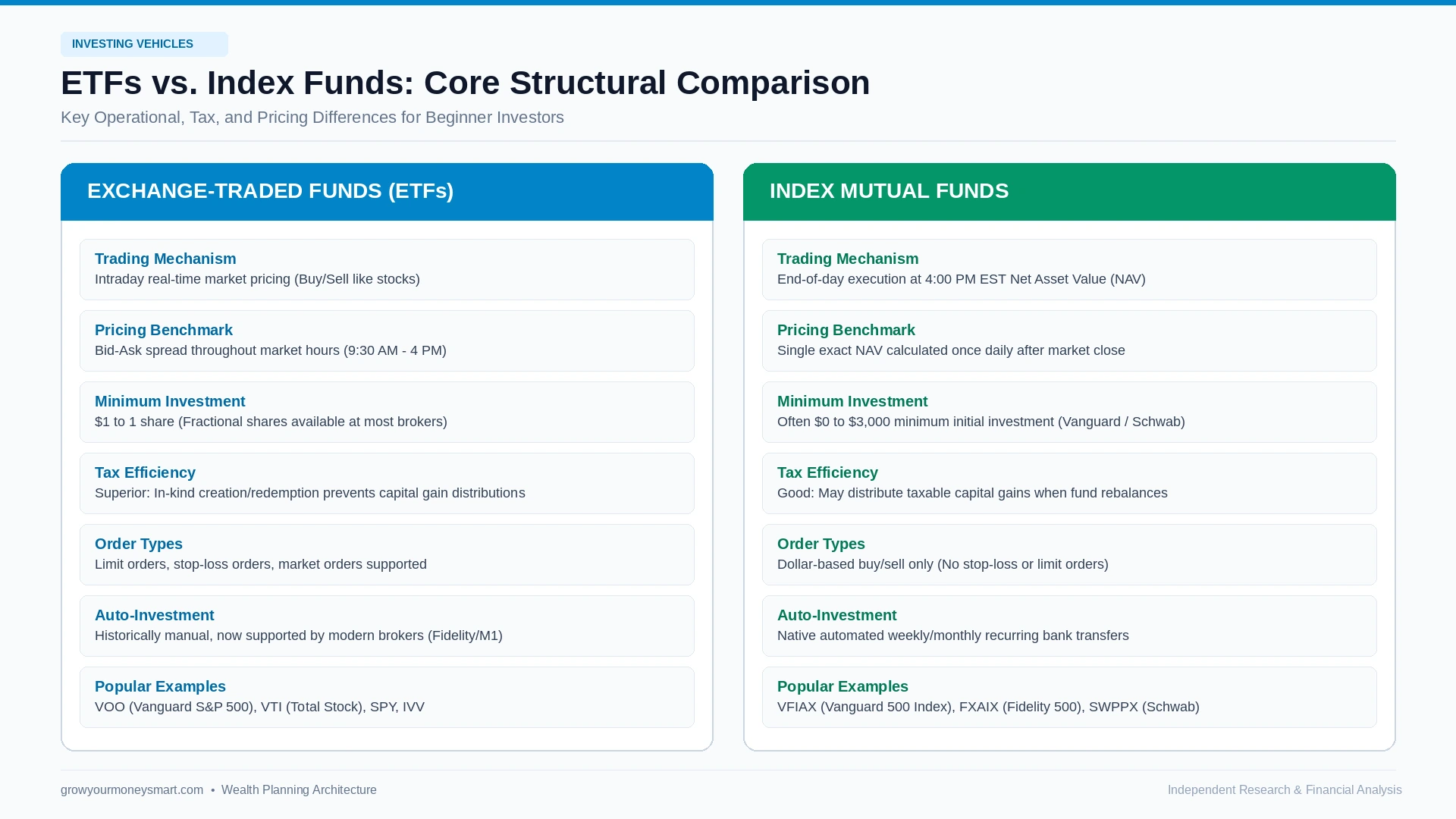
Here is how each vehicle functions when you place an order:
- Exchange-Traded Funds (ETFs): An ETF trades on a public stock exchange (such as the NYSE or Nasdaq) exactly like a share of Apple or Microsoft. You can buy or sell shares at 10:15 AM, 1:30 PM, or 3:55 PM at the exact prevailing market price. You can use advanced order types including limit orders, stop-loss orders, and market orders. Because they trade on the open market, transactions involve a bid-ask spread (the microscopic gap between the highest price a buyer will pay and the lowest price a seller will accept).
- Index Mutual Funds: An index mutual fund does not trade on an exchange. When you submit an order at 11:00 AM, nothing happens immediately. All orders accumulate until 4:00 PM EST market close. The fund accounting team calculates the Net Asset Value (NAV) by totaling the market value of all underlying shares minus liabilities and dividing by outstanding shares. Every investor—regardless of whether they submitted their order at 9:31 AM or 3:59 PM—transacts at that exact single NAV price with zero bid-ask spread.
Head-to-Head Comparison Matrix: The 7 Core Battlegrounds
To see how these operational mechanics impact your day-to-day investing, let us examine the seven critical operational parameters side by side:
| Feature / Parameter | Exchange-Traded Funds (ETFs) | Index Mutual Funds |
|---|---|---|
| Trading Frequency | Intraday real-time pricing (9:30 AM – 4:00 PM EST) | Once daily after 4:00 PM EST market close |
| Pricing Mechanism | Fluctuates continuously; subject to bid-ask spread | Single exact Net Asset Value (NAV); zero spread |
| Initial Minimums | Price of 1 share (or $1 with fractional shares) | $0 (Fidelity/Schwab) to $3,000 (Vanguard Admiral) |
| Tax Efficiency | Superior (In-kind creation/redemption prevents pass-through gains) | Moderate to High (May distribute taxable capital gains upon rebalancing) |
| Order Execution Types | Market, Limit, Stop-Loss, Stop-Limit orders | Dollar-value purchases only (e.g., invest exactly $150.00) |
| Automated Payroll Investing | Supported by modern brokers (Fidelity, Robinhood, M1) | Universally supported natively across all platforms |
| Brokerage Portability | Universal (Transfer via ACATS to any broker with 0 fee) | Restricted (Holding competitor fund can trigger $20–$75 fee) |
The Tax Efficiency Secret: In-Kind Creation & Redemption vs Capital Gains Drag
If you hold investments inside a tax-sheltered account like a Roth IRA or Traditional IRA, tax efficiency does not matter because trades and distributions occur tax-free. However, if you are investing in a standard taxable brokerage account—especially once you have maxed out your 401(k) and IRA limits—understanding how ETFs handle taxes is critical to preventing wealth destruction.
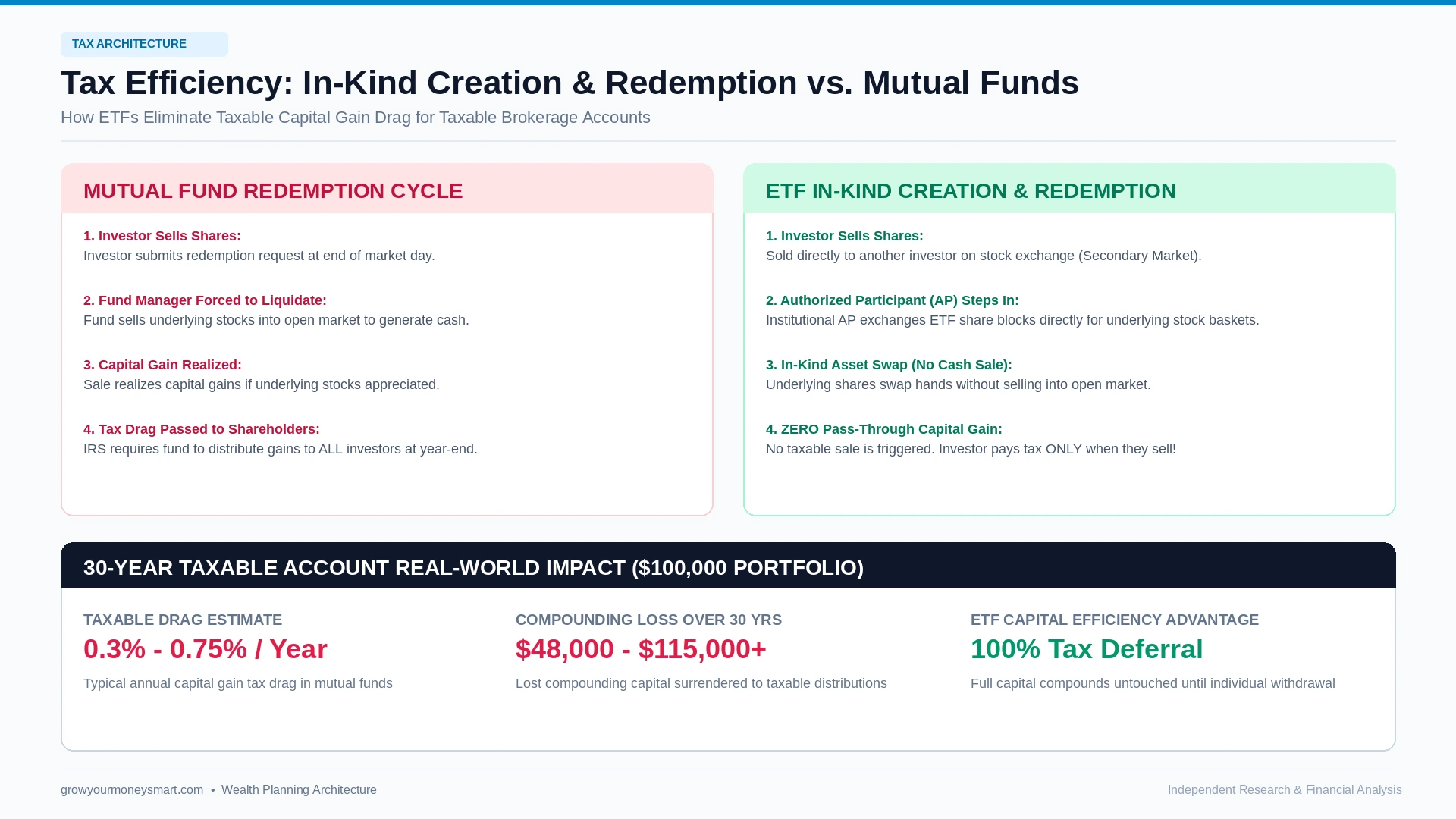
How Traditional Mutual Funds Trigger Unintended Taxes
When market volatility strikes and panicking investors liquidate their holdings in an index mutual fund, the fund manager faces a redemption call. To pay out those leaving investors, the manager must sell underlying stocks held inside the portfolio.
If those stocks were purchased years earlier at lower prices, selling them triggers realized capital gains. Under federal tax law, mutual funds cannot absorb these capital gains internally; they must distribute them to all remaining shareholders at the end of the calendar year. As a buy-and-hold investor who never sold a single share, you receive a Form 1099-DIV in January and owe taxes on gains generated by other investors dumping their shares!
How ETFs Eliminate Pass-Through Capital Gains
ETFs completely circumvent this vulnerability through their In-Kind Creation and Redemption Mechanism, governed by institutional entities called Authorized Participants (APs):
- When you want to sell your ETF shares, you sell them to another investor on the secondary market (the exchange). The fund manager is not involved and sells zero underlying securities.
- If massive selling occurs and the ETF share price temporarily dips below the value of its underlying assets, an Authorized Participant steps in to arbitrage the difference.
- The AP buys excess ETF shares and delivers them directly to the fund issuer in exchange for a custom basket of underlying stock shares.
- Crucially, this exchange is performed in-kind (shares for shares) rather than in cash. Under Section 852(b)(6) of the Internal Revenue Code, in-kind property transfers are non-taxable events. Furthermore, fund issuers strategically hand over their lowest-cost-basis shares to the AP, effectively purging taxable capital gains from the fund entirely.
Vanguard previously held a famous United States patent that allowed its mutual funds (like VFIAX) to exist as a direct share class of its ETFs (like VOO). Because of this shared structure, Vanguard index mutual funds enjoyed the exact same in-kind tax shield as ETFs. However, that patent expired in 2023. While other asset managers can now adopt this structure, standalone ETFs remain the universal gold standard for guaranteed tax efficiency across all brokerages.
Brokerage Minimums & Practical Mechanics: Vanguard vs Fidelity vs Schwab
Historically, beginner investors were pushed toward mutual funds because you could deposit odd sums (such as $25 or $50) and buy fractional shares, whereas ETFs required buying whole shares. In 2026, the retail brokerage landscape has radically evolved.
Here is how the top three low-cost brokerages handle these instruments today:
- Fidelity Investments: The ultimate champion for beginner flexibility. Fidelity offers both zero-expense-ratio index mutual funds (like FZROX and FNILX) with $0 minimums, and allows fractional share purchases of any ETF down to $1.00. You can easily set up automated recurring purchases of VOO or ITOT for $25 every Tuesday.
- Charles Schwab: Schwab provides outstanding index mutual funds with $1 initial minimums (such as SWPPX). However, its fractional share program (“Stock Slices”) currently only applies to individual S&P 500 stocks, not ETFs. Therefore, Schwab investors who want automatic dollar-based payroll investing often prefer Schwab’s native index mutual funds over ETFs.
- Vanguard: The pioneer of index investing maintains a strict distinction. Its premier index mutual funds (Admiral Shares like VFIAX or VTSAX) still require a $3,000 minimum initial investment. Conversely, Vanguard ETFs (like VOO and VTI) have a $1 minimum through Vanguard’s platform with automated fractional share recurring transfers.
Account-by-Account Strategy: Where Should You Hold Each Vehicle?
Portfolio architecture is not about declaring one vehicle universally superior; it is about deploying the right vehicle inside the appropriate tax bucket. Use this battle-tested blueprint:
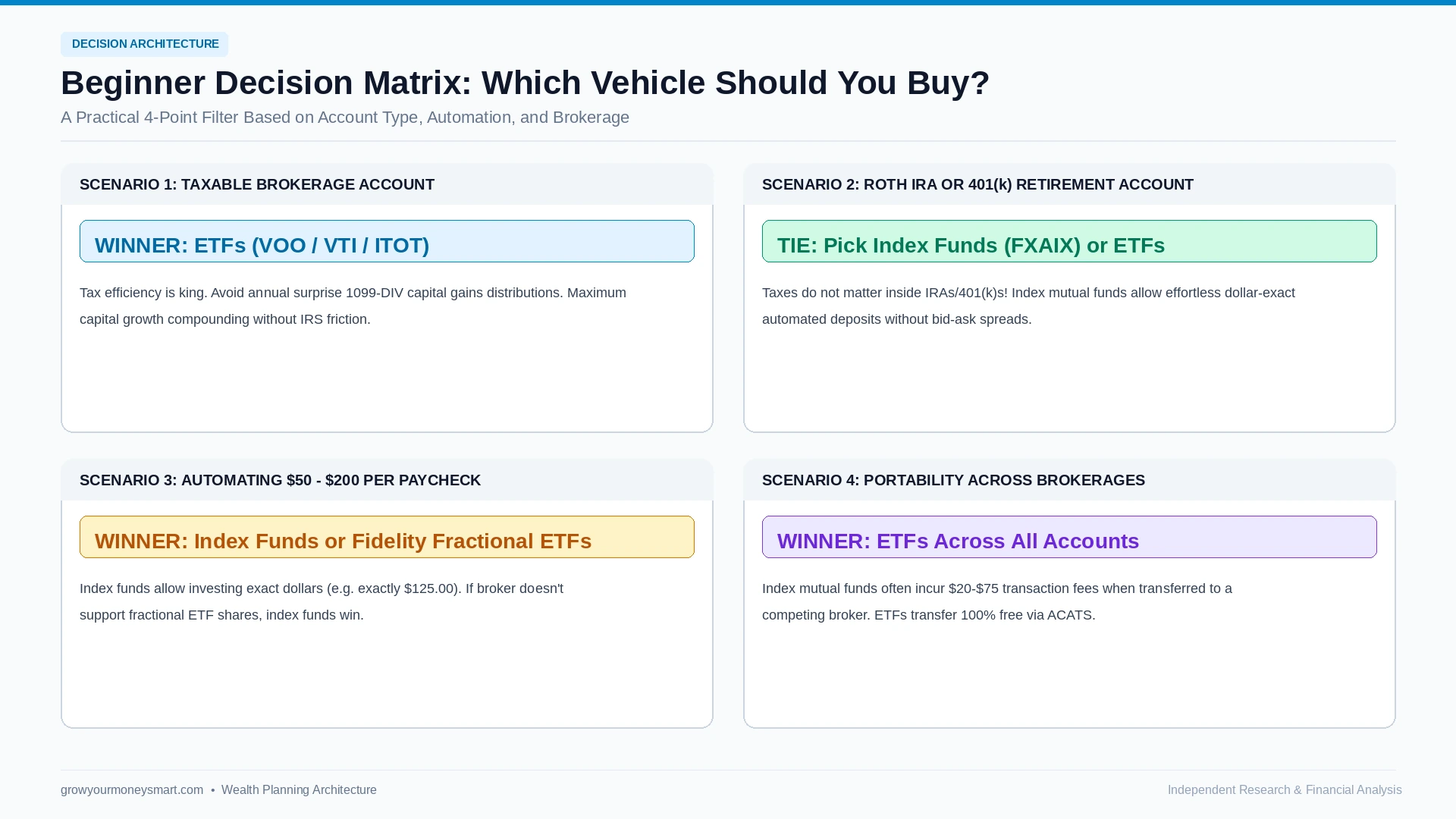
1. Taxable Brokerage Accounts → Choose ETFs
For non-retirement brokerage accounts, ETFs are the undisputed victor. The in-kind redemption shield guarantees that you will not receive phantom capital gain tax distributions during market corrections. You maintain full control over when gains are realized (only when you personally click “Sell”). Furthermore, if you ever decide to switch from Fidelity to Schwab or Vanguard, ETFs transfer seamlessly via ACATS without forcing you to liquidate and trigger taxable gains.
2. Roth IRA & Traditional IRA → Choose Index Mutual Funds (or ETFs)
Inside an IRA, capital gains distributions are non-taxable events. Therefore, the tax efficiency advantage of ETFs vanishes entirely. In this environment, index mutual funds often provide a superior psychological and behavioral experience for beginners:
- Total Hands-Free Automation: You can schedule your bank account to automatically transfer $250 on the 1st and 15th of every month directly into an index fund like FXAIX without worrying about market open hours, bid-ask spreads, or limit orders.
- Zero Day-Trading Temptation: For a completely hands-off automated glidepath that rebalances index funds for you, consider the trade-offs between Robo-Advisors vs Target Date Funds.
Because mutual funds price only once a day after market close, you cannot impulsively panic-sell during an intraday market dip at 11:30 AM.
3. 401(k), 403(b), and 457 Plans → Index Mutual Funds Rule
Most employer-sponsored retirement plans do not offer ETFs. Their recordkeeping systems are built exclusively around mutual fund accounting. Look inside your plan for low-cost institutional index funds tracking the S&P 500 or Total U.S. Stock Market with expense ratios under 0.05%.
Popular Head-to-Head Showdowns: Tickers Analyzed
To ground this in reality, let us examine the most popular index matchups in modern finance:
VOO (ETF): 0.03% Expense Ratio | $1 Minimum | Trades intraday.
VFIAX (Mutual Fund): 0.04% Expense Ratio | $3,000 Minimum | Trades at 4 PM NAV.
Verdict: VOO saves 1 basis point (0.01%) in fees and has no $3,000 entry barrier.
VTI (ETF): 0.03% Expense Ratio | Fractional shares supported.
VTSAX (Mutual Fund): 0.04% Expense Ratio | $3,000 Minimum.
Verdict: VTI is the superior portable choice for taxable brokerage accounts.
IVV (iShares S&P 500 ETF): 0.03% Expense Ratio | Tax-efficient.
FXAIX (Fidelity 500 Index): 0.015% Expense Ratio | $0 Minimum.
Verdict: FXAIX wins inside a Fidelity Roth IRA for razor-thin fees; IVV wins in taxable.
4-Step Action Roadmap for Beginner Investors
If you are ready to start investing today, execute these four actionable steps to avoid common beginner traps:
- Secure Your Cash Foundation First: Never invest money in either ETFs or index funds that you might need within the next 3 to 5 years. Before buying volatile equities, build a robust 3- to 6-month cash reserve parked in a high-yield vehicle. Review our master protocol on the Complete Emergency Fund & HYSA Guide and see how liquid cash compares against equities in HYSA vs Stocks.
- Choose Your Primary Low-Cost Brokerage: Open an account with Fidelity, Vanguard, or Charles Schwab. Avoid high-fee platforms that charge transaction commissions or monthly subscription fees. Even if you only have a modest budget, learn how effortless it is to start investing with $100 a month.
- Match Vehicle to Account Type: If funding a taxable brokerage account, select a broad-market ETF (such as VOO, VTI, or ITOT). If funding a Roth IRA, choose either an ETF or an automated index mutual fund (such as FXAIX or SWPPX).
- Activate Dividend Reinvestment (DRIP): Ensure the DRIP toggle is switched ON in your brokerage settings. Every quarterly dividend payment generated by your fund will automatically purchase additional fractional shares, accelerating your compound growth flywheel without manual intervention.
Frequently Asked Questions (FAQs)
Are ETFs safer than index funds?
Neither is inherently safer from an investment risk standpoint. If both track the S&P 500, they carry the exact same market volatility and underlying stock risk. ETFs carry minor intraday liquidity risk (bid-ask spreads during market turbulence), while mutual funds carry minor tax drag risk in taxable accounts.
Can I lose all my money in an index fund or ETF?
For a broad-market fund like an S&P 500 or Total US Stock Market fund to go to zero, all 500 largest American corporations would have to go bankrupt simultaneously—an apocalyptic scenario where currency itself would cease to hold value. Unlike individual stocks, broad index funds provide extreme structural diversification that prevents total loss.
Do ETFs pay dividends like index mutual funds?
Yes. Whenever underlying companies (such as Microsoft, Apple, or Johnson & Johnson) pay dividends, the ETF issuer collects them and distributes them to shareholders on a regular quarterly schedule. You can receive these payouts as cash or automatically reinvest them through DRIP.
Why do some mutual funds require a $3,000 minimum?
Mutual fund transaction accounting and shareholder servicing carry administrative overhead costs. Firms like Vanguard instituted $3,000 minimums on their Admiral Shares to discourage short-term trading and protect long-term buy-and-hold shareholders from elevated operating costs. ETFs avoid this requirement by trading on open exchanges.
What is a bid-ask spread and does it matter for beginners?
The bid is the highest price someone will pay for an ETF share; the ask is the lowest price a seller will accept. The spread is the difference. For massive, liquid ETFs like VOO or SPY, the spread is typically one cent ($0.01), which is negligible. For small, illiquid specialty ETFs, wide spreads can cost 0.2% to 0.5% upon entry and exit.
Can I convert my index mutual funds to ETFs without paying taxes?
At Vanguard, yes. Because Vanguard’s mutual fund shares and ETFs share a linked corporate structure, Vanguard allows investors to execute a non-taxable internal conversion from mutual fund shares (e.g., VFIAX or VTSAX) into ETF shares (VOO or VTI). At other brokerages like Fidelity or Schwab, converting requires selling the mutual fund before purchasing the ETF.
Which is better for dollar-cost averaging (DCA)?
Index mutual funds were historically best because you could automate exact dollar purchases without leftover cash. However, modern brokerages now offer automated fractional ETF purchases. If your brokerage allows automated fractional ETFs, both vehicles are equally suited for dollar-cost averaging. To decide whether to invest your cash immediately or spread it out, review our analysis of Dollar-Cost Averaging vs Lump Sum.
Should beginners own both ETFs and index funds?
You can hold both, but do not buy an ETF and an index fund tracking the exact same index in the same account. That merely creates redundant paperwork without adding any diversification. It is completely standard, however, to hold index mutual funds inside your 401(k) or IRA while holding ETFs in your taxable brokerage.

Jaiveer Hooda is a personal finance researcher and the founder of Grow Your Money Smart. With a background in computer engineering, he approaches money the way an engineer approaches any complex system — through data analysis, mathematical modeling, and ruthless optimization.
He built this platform on a single conviction: financial freedom is not a matter of luck. It is a system that can be designed, tested, and executed by anyone willing to follow the right blueprint. Every strategy published here is researched to the numbers, not written to the trend.
Expertise: Debt elimination · Retirement planning · Passive income · Budgeting systems
Connect: Pinterest | growyourmoneysmart.com | Contact Us