
- The Math Target: Increasing your monthly principal and interest payment by 35% to 42% on a 30-year fixed loan cuts the loan term in half (from 360 to 180 months) and eliminates up to 55% of total interest fees.
- Massive Dollar Savings: On a $400,000 loan at 6.5% interest, an extra $960/month saves $282,393 in interest and frees up your cash flow 15 years earlier.
- The Flexibility Advantage: Making voluntary extra payments on a 30-year mortgage offers identical interest savings to a 15-year refinance, without closing costs ($3,000–$6,000) or legally mandatory high monthly payments during financial hardship.
- The Biweekly Accelerator: Paying half your monthly mortgage every two weeks generates 13 full payments per year, automatically shaving 4 to 6 years off your loan without altering your core lifestyle.
- Prerequisite Checklist: Never accelerate mortgage paydown until you eliminate high-interest debt, fund a 3–6 month liquid safety reserve, and capture employer 401(k) matching.
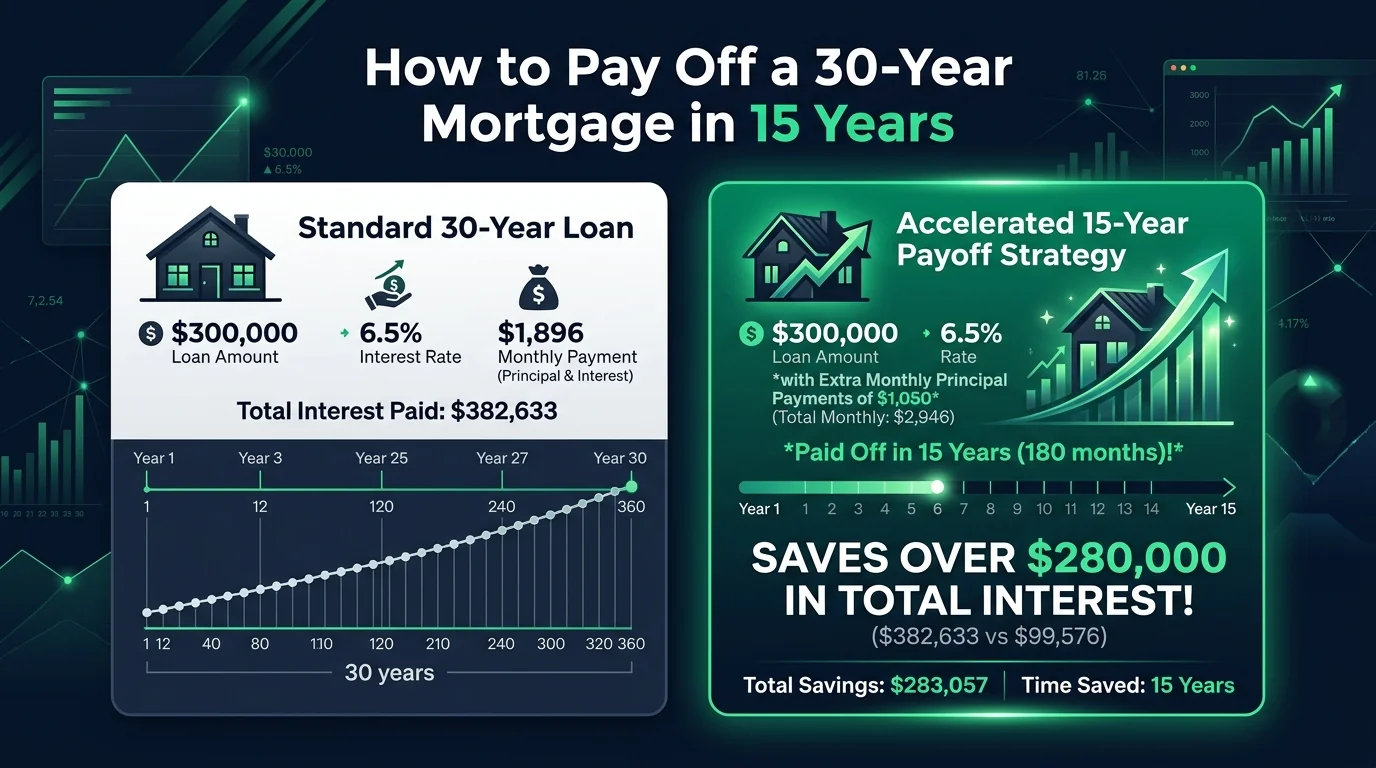
The True Cost of a 30-Year Mortgage: The Front-Loaded Amortization Trap
When you sign a standard 30-year fixed-rate mortgage, the lender presents an attractive, manageable monthly payment. What the closing documents often gloss over is the aggressive reality of front-loaded amortization. In the first 7 to 10 years of a 30-year loan, more than 70% of every dollar you pay goes directly to bank interest, while your actual home equity creeps upward at a glacial pace.
Consider a standard $400,000 mortgage at a 6.50% fixed interest rate. Over the full 360-month term, you will pay $510,177 in interest alone on top of the original $400,000 principal. In essence, you buy your home once for yourself and more than one-and-a-quarter times over for the bank. Learning how to pay off 30-year mortgage in 15 years is not merely a psychological milestone—it is one of the single most powerful wealth-building strategies available to American homeowners, instantly redirecting hundreds of thousands of dollars toward your long-term investment time horizon and retirement independence.
The Exact Math: 30-Year vs 15-Year Payoff Simulations
To pay off a 30-year mortgage in 15 years without refinancing, you must calculate the exact monthly principal payment required to compress 360 amortization cycles into 180 cycles. Below is a detailed mathematical simulation comparing standard 30-year repayment against an accelerated 15-year self-directed strategy across three common loan amounts at prevailing 6.50% interest rates:
| Loan Amount | Standard 30-Yr Payment (P&I) | Total 30-Yr Interest Paid | Accelerated 15-Yr Payment (P&I) | Extra Monthly Principal Needed | Total 15-Yr Interest Paid | Total Interest Saved |
|---|---|---|---|---|---|---|
| $250,000 | $1,580.17 | $318,861 | $2,179.81 | +$599.64 / mo | $142,365 | $176,496 |
| $350,000 | $2,212.24 | $446,405 | $3,051.73 | +$839.49 / mo | $199,311 | $247,094 |
| $400,000 | $2,528.27 | $510,177 | $3,487.69 | +$959.42 / mo | $227,784 | $282,393 |
| $500,000 | $3,160.34 | $637,721 | $4,359.61 | +$1,199.27 / mo | $284,730 | $352,991 |
| $650,000 | $4,108.44 | $829,038 | $5,667.50 | +$1,559.06 / mo | $370,149 | $458,889 |
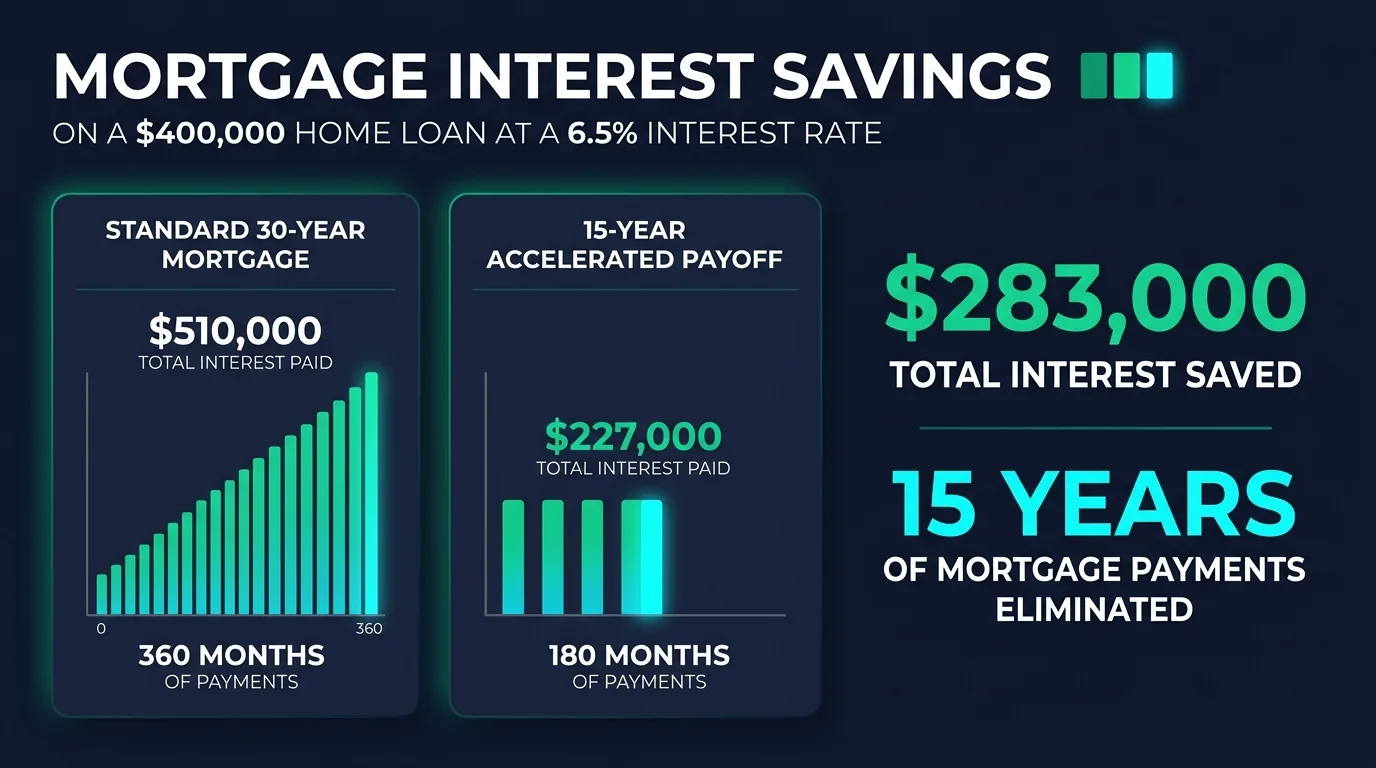
As the table and visual chart illustrate, adding roughly 38% to your baseline payment ($959.42/month on a $400,000 loan) achieves a staggering $282,393 reduction in total interest paid. You bypass 180 monthly payments and build 100% equity in half the time. You can model personalized scenarios using our dedicated debt payoff calculator to see how extra principal alters your specific timeline.
5 Proven Strategies to Pay Off a 30-Year Mortgage in 15 Years
Accelerating your mortgage does not require winning the lottery. It requires an intentional execution framework. Below are the five most effective financial blueprints to shave 15 years off your mortgage timeline:
Strategy 1: The Fixed Extra Monthly Principal Strategy
The most reliable method is calculating the exact 15-year payment on your current balance and setting up an automated monthly recurring transfer with your loan servicer. The critical requirement is ensuring the payment is labeled as a Principal-Only Payment. If you send extra money without checking the principal box, some servicers may apply the cash as an unearned prepayment toward next month’s interest, destroying your compounding savings advantage.
Strategy 2: The Biweekly Mortgage Payment Schedule
If allocating an extra $800 to $1,000 per month feels tight, the biweekly payment schedule is the premier stepping stone. Under this system, you pay half of your regular monthly mortgage bill every two weeks.
Because there are 52 weeks in a calendar year, you make 26 half-payments, which equals 13 full monthly payments per year instead of 12. That single extra monthly payment goes 100% toward the principal balance. On a $400,000 loan, biweekly payments shorten your loan term by 4.5 to 6 years and save over $78,000 in interest automatically. When paired with modest budget optimizations from our budgets calculator, you can easily bridge the remaining gap to hit the 15-year mark.
Strategy 3: The 1/12th Budget Rule
For homeowners whose loan servicers do not support true biweekly processing without charging administrative setup fees, the 1/12th Rule delivers the exact same mathematical benefit with total self-directed control. Divide your current principal and interest payment by 12, and add that figure to every monthly payment. For instance, if your payment is $2,400 per month, adding $200 each month ensures you complete 13 full payments every 12 months with zero third-party fees.
Strategy 4: Windfall Capital Infusions (The Milestone Accelerant)
Lump-sum capital infusions can dramatically truncate your amortization schedule when applied early in the loan lifecycle. Channeling annual tax refunds, performance bonuses, inheritance, or profits from secondary income streams directly to your loan balance produces outsized savings. A single $10,000 lump-sum principal payment in Year 2 of a 6.5% mortgage saves over $28,000 in future cumulative interest fees.
Strategy 5: Mortgage Recasting vs Refinancing into a 15-Year Note
Many homeowners assume that the only way to get a 15-year mortgage is to refinance. However, a mortgage recast is often a vastly superior alternative. When you make a substantial lump-sum principal reduction (typically $5,000 to $10,000+), your lender recalculates your monthly payment based on the remaining balance and term for a modest fee of $250 to $500, with no credit check, no appraisal, and no closing costs. If you continue paying your original, higher monthly amount after recasting, 100% of the surplus goes toward principal, accelerating your payoff while maintaining a low mandatory floor.
Voluntary Extra Payments vs 15-Year Refinancing: The Risk Analysis
Homeowners often debate whether to formally refinance into a 15-year loan or maintain their 30-year loan while paying it off like a 15-year loan. While a 15-year refinance may offer a slightly lower interest rate (historically 0.50% to 0.75% lower), it strips away your financial safety margin. The comparison table below highlights why self-directed 30-year paydown dominates for most families:
| Decision Factor | Extra Payments on 30-Year Loan | Refinancing into 15-Year Loan |
|---|---|---|
| Payment Obligation | Flexible: Extra payment is 100% optional. | Rigid: High monthly payment is legally mandatory. |
| Upfront Closing Costs | $0: No loan origination, appraisal, or title fees. | $3,000 to $6,000+ in closing and settlement fees. |
| Financial Hardship Safety | Revert instantly to lower 30-year baseline if income drops. | Risk of default or foreclosure if income is interrupted. |
| Interest Rate | Current locked 30-year rate. | Typically 0.50% to 0.75% lower fixed rate. |
| Payoff Timeline | 15 Years (when target payment is maintained). | 15 Years (contractually enforced). |
| Ideal For | Disciplined savers seeking maximum cash flow flexibility. | Homeowners seeking forced discipline with secure high income. |
The Opportunity Cost Debate: Pay Off Mortgage Early vs Invest in the Stock Market
One of the most fiercely debated topics in personal finance is whether to accelerate mortgage paydown or invest surplus cash into broad-market index funds (such as the S&P 500). The optimal decision rests on your loan interest rate, risk tolerance, and psychological relationship with debt as explored in our guide on debt-free vs having debt strategies.
Paying down a mortgage with an interest rate of 6.50% to 7.50% offers a guaranteed, risk-free, tax-exempt return of 6.50% to 7.50%. In comparison, while the stock market has delivered a historical annualized return of roughly 10%, that return is volatile and subject to market downturns and capital gains taxation. If your mortgage rate is under 3.5%, investing surplus funds generates greater mathematical wealth. However, at today’s rates above 6%, accelerating your mortgage payoff combines immense guaranteed financial returns with the unmatched psychological freedom of owning your home free and clear.
Prerequisites: 3 Things to Do Before Paying Off Your Mortgage
While being mortgage-free is a transformative financial goal, paying down your mortgage prematurely can leave you “house-rich and cash-poor.” Before channeling an extra dollar toward your home loan, ensure you have established these three foundational pillars:
1. Eliminate All High-Interest Consumer Debt: Credit cards, personal loans, and high-interest auto loans carry rates ranging from 12% to 28%+ APR. Prioritize paying off toxic consumer debts following our comprehensive debt management strategies guide before accelerating your low-rate mortgage.
2. Build a Fully Funded Liquid Emergency Reserve: Equity trapped in home drywall cannot buy groceries or cover medical emergencies during a sudden layoff without taking out a high-cost HELOC. Use our emergency fund calculator to establish a liquid 3-to-6 month cash cushion in a high-yield savings account or check our starter guide on how to save your first $1,000 on low income.
3. Maximize Employer 401(k) Matching: Never sacrifice an immediate 50% to 100% guaranteed return on your 401(k) company match to pay down a mortgage. Ensure your retirement plan lifecycle is fully funded across all stages of retirement planning before directing excess cash flow toward your house.
Step-by-Step Blueprint: How to Execute Your 15-Year Payoff Plan Today
Ready to eliminate your 30-year mortgage in 15 years? Follow this 5-step actionable implementation roadmap:
Step 1: Check for Prepayment Penalties: Review your original promissory note or contact your mortgage servicer to verify that your loan has zero prepayment penalties (standard on nearly all post-2014 residential mortgages).
Step 2: Calculate Your Exact 15-Year Target Payment: Use an amortization calculator with your current loan balance and interest rate to determine the exact monthly dollar figure required to reach a zero balance in 180 months.
Step 3: Configure Automated Principal-Only Recurring Transfers: Log into your mortgage servicer’s online portal and set up an automated monthly payment. Explicitly select the “Additional Principal” or “Principal Only” allocation field.
Step 4: Conduct a Bi-Annual Amortization Audit: Every 6 months, review your mortgage statement to verify that 100% of your extra payments are properly credited to reducing the principal balance rather than held in escrow or prepaying interest.
Step 5: Celebrate Milestones and Consult a Certified Advisor: Track your equity accumulation milestones at 25%, 50%, and 75% loan payoff. If you are balancing complex tax deductions or multi-asset retirement goals, evaluate whether working with a fiduciary via our DIY vs financial advisor guide can optimize your holistic wealth strategy.
⚡ Strategic Mortgage Refinancing & Payoff Guides
Explore alternative loan adjustments to optimize your housing costs:
- Recast Alternative: Explore our guide on mortgage recasting versus traditional refinancing for an instant drop in monthly obligations without changing your interest rate.
- Mathematical Payoff Rules: Explore our guide on early mortgage payoff mathematical strategies to verify whether your mortgage rate justifies aggressive prepayments.
Frequently Asked Questions (FAQs)
Below are clear, actionable answers to the most common questions homeowners ask when planning to pay off their 30-year mortgage early:
To cut a 30-year mortgage down to 15 years, you generally need to increase your monthly principal and interest payment by 35% to 45%, depending on your interest rate. For example, on a $400,000 loan at a 6.5% interest rate, the required 30-year payment is $2,528 per month. Adding an extra $960 per month directly to principal ($3,488 total) pays off the entire balance in exactly 180 months (15 years) and saves $282,393 in interest.
Making voluntary extra principal payments on your existing 30-year loan provides superior cash flow flexibility with zero closing costs. If you face job loss or financial hardship, you can immediately stop the extra payments and revert to your low 30-year baseline. In contrast, refinancing into a 15-year mortgage legally locks you into the higher payment every month and incurs $3,000 to $6,000 in closing fees, making it advantageous only if you secure a substantially lower interest rate (at least 0.75% to 1.00% lower).
When you switch to biweekly payments, you pay half of your monthly mortgage payment every two weeks. Because there are 52 weeks in a calendar year, you make 26 half-payments, which equals 13 full monthly payments per year instead of 12. That single extra monthly payment goes 100% toward principal, automatically shaving 4 to 6 years off a standard 30-year amortization schedule without disrupting your monthly budget.
A principal-only payment immediately reduces the remaining loan balance, which instantly stops interest from accruing on that amount for all future cycles. If you do not explicitly designate your extra payment as ‘Principal Only’ on your lender’s portal, the servicer may treat it as an early advance payment for the next month’s installment, which merely prepays future unaccrued interest without shortening your amortization schedule.
Under the Dodd-Frank Wall Street Reform and Consumer Protection Act, virtually all modern conventional, FHA, VA, and USDA residential mortgages originated after 2014 prohibit prepayment penalties. However, if you hold a specialized private loan, subprime mortgage, or commercial real estate note, check your original promissory note or contact your loan servicer to confirm zero prepayment restrictions.
The decision hinges on your mortgage interest rate versus expected stock market returns. Paying down a mortgage with a 6.5% to 7.5% interest rate provides a guaranteed, risk-free, tax-exempt return equal to the interest rate saved. Conversely, if your mortgage rate is locked below 3.5%, investing surplus cash in broad-market index funds (historical 10% annualized return) yields significantly higher net wealth over a 15-year horizon, provided you have a high risk tolerance.
Mortgage recasting is a servicer feature where you make a lump-sum principal payment (typically $5,000 to $10,000 minimum), and the lender re-amortizes your remaining loan balance over the original term for a nominal administrative fee ($250 to $500) without refinancing. While recasting lowers your mandatory monthly payment, if you continue paying your previous higher amount, the entire difference goes straight to principal, dramatically accelerating your 15-year payoff.
Before putting extra dollars toward your mortgage, ensure you complete three critical financial milestones: eliminate all high-interest consumer debt (credit cards and personal loans charging 15% to 28%+ APR), establish a fully funded 3-to-6 month emergency cash reserve in a high-yield savings account, and capture your full employer 401(k) retirement match.
Homeowners accelerating mortgage amortizations must ensure their lender applies extra payments directly to loan principal rather than prepaid interest. Consult the official Consumer Financial Protection Bureau (CFPB) Owning a Home and Loan Options for statutory guidelines and consumer protections.
📊 Mortgage Payoff Strategies & Down Payment Systems
Expand your real estate wealth playbook with these mortgage restructuring and savings guides:
- Rate Comparison Math: paying off mortgage early math: 3% vs 7% rates — discovering how interest rate climate changes the math on mortgage prepayments.
- Fee-Free Restructuring: mortgage recast vs refinance which saves more money — recalculating monthly amortizations without origination fees.
- Cash Accumulation: saving for a house down payment fast — parking property down payments in high-yield vehicles.
- Debt Acceleration: debt avalanche vs snowball payoff strategies — applying systematic debt payoff rules across all household liabilities.

Jaiveer Hooda is the Lead Financial Researcher & Personal Finance Analyst at Grow Your Money Smart. Specializing in personal wealth optimization, index fund compounding, high-yield savings mechanics, and consumer debt elimination strategies. With a background in computer engineering, he applies mathematical modeling, cashflow simulations, and empirical risk analysis to evaluate personal finance vehicles and credit products. Every analysis is backed by verified regulatory disclosures, IRS tax schedules, and empirical APY compounding math.
Areas of Expertise: Personal Finance · High-Yield Savings Accounts (HYSA) · Index Funds & S&P 500 Compounding · Retirement Planning (401k/IRA) · Debt Optimization · Credit Card APR Mechanics.
Transparency & Editorial Policy: Editorial Standards | Report a Correction