
Under federal consumer protection laws, borrowers have the legal right to request debt validation and dispute inaccurate balance claims. Consult the official Consumer Financial Protection Bureau (CFPB) Debt Collection Rights for statutory guidelines and consumer protections.
Juggling multiple credit cards, personal loans, auto financing, and student debt often feels like trying to plug leaks on a sinking ship. When you scatter your money across four or five different creditors with arbitrary payments, the relentless drag of high compounding interest ensures that your balances barely budge each month. To visualize extra payments accelerating your debt freedom date, download our free monthly budget spreadsheet.
Learning how to prioritize multiple debts is the single most important financial skill you can master to stop leaking cash, lower your stress, and accelerate your timeline to zero debt. By organizing your accounts into a structured mathematical framework, you transform chaotic minimum payments into a focused debt-elimination machine.
- Protect Tier 1 Essentials First: Always pay required minimums on secured shelter (rent/mortgage) and transportation (auto loan) to protect your basic livelihood.
- Crush Toxic High-APR Revolving Debt: Unsecured credit cards charging 20% to 30% APR compound daily and must be your #1 target for accelerated principal payments.
- Choose Your Strategy Engine: Deploy the Debt Avalanche (highest APR first) for maximum mathematical savings, or the Debt Snowball (smallest balance first) for rapid psychological momentum.
- Lock Down a Starter Buffer: Establish a $1,000 to 1-month cash cushion in a high-yield account before aggressive debt payoff to prevent unexpected expenses from forcing new credit card balances.
- Automate Minimums Across All Other Debts: Set automatic minimum payments on every non-target account to safeguard your credit score while directing 100% of excess cash flow into your top priority account.
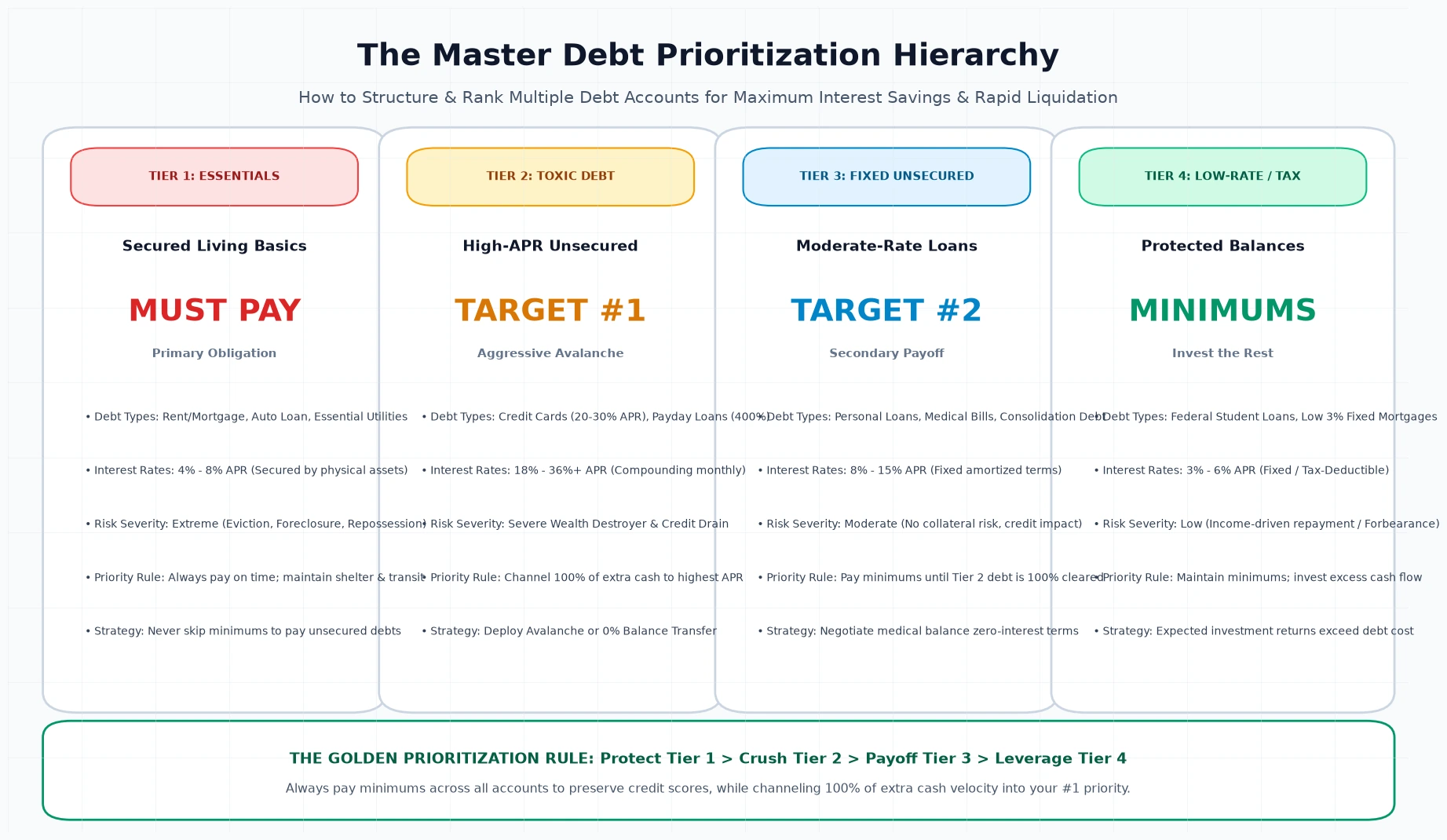
The Debt Prioritization Framework: Secured vs. Unsecured & Toxic vs. Productive
Not all debt is created equal. Treating a 28% APR store credit card the same as a 5% fixed auto loan or a 4.5% federal student loan is a critical mistake that costs borrowers thousands of dollars in unnecessary interest charges.
To prioritize multiple balances effectively, you must categorize every obligation into four distinct structural tiers based on collateral risk, interest rates, and legal protections:
Tier 1: Essential Secured Living Debts (Must Pay)
These debts are attached to physical collateral that directly enables your daily survival and income-earning ability:
- Mortgage / Rent: Missing payments puts you at risk of foreclosure or eviction.
- Primary Vehicle Auto Loan: Defaulting leads to rapid repossession, eliminating your ability to commute to work.
- Core Utilities: Power, water, heating, and primary internet connectivity.
The Golden Rule of Tier 1: Never skip or shortchange Tier 1 payments to pay off unsecured credit card balances. Preserving your living baseline is the foundation of any sustainable debt management strategy.
Tier 2: Toxic High-Interest Revolving Debts (Primary Liquidation Target)
Toxic debt is defined as any unsecured borrowing with variable or compounding interest rates above 18% APR. Because interest compounds continuously on revolving balances, minimum payments on these accounts are almost entirely absorbed by finance charges:
- General Credit Cards & Retail Store Cards (20% – 32% APR): The primary wealth killer in modern household finance.
- Payday Loans & Cash Advances (100% – 400%+ APR): Predatory lending traps that demand immediate emergency payoff or refinancing.
- High-Interest Personal Lines of Credit (18% – 28% APR): Revolving debt that drains monthly cash flow.
Tier 2 debts must receive 100% of your extra cash flow until they are completely eliminated. If you are struggling with large revolving balances, review our blueprint on how to pay off $10k debt in 1 year for actionable pacing schedules.
Tier 3: Fixed Moderate-Interest Unsecured Debts (Secondary Target)
These debts carry fixed amortized repayment schedules with moderate interest rates (typically 8% to 15% APR):
- Unsecured Personal Consolidation Loans (9% – 14% APR): Predictable monthly payments with fixed end dates.
- Medical Debt (0% – 10% APR): Often negotiable down to zero-interest installment plans directly through hospital billing departments.
- Private Student Loans (7% – 12% APR): Lacking federal borrower protections, these require steady fixed payments.
Tier 4: Low-Interest & Protected Debts (Baseline Maintenance)
Debts with fixed interest rates below 6% APR or statutory borrower safety nets should be maintained with regular minimum payments rather than aggressive prepayment:
- Federal Student Loans (3.5% – 6.5% APR): Protected by Income-Driven Repayment (IDR), public service forgiveness, and deferment options.
- Low Fixed Mortgages (2.5% – 5% APR): Long-term low-cost leverage where excess cash yields higher returns in broad market index funds or high-yield savings.
Comparing Debt Prioritization Strategies: Avalanche vs. Snowball vs. Hybrid
Once you have separated your debts into priority tiers, you need an acceleration engine to liquidate your Tier 2 and Tier 3 accounts. The two primary proven frameworks are the Debt Avalanche and the Debt Snowball, along with advanced consolidation hybrids:
| Strategy | Ordering Logic | Primary Advantage | Mathematical Efficiency | Best Suited For |
|---|---|---|---|---|
| Debt Avalanche | Highest APR to Lowest APR | Saves maximum money in compound interest; shortest total payoff duration | 100% Optimal (Lowest total cost) | Analytical individuals, large balances with wide APR variance |
| Debt Snowball | Smallest Balance to Largest Balance | Delivers fast psychological victories; reduces number of open accounts quickly | Moderate (Costs slightly more interest) | Borrowers needing early motivation and quick cash-flow relief |
| 0% APR Balance Transfer Hybrid | Freeze high-APR debt into 0% promo window, then avalanche rest | Halts interest accrual for 15 to 21 months; 100% of payment hits principal | High (Requires strict payoff discipline) | Credit scores 670+ with high credit card balances |
| Consolidation Loan Hybrid | Combine multiple revolving balances into one fixed 36-48 month note | Simplifies multiple due dates into a single predictable monthly payment | Moderate (Lowers weighted average APR) | Borrowers overwhelmed by managing 5+ different account logins |
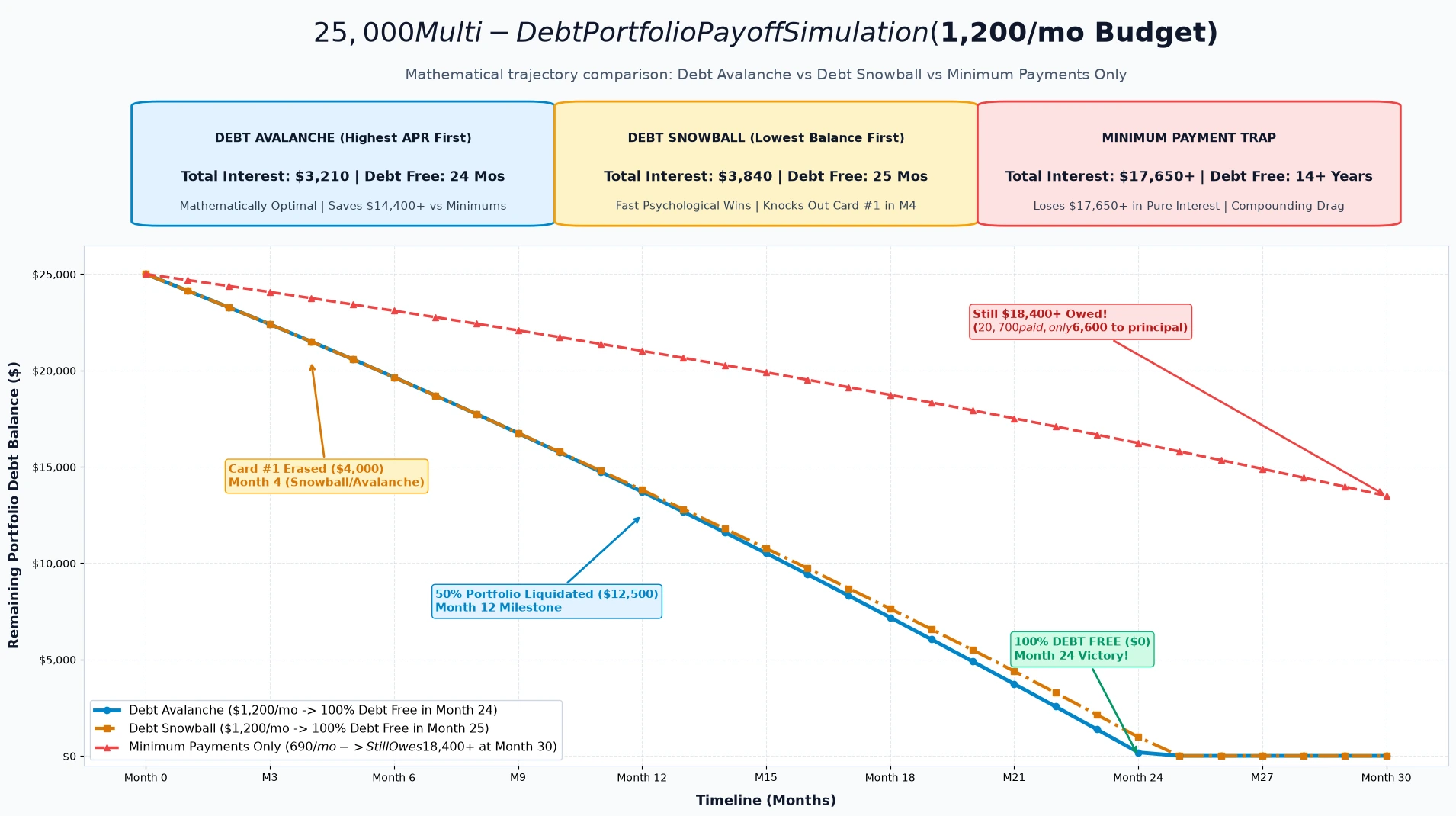
Real-World Mathematical Simulation: Prioritizing a $25,000 Multi-Debt Portfolio
To understand how prioritization transforms your financial outcome, let us examine a realistic multi-account debt portfolio totaling $25,000 across four common credit products:
- Account A (Credit Card #1): $4,000 balance @ 28.99% APR | Minimum payment: $120/month
- Account B (Credit Card #2): $7,500 balance @ 22.49% APR | Minimum payment: $190/month
- Account C (Personal Loan): $8,500 balance @ 12.50% APR | Minimum payment: $220/month
- Account D (Auto Loan): $5,000 balance @ 5.75% APR | Minimum payment: $160/month
Baseline Obligation: Total minimum payments equal $690 per month. If the borrower commits a total monthly debt payoff budget of $1,200 ($690 minimums + $510 extra cash velocity), here is how the different prioritization methods perform:
| Payoff Strategy | Monthly Commitment | Time to Debt-Free | Total Interest Paid | Net Interest Savings |
|---|---|---|---|---|
| Minimum Payments Only | $690 / month (decaying) | 14.2 Years (170 Months) | $17,650+ | $0 (Baseline Trap) |
| Debt Snowball (Lowest Balance First) | $1,200 / month | 25 Months (2.1 Years) | $3,840 | +$13,810 Saved |
| Debt Avalanche (Highest APR First) | $1,200 / month | 24 Months (2.0 Years) | $3,210 | +$14,440 Saved |
| 0% APR Transfer + Avalanche Hybrid | $1,200 / month | 22 Months (1.8 Years) | $1,820 | +$15,830 Saved |
The mathematical results are striking. Sticking to minimum payments costs an astounding $17,650 in pure interest over 14 years. In contrast, channeling an extra $510 per month into a prioritized Debt Avalanche eliminates the entire $25,000 balance in just 24 months, saving $14,440 in cash. You can test your own custom numbers using our interactive debt payoff calculator.
The 5-Step Master Action Blueprint to Prioritize Multiple Debts
Follow this step-by-step roadmap to organize and liquidate your debts with zero guesswork:
Step 1: Conduct a Comprehensive Debt Inventory Audit
Gather every statement and log into all lender portals. Create a centralized spreadsheet containing the following data points for every single account:
- Creditor name and account type (Credit card, personal loan, auto loan, student loan)
- Current outstanding balance
- Exact interest rate (APR)
- Monthly minimum payment due
- Monthly payment due date
Step 2: Establish a $1,000 Starter Safety Buffer
Before throwing every spare dollar at debt reduction, build a starter cash buffer of $1,000 to one month of basic living expenses in a separate high-yield account. If you experience an unexpected car repair or medical copay without cash reserves, you will be forced to swipe a credit card, sabotaging your momentum. Learn how to construct this initial safety net in our guide on how to save your first $1,000 on low income, and calculate your target with our emergency fund calculator.
Step 3: Categorize Balances by Interest Rate and Risk Severity
Separate your secured living essentials (Tier 1) from unsecured debt. Next, highlight all accounts charging over 15% APR. These high-rate revolving accounts represent your primary financial leak and will form your aggressive strike list.
Step 4: Lock In Your Payoff Engine (Avalanche or Snowball)
Decide whether you need maximum interest efficiency or behavioral momentum:
- Choose Debt Avalanche if you are motivated by numbers, want to save the highest dollar amount in interest, and have large balances with steep APR gaps (e.g., 29% credit card vs. 7% loan).
- Choose Debt Snowball if you feel overwhelmed by juggling numerous accounts and need quick psychological wins within 60 to 90 days to stay committed. For a deeper philosophical analysis, explore our guide on debt-free vs. having debt strategies.
Step 5: Automate Minimums and Funnel Extra Cash to Priority #1
Set up automatic monthly bank transfers for the minimum payment due on every account except your top priority. Then, calculate your total monthly surplus using our budgets calculator or our $3,000 monthly budget blueprint, and channel 100% of that extra cash into Account #1. Once Account #1 hits $0, roll its entire payment into Account #2.
Critical Traps to Avoid When Prioritizing Multiple Debts
Even well-intentioned debt payoff plans can derail if you fall into common strategic pitfalls:
- Splitting Extra Payments Equally: Sending an extra $50 to four different cards dilutes your cash velocity and prolongs payoff timelines across all accounts. Concentrate all extra cash into a single target.
- The Minimum Payment Illusion: Making only minimum payments on credit cards extends payoff to 10–20 years because minimum formulas primarily cover interest and fees.
- Raiding 401(k) Retirement Plans: Taking a 401(k) loan to pay off unsecured debt sacrifices compound stock market growth and exposes you to immediate tax penalties if you change employers.
- Closing Credit Cards Immediately After Payoff: Canceling paid-off credit cards reduces your total available credit limit, instantly spiking your credit utilization ratio and lowering your FICO score. Keep accounts open with zero balances.
- Consolidating Without Fixing Cash Flow: Taking out a personal consolidation loan clears your credit cards, but if you do not fix the monthly spending deficit, you risk racking up new card balances alongside the loan payment.
Expert Video Walkthrough: Avalanche vs. Snowball Prioritization
To reinforce these mathematical and behavioral frameworks with visual modeling, watch this detailed educational breakdown by financial educator Humphrey Yang on “How to Payoff Debt: Avalanche vs. Snowball Method”:
Frequently Asked Questions (FAQs)
Below are clear, actionable answers to the most common questions borrowers ask when structuring and prioritizing multiple debt balances:
The mathematically superior order is the Debt Avalanche: rank debts by interest rate (APR) from highest to lowest. Pay minimum payments across all accounts, and funnel all extra cash toward the balance with the highest APR (typically credit cards charging 22% to 30%). Alternatively, the Debt Snowball ranks debts from smallest balance to largest for fast psychological wins.
In almost all cases, you should pay off credit cards before personal loans. Credit cards carry variable, compounding interest rates between 20% and 30% APR, whereas personal loans typically feature fixed APRs between 8% and 15%. Eliminating the highest APR credit cards first saves significantly more money in compound interest.
Always maintain on-time minimum payments on your car loan to protect your vehicle from repossession, but direct extra cash toward credit cards. Auto loans generally have modest interest rates (4% to 8%), whereas credit cards compound at 20% to 30%. Never divert required auto loan payments to pay credit cards.
Multiple debts affect your credit score primarily through credit utilization (which accounts for 30% of your FICO score) and payment history (35%). Maxing out several credit cards creates high utilization, dropping your score. Consistently making on-time minimum payments and paying down revolving balances rapidly improves your score.
Build a starter emergency fund of $1,000 to one month of basic living expenses before aggressively paying off debt. Without this liquid cash buffer, any unexpected expense (such as a car repair or medical bill) will force you back onto high-interest credit cards, restarting the debt cycle.
Yes, debt consolidation can simplify multiple debts into a single monthly payment with a lower fixed interest rate. However, consolidation only succeeds if your underlying spending habits are fixed and you do not run up new balances on the newly cleared credit cards.
Secured debts are backed by collateral (such as a mortgage or auto loan) and must always receive baseline on-time payments to avoid losing your home or transportation. Unsecured debts (credit cards, medical bills) carry no collateral risk but often have higher APRs, making them the primary target for accelerated extra payments.
Generally, no. Keeping the card open preserves your total available credit limit (which lowers your overall credit utilization ratio) and maintains your length of credit history. Keep the card open with zero balance, or charge a single recurring micro-subscription with auto-pay enabled to keep the account active.
Summary: Taking Immediate Command of Your Debt Portfolio
Prioritizing multiple debts is not about relying on willpower; it is about building an automated mathematical system that ruthlessly attacks interest while safeguarding your core living expenses. By organizing your obligations into the 4-Tier Hierarchy, picking a disciplined payoff engine (Avalanche or Snowball), and automating baseline payments, you take permanent control of your financial destiny.
Take 15 minutes today to audit your debt inventory, identify your #1 high-APR target, and direct your first extra payment toward lasting financial freedom.

Jaiveer Hooda is the Lead Financial Researcher & Personal Finance Analyst at Grow Your Money Smart. Specializing in personal wealth optimization, index fund compounding, high-yield savings mechanics, and consumer debt elimination strategies. With a background in computer engineering, he applies mathematical modeling, cashflow simulations, and empirical risk analysis to evaluate personal finance vehicles and credit products. Every analysis is backed by verified regulatory disclosures, IRS tax schedules, and empirical APY compounding math.
Areas of Expertise: Personal Finance · High-Yield Savings Accounts (HYSA) · Index Funds & S&P 500 Compounding · Retirement Planning (401k/IRA) · Debt Optimization · Credit Card APR Mechanics.
Transparency & Editorial Policy: Editorial Standards | Report a Correction