
The choice between Robo-Advisors and Target Date Funds (TDFs) comes down to account type and tax management. For tax-sheltered retirement accounts like a 401(k) or Roth IRA, Target Date Funds (such as Vanguard Target Retirement or Fidelity Freedom Index) are the clear winner due to ultra-low all-in fees (0.08% – 0.12%) with zero advisory markup. For taxable brokerage accounts, Robo-Advisors (such as Betterment or Wealthfront) win decisively because their automated algorithmic Tax-Loss Harvesting (TLH) easily offsets their 0.25% management fee, whereas holding Target Date Funds in taxable accounts exposes you to catastrophic surprise capital gains taxes.
30-Second Executive Summary for Beginners
- Both Provide Total Hands-Off Automation: Both options eliminate stock picking and rebalance your portfolio automatically as you age without manual intervention.
- Fee Comparison: Target Date Funds charge just 0.08% to 0.12% per year ($8–$12 per $10,000). Robo-advisors charge a 0.25% advisory fee plus ~0.08% in underlying ETF costs ($33 per $10,000).
- The Taxable Account Danger: Target Date Funds should never be held in a taxable brokerage account due to mutual fund capital gains distribution risks (the infamous Vanguard 2021 tax fiasco).
- Tax-Loss Harvesting Superpower: In taxable accounts, robo-advisors can generate 0.5% to 1.0%+ in annual “tax alpha,” easily overcoming their 0.25% management fee.
For millions of busy working professionals, the ideal investment strategy is simple: you want your money to compound globally, you want your asset allocation to automatically shift from aggressive to conservative as you approach retirement, and you want to spend literally zero hours per year managing spreadsheets or tracking financial headlines.
To achieve this “set-it-and-forget-it” lifestyle, investors invariably face a modern technological showdown: should you hire a digital Robo-Advisor (like Betterment or Wealthfront) or simply buy a single Target Date Index Fund (from Vanguard, Fidelity, or Charles Schwab)?
While both vehicles deliver hands-free diversification, they operate on completely different cost structures, software capabilities, and tax rules. Choosing the wrong vehicle for your specific account type can cost you thousands of dollars in compounding fees or trigger catastrophic surprise tax bills from the IRS. In this comprehensive master guide, we compare both automated solutions head-to-head, analyze the taxable account trap, and provide the exact decision blueprint for 2026. If you are comparing this against manual portfolio construction, review our foundational guides on The 3-Fund Portfolio, How to Invest in the S&P 500, and ETFs vs Index Funds.
Former investment manager Barbara Friedberg compares Robo-Advisors and Target Date Funds across annual fees, portfolio rebalancing, and tax efficiency.
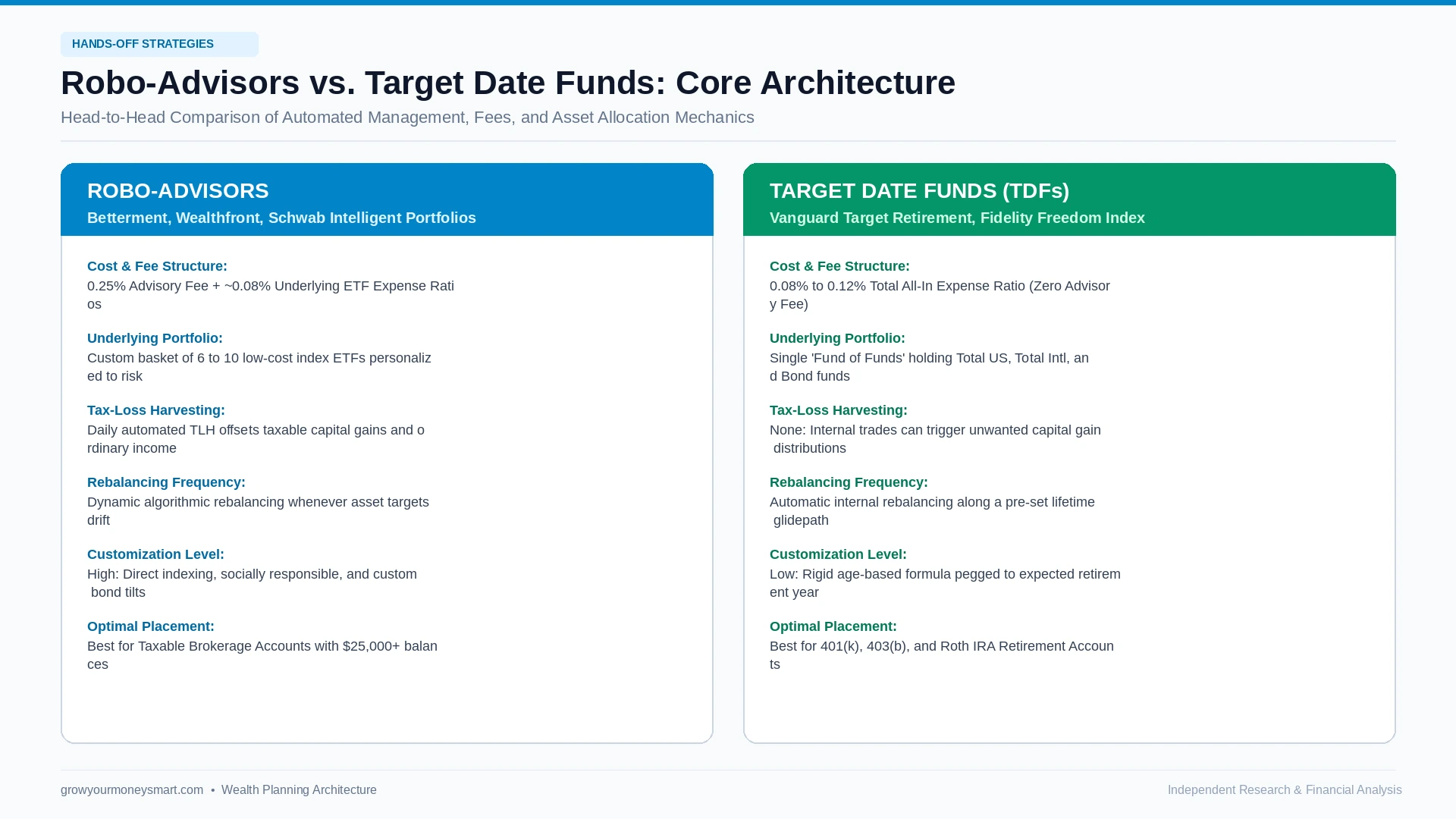
Robo-Advisors vs Target Date Funds: Head-to-Head Architecture
To understand where each option excels, consider how they construct and manage your money behind the scenes:
What Is a Target Date Fund (TDF)?
A Target Date Fund (often called a lifecycle fund) is a “fund of funds” packaged inside a single mutual fund. You choose a fund pegged to your estimated retirement year (for example, Vanguard Target Retirement 2060 Fund).
When you are 30 years away from retirement, the fund holds roughly 90% equities (U.S. and international stocks) for maximum growth. As the calendar approaches your target year, the fund’s internal managers automatically execute a gradual “glidepath,” shifting capital out of volatile stocks and into safe, defensive bonds and cash preservation instruments. You never have to rebalance, trade, or adjust your portfolio—ever.
What Is a Robo-Advisor?
A Robo-Advisor is an automated digital wealth management platform governed by FINRA and SEC regulations. Instead of putting your money into a single pre-packaged mutual fund, the robo-advisor opens a dedicated brokerage account in your name and uses mathematical algorithms to purchase an individualized basket of 6 to 10 low-cost index ETFs.
Robo-advisors continuously monitor your account 24/7. Whenever market movements push your asset allocation out of alignment, the software automatically executes rebalancing trades. Furthermore, premier robo-advisors (such as Wealthfront and Betterment) perform automated daily Tax-Loss Harvesting (TLH), turning market dips into valuable tax deductions.
The Fee Drag Reality: 0.08% vs 0.33% Over 30 Years
The most immediate distinction between these two options is their annual fee structure:
| Fee Component | Target Date Index Funds | Robo-Advisors |
|---|---|---|
| Advisory / Platform Fee | $0.00 (0.0%) | 0.25% / year (Betterment / Wealthfront) |
| Underlying Fund Fees | 0.08% – 0.12% (Vanguard / Fidelity) | 0.06% – 0.09% (Weighted ETF expense ratios) |
| Total Annual All-In Cost | 0.08% – 0.12% ($8–$12 / $10k) | 0.31% – 0.34% ($31–$34 / $10k) |
| 30-Year Compounding Drag ($100k) | ~$28,000 lost to fees | ~$78,000 lost to fees (+$50,000 cost gap) |
Over a 30-year career, an extra 0.25% fee drag on a $100,000 portfolio compounding at 8% per year costs you roughly $50,000 in lost compounding growth. For a robo-advisor to justify this cost, it must deliver tangible economic value that target date funds cannot provide. That value is found entirely in tax efficiency.
The Tax Efficiency Audit: TDF Taxable Trap vs Robo Tax Alpha
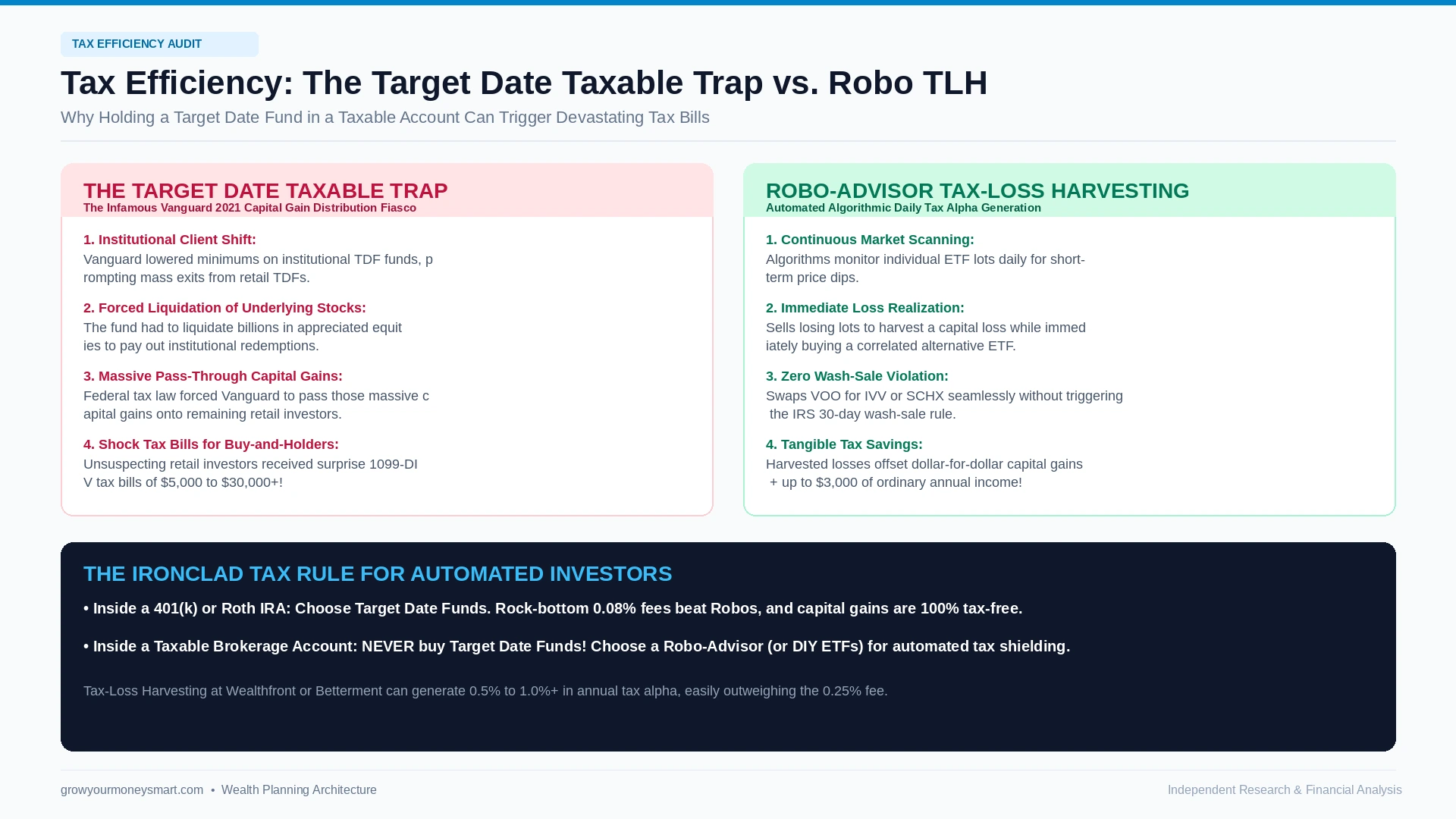
If you are investing inside a retirement account like a Roth IRA or 401(k), taxes do not exist. But if you are investing in a standard taxable brokerage account (once you have maxed out your tax-sheltered accounts), the comparison shifts dramatically:
The Catastrophic Target Date Fund Taxable Trap
In 2021, Vanguard made a routine corporate decision: it lowered the minimum investment threshold on its institutional target-date funds from $100 million down to $5 million. Large corporate 401(k) plans immediately sold billions of dollars out of Vanguard’s retail target date funds to move into the cheaper institutional share class.
To pay out these massive institutional exits, Vanguard’s retail target-date funds were forced to liquidate decades of highly appreciated underlying stocks. Because mutual funds cannot absorb capital gains internally, federal law forced Vanguard to distribute those billions in realized capital gains to all remaining retail shareholders.
Everyday buy-and-hold investors who held Vanguard Target Retirement funds in taxable brokerage accounts—investors who had never sold a single share—received massive surprise Form 1099-DIV statements. Many ordinary working people faced sudden, unexpected tax bills ranging from $5,000 to over $35,000! Lawsuits and SEC inquiries followed, cementing an ironclad financial rule:
Target Date Funds belong exclusively inside tax-sheltered retirement buckets: 401(k)s, 403(b)s, Traditional IRAs, and Roth IRAs. In a tax-advantaged account, internal rebalancing and capital gain distributions are 100% tax-free. Placing a target date mutual fund inside a taxable brokerage account is an unforced financial error.
How Robo-Advisors Generate Real Tax Alpha
In stark contrast, robo-advisors are engineered from the ground up for taxable brokerage accounts:
- 100% ETF Architecture: Robo-advisors hold Exchange-Traded Funds (ETFs), which utilize the institutional in-kind creation and redemption mechanism to eliminate pass-through capital gains distributions (as detailed in our guide on ETFs vs Index Funds).
- Automated Tax-Loss Harvesting (TLH): When market volatility dips an individual ETF into the red (for example, during a 5% market pullback), the robo-advisor’s algorithm automatically sells that losing ETF lot to harvest a tax loss. It immediately reinvests the proceeds into a correlated alternative ETF (swapping VOO for IVV) to stay 100% invested without violating the IRS 30-day wash-sale rule.
- Offsetting Gains & Income: Harvested losses can offset an unlimited amount of capital gains, plus up to $3,000 of ordinary wage income each year. Independent studies show that for investors in high tax brackets with active contributions, TLH can generate between 0.50% and 1.00%+ in net annual tax alpha—more than double the 0.25% advisory fee!
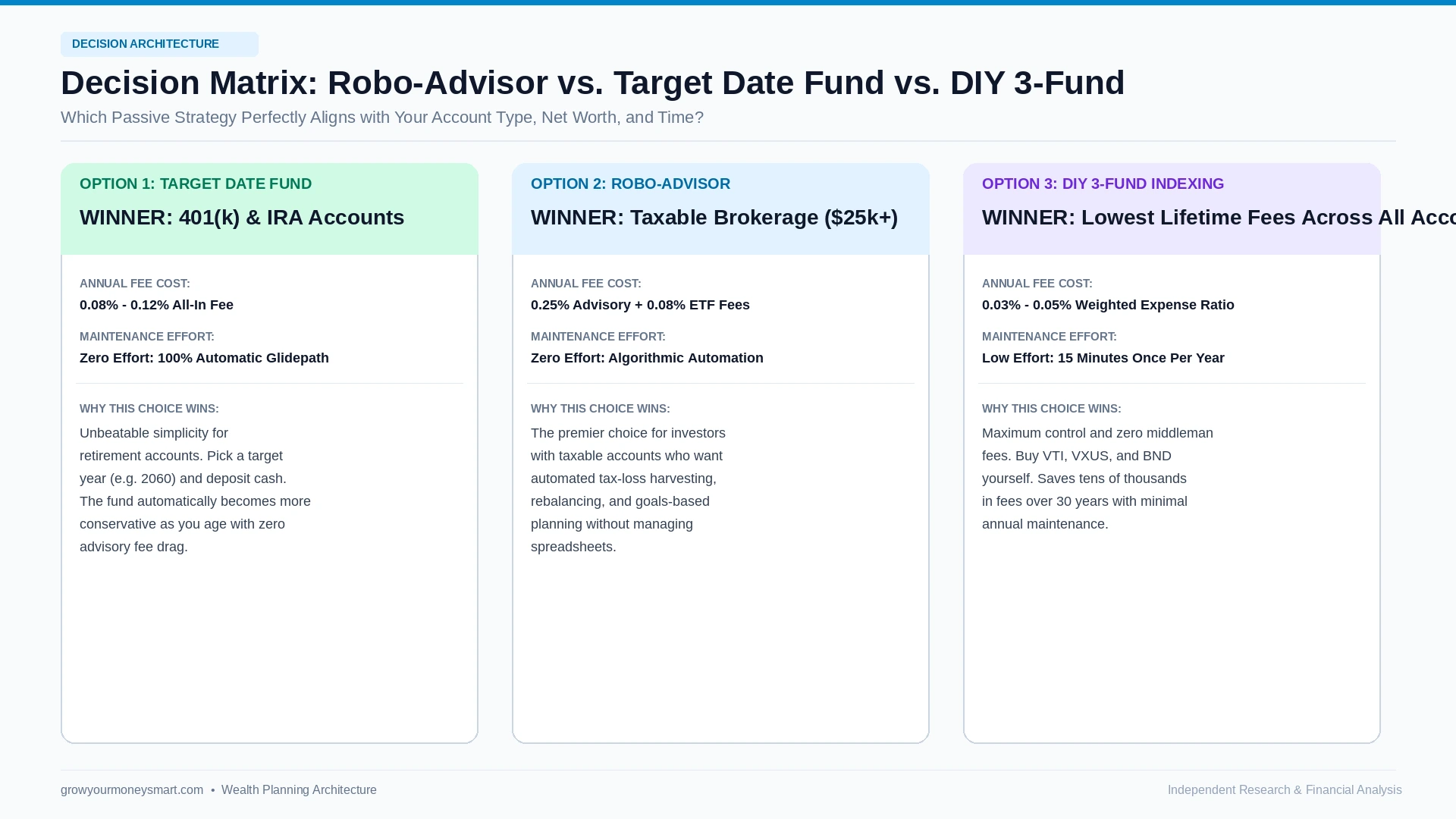
The 3-Way Decision Matrix: Robo vs TDF vs DIY Indexing
To choose the ideal strategy for your financial life, evaluate where you stand across account types, net worth, and your willingness to spend 15 minutes a year:
1. Choose a Target Date Fund If:
- You are investing inside an employer 401(k), 403(b), or Roth IRA.
- You want the lowest possible management fee (0.08% – 0.12%) with zero advisory surcharge.
- You never want to make another investment decision until retirement.
2. Choose a Robo-Advisor If:
- You have $25,000+ in a standard taxable brokerage account.
- You are in the 24%+ federal tax bracket and can capture massive value from automated Tax-Loss Harvesting.
- You want automated goal-tracking, multi-account net worth integration, and modern fintech mobile interfaces.
3. Choose a DIY 3-Fund Portfolio If:
- You are willing to spend 15 minutes once per year rebalancing your own portfolio.
- You want the absolute lowest possible lifetime fee structure (0.03% – 0.05% weighted fees via VTI, VXUS, and BND).
- You want total custody and portability across any brokerage without third-party platform lock-in (see our Complete 3-Fund Portfolio Guide).
How to Set Up Your Hands-Off Portfolio Today
If you are ready to automate your wealth today, execute these four simple steps:
- Audit Your Account Type: If funding an IRA or 401(k), look up the native index Target Date Fund (e.g., Vanguard Target Retirement 2060 or Fidelity Freedom Index 2060—make sure the word “Index” is in the name to avoid high-fee active versions!). If funding a taxable brokerage account, select a Robo-Advisor like Betterment or Wealthfront, or build a DIY ETF portfolio.
- Establish Your Emergency Buffer: Never invest funds you will need within the next 3 to 5 years into either equities or target date funds. Secure your cash in an FDIC-insured account first (see our Complete Emergency Fund & HYSA Guide).
- Automate Paycheck Transfers: Schedule an automatic monthly deposit on the 1st or 15th of every month. Whether deploying a large windfall (see our analysis of Dollar-Cost Averaging vs Lump Sum) or starting with modest savings, consistent automation is what creates wealth.
- Turn On Dividend Reinvestment: Ensure dividends automatically purchase additional shares through DRIP (as explained in our Dividend Investing Guide) to accelerate compound growth without manual intervention.
Frequently Asked Questions (FAQs)
Is a robo-advisor worth the 0.25% fee?
In a taxable brokerage account, yes—provided you have an account balance above $20,000 to $25,000. Algorithmic tax-loss harvesting and automated rebalancing routinely generate 0.50% to 1.0%+ in annual tax alpha, easily exceeding the 0.25% fee. Inside a tax-free Roth IRA or 401(k), however, tax-loss harvesting does not exist, making the 0.25% fee harder to justify over a cheap Target Date Fund.
Why shouldn’t I hold a Target Date Fund in a taxable brokerage account?
Because Target Date Funds are mutual funds that regularly trade underlying stocks and bonds to adjust their glidepaths. When institutional investors redeem shares or the fund rebalances, it realizes taxable capital gains that are distributed to you on Form 1099-DIV, generating unexpected tax bills even if you never sold a single share.
What is the difference between Fidelity Freedom and Fidelity Freedom Index?
This is one of the most critical gotchas in 401(k) plans: “Fidelity Freedom Funds” are actively managed and charge high expense ratios (~0.75%). “Fidelity Freedom Index Funds” use passive index funds and charge just 0.12%. Always verify that the word “Index” is in the fund title before buying.
Can I lose money in a Target Date Fund?
Yes. Target date funds invest in equities and bonds. When global stock markets drop during recessions, the equity portion of a target date fund drops as well. However, because target date funds hold thousands of global securities, they cannot go to zero unless global civilization collapses.
Does Schwab Intelligent Portfolios charge a management fee?
Schwab Intelligent Portfolios charges a 0.0% management fee, but it mandates an aggressive cash drag: requiring 6% to 10%+ of your portfolio to sit in Schwab cash paying below-market interest. For large portfolios, this cash drag often costs more in missed market returns than Betterment or Wealthfront’s 0.25% fee.
Can I transfer out of a robo-advisor without paying taxes?
Yes! Because robo-advisors hold real shares of standard ETFs (like VTI, VEA, VWO, and BND), you can execute an ACATS in-kind transfer directly to Vanguard, Fidelity, or Charles Schwab without selling shares or triggering capital gains taxes.
What if I retire earlier or later than the target date?
You are never locked into the date on the fund. If you want a more aggressive portfolio with higher stock exposure, simply pick a fund with a date 10 years further out (e.g., picking 2065 instead of 2055). If you want a more conservative portfolio, pick an earlier date.
Can I start investing in a Target Date Fund with $100 a month?
Yes. At Fidelity and Charles Schwab, index target date funds have zero minimum investment requirements. You can schedule an automatic recurring deposit of $100 every single month directly into your retirement account.

Jaiveer Hooda is a personal finance researcher and the founder of Grow Your Money Smart. With a background in computer engineering, he approaches money the way an engineer approaches any complex system — through data analysis, mathematical modeling, and ruthless optimization.
He built this platform on a single conviction: financial freedom is not a matter of luck. It is a system that can be designed, tested, and executed by anyone willing to follow the right blueprint. Every strategy published here is researched to the numbers, not written to the trend.
Expertise: Debt elimination · Retirement planning · Passive income · Budgeting systems
Connect: Pinterest | growyourmoneysmart.com | Contact Us