
Choosing between an Individual Retirement Account (IRA) isn’t just about saving money—it’s about engineering your tax liability so Uncle Sam takes the smallest possible slice of your lifetime wealth. When weighing a Traditional IRA vs Roth IRA, the central decision hinges on one fundamental question: Do you want your tax break today, or do you want 100% tax-free income in retirement?
- Traditional IRA: Contributions are pre-tax or tax-deductible today; investments compound tax-deferred; withdrawals in retirement are taxed as ordinary income. Mandatory RMDs begin at age 73.
- Roth IRA: Contributions are made with post-tax dollars; growth and qualified withdrawals after age 59½ are 100% tax-free. No Required Minimum Distributions (RMDs) during your lifetime.
- 2026 Contribution Limits: $7,000/year for individuals under 50, and $8,000/year for those age 50 and older (combined across all IRAs).
- Income Caps: Traditional IRAs have no income limit to contribute (though tax deductibility phases out if covered by a workplace plan). Roth IRAs have strict income phase-outs starting at $150,000 (Single) and $236,000 (Married Filing Jointly).
- The Golden Rule of Thumb: If your current marginal tax bracket is higher than your expected retirement bracket, choose a Traditional IRA. If you expect your tax rate to stay the same or rise, or you want maximum liquidity and tax-free legacy wealth, choose a Roth IRA.
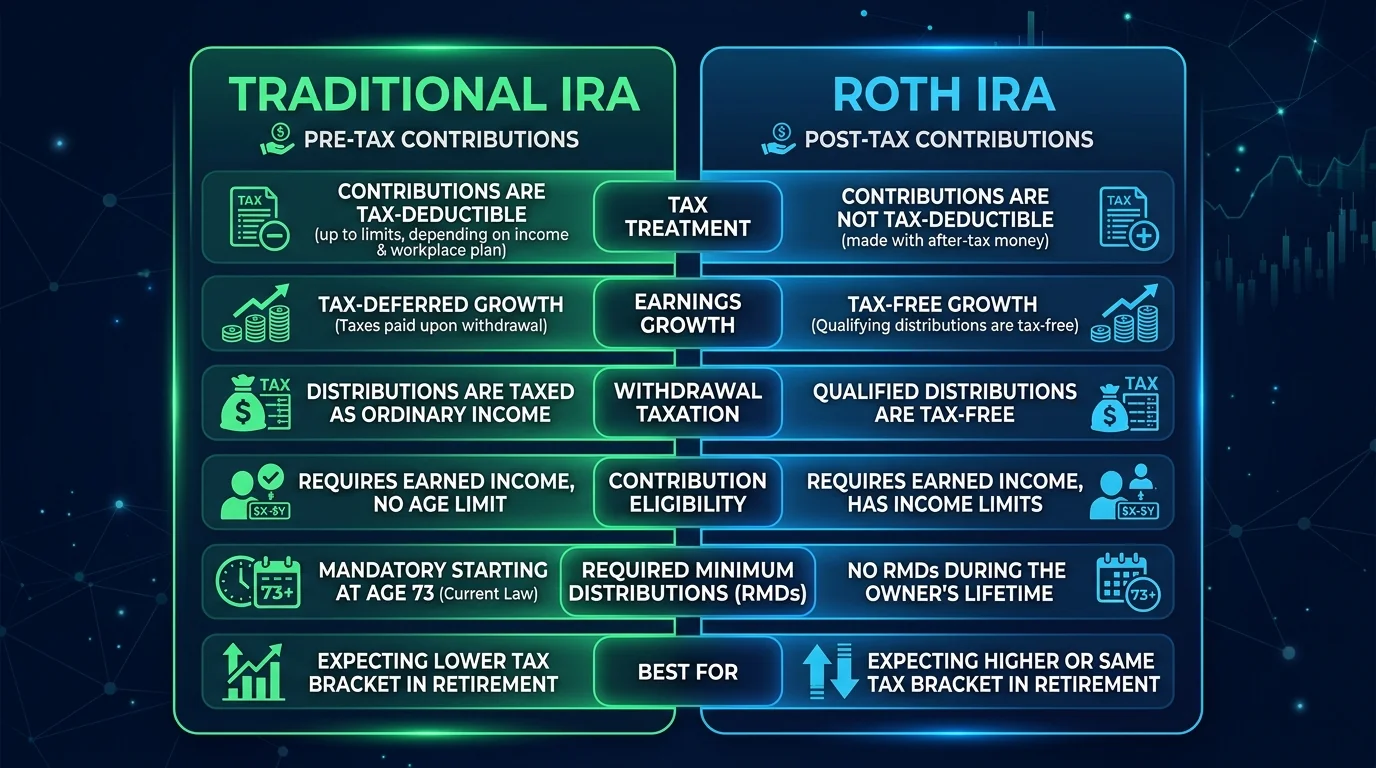
The Core Philosophy: Tax-Deferred vs Tax-Exempt Wealth Building
To master retirement planning, you must understand the distinction between tax-deferred and tax-exempt accounts. Both vehicles offer massive advantages over standard taxable brokerage accounts by shielding your dividends, interest, and capital gains from annual taxation while you build your portfolio.
In a taxable account, every dividend payout and rebalancing sale triggers a tax event that drags down your compounding velocity. Within either a Traditional or Roth IRA, your capital compounds undisturbed. However, the timing of taxation creates two entirely different wealth trajectories:
A Traditional IRA acts as a tax postponement tool. By taking an upfront tax deduction in the contribution year, you lower your current Adjusted Gross Income (AGI). In exchange, the IRS treats every dollar you withdraw in retirement—both your original contributions and decades of market growth—as regular taxable income. Understanding your overall investment time horizon is essential to maximizing this compounding period.
A Roth IRA, established under the Taxpayer Relief Act of 1997 and named after Senator William Roth, operates on the opposite principle. You pay your regular income tax today, deposit after-tax money, and let the account compound. When you withdraw qualified funds after age 59½ (and meeting the 5-year rule), every single dollar of profit is 100% free of federal and state taxes.
Traditional IRA vs Roth IRA: Head-to-Head Comparison Matrix (2026)
Below is the complete architectural comparison of rules, IRS limits, and features governing Traditional and Roth IRAs for the 2026 tax year:
| Feature / Rule | Traditional IRA | Roth IRA |
|---|---|---|
| Tax Treatment on Contribution | Pre-tax / Tax-deductible (subject to income phase-outs) | Post-tax (No upfront deduction) |
| Investment Growth | Tax-deferred compounding | 100% Tax-free compounding |
| Tax Treatment on Withdrawal | Taxed as ordinary income at retirement bracket | 100% Tax-free on qualified distributions |
| 2026 Annual Contribution Limit | $7,000 (<50) / $8,000 (50+) | $7,000 (<50) / $8,000 (50+) |
| Income Limits to Contribute | No income cap to contribute non-deductible funds | Phases out at MAGI $150k-$165k (Single) / $236k-$246k (MFJ) |
| Early Principal Access | 10% penalty + taxes before age 59½ (few exceptions) | Contributions withdrawable anytime penalty & tax-free |
| Required Minimum Distributions (RMDs) | Mandatory starting at age 73 (SECURE 2.0 Act) | None during owner’s lifetime |
| Best Suited For | High earners wanting immediate tax deductions | Younger savers, long time horizons, tax diversification |
IRS 2026 Contribution & Income Deduction Phase-Out Rules
To navigate IRAs without triggering IRS penalties, you must understand two separate sets of rules: Contribution Eligibility and Deductibility Phase-Outs.
1. Traditional IRA Deductibility Limits (If Covered by Workplace Retirement Plan)
Anyone with earned income can contribute to a Traditional IRA. However, if you or your spouse participate in an employer-sponsored retirement plan (like a 401k or 403b), your ability to deduct those contributions from your taxes phases out based on your Modified Adjusted Gross Income (MAGI):
| Filing Status | Full Deduction MAGI | Partial Deduction MAGI | No Deduction Allowed |
|---|---|---|---|
| Single / Head of Household | $79,000 or less | $79,000 – $89,000 | More than $89,000 |
| Married Filing Jointly (Active Plan) | $126,000 or less | $126,000 – $146,000 | More than $146,000 |
| Married Filing Jointly (Spouse Covered) | $236,000 or less | $236,000 – $246,000 | More than $246,000 |
2. Roth IRA Income Eligibility Limits (2026)
Unlike Traditional IRAs, high earners are directly barred from making direct contributions to a Roth IRA once their MAGI crosses IRS statutory caps:
| Filing Status | Full Contribution Allowed | Reduced / Phase-Out Range | Direct Contribution Prohibited |
|---|---|---|---|
| Single / Head of Household | Under $150,000 | $150,000 – $165,000 | $165,000 or more |
| Married Filing Jointly | Under $236,000 | $236,000 – $246,000 | $246,000 or more |
If you find yourself earning above these caps, do not despair. High-income professionals routinely utilize the Backdoor Roth IRA strategy (explored in detail below) to bypass these phase-outs legally.
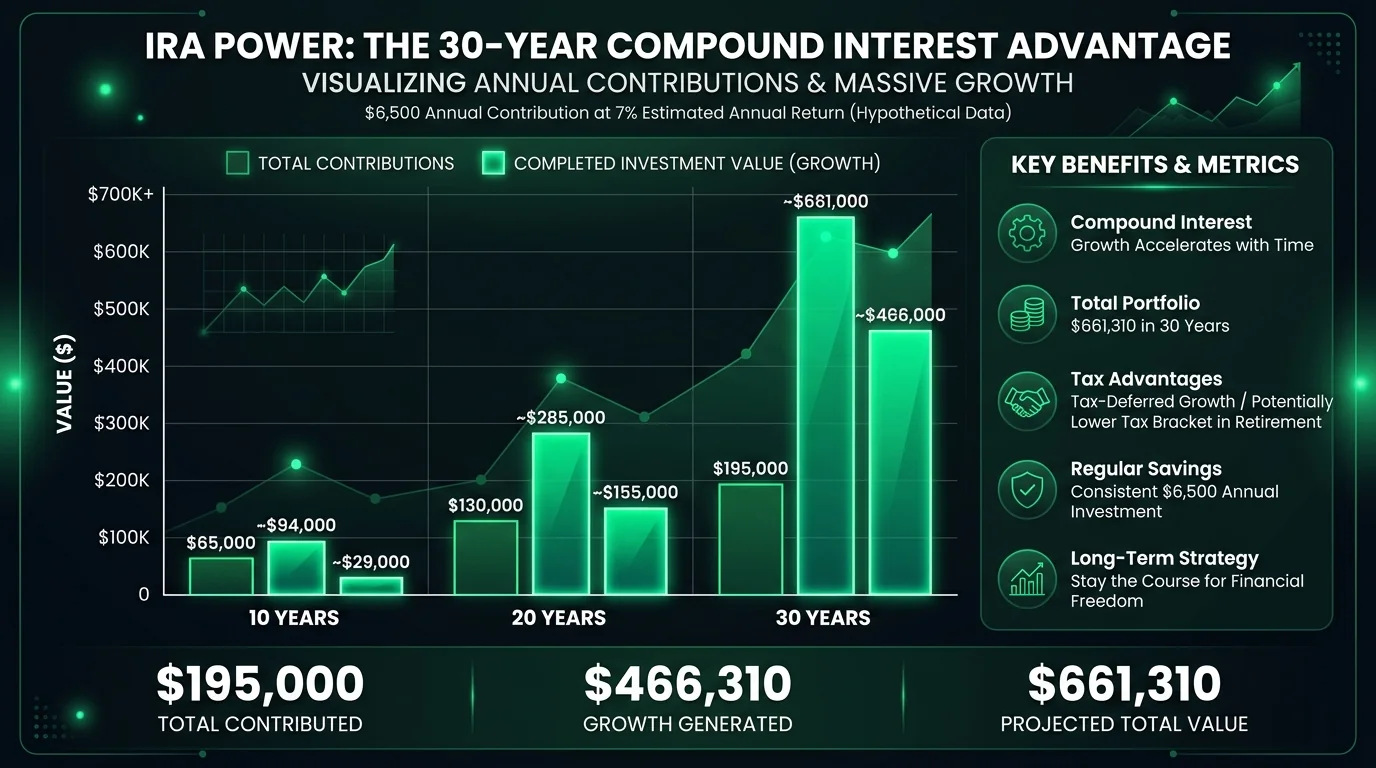
Mathematical Compounding Simulation: Traditional vs Roth Over 30 Years
To truly appreciate the power of these accounts, let’s look at real mathematical simulations. Assume an investor contributes $7,000 annually into an equity portfolio achieving an average 8.0% annualized compound return over 10, 20, and 30 years.
Let’s simulate how compounding accelerates inside an IRA asset vehicle:
| Timeline | Total Contributed | Compounded Growth | Total Portfolio Value | Roth Value (After-Tax) | Traditional Value (22% Tax) |
|---|---|---|---|---|---|
| 10 Years | $70,000 | $39,516 | $109,516 | $109,516 | $85,422 |
| 20 Years | $140,000 | $206,064 | $346,064 | $346,064 | $269,930 |
| 30 Years | $210,000 | $652,698 | $862,698 | $862,698 | $672,904 |
*Note on the Mathematical Comparison: In a pure theoretical vacuum where your current marginal tax bracket equals your future retirement tax bracket, Traditional and Roth produce the exact same final purchasing power if and only if you reinvest 100% of the upfront Traditional tax savings into an investment account. However, in reality, most individuals spend their tax refund rather than reinvesting it, making the Roth IRA mathematically superior for forced savings discipline.
Tax Bracket Arbitrage: Which Account Yields Higher Net Wealth?
The decisive factor in the Traditional IRA vs Roth IRA debate comes down to tax arbitrage: comparing your marginal tax rate today versus your effective tax rate in retirement.
Consider these three realistic real-world scenarios:
Scenario A: Early-Career Professional (Roth Wins Decisively)
You are 26 years old, earning $55,000 in the 12% marginal federal tax bracket. By funding a Roth IRA now, you “lock in” an ultra-low 12% tax rate on your $7,000 contribution ($840 in taxes paid). Over the next 35 years, that money grows to $100,000+. When you withdraw it at age 61 in a higher tax bracket (say 24%), all $100,000 is distributed 100% tax-free. You avoided paying $24,000 in future taxes by paying $840 today. If you’re building a foundation, see our actionable blueprint on how to start investing with $100 a month.
Scenario B: Peak Earning Executive (Traditional Wins on Arbitrage)
You are 52 years old, earning $220,000 in the 32% marginal tax bracket. By contributing $8,000 to a Traditional IRA (assuming eligibility via no active plan or self-employed structure), you immediately save $2,560 on your current year’s tax return. In retirement, when your income drops and you fill up lower tax brackets (10%, 12%, and 22%), your effective blended tax rate on withdrawals may only be 15%. You captured a 17% net tax arbitrage profit.
Scenario C: Future Tax Code Uncertainty (Roth Wins as Tax Insurance)
With rising national debt, historical tax rates well below 1970s levels (when top brackets reached 70%), and potential sunsetting of current tax brackets, many investors treat the Roth IRA as a hedge against future tax hikes. Knowing that your retirement balance cannot be taxed regardless of future legislative changes delivers priceless peace of mind.
Watch: Expert Breakdown of Traditional vs Roth IRAs
For a detailed visual walkthrough comparing retirement account mechanics and asset allocation strategies, watch this comprehensive breakdown by personal finance educator Humphrey Yang:
Advanced Strategy: The Backdoor Roth IRA & The Pro-Rata Trap
If your MAGI exceeds $165,000 (Single) or $246,000 (Married Filing Jointly), the IRS bars you from contributing directly to a Roth IRA. However, tax law explicitly permits a two-step workaround known as the Backdoor Roth IRA:
1. Open and deposit $7,000 into a standard Traditional IRA as a non-deductible contribution (Form 8606).
2. Once the cash clears (usually 1–2 business days), execute a Roth Conversion transferring the funds into your Roth IRA.
3. Because the contribution was made with after-tax non-deductible dollars and had negligible earnings before conversion, the transfer occurs virtually tax-free.
⚠️ Crucial Warning: The IRS Pro-Rata Rule
Under IRC Section 408(d)(2), if you hold existing pre-tax money in ANY Traditional IRA, SEP-IRA, or SIMPLE IRA on December 31st of the conversion year, the IRS aggregates all your IRA assets. You cannot choose to convert only your non-deductible funds. If 80% of your total IRA assets are pre-tax, 80% of your conversion will be taxed as ordinary income. To avoid this trap, many investors “reverse rollover” their pre-tax Traditional IRA balances into an active employer 401(k) plan prior to initiating the conversion.
The 5-Step Actionable Decision Blueprint
Follow this systematic 5-step framework to configure your retirement accounts with surgical precision:
Step 1: Secure Any 401(k) Employer Match First
Before funding any IRA, ensure you capture 100% of your employer’s 401(k) match. That is an immediate, guaranteed 50% to 100% return on your capital that no IRA can match. Review the stages of retirement plan lifecycles to ensure proper sequencing.
Step 2: Build a Solid Cash Cushion
Never invest retirement capital before securing a liquid high-yield cash reserve. Use our free interactive Emergency Fund Calculator to calculate your 3-to-6 month safety buffer and compare yields in our HYSA vs Stock Market guide.
Step 3: Evaluate Your Current Marginal Tax Rate
If your household income puts you in the 10%, 12%, or 22% tax brackets, fund a Roth IRA up to the $7,000 maximum ($8,000 if 50+). If you are in the 32%, 35%, or 37% brackets, maximize pre-tax vehicles first (Traditional 401k/IRA) or execute a Backdoor Roth.
Step 4: Select Broad-Market Low-Cost Index Funds
Do not leave your IRA contribution sitting in uninvested settlement cash. Deploy your funds into ultra-low-cost, broad-market index funds (such as VOO, VTI, or total world index funds). Read our breakdown on Index Funds vs Mutual Funds to eliminate hidden management fees.
Step 5: Automate and Rebalance Annually
Set up an automatic monthly transfer of $583.33 ($7,000 / 12 months) into your IRA. Use our Budgets Calculator to align your monthly cash flow effortlessly.
⚡ Advanced Tax-Advantaged Retirement Account Frameworks
Maximize your tax diversification with these complementary retirement vehicle blueprints:
- Maxing Accounts Roadmap: Explore our guide on how to max out both a 401(k) and Roth IRA with the exact sequential order of funding contributions.
- Retirement Terms Decoded: Explore our guide on retirement account glossary for beginners explaining MAGI limits, backdoor conversions, and tax deferrals.
- Multi-Bucket Strategy: Explore our guide on three-legged retirement income framework to balance taxable, tax-deferred, and tax-free retirement buckets.
Frequently Asked Questions (FAQs)
Yes, you can own and contribute to both accounts in the same tax year. However, the IRS annual contribution limit ($7,000 in 2026, or $8,000 if age 50+) is a combined total across all your Traditional and Roth IRAs, not per account.
You can withdraw your original direct contributions from a Roth IRA at any time, at any age, 100% tax-free and penalty-free. However, if you withdraw earnings (investment growth) before age 59½ and before the account has been open for at least 5 years, you will typically owe regular income tax plus a 10% IRS early withdrawal penalty unless you qualify for an IRS exception (such as a first-time home purchase up to $10,000).
Yes. Participating in a workplace 401(k) does not prevent you from opening or funding an IRA. It only impacts whether your Traditional IRA contributions are tax-deductible based on the IRS MAGI phase-out thresholds.
The 5-Year Rule stipulates that at least 5 tax years must pass from the first day of the year you made your first Roth IRA contribution before you can withdraw earnings tax-free, even if you are already over age 59½. The clock starts on January 1 of the tax year for which your initial contribution was designated.
No. Unlike Traditional IRAs and 401(k)s which require mandatory withdrawals starting at age 73 under the SECURE 2.0 Act, original Roth IRA owners are never forced to take RMDs. Your money can continue compounding tax-free for your entire lifetime and pass to your heirs tax-free.
Yes. Anyone can perform a Roth conversion regardless of income level. However, any previously deducted contributions and untaxed investment earnings that are converted will be added to your gross income and taxed at ordinary income rates in the conversion year.
You have until the federal tax filing deadline (typically April 15 of the following calendar year) to make an IRA contribution designated for the prior tax year. For example, you have until mid-April 2027 to complete your 2026 IRA contributions.
For most individuals, opening an account at low-cost brokerages like Vanguard, Fidelity, or Charles Schwab and investing in broad-market index funds requires minimal effort. However, if you are navigating complex Backdoor Roth conversions or multi-million dollar estate planning, a fee-only fiduciary advisor can be valuable. Read our guide on DIY vs Financial Advisor to evaluate your options.
Summary & Next Steps
Both Traditional and Roth IRAs are premier wealth-building vehicles that give everyday investors institutional-grade tax advantages. If you want upfront deductions and expect lower income in retirement, the Traditional IRA is your weapon of choice. If you desire tax-free compounding, penalty-free access to your principal, zero lifetime RMDs, and protection against future tax increases, the Roth IRA stands undefeated.
If you’re managing outstanding consumer obligations, use our Debt Payoff Calculator and explore debt payoff vs investing strategies to accelerate your monthly savings capacity.
Comparing upfront tax deductions against tax-free retirement distributions hinges on your current vs expected future marginal tax bracket. Consult the official Internal Revenue Service (IRS) Traditional and Roth IRAs Topic Guide for statutory guidelines and consumer protections.

Jaiveer Hooda is the Lead Financial Researcher & Personal Finance Analyst at Grow Your Money Smart. Specializing in personal wealth optimization, index fund compounding, high-yield savings mechanics, and consumer debt elimination strategies. With a background in computer engineering, he applies mathematical modeling, cashflow simulations, and empirical risk analysis to evaluate personal finance vehicles and credit products. Every analysis is backed by verified regulatory disclosures, IRS tax schedules, and empirical APY compounding math.
Areas of Expertise: Personal Finance · High-Yield Savings Accounts (HYSA) · Index Funds & S&P 500 Compounding · Retirement Planning (401k/IRA) · Debt Optimization · Credit Card APR Mechanics.
Transparency & Editorial Policy: Editorial Standards | Report a Correction