
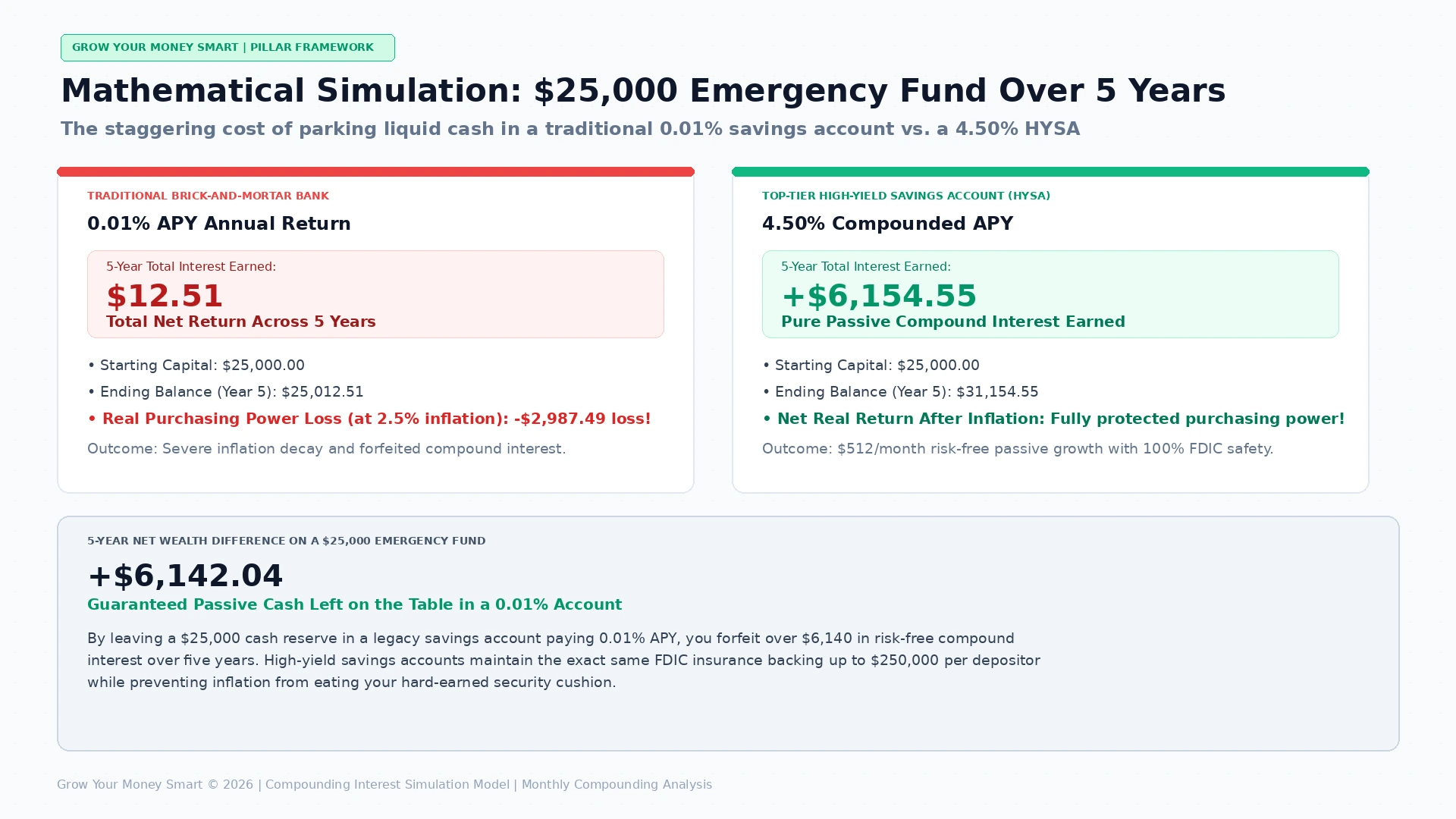
- The 0.01% Wealth Trap: Leaving a $25,000 emergency reserve in a traditional mega-bank paying 0.01% APY forfeits over $6,140 in risk-free compound interest over 5 years compared to a 4.50% High-Yield Savings Account (HYSA).
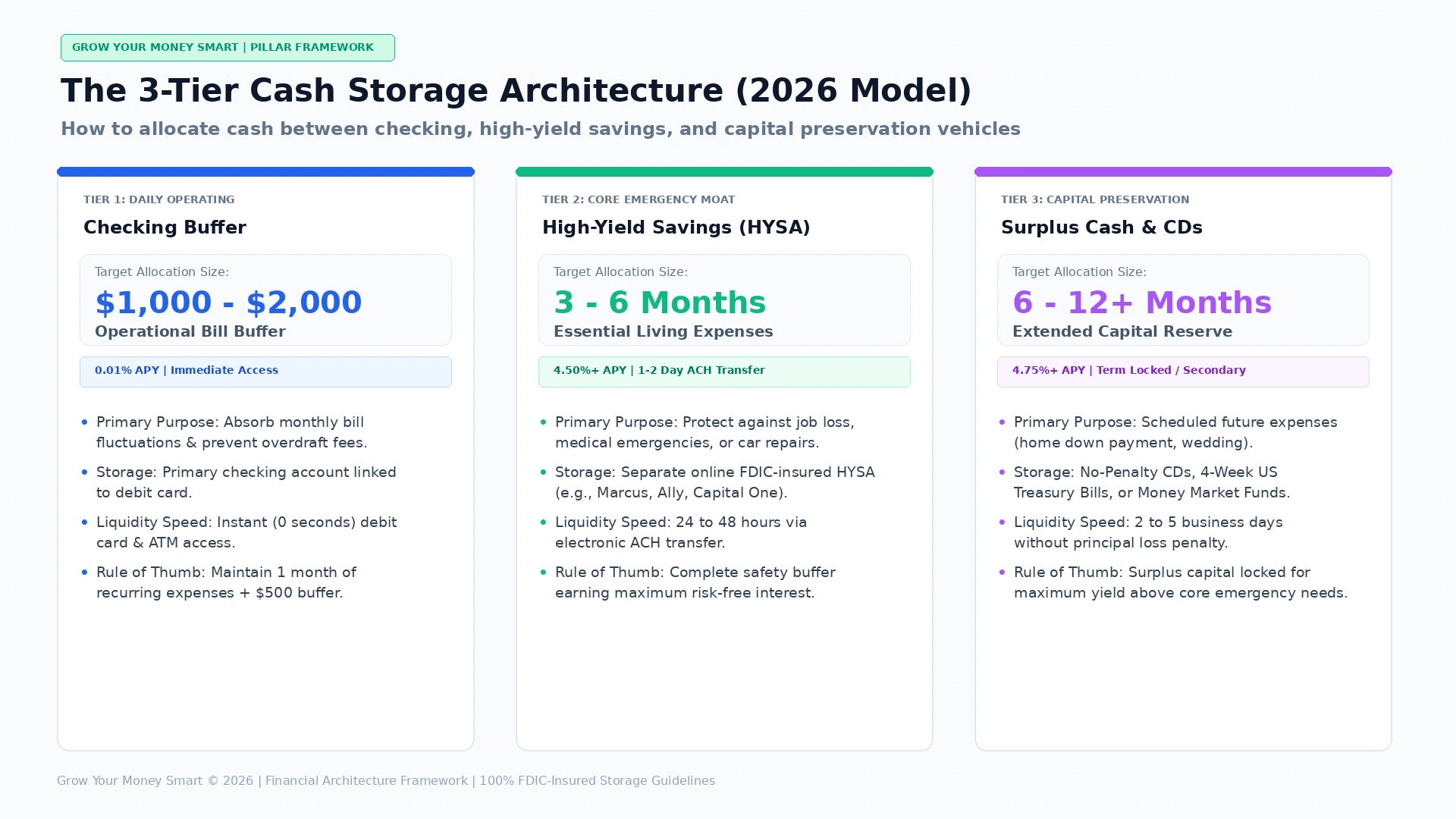
- The 3-Tier Storage Model: Never keep all cash in one bucket. Divide liquidity into Tier 1 Checking Buffer ($1,000–$2,000), Tier 2 Core HYSA Reserve (3–6 months essential expenses), and Tier 3 Capital Preservation (No-Penalty CDs or Short-Term Treasuries).
- Debt vs. Cash Rule: Always build a $1,000 starter emergency cushion before aggressively paying down high-interest debt; once revolving credit is eliminated, scale your emergency fund to a fortified 3 to 6-month safety moat.
In modern personal finance, an emergency fund is not merely a dormant pile of cash; it is the load-bearing foundation of your entire balance sheet. Without liquid reserves, every unexpected life event—a transmission failure, emergency root canal, sudden job reduction, or unanticipated home repair—instantly mutates into high-interest revolving credit card debt compounding at 24% to 29% APR.
However, the financial landscape has fundamentally shifted. For over a decade following the 2008 Great Financial Crisis, near-zero interest rates meant parking cash in a savings account was an afterthought. Today, with benchmark rates elevated and competitive banks offering 4.0% to 5.0%+ Annual Percentage Yield (APY), keeping your emergency cash in a traditional brick-and-mortar savings account is a silent wealth killer. This master pillar blueprint establishes the complete mathematical frameworks, account architectures, and strategic decision trees you need to build and optimize your cash reserves in 2026.
Traditional Banks vs. HYSA (0.01% vs. 4.5%+ APY): The Mathematical Reality
The average national savings account interest rate at legacy brick-and-mortar banks (such as Chase, Wells Fargo, and Bank of America) hovers at an astonishingly low 0.01% to 0.04% APY. Meanwhile, top-tier High-Yield Savings Accounts (HYSAs)—operated primarily by digital banking divisions and chartered institutions with lean physical overhead—consistently deliver between 4.25% and 5.00% APY with identical Federal Deposit Insurance Corporation (FDIC) protection up to $250,000 per depositor.
When you leave cash in a 0.01% account while inflation runs at 2.5% to 3.5%, your money experiences severe negative real yield. You are not keeping your money “safe”—you are guaranteeing a permanent loss of purchasing power. The table below illustrates the mathematical compounding divergence on a $25,000 emergency fund balance over a 5-year timeline:
| Timeline | Traditional Bank (0.01% APY) | High-Yield Savings (4.50% APY) | Passive Interest Difference |
|---|---|---|---|
| Year 1 | $2.50 | $1,148.55 | +$1,146.05 |
| Year 2 | $5.00 | $2,349.52 | +$2,344.52 |
| Year 3 | $7.50 | $3,605.81 | +$3,598.31 |
| Year 4 | $10.01 | $4,919.98 | +$4,909.97 |
| Year 5 | $12.51 | $6,293.91 | +$6,281.40 |
Over five years, the difference between taking 10 minutes to open an online HYSA versus leaving cash in a legacy checking or savings account is over $6,280 in pure, risk-free cashflow. That interest alone is large enough to cover a major medical deductible, pay for a complete HVAC overhaul, or fund an entire starter emergency buffer.
How Much Emergency Fund Do You Really Need? (The 3 vs. 6 vs. 12-Month Framework)
A standard financial rule of thumb dictates maintaining “3 to 6 months of living expenses.” However, applying a one-size-fits-all metric is dangerous. A dual-income couple with tenured corporate jobs and no children requires a radically different cash cushion than a freelance graphic designer supporting a family with high fixed mortgage overhead.
To determine your exact target, you must calculate your Essential Baseline Survival Floor—not your gross monthly income. Your survival floor includes:
- Housing (Rent or Mortgage Principal, Interest, Taxes, and Insurance).
- Core Utilities (Electric, Water, Gas, Essential Internet, Phone).
- Groceries & Basic Household Goods (excluding dining out and delivery).
- Healthcare (Insurance Premiums, Co-pays, Life-Sustaining Medications).
- Transportation (Auto Loan Minimum, Gas, Public Transit Passes, Maintenance).
- Minimum Required Debt Payments (Student loans, credit card minimums).
Use the risk matrix below to identify your optimal cash duration category:
| Target Duration | Risk Profile & Household Criteria | Primary Rationale |
|---|---|---|
| 3 Months Baseline | Dual-income household; salaried government or corporate roles; zero dependents; low fixed overhead; renting in MCOL city. | Low probability of simultaneous income loss; rapid re-employment potential within 60–90 days. |
| 6 Months Standard | Single-income earner; homeowners; private corporate sector; children or elderly dependents; minor medical overhead. | Buffers against standard 4–5 month white-collar corporate severance cycles and unexpected home maintenance liabilities. |
| 9 to 12 Months Fortified | 1099 independent contractors; commission-based sales; high volatility niche industries; single earner with multiple dependents; chronic health considerations. | Protects against extended macroeconomic recessions, severe revenue dry spells, and seasonal income dips without forcing early asset liquidation. |
If you are starting from complete scratch, do not be intimidated by an ultimate 6-month goal of $20,000 or $30,000. Focus first on our actionable step-by-step blueprint on how to save your first $1,000 fast. If you earn a mid-tier income, align your monthly cashflow using our $4,000 monthly salary budget allocation guide to generate the surplus savings required.
The 3-Tier Cash Storage Architecture: Where to Keep Your Money
One of the most common mistakes individuals make is dumping their entire liquidity reserve into a single bank account. If your emergency fund sits in your everyday checking account, lifestyle creep will erode it. Conversely, locking 100% of your cash in multi-year CDs creates severe liquidity friction when an emergency strikes at 2:00 AM on a Sunday.
The optimal modern framework is the 3-Tier Cash Storage Architecture:
Tier 1: The Checking Account Operational Buffer ($1,000 – $2,000)
Your primary checking account should hold enough capital to clear all scheduled monthly bills plus a permanent buffer of $1,000 to $2,000. This tier is not an emergency fund; it is an operational shock absorber. Its sole purpose is to eliminate overdraft fees, absorb irregular utility spikes, and provide instant point-of-sale liquidity via debit card.
Tier 2: The Core High-Yield Savings Account (3 to 6 Months of Expenses)
This is your true Emergency Moat. It should be housed in a standalone online HYSA with a dedicated FDIC-insured institution (such as Ally Bank, Marcus by Goldman Sachs, Capital One 360, or American Express National Bank). Keeping this account physically separated from your primary daily checking account adds healthy psychological friction, preventing impulse transfers while maintaining 24-to-48-hour Automated Clearing House (ACH) accessibility.
Tier 3: The Capital Preservation Buffer (Surplus Emergency Reserves & CDs)
If your risk profile necessitates an extended 9 to 12-month emergency cushion, holding $40,000+ in pure cash can be optimized further. You can park months 7 through 12 in No-Penalty Certificates of Deposit (CDs) or 4-week US Treasury Bills. No-penalty CDs allow you to lock in an attractive APY with the legal right to break the deposit early and withdraw your entire principal without penalty after the first 7 days of funding.
Emergency Fund vs. Paying Off High-Interest Debt: Which Comes First?
One of the most fiercely contested personal finance debates is whether to stockpile emergency cash or eliminate debt first. Mathematically, carrying credit card debt at 25% APR while earning 4.5% in an HYSA represents a net negative return of -20.5%. However, human psychology and cashflow volatility do not operate in a frictionless spreadsheet vacuum.
If you aggressively send every extra dollar to debt payoff without maintaining a liquid cash buffer, the next unexpected expense (e.g., an $800 car repair) forces you to swipe the exact credit cards you just paid down. This induces psychological defeat and re-ignites the cycle of revolving debt. Read our complete comparative strategic breakdown on whether to pay off debt or save an emergency fund first.
The optimal phased sequencing model follows three strict steps:
- Phase 1: Establish the $1,000 Starter Moat: Pause all extra debt principal payments and aggressively funnel cash into an HYSA until you hit $1,000 to $2,000.
- Phase 2: Eliminate Toxic High-Interest Debt: Keep your starter moat untouched and direct 100% of discretionary surplus toward high-interest debt (> 8% APR). Accelerate your payoff using proven debt avalanche vs snowball payoff strategies, or model your exact debt-free timeline with our free interactive debt payoff calculator.
- Phase 3: Fortify the Full 3 to 6-Month Reserve: Once revolving toxic credit is eliminated, redirect your former debt payments into your Tier 2 HYSA until your full living expense reserve is completed.
HYSA vs. S&P 500 Index Funds: Capital Preservation vs. Growth
A frequent error among aggressive wealth builders is asking: “Why should I leave $30,000 in an HYSA earning 4.5% when the S&P 500 historically returns 10% annually?”
The answer boils down to one fundamental principle: Sequence of Returns Risk and Asset Correlation. An emergency fund is an insurance policy, not an investment engine. During widespread economic recessions, corporate layoffs and equity bear markets frequently strike simultaneously. If your emergency reserve is invested 100% in equities and the market drops 30% right when your company downsizes, you are forced to liquidate stocks at the exact market bottom to pay your rent, permanently locking in capital losses.
To avoid this catastrophic outcome, align your capital strictly by time horizon:
- Money Needed in 0 to 3 Years (Emergency Fund, Down Payment): 100% in an FDIC-insured High-Yield Savings Account or short-term Treasury bills. Read our direct head-to-head comparison on HYSA vs stock market investing for detailed asset allocation modeling.
- Money Needed in 5+ Years (Retirement, Long-Term Compounding): Broad-market equity index funds (VOO, VTI). Once your emergency cash reserve is secure, follow our complete waterfall on what to do after maxing out your 401(k) and Roth IRA to build tax-sheltered wealth.
Interactive Tool: Calculate Your Exact Emergency Fund Target
Determining your exact 3 to 6-month cash reserve requires analyzing your individual housing overhead, grocery bills, healthcare premiums, and debt obligations. Rather than relying on guesswork, use our dedicated interactive calculator to generate a personalized survival baseline:
Input your rent/mortgage, utilities, insurance, food, and transport costs into our free calculator to see your exact 3, 6, and 12-month emergency fund targets.
Launch Free Emergency Fund Calculator »Authority Video Guide: How High-Yield Savings Accounts Actually Work
To reinforce these liquidity principles with visual walkthroughs, watch this clear educational explainer breaking down why high-yield savings accounts pay 10x to 40x more interest than brick-and-mortar institutions and how online banks operate safely under FDIC regulation:
Frequently Asked Questions (FAQs)
Below are clear, authoritative answers to the most crucial questions savers and investors ask when structuring their emergency funds and high-yield savings accounts:
The Federal Deposit Insurance Corporation (FDIC) provides statutory insurance coverage of up to $250,000 per depositor, per insured bank, for each account ownership category. If you open an individual HYSA, your deposits are legally protected up to $250,000. If you open a joint account with a spouse, the total coverage increases to $500,000 ($250,000 per co-owner). In the rare event of bank insolvency, the FDIC guarantees full restitution of insured principal and accrued interest.
Interest earned in a High-Yield Savings Account is classified as unearned income and taxed as ordinary income at your marginal federal and state tax rates. If you earn more than $10 in interest during the calendar year, your bank will issue IRS Form 1099-INT in January. Unlike long-term capital gains or qualified dividends from stocks, HYSA interest does not qualify for preferential lower tax brackets.
Yes. High-Yield Savings Accounts feature variable interest rates that fluctuate in tandem with the Federal Reserve’s Federal Funds Rate and general interbank lending yields. When the Federal Reserve raises interest rates, online banks typically increase HYSA yields; when the central bank lowers rates, HYSA APYs will adjust downward accordingly. Unlike fixed Certificates of Deposit (CDs), an HYSA does not lock in a guaranteed rate for a multi-year term.
Standard electronic Automated Clearing House (ACH) transfers between an online HYSA and an external checking account typically settle within 1 to 2 business days. Many major institutions (including Ally, Capital One, and Discover) support same-day or next-business-day expedited ACH transfers. For urgent emergency needs, you can also execute an instant domestic wire transfer or access funds immediately if your HYSA provider offers an optional debit card or check-writing privileges.
Historically, Federal Reserve Regulation D imposed a strict limit of six convenient withdrawals or transfers per monthly statement cycle on savings accounts. In April 2020, the Federal Reserve permanently amended Regulation D, allowing financial institutions to suspend the 6-transaction cap. While many top online banks have eliminated withdrawal penalty fees, some institutions retain internal caps, so always verify your bank’s specific account agreement.
Yes, keeping cash in a reputable online bank is 100% as safe as keeping it in a local branch bank, provided the institution is an active FDIC member. Online banks eliminate the substantial real estate, utility, and branch teller payroll costs associated with traditional retail banking, passing those operational savings directly to depositors in the form of higher interest yields. Verify any bank’s official charter status using the FDIC BankFind Suite before depositing funds.
For most wealth builders, housing your emergency fund at a completely separate financial institution is advantageous. When your emergency reserves appear on the exact same mobile dashboard as your daily checking account, the optical illusion of having surplus cash tempts impulse spending. An external institution introduces a 24-hour psychological buffer, ensuring you only withdraw funds for genuine, unavoidable financial crises.
The fundamental difference is liquidity versus rate certainty. An HYSA allows continuous deposits and withdrawals anytime with a variable interest rate. A CD locks your principal for a fixed term (e.g., 6 months, 12 months, 5 years) at a guaranteed, unchangeable APY; if you withdraw cash before the maturity date, you pay an early withdrawal interest penalty. Core emergency cash should remain in an HYSA, while Tier 3 surplus reserves can utilize No-Penalty CDs.

Jaiveer Hooda is a personal finance researcher and the founder of Grow Your Money Smart. With a background in computer engineering, he approaches money the way an engineer approaches any complex system — through data analysis, mathematical modeling, and ruthless optimization.
He built this platform on a single conviction: financial freedom is not a matter of luck. It is a system that can be designed, tested, and executed by anyone willing to follow the right blueprint. Every strategy published here is researched to the numbers, not written to the trend.
Expertise: Debt elimination · Retirement planning · Passive income · Budgeting systems
Connect: Pinterest | growyourmoneysmart.com | Contact Us