
Dividend investing is a strategy where you buy shares of profitable companies or dedicated dividend ETFs that regularly distribute a portion of corporate earnings back to shareholders as cash. Beginners should focus on Dividend Growth Investing (DGI)—targeting healthy starting yields of 2.5% to 4.0% with strong annual payout growth (such as SCHD or VYM)—rather than chasing risky 10%+ “yield traps.” Reinvesting your payouts through an automated Dividend Reinvestment Plan (DRIP) compounds your shares exponentially, creating thousands of dollars in annual passive income without ever selling principal capital.
30-Second Executive Summary for Beginners
- Dual Income Stream: Dividend stocks deliver both share price appreciation and regular quarterly cash payouts directly into your brokerage account.
- Avoid the High-Yield Trap: Stocks yielding 8% to 15%+ often mask collapsing stock prices, high debt, and impending dividend cuts. Sustainable 2.5% to 4% yields with double-digit growth outperform over time.
- The Power of the DRIP Snowball: Reinvesting dividends automatically purchases more shares, which generate higher dividends, which buy even more shares—creating an accelerating compounding flywheel.
- Qualified Tax Advantage: In taxable accounts, qualified dividends are taxed at favorable capital gains rates (0% or 15% for most earners) rather than ordinary income tax rates.
Few concepts in personal finance are as emotionally satisfying as opening your brokerage account and seeing cold, hard cash deposited into your ledger—money generated completely passively while you slept, worked, or spent time with family.
Unlike speculative growth stocks where your only path to realizing profit is selling off your principal shares, dividend investing rewards you simply for being an owner. However, many beginners fall victim to dangerous rookie traps: chasing ultra-high double-digit yields that destroy their capital or buying individual stocks without understanding cash flow coverage.
In this master guide, we break down the proven Dividend Growth Investing (DGI) blueprint. We show you how to separate elite dividend growers from toxic yield traps, compare the premier low-cost dividend ETFs (SCHD vs VYM vs DGRO), and demonstrate how the DRIP snowball transforms modest monthly contributions into a four-figure monthly income stream. If you are comparing this against broader index strategies, review our guides on The 3-Fund Portfolio and How to Invest in the S&P 500.
Educational walkthrough demonstrating how dividend reinvestment plans (DRIP) and dividend growth ETFs like SCHD compound cash flow over time.
Sustainable Dividend Growth vs. The High-Yield Value Trap
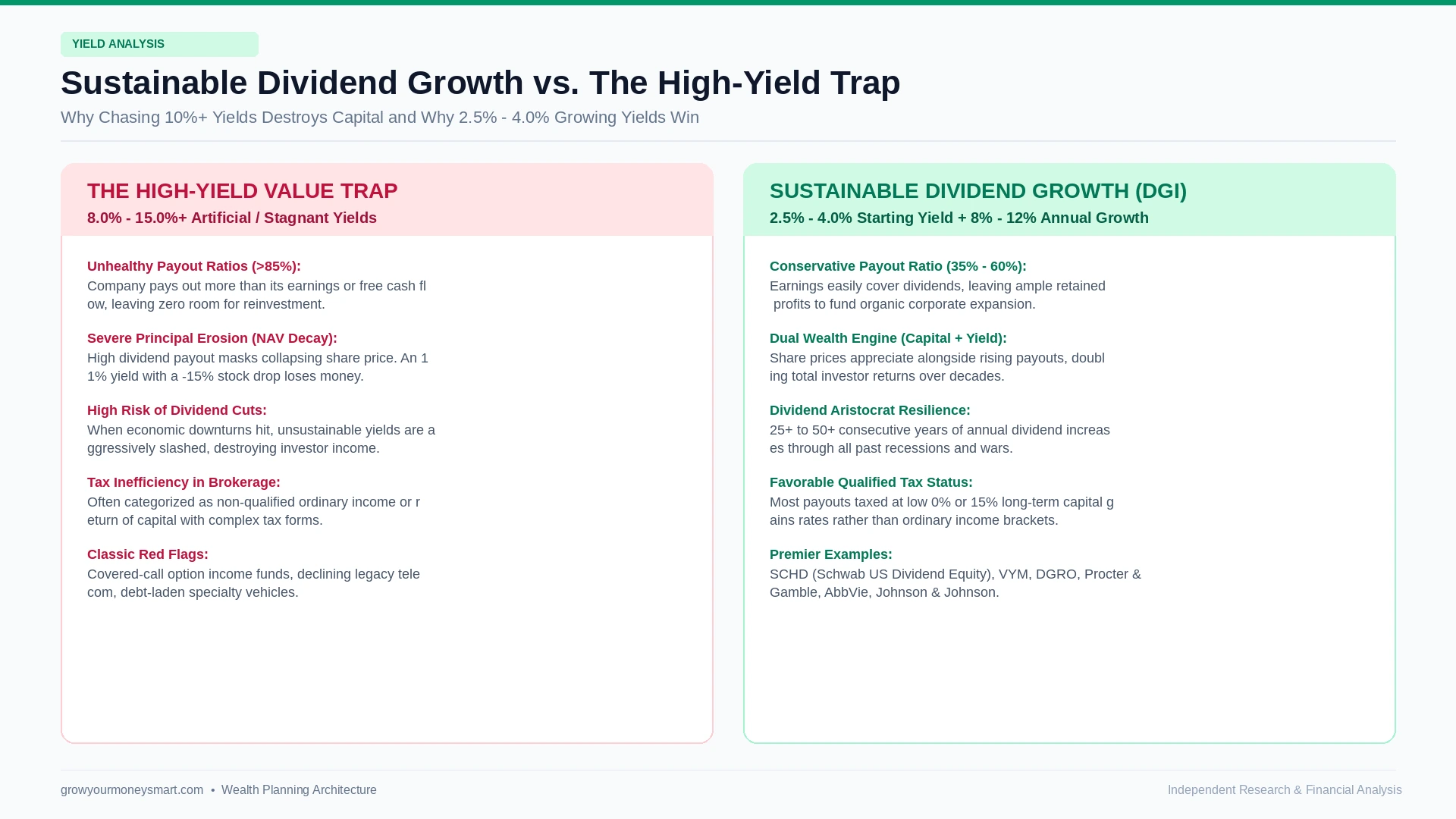
The single most dangerous misconception among new dividend investors is assuming that a higher dividend yield is always better. When a beginner sees a stock yielding 12% next to an ETF yielding 3.5%, intuition suggests the 12% option will generate more wealth. In reality, chasing yield is the fastest way to lose capital.
To see why, understand how dividend yield is calculated:
Notice the denominator: if a company’s business model is failing and its stock price plunges from $50 down to $10 while paying a $1 dividend, its yield artificially spikes from 2% up to 10%! This is not generosity; it is a High-Yield Value Trap.
The company is almost certainly paying out more than its earnings (a payout ratio exceeding 90% or 100%). Soon, management faces bankruptcy or an inevitable dividend cut. When the cut is announced, the yield collapses and panicked shareholders dump the stock, locking in permanent capital destruction.
Conversely, Dividend Growth Investing (DGI) focuses on companies with modest starting yields (2.5% – 4.0%) backed by growing earnings, low debt, and healthy payout ratios (35% – 60%). As corporate profits expand, management raises the payout by 8% to 12% every single year. Within 10 to 15 years, your yield on cost (the dividend payout divided by your original purchase price) can easily exceed 10% to 15%, while your underlying principal has multiplied several times over!
ETF-First Approach: Top 4 Dividend ETFs Compared
While picking individual dividend stocks like Procter & Gamble or Johnson & Johnson is popular, beginners should start with a diversified Dividend ETF. A single ETF instantly spreads your risk across 100 to 400 vetted, profitable corporations while automating portfolio rebalancing. Remember to check whether holding ETFs vs Index Funds fits your specific brokerage account type.
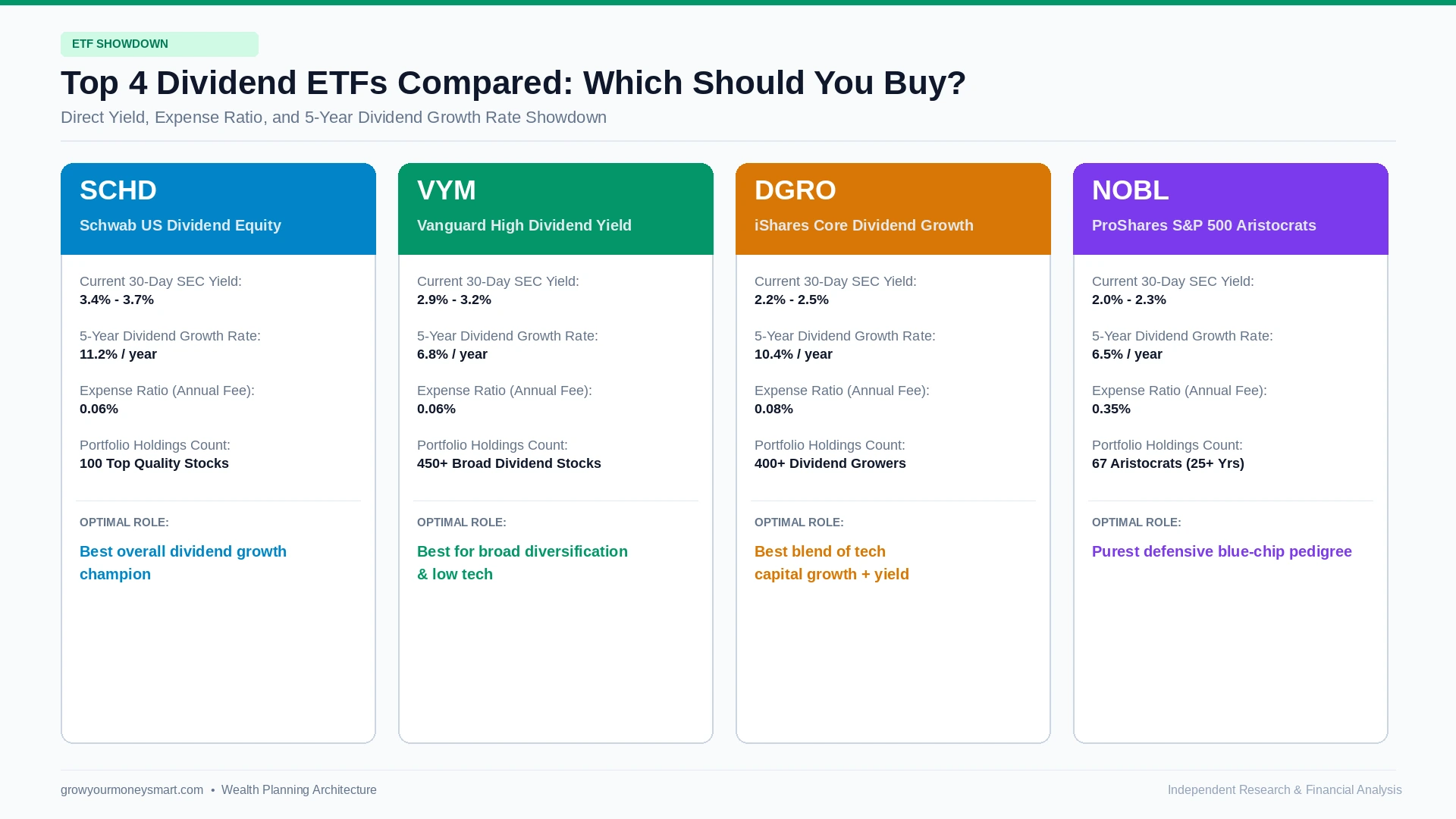
| Ticker & Fund Name | SEC Yield | 5-Yr Div Growth | Expense Ratio | Best For… |
|---|---|---|---|---|
| SCHD (Schwab US Dividend Equity) | ~3.4% – 3.7% | 11.2% / yr | 0.06% | The ultimate all-around dividend growth ETF |
| VYM (Vanguard High Dividend Yield) | ~2.9% – 3.2% | 6.8% / yr | 0.06% | Broad diversification (450+ stocks) |
| DGRO (iShares Core Dividend Growth) | ~2.2% – 2.5% | 10.4% / yr | 0.08% | Young investors wanting tech capital growth |
| NOBL (ProShares S&P 500 Aristocrats) | ~2.0% – 2.3% | 6.5% / yr | 0.35% | Strict Aristocrats (25+ yrs hikes); higher fee |
For most beginner investors, SCHD has earned its reputation as the benchmark king. Its underlying index applies rigorous quality filters: companies must have paid dividends for at least 10 consecutive years and are ranked based on cash-flow-to-total-debt, return on equity (ROE), and 5-year dividend growth rate. This mathematical filter automatically weeds out struggling companies while retaining robust dividend compounders.
The DRIP Snowball: How Reinvestment Builds Exponential Cash Flow
When you activate a Dividend Reinvestment Plan (DRIP), magic happens behind the scenes. Instead of taking dividend checks as spending cash, your brokerage automatically uses every dividend dollar to purchase additional fractional shares of the underlying fund—commission-free.
This creates a self-propelling compounding flywheel:
- Your initial shares pay quarterly dividends.
- Those dividends purchase additional shares.
- Next quarter, your original shares plus your new shares pay dividends.
- Meanwhile, the underlying companies increase their payouts by 8% to 10%.
- Your passive cash flow begins compounding at an accelerating parabolic rate!
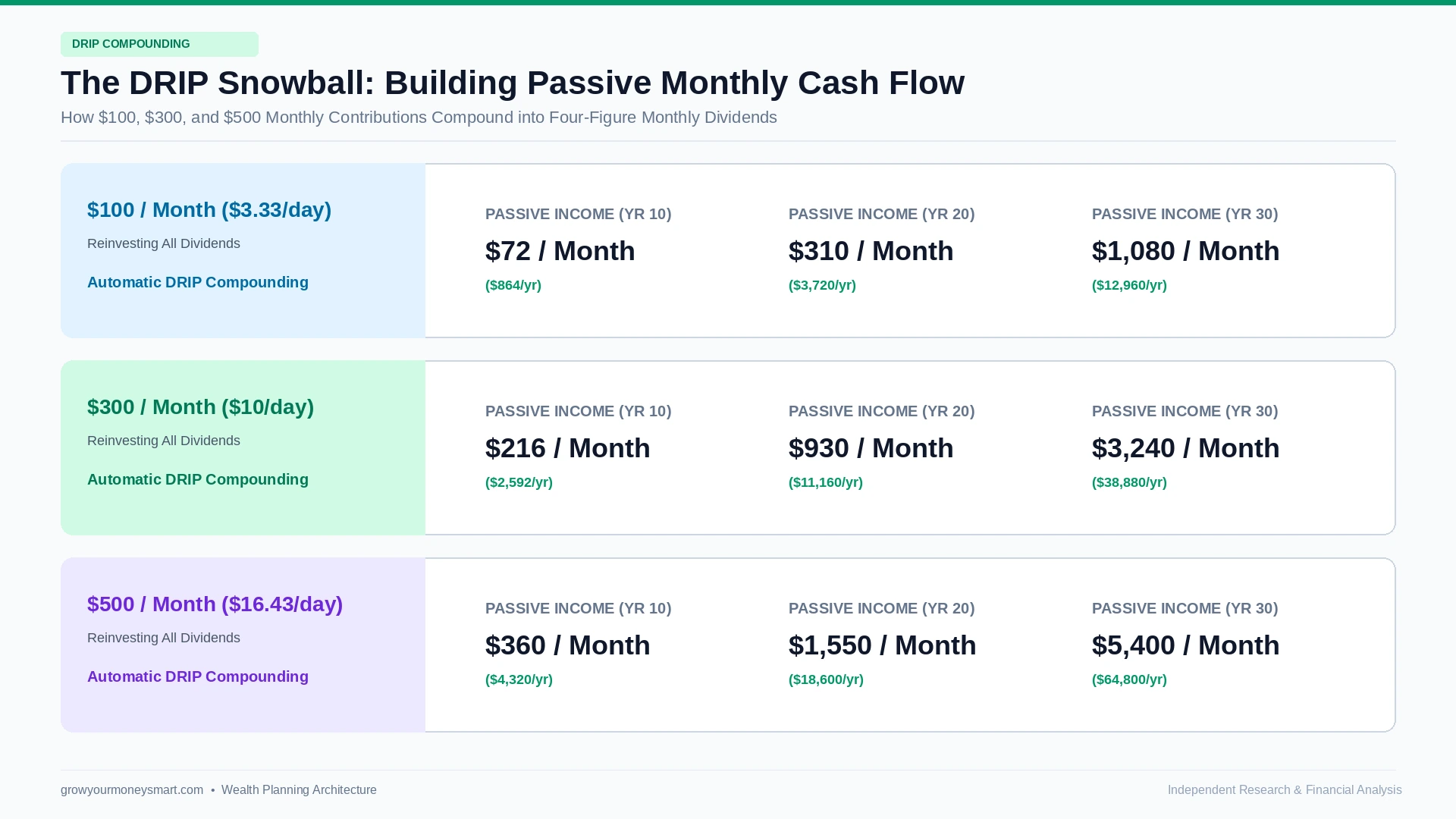
Look at the numbers: If you invest $300 per month into a quality dividend growth ETF (assuming a 3.5% starting yield and 7% dividend growth + capital appreciation):
- Year 10: Your portfolio generates approximately $216/month ($2,592/year) in passive income.
- Year 20: Your cash flow expands to $930/month ($11,160/year)—covering your groceries or utility bills permanently.
- Year 30: The snowball reaches critical mass, delivering $3,240/month ($38,880/year) in hands-free cash flow without you ever touching a penny of your principal capital!
Even if you are starting with a modest monthly budget, our step-by-step roadmap on how to start investing with $100 a month shows you how to kickstart this exact snowball immediately.
Tax Architecture: Qualified vs. Ordinary Dividends
Taxes can dramatically erode dividend returns if you do not understand IRS classifications. Under federal tax law (IRS Topic No. 404), dividends fall into two categories:
- Qualified Dividends (Tax-Favored): Paid by American corporations (or qualified foreign corporations) where you have held the stock for more than 60 days during the 121-day period surrounding the ex-dividend date. Qualified dividends are taxed at preferential long-term capital gains tax rates (0%, 15%, or 20%). For single filers earning under ~$47,000 (or married filing jointly under ~$94,000), the federal dividend tax rate is 0.0%!
- Ordinary / Non-Qualified Dividends: Paid by Real Estate Investment Trusts (REITs), business development companies (BDCs), covered-call income ETFs, or stocks held for less than 60 days. These payouts are taxed at your ordinary federal income tax bracket (up to 37%), substantially reducing your net return in a taxable account.
If you hold REITs or high-yield specialty funds, hold them inside a Roth IRA so high ordinary dividend payouts escape taxation entirely (see our Traditional vs Roth IRA Guide). For qualified dividend growth ETFs like SCHD and VYM, holding them in a standard taxable brokerage account is highly tax-efficient once you have maxed out your 401(k) and IRA limits.
Frequently Asked Questions (FAQs)
How much do I need to invest to get $1,000 a month in dividends?
To generate $1,000 per month ($12,000 per year) at a sustainable 3.5% dividend yield (e.g., SCHD), you need a portfolio of approximately $342,850. If targeting a conservative 3.0% yield, you need $400,000. Chasing an 8% yield to reduce the needed capital to $150,000 exposes you to severe capital loss.
Can a company stop paying dividends at any time?
Yes. Unlike bond coupon interest payments which are legally binding debt obligations, stock dividends are approved at the discretion of the Board of Directors. In financial crises, struggling companies can pause or eliminate dividends. This is why investing in diversified Dividend ETFs or certified Dividend Aristocrats with 25+ year hiking track records is essential.
What is a Dividend Aristocrat vs a Dividend King?
A Dividend Aristocrat is an S&P 500 company that has increased its base dividend payout for at least 25 consecutive years. A Dividend King is an elite company that has increased dividends for at least 50 consecutive years (such as Procter & Gamble, Coca-Cola, and 3M).
Is dividend investing better than growth investing?
Neither is universally better. Growth stocks (like Big Tech) often deliver higher capital appreciation during bull markets but pay zero income. Dividend growth stocks offer lower volatility, tangible cash flow, and downside protection during bear markets. A balanced wealth plan incorporates elements of both.
What is an ex-dividend date?
The ex-dividend date is the cutoff date set by stock exchanges. You must own the stock before the ex-dividend date to receive the upcoming payout. If you purchase shares on or after the ex-dividend date, the upcoming dividend goes to the previous seller.
Do I have to pay taxes on reinvested dividends (DRIP)?
Yes, if held in a taxable brokerage account. Even though you never transferred the cash into your checking account, the IRS considers dividend payouts as realized taxable income in the year distributed. Inside a Roth IRA or Traditional 401(k), however, reinvested dividends incur zero taxes.
What is a healthy dividend payout ratio?
For traditional corporations, a payout ratio between 35% and 60% is considered the goldilocks zone. It proves the company generates plenty of cash to fund operations, reinvest in research, and comfortably service its dividend even during a severe recession.
Can I live off dividends in retirement?
Yes. In fact, living off dividends is the holy grail for many retirees because you spend only the cash generated by the assets while leaving 100% of your underlying share ownership intact to pass onto heirs or future generations.

Jaiveer Hooda is a personal finance researcher and the founder of Grow Your Money Smart. With a background in computer engineering, he approaches money the way an engineer approaches any complex system — through data analysis, mathematical modeling, and ruthless optimization.
He built this platform on a single conviction: financial freedom is not a matter of luck. It is a system that can be designed, tested, and executed by anyone willing to follow the right blueprint. Every strategy published here is researched to the numbers, not written to the trend.
Expertise: Debt elimination · Retirement planning · Passive income · Budgeting systems
Connect: Pinterest | growyourmoneysmart.com | Contact Us