
A Backdoor Roth IRA is an IRS-sanctioned two-step wealth strategy allowing high earners exceeding annual income limits ($161,000 for single filers and $240,000 for married filing jointly in 2026) to legally fund a Roth IRA. By making a non-deductible contribution to an empty Traditional IRA and immediately converting those funds to a Roth IRA, high earners secure permanent tax-free growth and tax-free retirement withdrawals. To execute tax-free, you must avoid the costly IRS Pro-Rata Rule on Form 8606 by maintaining zero pre-tax IRA balances across all accounts.
As your career accelerates and your income crosses into six figures, the IRS progressively closes the door on traditional tax deductions and tax-advantaged savings vehicles. For many professionals, corporate executives, physicians, and tech workers, the first painful realization of this reality is the complete elimination of direct Roth IRA contributions.
The Roth IRA is widely considered the crown jewel of American retirement accounts: money compounds 100% tax-free for decades, withdrawals in retirement are completely exempt from federal and state income tax, and the account carries no mandatory Required Minimum Distributions (RMDs). Fortunately, the tax code contains an entirely legal, codified mechanism designed to bypass these income restrictions: the Backdoor Roth IRA.
However, executing a Backdoor Roth is not as simple as clicking a button on your brokerage dashboard. A single misunderstanding of the IRS “Pro-Rata Rule” can trigger an unexpected and punitive tax bill. This master guide provides the exact step-by-step blueprint to executing a Backdoor Roth conversion with surgical precision, avoiding costly tax traps, and automating your high-income wealth machine.
The High-Earner Income Wall: 2026 IRS Phase-Out Limits
Under IRS tax law, your eligibility to contribute directly to a Roth IRA is strictly governed by your Modified Adjusted Gross Income (MAGI). Once your earnings enter the phase-out corridor, your allowable contribution limit shrinks rapidly until reaching zero.
If your MAGI exceeds these limits, contributing directly to a Roth IRA triggers a severe 6% annual excise tax penalty for every year the excess funds remain in the account. The Backdoor Roth eliminates this risk entirely. For a comprehensive comparison of standard account options, review our foundational breakdown of Traditional IRA vs Roth IRA.
Video Guide: 12 Things You Must Know About A Backdoor Roth IRA
To see how financial expert Rob Berger analyzes the mechanics, pro-rata tax traps, and custodian execution workflows of the Backdoor Roth, watch this detailed video walkthrough:
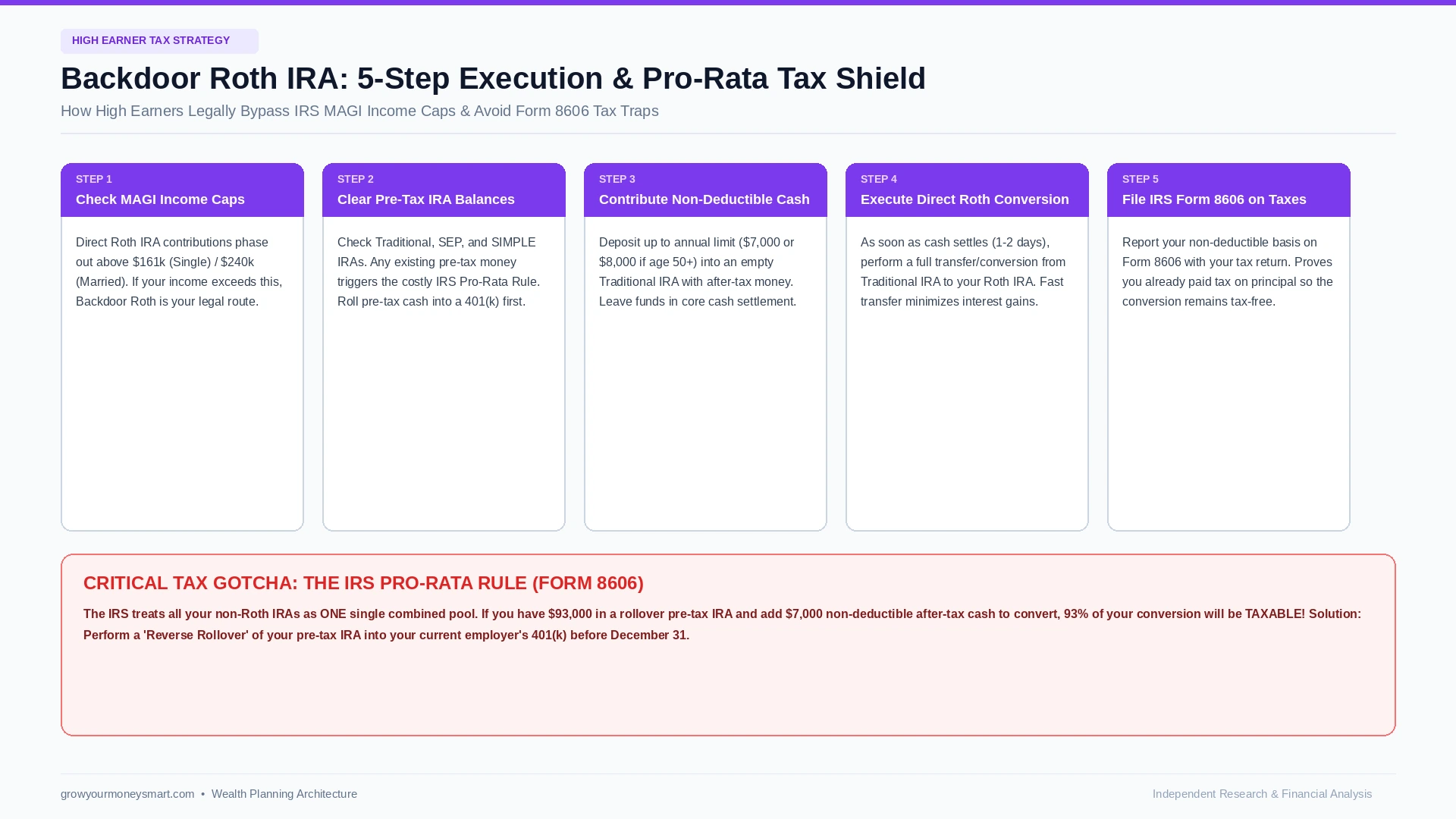
The 5-Step Execution Blueprint: How to Do a Backdoor Roth IRA
Executing a Backdoor Roth conversion is straightforward when followed in sequential order. Most major custodians (such as Vanguard, Fidelity, and Charles Schwab) have streamlined this workflow:
If you do not already have them, open both accounts at the same brokerage firm. Using a single custodian ensures instantaneous transfers between accounts without multi-day settlement delays or paper check transfers.
Before initiating any transfers, verify that you hold $0.00 in pre-tax balances across all Traditional IRAs, Rollover IRAs, SEP-IRAs, and SIMPLE IRAs. (Note: Workplace 401(k) accounts do NOT count against this rule).
Deposit up to your annual maximum ($7,000 or $8,000 if age 50+) into the Traditional IRA from your linked checking account. CRITICAL RULE: Leave this money sitting in the core cash/money market settlement fund. Do NOT invest it into stocks or mutual funds while inside the Traditional IRA.
Once your initial deposit clears (typically 1 to 2 business days), select “Convert to Roth” on your brokerage platform. Transfer 100% of the Traditional IRA balance into your Roth IRA. Once inside the Roth, immediately invest the capital into your target diversified assets, such as the 3-Fund Portfolio.
When filing your federal tax return the following spring, file IRS Form 8606 (Nondeductible IRAs). This form proves to the IRS that you contributed after-tax dollars, ensuring your conversion is treated as completely non-taxable.
The Pro-Rata Trap: Why Many High Earners Get Blindsided
The single greatest pitfall in high-income retirement planning is the IRS Pro-Rata Rule (codified under Internal Revenue Code Section 408(d)(2)).
When you convert funds from a Traditional IRA to a Roth IRA, you cannot simply choose to convert only your non-deductible (after-tax) dollars while leaving pre-tax dollars untouched. The IRS views all non-Roth IRA accounts owned by the individual as one single combined pool.
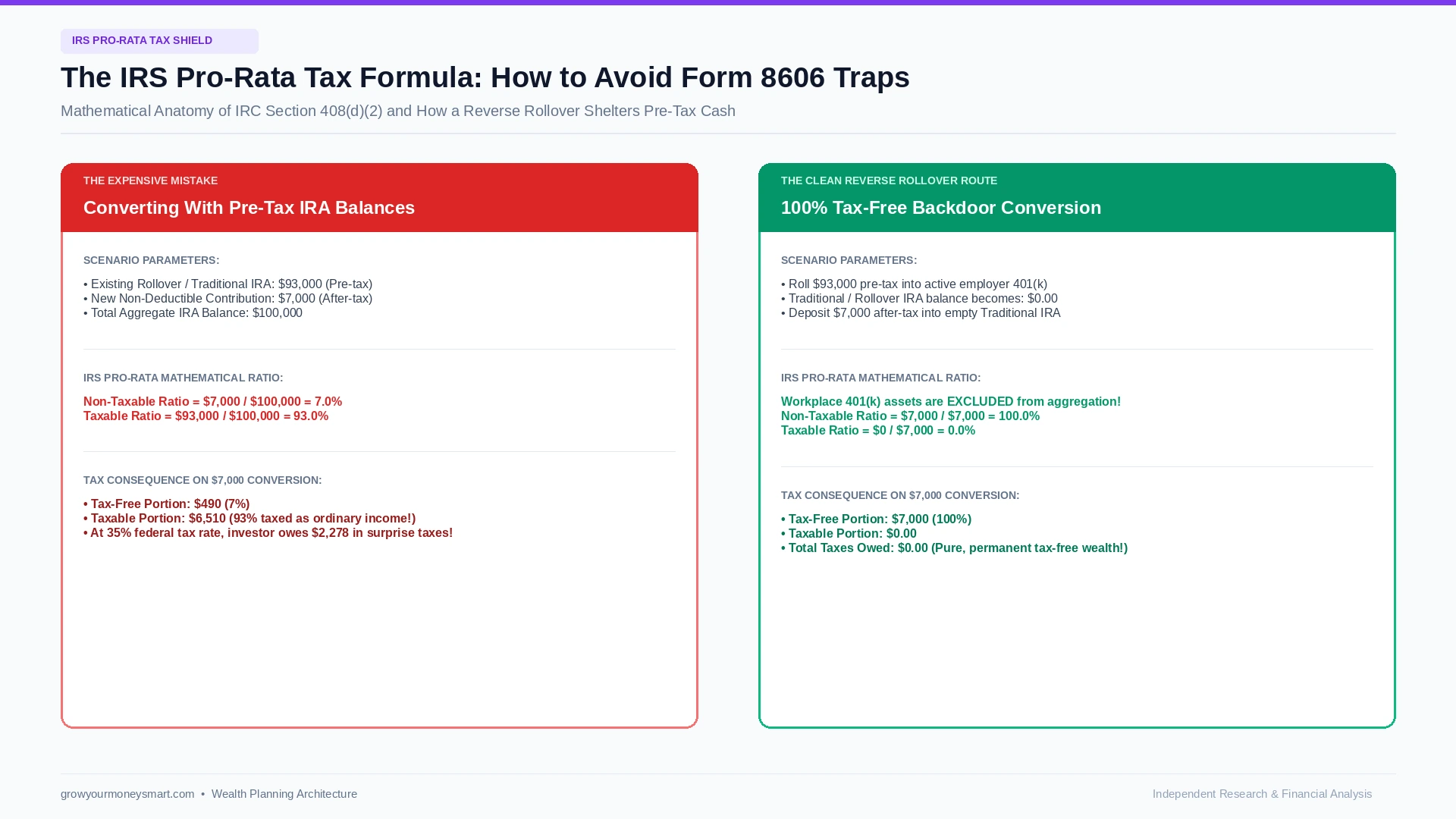
Imagine Sarah has $93,000 sitting in a Rollover IRA from an old job. She deposits $7,000 of after-tax cash into a new Traditional IRA and converts $7,000 to a Roth IRA, assuming the conversion will be tax-free.
The IRS Formula:
Total IRA Balance = $93,000 (pre-tax) + $7,000 (after-tax) = $100,000.
Non-taxable percentage = $7,000 / $100,000 = 7.0%.
Taxable percentage = $93,000 / $100,000 = 93.0%.
When Sarah converts her $7,000, 93% ($6,510) is deemed taxable income at her marginal rate! If Sarah is in the 35% federal tax bracket, she owes an unexpected $2,278 in taxes on money she thought was already taxed!
The Fix: The “Reverse Rollover” into an Employer 401(k)
Fortunately, there is an elegant institutional solution to eliminate the Pro-Rata Rule: the Reverse Rollover.
Under IRS regulations, assets held inside a qualified employer retirement plan—such as an active 401(k), 403(b), or 457(b)—are completely excluded from the pro-rata aggregation calculation. If you have pre-tax money sitting in a Traditional or Rollover IRA, contact your current employer’s 401(k) plan administrator and request a reverse rollover packet to roll your pre-tax IRA funds into your workplace 401(k).
Once your pre-tax IRA balances reach $0.00 before December 31, the pro-rata calculation drops to zero, and your Backdoor Roth conversion becomes 100% tax-free. To review your plan limits and sequence your account funding, check our blueprint on how to max out your 401(k) and Roth IRA, as well as what to do after maxing out your accounts.
Frequently Asked Questions: Backdoor Roth IRA
Yes. The Tax Cuts and Jobs Act (TCJA) legislative history explicitly recognized and affirmed the Backdoor Roth conversion process. In 2018, IRS officials confirmed that the tax code contains no step-transaction prohibition preventing taxpayers from contributing non-deductible funds to a Traditional IRA and immediately converting them to a Roth IRA.
This is extremely common known as “pennies of interest.” Simply convert the entire balance—including the extra few dollars—into your Roth IRA. You will pay ordinary income tax only on the tiny earnings amount (e.g., pennies in taxes on a few dollars), and your Traditional IRA will cleanly return to a $0.00 balance.
No. An IRA is an Individual Retirement Account. The IRS applies the pro-rata rule strictly on a per-person basis. If you have $0 in pre-tax IRAs but your spouse has $100,000 in a Rollover IRA, you can execute your own Backdoor Roth with zero pro-rata taxation.
You have until Tax Day (typically April 15) of the following year to make your annual Traditional IRA contribution for that tax year. However, conversions are strictly reported on a calendar-year basis (January 1 to December 31). To keep your tax paperwork simple, contribute and convert in the same calendar year.
Yes! 401(k) contribution limits ($23,500 in 2026) and IRA contribution limits ($7,000 in 2026) are completely independent of each other. Maxing out your 401(k) does not restrict you from executing a Backdoor Roth.
A regular Backdoor Roth utilizes an IRA up to the $7,000 limit. A Mega-Backdoor Roth operates inside an employer 401(k) plan that permits after-tax (non-Roth) contributions and in-plan Roth conversions, allowing high earners to shelter up to an additional $46,000+ into Roth accounts each year.
If you fail to file Form 8606, the IRS may assume your Traditional IRA contribution was made with pre-tax dollars and issue a CP2000 notice taxing your conversion a second time. The IRS charges a minor $50 penalty for failure to file Form 8606, but it can be filed retroactively to fix the omission.
There is no required IRS waiting period. As soon as your deposit settles into cash (usually 1 to 3 business days), you can convert immediately. Converting promptly minimizes interest accrual in the Traditional IRA.

Jaiveer Hooda is a personal finance researcher and the founder of Grow Your Money Smart. With a background in computer engineering, he approaches money the way an engineer approaches any complex system — through data analysis, mathematical modeling, and ruthless optimization.
He built this platform on a single conviction: financial freedom is not a matter of luck. It is a system that can be designed, tested, and executed by anyone willing to follow the right blueprint. Every strategy published here is researched to the numbers, not written to the trend.
Expertise: Debt elimination · Retirement planning · Passive income · Budgeting systems
Connect: Pinterest | growyourmoneysmart.com | Contact Us