
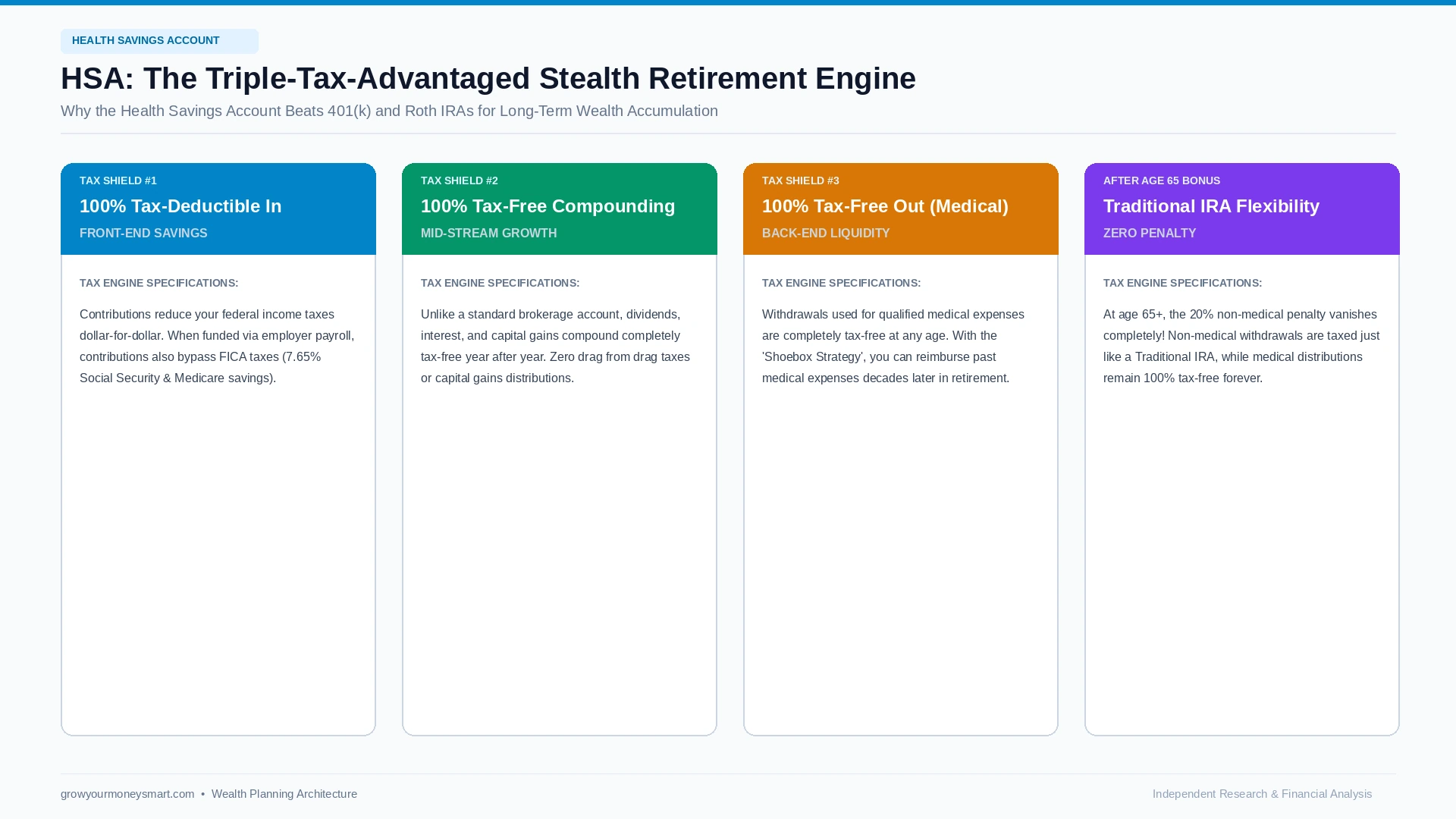
The HSA Triple Tax Advantage operates as the single most tax-efficient retirement vehicle in the United States: contributions are 100% tax-deductible (and bypass 7.65% FICA payroll taxes), investment earnings compound completely tax-free, and distributions for qualified medical expenses are 100% tax-free at any age. In 2026, individuals can contribute up to $4,300 ($8,550 for families). After age 65, the HSA seamlessly converts into a Traditional IRA where non-medical withdrawals incur zero penalty, while medical reimbursements remain tax-free forever.
When most Americans think about retirement planning, their minds immediately default to the classic duo: the workplace 401(k) and the Roth IRA. While both accounts are foundational wealth-building tools, neither possesses the ultimate tax efficiency permitted under the Internal Revenue Code.
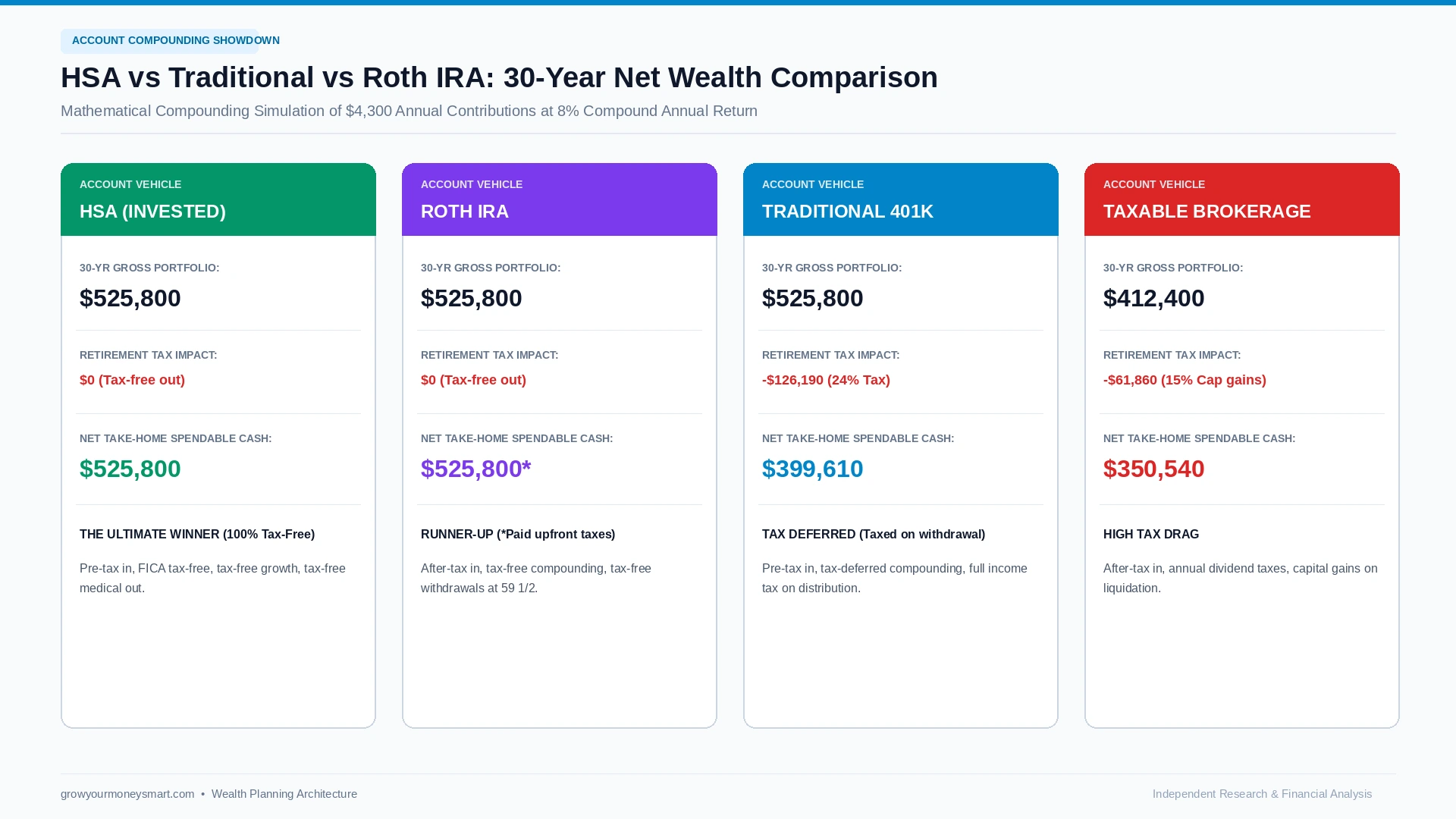
A Traditional 401(k) gives you a tax deduction today, but taxes your withdrawals tomorrow. A Roth IRA taxes you today, but gives you tax-free withdrawals tomorrow. There is only one account in existence that gives you both: a tax deduction on the way in, tax-free compounding in the middle, and completely tax-free withdrawals on the way out.
That vehicle is the HSA Triple Tax Advantage inside a Health Savings Account. While masquerading as a medical rainy-day fund, wealthy investors and institutional planners recognize the HSA as a Stealth Retirement Account capable of compounding hundreds of thousands of dollars completely shielded from Uncle Sam. Here is the comprehensive playbook for weaponizing your HSA into a core pillar of your retirement architecture.
The Anatomy of the HSA Triple Tax Advantage
To understand why the HSA outperforms every other tax-advantaged account on paper, you must examine its three distinct layers of legal tax immunity:
Every dollar deposited into an HSA reduces your federal and state taxable income dollar-for-dollar. Even better: when funded through employer payroll deductions (Section 125 cafeteria plan), contributions bypass 7.65% FICA taxes (Social Security and Medicare), providing an immediate savings boost no Traditional IRA or 401(k) can match.
Once cash balances exceed basic thresholds (typically $1,000), HSA funds can be invested into low-cost index funds, ETFs, and stock portfolios. Capital gains, quarterly dividends, and interest compound year after year with zero drag from annual tax reporting or capital gains taxes.
Withdrawals used for qualified medical expenses—ranging from doctor visits, prescriptions, and surgeries to dental care, vision, and Medicare Part B/D premiums—are 100% tax-free. You never pay a single cent of tax on either your principal or your compounded investment gains.
Video Guide: What Is The Best Way To Invest HSA Funds?
To see how financial advisors structure and invest Health Savings Accounts for maximum compound growth, watch this expert analysis from The Money Guy Show:
2026 IRS Contribution Limits & HDHP Qualifications
To qualify for an HSA, you must be enrolled in an IRS-qualified High-Deductible Health Plan (HDHP). You cannot be covered by other non-HDHP health insurance or enrolled in Medicare, and you cannot be claimed as a dependent on someone else’s tax return.
The “Shoebox Strategy”: Turning Old Medical Receipts into Tax-Free Cash
Most individuals make a critical tactical mistake with their HSA: they swipe their HSA debit card every time they visit the dentist or purchase prescription medication. While convenient, this short-circuits the compounding engine of the account.
The true power of the HSA is unlocked through the Shoebox Strategy. Under IRS rules, there is no statutory deadline for when you must reimburse yourself for a qualified medical expense, provided the expense occurred after the HSA was established.
- Pay Out-of-Pocket: When you incur medical, dental, or vision expenses today, pay for them using regular cash from your checking account or a rewards credit card.
- Digitize and Store the Receipts: Scan your receipts and Explanation of Benefits (EOB) statements. Save them in a dedicated cloud folder (Google Drive, Dropbox, or your HSA custodian portal).
- Invest 100% of Your HSA: Leave your HSA contributions fully invested in low-cost broad market index funds (such as the S&P 500 or total market funds) to compound tax-free.
- Reimburse Decades Later: Twenty or thirty years from now in retirement, you can submit those historical receipts and withdraw tens of thousands of dollars completely tax-free and penalty-free to fund home renovations, travel, or living expenses!
By delaying reimbursement, you allow money that would have been spent on medical copays to compound into an enormous tax-sheltered nest egg. For insights on managing healthcare volatility in retirement, review our study on healthcare costs in retirement planning.
The Age 65 Superpower: The Traditional IRA Transformation
A common concern among pre-retirees is: “What if I stay healthy and don’t have enough medical expenses to spend all my HSA money?”
Prior to age 65, withdrawing HSA funds for non-qualified expenses triggers ordinary income tax plus a severe 20% IRS penalty. However, upon reaching your 65th birthday, a remarkable transformation occurs: the 20% penalty completely disappears!
After age 65, you can withdraw money from your HSA for any reason whatsoever—buying groceries, leasing a vehicle, or traveling the world. Non-medical withdrawals are taxed as ordinary income, making the HSA behave exactly like a Traditional IRA. Meanwhile, any funds used for qualified healthcare expenses remain 100% tax-free! In essence, an HSA is a Traditional IRA with a built-in tax-free escape hatch for medical care.
Frequently Asked Questions: HSA Triple Tax Advantage
No! That is a common myth that confuses HSAs with FSAs (Flexible Spending Accounts). HSAs have NO “use-it-or-lose-it” rule. Your entire balance rolls over year after year indefinitely, earning interest and compound market returns forever.
Yes. Most modern HSA custodians (such as Fidelity) allow you to invest 100% of your contributions into individual stocks, broad-market index funds, and ETFs with zero commissions and zero monthly account fees.
Yes! Once you reach age 65, you can use your HSA funds completely tax-free to pay for Medicare Part B and Part D premiums, as well as Medicare Advantage premiums (though Medicare Supplement / Medigap premiums are excluded by statute).
The HSA is 100% your personal property—it is completely portable and does not belong to your employer. You keep the entire balance, and you can roll it over to an independent custodian of your choice at any time.

Jaiveer Hooda is a personal finance researcher and the founder of Grow Your Money Smart. With a background in computer engineering, he approaches money the way an engineer approaches any complex system — through data analysis, mathematical modeling, and ruthless optimization.
He built this platform on a single conviction: financial freedom is not a matter of luck. It is a system that can be designed, tested, and executed by anyone willing to follow the right blueprint. Every strategy published here is researched to the numbers, not written to the trend.
Expertise: Debt elimination · Retirement planning · Passive income · Budgeting systems
Connect: Pinterest | growyourmoneysmart.com | Contact Us