
To budget a $6,000 monthly income effectively, apply the 50/30/20 rule to your take-home pay: allocate $3,000 (50%) to essential needs, $1,800 (30%) to flexible lifestyle wants, and $1,200 (20%) to debt payoff and compounding wealth. Cap housing at $1,800 and automate your $1,200 savings transfer on payday to guarantee financial freedom.
- High-Earner Take-Home Reality: A $6,000 monthly take-home pay equals $72,000 net after taxes—equivalent to an $88,000 to $98,000 gross annual salary. You have substantial capital to build permanent wealth if structured properly.
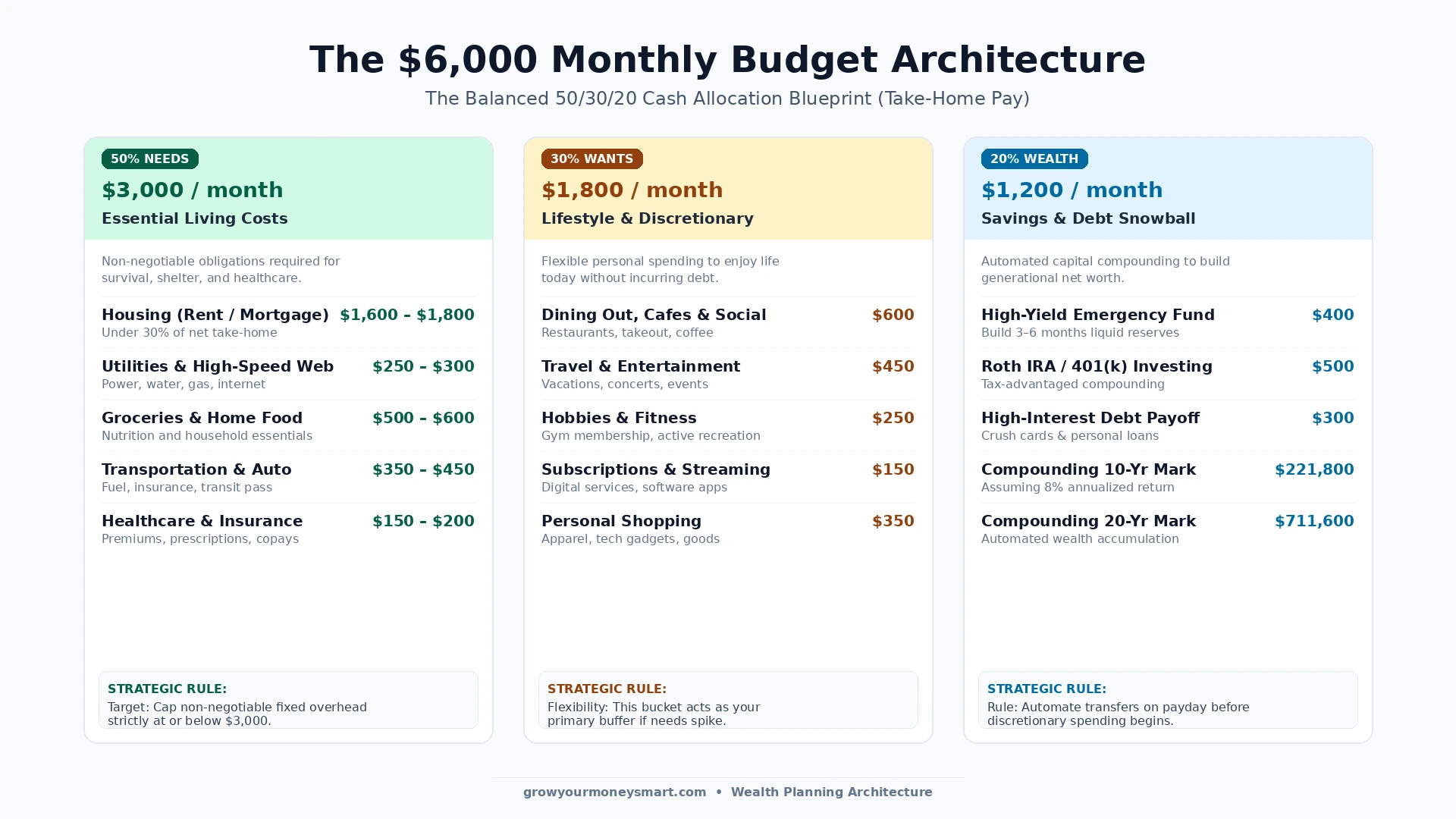
- The 50/30/20 Benchmark: Allocate exactly $3,000 for mandatory needs (housing, food, transit), $1,800 for lifestyle wants (dining out, entertainment, travel), and $1,200 for savings and debt acceleration.
- The 30% Housing Anchor: Cap total rent or mortgage payments at $1,680 to $1,800 per month (including utilities and insurance) to prevent becoming “house poor.”
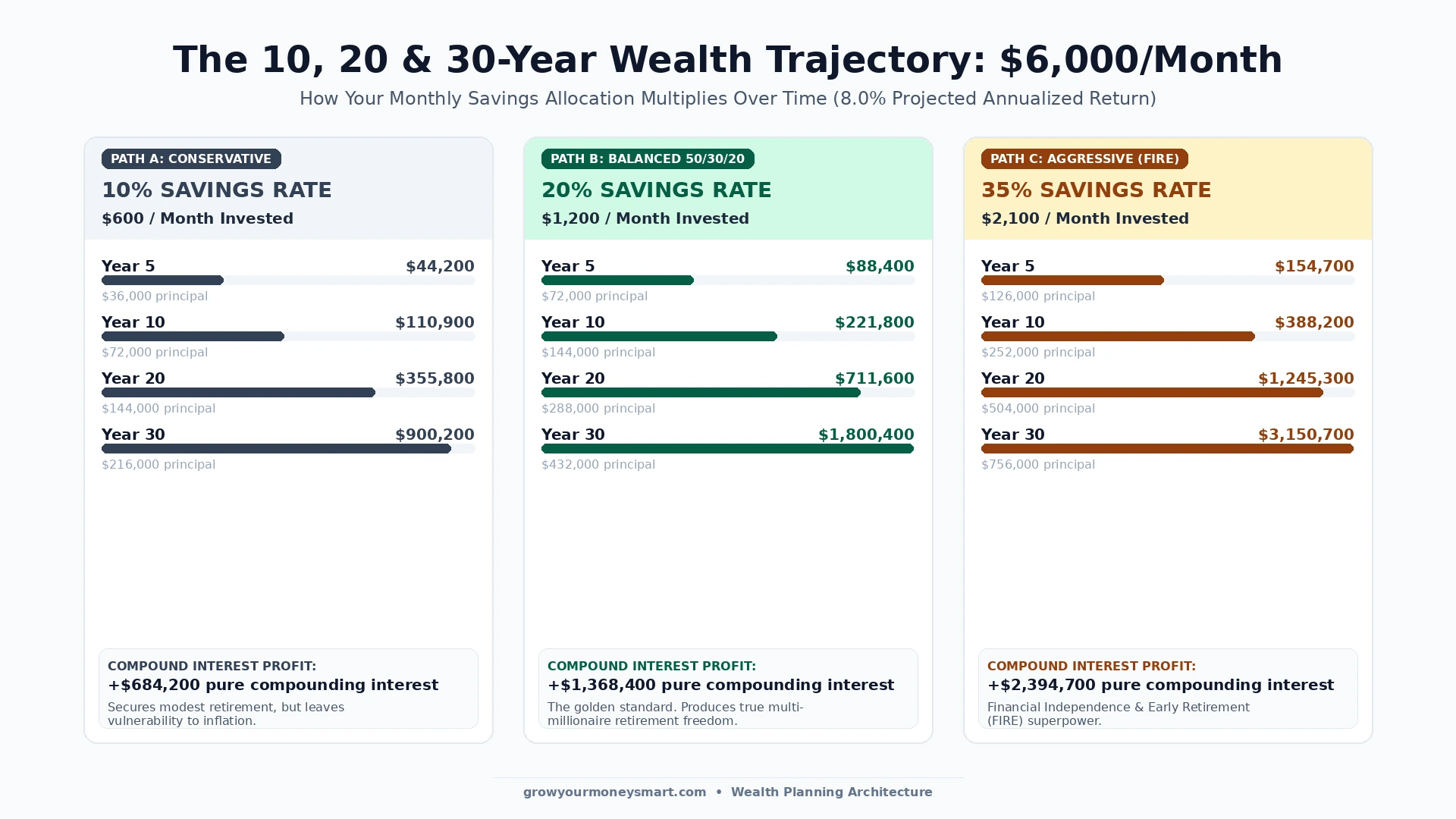
- The $1.8M Compounding Engine: Consistently investing your $1,200 monthly savings at an 8.0% annualized stock market return grows into $221,800 in 10 years, $711,600 in 20 years, and over $1.8 million in 30 years.
- The Reverse Budgeting Shield: Prevent lifestyle creep by automating transfers to savings and brokerage accounts the instant your paycheck lands, before discretionary spending begins.
Earning a $6,000 monthly income is a monumental milestone. At $72,000 per year in direct take-home pay—representing roughly $88,000 to $98,000 in gross pre-tax salary—you have moved well beyond basic survival. You have entered the income tier where financial independence, homeownership, and multi-millionaire retirement are no longer distant daydreams; they are mathematically predictable realities.
Yet, thousands of individuals and families earning $6,000 every single month find themselves asking the exact same frustrating question at the end of every billing cycle: Where did all my money go?
Without an intentional, mathematically sound cash flow architecture, high incomes are surprisingly fragile. Between lifestyle inflation, insidious subscription creep, expensive vehicle leases, and escalating dining habits, $6,000 can evaporate into thin air just as easily as $3,000. In fact, studies show that over 40% of Americans earning above $100,000 still report living paycheck to paycheck.
In this 2026 master blueprint, you will master exactly how to budget a $6,000 monthly income. We break down the proven 50/30/20 framework to the penny, compare three tailored allocation models (including High-Cost-of-Living and aggressive FIRE adjustments), reveal how $1,200 monthly investments compound into over $1.8 million, and give you an actionable 5-stage cash waterfall roadmap to automate your financial freedom. You can also benchmark your numbers directly with our interactive free budget calculator.
Understanding Your $6,000 Monthly Income: Gross Salary vs. Net Take-Home Pay
Before allocating a single dollar, it is crucial to establish total clarity: Is your $6,000 income gross earnings or net take-home cash? Treating gross income as spendable cash is the single most common budgeting blunder made by middle and upper-middle income earners.
Here is how the financial mechanics break down:
- Scenario A: $6,000 Gross Income: If $6,000 is your top-line pre-tax salary ($72,000/year), mandatory deductions will significantly reduce your disposable cash. After federal income tax (12%–22% marginal brackets), state income taxes (0% in Texas/Florida, up to 9%+ in California/New York), FICA payroll taxes (7.65% for Social Security and Medicare), and employer health insurance deductions, your actual net bank deposit will range between $4,400 and $4,850 per month. If you are in this bracket, explore our sibling guide on how to budget a $4,000 monthly salary for tailored allocations.
- Scenario B: $6,000 Net Take-Home Pay (The Focus of This Guide): In this scenario, $6,000 is the liquid cash deposited directly into your checking account every calendar month. To take home $6,000 net, your gross base salary is approximately $88,000 to $98,000 per year (or two earners bringing in $50,000 each in a dual-income household). This means all payroll taxes, mandatory health deductions, and employer 401(k) matches may have already been accounted for.
For the remainder of this master guide, we evaluate a true $6,000 monthly net take-home pay. Every calculation, percentage, and category represents real, spendable cash under your direct command.
The Core 50/30/20 Budget Breakdown for $6,000/Month
Popularized by Harvard bankruptcy expert Senator Elizabeth Warren, the 50/30/20 budgeting rule is widely recognized by financial planners as the gold standard for sustainable wealth building. On a $6,000 monthly salary, this framework creates an elegant, balanced distribution of capital:
1. Essential Needs: $3,000 / Month (50%)
Your “Needs” bucket represents the non-negotiable living expenses required to maintain your shelter, health, physical safety, and ability to earn a living. If you lost your employment tomorrow, these are the critical bills that must be paid:
- Housing (Rent / Mortgage & Property Taxes): Target $1,600 to $1,800. Financial guidelines from the Consumer Financial Protection Bureau (CFPB) recommend capping total housing costs under 28% to 30% of take-home pay.
- Utilities & Communication: $250 to $300 for electricity, natural gas, municipal water, sewer, trash, and high-speed home internet.
- Groceries & Household Essentials: $500 to $600 for nutritious home cooking, pantry staples, and cleaning products (excluding sit-down restaurants or alcohol delivery).
- Transportation & Auto: $350 to $450 covering fuel, auto insurance premiums, routine maintenance, vehicle registration, or municipal transit passes.
- Healthcare & Insurance: $150 to $200 for prescription copays, dental care, vision checks, and out-of-pocket medical expenses.
- Minimum Debt Obligations: Any statutory minimum payments on student loans, personal financing, or auto loans.
2. Lifestyle Wants: $1,800 / Month (30%)
Personal finance should never feel like psychological deprivation. The 30% “Wants” bucket is designed to ensure you enjoy your hard work today without sabotaging your tomorrow. On $6,000 per month, having $1,800 in guilt-free lifestyle capital offers immense comfort:
- Dining Out, Takeout & Cafes: $600 for weekend dinners, artisan coffee, work lunches, and social drinks.
- Travel, Getaways & Entertainment: $450 allocated into a dedicated vacation sinking fund, live concerts, movies, and sports games.
- Hobbies, Fitness & Recreation: $250 for gym memberships, fitness classes, outdoor gear, and personal creative pursuits.
- Digital Subscriptions & Tech Services: $150 covering Netflix, Spotify, cloud storage, software tools, and gaming passes.
- Personal Care & Shopping: $350 for modern apparel, electronics, grooming, home decor, and personal gifts.
3. Wealth Building & Debt Acceleration: $1,200 / Month (20%)
This is where real financial power resides. Allocating $1,200 every single month into wealth accumulation shifts you from an economic consumer into an equity owner. This capital is deployed into three distinct wealth pillars:
- Liquid Emergency Fortress: Funding an FDIC-insured High-Yield Savings Account until you hold 3 to 6 months of basic living expenses ($9,000 to $18,000). Check our comprehensive emergency fund and HYSA master guide for high-yield banking strategies.
- Retirement Investing (Roth IRA & 401k): Investing systematically in broad-market index funds (such as S&P 500 or Total Stock Market indexes). Under current IRS IRA contribution limits, maxing out an annual $7,000 Roth IRA requires $583.33 per month, leaving over $600 for additional investing or debt payoff.
- High-Interest Debt Liquidation: Accelerating debt freedom by throwing extra principal at credit cards, personal loans, or high-rate auto financing using our proven debt prioritization strategies.
Comparing 3 Strategic Budgeting Models for a $6,000 Income
Because no two households have identical living costs, family sizes, or financial goals, rigid templates often fail. Below is a head-to-head comparison of three distinct allocation archetypes for a $6,000 monthly take-home salary:
| Budget Category | Model 1: Balanced (50/30/20) | Model 2: FIRE / Wealth (50/15/35) | Model 3: HCOL City (65/20/15) |
|---|---|---|---|
| Essential Needs (Housing, Food, Transit) | $3,000 (50%) | $3,000 (50%) | $3,900 (65%) |
| Housing Ceiling (Rent / Mortgage) | $1,800 max | $1,700 max | $2,500 max |
| Lifestyle & Personal Wants | $1,800 (30%) | $900 (15%) | $1,200 (20%) |
| Savings, Investing & Debt Payoff | $1,200 (20%) | $2,100 (35%) | $900 (15%) |
| 10-Year Wealth Projection (@ 8% ROI) | $221,800 | $388,200 | $166,300 |
| 20-Year Wealth Projection (@ 8% ROI) | $711,600 | $1,245,300 | $533,700 |
| Best Suited For | Balanced lifestyle & steady wealth | Early retirement & rapid debt crush | Renters in NYC, SF, Boston, Seattle |
If you prefer allocating every dollar to zero before the month begins rather than percentage buckets, compare our guide on zero-based budgeting vs 50/30/20 rule to decide which structure aligns with your personality.
The Mathematical Compounding Engine: How $1,200 Turns Into $1.8 Million
The single greatest advantage of earning $6,000 monthly is your capacity to harness exponential compounding. When you save and invest $1,200 every month into broad-market index funds averaging an 8.0% historical annualized return, the results defy intuition:
- Year 5: You have contributed $72,000 in personal capital. Your account balance reaches approximately $88,400 (earning over $16,400 in pure compound interest).
- Year 10: Your total contributions equal $144,000. Your portfolio grows to $221,800, generating $77,800 in free investment returns.
- Year 20: You have invested $288,000 out of pocket. Your total nest egg surges to $711,600—more than doubling your total lifetime contributions through $423,600 in compound gains.
- Year 30: You have contributed $432,000. Your net worth reaches a staggering $1,800,400! At this stage, your investments earn more in annual compound growth than your original full-time salary.
If you increase your savings rate to 35% ($2,100/month) under an aggressive Financial Independence, Retire Early (FIRE) path, your 30-year portfolio surpasses $3.15 million. To understand the risk and asset balance between equities and cash, review our analysis on HYSA vs stock market investing.
The $6,000 Cash Flow Waterfall: 5 Sequential Financial Priorities
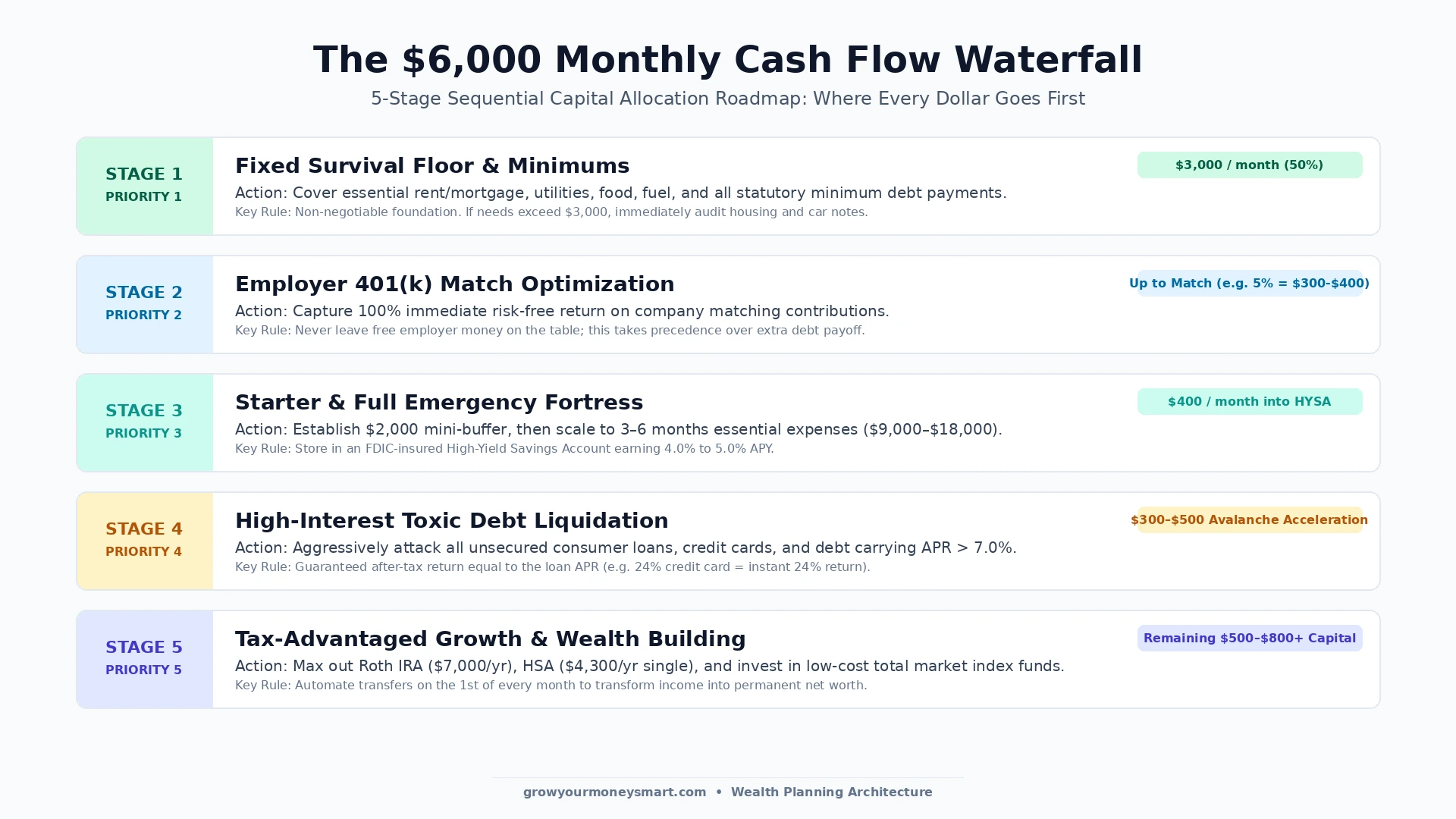
When you receive your paycheck, random spending creates financial leaks. Instead, implement a sequential capital waterfall where every dollar cascades through five disciplined priorities:
Stage 1: Secure Your Survival Floor ($3,000 / Month)
Before investing or paying extra on debt, lock down housing, food, utilities, medical care, and statutory minimum debt payments. If your fixed overhead currently exceeds $3,000, your budget is out of balance. Prioritize downsizing housing, getting a roommate, or refinancing an overpriced auto loan.
Stage 2: Capture Your Employer 401(k) Match (100% Instant Return)
If your employer provides a 401(k) match (e.g., matching 50% or 100% on the first 4% to 6% of your salary), contribute enough to capture the complete match immediately. A dollar-for-dollar match provides a guaranteed 100% instant return on your capital—no stock, crypto, or real estate investment can match this return.
Stage 3: Construct a $9,000 to $18,000 High-Yield Emergency Fortress
Never invest aggressively without an emergency buffer. Calculate 3 to 6 months of your essential needs ($3,000/mo = $9,000 to $18,000). Deposit this capital into an FDIC-insured High-Yield Savings Account earning 4.0% to 5.0% APY. Use our free emergency fund calculator to compute your exact vulnerability score.
Stage 4: Liquidate High-Interest Toxic Debt (> 7.0% APR)
Any credit card balance, payday loan, or unsecured personal loan with an interest rate exceeding 7% is a financial emergency. Paying off a 24% APR credit card delivers a guaranteed, risk-free 24% return after taxes. Deploy our interactive debt payoff calculator to execute an aggressive Debt Avalanche payoff schedule.
Stage 5: Max Out Tax-Advantaged Growth (Roth IRA & HSA)
Once high-interest consumer debt is eradicated and your emergency fund is intact, funnel your $1,200 monthly wealth allocation into a Roth IRA ($583/month) and Health Savings Account (HSA, if enrolled in a high-deductible healthcare plan). If you max both, celebrate your milestone and consult our guide on what to do after maxing out your 401(k) and Roth IRA.
Real-Life Budget Scenarios: 3 Detailed Case Studies on $6,000/Month
To see how these principles function in real life, review these three itemized case studies reflecting common household dynamics:
Case Study 1: The Single Urban Professional
Marcus, 29, lives in Denver, CO, with a $6,000 monthly take-home income. His priority is balancing an active social life with rapid retirement investing:
- Rent & Utilities (1-Bedroom Apartment): $1,750 (29.2%)
- Groceries & Meal Prep: $450 (7.5%)
- Car Payment, Gas & Insurance: $400 (6.7%)
- Health & Life Insurance: $150 (2.5%)
- Discretionary Dining & Nightlife: $650 (10.8%)
- Travel, Skiing & Weekend Trips: $550 (9.2%)
- Fitness & Tech Subscriptions: $250 (4.2%)
- Personal Shopping & Grooming: $300 (5.0%)
- Roth IRA Contribution: $583 (9.7%)
- Taxable Index Fund Brokerage: $500 (8.3%)
- High-Yield Savings Buffer: $417 (6.9%)
- Total Cash Flow: Exactly $6,000.00 (Zero Waste)
Case Study 2: Married Couple with Dual Incomes ($6,000 Total Take-Home)
Elena and David combine their paychecks for a total net income of $6,000. They are aggressively saving for their first home down payment while paying off $14,000 in student debt:
- Housing (Shared 2-Bedroom Rental): $1,800 (30.0%)
- Utilities & Fiber Internet: $300 (5.0%)
- Groceries (Cooking at Home): $650 (10.8%)
- Two Used Vehicles (Insurance & Fuel): $450 (7.5%)
- Combined Medical / Dental: $200 (3.3%)
- Date Nights & Entertainment: $500 (8.3%)
- Personal Allowances ($250 each): $500 (8.3%)
- Subscriptions & Streaming: $100 (1.7%)
- Accelerated Student Loan Payoff: $700 (11.7%)
- House Down Payment HYSA Sinking Fund: $800 (13.3%)
- Total Cash Flow: Exactly $6,000.00 (Zero Waste)
Case Study 3: Family of Four (Suburban Homeowners)
Sarah and Tom earn $6,000 net monthly supporting two young children in suburban Ohio. Fixed needs are naturally higher due to childcare and home maintenance:
- Mortgage, Property Taxes & Insurance: $1,900 (31.7%)
- Utilities, Heating & Internet: $350 (5.8%)
- Family Food & Household Supplies: $850 (14.2%)
- Minivan Gas, Insurance & Maintenance: $500 (8.3%)
- Pediatric Healthcare & Medications: $250 (4.2%)
- Children Activities & School Sports: $300 (5.0%)
- Family Outings & Occasional Takeout: $350 (5.8%)
- Home Maintenance Sinking Fund: $300 (5.0%)
- College 529 Plans ($150 per child): $300 (5.0%)
- Roth IRA Retirement Investing: $600 (10.0%)
- Emergency Fund Top-Off: $300 (5.0%)
- Total Cash Flow: Exactly $6,000.00 (Zero Waste)
The 4-Step Automation System: Putting Your $6,000 Budget on Autopilot
Relying on daily willpower to stick to a budget is a recipe for failure. Wealthy budgeters build automated systems so making the right financial decision requires zero effort:
- Establish Two Separate Checking Accounts: Open one checking account strictly for fixed bills (rent, utilities, insurance) and a second checking account for variable discretionary spending (groceries, dining, entertainment). Transfer your $1,800 “Wants” budget into your second account every month. When that debit card balance hits $0, lifestyle spending stops until the next month.
- Automate Your “Pay Yourself First” Transfer: Schedule an automatic transfer of $1,200 from your primary account to your investment brokerage and HYSA for the first business day following each payday. Never wait until the end of the month to “see what is left over.”
- Consolidate Sinking Funds in Sub-Savings Accounts: Open high-yield savings sub-accounts labeled “Auto Repair”, “Annual Vacations”, “Holiday Gifts”, and “Tax Reserve.” Deposit small recurring amounts monthly so large irregular expenses never derail your monthly cash flow.
- Conduct a 15-Minute Monthly Wealth Audit: On the last Sunday of every month, spend 15 minutes reviewing your account balances, confirming automated transfers cleared, and adjusting next month’s line items for upcoming birthdays or seasonal events.
Frequently Asked Questions: Budgeting a $6,000 Monthly Income
Conclusion: Taking Command of Your Financial Future
Budgeting a $6,000 monthly income is never about penny-pinching or saying no to everyday pleasures. It is about creating a deliberate, high-leverage money pipeline where your financial survival is guaranteed, your lifestyle is genuinely enjoyed, and your future multi-millionaire status is mathematically locked in.
By establishing your 50% Needs ceiling at $3,000, capping your housing costs under $1,800, savoring your $1,800 Wants guilt-free, and automating your $1,200 wealth contributions on payday, you transcend the trap of living paycheck to paycheck.
Take action today: set up your two checking accounts, automate your first $1,200 wealth transfer, and benchmark your progress using our interactive budget calculator. Your future self will thank you.

Jaiveer Hooda is a personal finance researcher and the founder of Grow Your Money Smart. With a background in computer engineering, he approaches money the way an engineer approaches any complex system — through data analysis, mathematical modeling, and ruthless optimization.
He built this platform on a single conviction: financial freedom is not a matter of luck. It is a system that can be designed, tested, and executed by anyone willing to follow the right blueprint. Every strategy published here is researched to the numbers, not written to the trend.
Expertise: Debt elimination · Retirement planning · Passive income · Budgeting systems
Connect: Pinterest | growyourmoneysmart.com | Contact Us