
Allocating a $4,000 monthly take-home income using standard financial ratios protects against housing cost burdens while funding future savings. Consult the official Consumer Financial Protection Bureau (CFPB) Budgeting Guide for statutory guidelines and consumer protections.
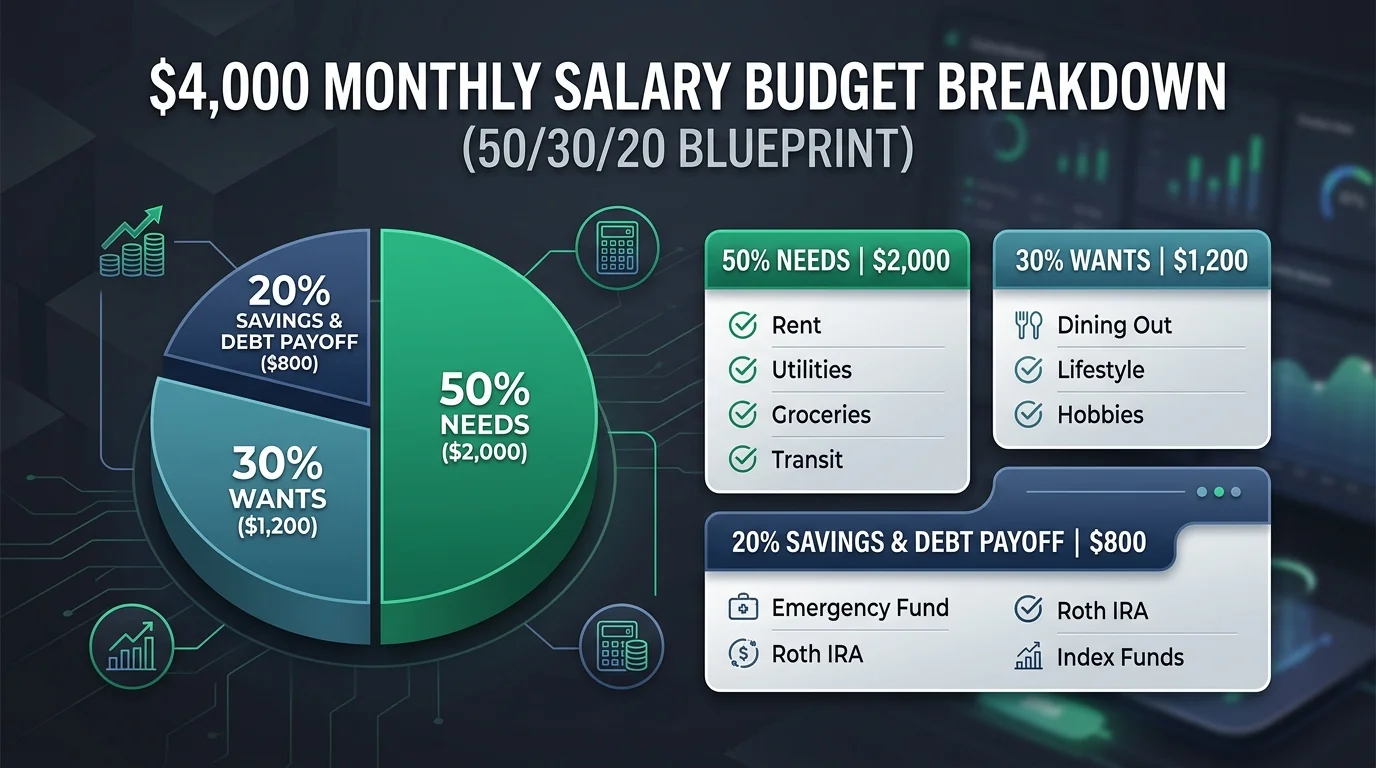
- The Golden Benchmark: Under the foundational 50/30/20 framework, a $4,000 take-home monthly salary divides cleanly into $2,000 for Needs (50%), $1,200 for Wants (30%), and $800 for Savings & Debt Elimination (20%).
- Housing Safeguard: Keep total housing overhead (rent/mortgage + basic utilities) strictly below $1,200 to $1,350/month (30%–33% of net income) to avoid becoming “house poor.”
- Automated Wealth Engine: Directing your 20% savings ($800/month) into a low-cost index fund (e.g., S&P 500) compounding at an average 8% annual return builds $146,000+ in 10 years and over $475,000 in 20 years.
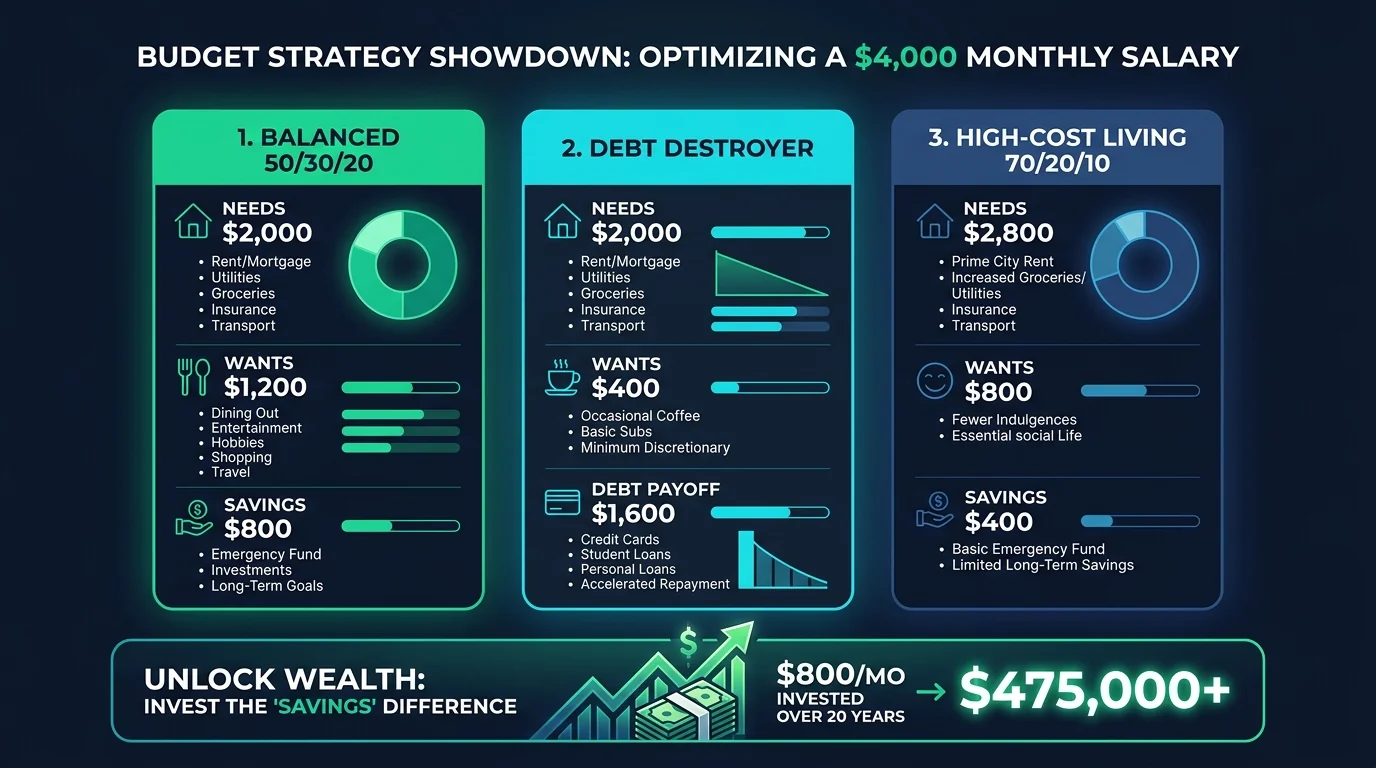
- Debt Strategy Priority: If carrying toxic credit card debt, temporarily re-allocate $400 from discretionary “Wants” to funnel $1,200/month into high-speed debt payoff via the Avalanche or Snowball method.
- Dynamic Customization: If living in a High Cost of Living (HCOL) city, transition to the 70/20/10 model ($2,800 Needs, $800 Wants, $400 Savings) rather than abandoning budgeting altogether.
Earning a $4,000 monthly salary ($48,000 net take-home annually, equivalent to approximately $58,000 to $64,000 gross before taxes) places you in an enviable position within modern personal finance. It represents a substantial cash flow that, when managed with intentional precision, delivers total lifestyle autonomy, freedom from consumer debt anxiety, and rapid wealth accumulation.
However, without an explicit capital allocation blueprint, even a healthy $4,000 monthly paycheck can evaporate into lifestyle creep, uncontrolled micro-transactions, and runaway housing costs. Whether you are living on your own, managing a household, or aggressively building an emergency reserve, this comprehensive 2026 guide will teach you how to engineer, execute, and automate every single dollar of your $4,000 paycheck using mathematical models, real-world expense breakdowns, and proven wealth compounding strategies.
Understanding Your $4,000 Net vs. Gross Income Reality
Before allocating a single cent into budget categories, you must establish an absolute rule of financial planning: always build your operating budget around Net Take-Home Pay, never Gross Stated Salary. If your official employment offer states $48,000 annually ($4,000 gross monthly), your actual take-home paycheck will range between $3,150 and $3,450 after Federal FICA, state withholdings, and pre-tax healthcare premiums. (If your take-home pay is closer to $3,000, explore our targeted $3,000 monthly income budget guide).
Throughout this blueprint, we treat $4,000 as your actual net deposited cash flow—the exact dollar amount that hits your checking account across your monthly pay cycles (e.g., two bi-weekly deposits of $2,000 or four weekly checks of $1,000). You can simulate your customized deductions and personal tax allowances using our free Interactive Budgets Calculator.
Is $4,000 a Month a Good Salary in 2026?
A frequent question from career starters and working professionals is: is $4,000 a month a good salary? The definitive answer is yes, but whether $4,000 feels comfortable or financially tight depends on whether that figure represents your net take-home pay or gross stated salary, and where you live in the United States.
| Metric | $4,000 Gross Monthly | $4,000 Net (Take-Home) Monthly |
|---|---|---|
| Annualized Equivalent | $48,000 Gross / Year | $58,000 – $64,000 Gross / Year |
| US Median Individual Comparison | Near national median (~$48,000) | 25%–30% above US individual median |
| Max Recommended Housing (30% Rule) | $950 – $1,050 / month | $1,200 / month |
| Cost of Living Feasibility | Challenging in major metros without roommates | Comfortable in Low/Mid Cost of Living markets |
If your $4,000 monthly salary is take-home cash flow ($48,000 net annually), you are earning the equivalent of roughly $60,000 before taxes. For a single earner, this provides an exceptional launchpad to eliminate debt, build an emergency buffer, and invest for retirement—provided you adhere to strict housing cost limits. To discover how to budget 4000 a month with exact category allocations, explore our proven framework below.
The Core Framework: The 50/30/20 Budget Breakdown for $4,000
Originally popularized by personal finance academics, the 50/30/20 rule serves as the premier benchmark for middle-income budgeting because it balances essential survival obligations with lifestyle enjoyment and long-term financial security.
Here is how a $4,000 monthly salary breaks down mathematically across the three standard pillars:
| Category | Target % | Monthly Dollar Amount | Annual Dollar Total | Core Expense Inclusions |
|---|---|---|---|---|
| 1. Essential Needs | 50% | $2,000.00 | $24,000.00 | Rent/Mortgage, Utilities, Basic Groceries, Transport, Health/Auto Insurance, Minimum Debt Payments |
| 2. Discretionary Wants | 30% | $1,200.00 | $14,400.00 | Dining Out, Streaming Apps, Hobbies, Gym, Travel, Entertainment, Fashion, Personal Upgrades |
| 3. Wealth & Debt Payoff | 20% | $800.00 | $9,600.00 | High-Yield Savings, Emergency Fund, Roth IRA, 401(k), Index Funds, Extra Debt Principal |
| Total Net Monthly Flow | 100% | $4,000.00 | $48,000.00 | 100% Balanced Zero-Deficit Cash Flow |
1. Needs ($2,000 / Month): The Non-Negotiable Survival Floor
Your 50% “Needs” bucket encompasses obligations required to maintain your physical shelter, employment, and health. If eliminating an expense would cause eviction, hunger, power shutoff, or legal default, it belongs strictly in this category:
- Housing (Rent / Mortgage): $1,150.00 (Targeting 28%–30% of total take-home pay).
- Core Utilities (Electric, Water, Gas, Trash): $175.00.
- High-Speed Home Internet & Mobile Phone: $125.00.
- Nutritional Groceries (Home Cooking & Staples): $350.00.
- Transportation (Fuel, Public Transit Passes, Maintenance): $120.00.
- Insurance Premiums (Auto, Renter’s, Copays): $80.00.
2. Wants ($1,200 / Month): Guilt-Free Lifestyle Freedom
The 30% “Wants” allocation prevents budget burnout. Restrictive budgets that force 100% austerity fail because human psychology requires positive reinforcement. With $1,200 per month dedicated to discretionary spending, you enjoy true lifestyle flexibility:
- Social Dining & Weekend Takeout: $400.00.
- Entertainment, Concerts & Nightlife: $250.00.
- Digital Subscriptions (Netflix, Spotify, Cloud Storage): $50.00.
- Apparel, Personal Grooming & Wellness: $150.00.
- Vacation & Weekend Getaway Sinking Fund: $250.00.
- Hobbies, Fitness Memberships & Tech Gear: $100.00.
3. Savings & Debt Elimination ($800 / Month): Your Wealth Compounder
The 20% “Savings” allocation is your ticket to long-term financial independence. Putting away $800 every month ($9,600 annually) ensures you build an unshakable safety cushion and participate actively in equity compounding. Track and model your safety reserves with our dedicated Emergency Fund Calculator.
- Emergency Liquidity Reserve: $300.00 (Rather than leaving your savings in a low-interest checking account, park your savings in a high-yield savings account to earn 4%+ APY).
- Roth IRA / Tax-Advantaged Index Funds: $400.00 (Directed to total stock market funds like VOO/VTI. Once your $4,000 monthly cash flow allows you to hit annual contribution caps, explore what to do after maxing out your 401(k) and Roth IRA).
- Sinking Fund for Irregular Annual Costs (Taxes, Car Repairs): $100.00.
Comparing Alternative Budget Strategies for a $4,000 Income
Depending on your geographic location, family status, and existing debt balance, the 50/30/20 rule may require tailoring. Below is an analytical matrix comparing the top three budgeting methodologies for managing a $4,000 monthly paycheck:
| Budget Model | Needs Allocation | Wants Allocation | Savings & Debt | Ideal User Profile | Core Benefit |
|---|---|---|---|---|---|
| Balanced 50/30/20 | $2,000 (50%) | $1,200 (30%) | $800 (20%) | Individuals with low consumer debt in MCOL cities | Maximum sustainability and low psychological friction |
| The Debt Destroyer | $2,000 (50%) | $400 (10%) | $1,600 (40%) | Individuals carrying high-interest credit card/personal debt | Eliminates toxic interest fees and accelerates debt freedom |
| HCOL Adaptive (70/20/10) | $2,800 (70%) | $800 (20%) | $400 (10%) | Renters in metropolitan hubs (NYC, LA, Seattle, Boston) | Accommodates elevated rent without debt accumulation |
| Aggressive FIRE (40/10/50) | $1,600 (40%) | $400 (10%) | $2,000 (50%) | Frugal professionals pursuing early retirement | Creates millionaire net worth in under 15–18 years |
If you find yourself burdened with consumer obligations, evaluate our complete handbook on strategic debt management frameworks or model your payoff timeline using the Debt Payoff Acceleration Calculator. Allocate your debt repayment line item using proven debt avalanche vs snowball payoff strategies to accelerate your progress.
Mathematical Simulation: The Compounding Power of Your $800/Month Savings
What happens when you consistently preserve and invest the 20% savings portion ($800/month) of your $4,000 salary? The table below illustrates the exponential power of compound interest assuming a conservative 8.0% annualized nominal return in broad-market index funds (reinvesting all dividends):
| Investment Horizon | Total Cumulative Contributions | Compound Interest Earned | Total Portfolio Value | Purchasing Power Milestone |
|---|---|---|---|---|
| Year 1 | $9,600 | $428 | $10,028 | Fully funded emergency reserve cushion |
| Year 3 | $28,800 | $4,115 | $32,915 | Substantial home down payment or security fund |
| Year 5 | $48,000 | $12,382 | $60,382 | Half-decade financial independence milestone |
| Year 10 | $96,000 | $58,154 | $154,154 | Interest gains begin outpacing annual deposits |
| Year 20 | $192,000 | $283,923 | $475,923 | Substantial self-sustaining wealth engine |
| Year 30 | $288,000 | $904,651 | $1,192,651 | Fully Liquid 7-Figure Retirement Nest Egg |
Notice how by Year 30, your out-of-pocket contributions amount to only $288,000, while compound interest generates over $904,000 in pure capital growth. Aligning your portfolio across different milestones is explored in our deep-dive on optimizing your investment time horizon and navigating the stages of the retirement lifecycle.
Authority Video Guide: Visualizing Money Management & The 50/30/20 Rule
To reinforce the fundamentals of cash flow structuring and visualize the behavioral psychology behind automated budgeting, watch this breakdown by veteran personal finance educator Marko from WhiteBoard Finance:
Step-by-Step Action Blueprint: How to Budget $4,000 Monthly
Follow this systematic 5-step operational protocol to transform your $4,000 paycheck into an automated, stress-free wealth system:
Step 1: Calculate Real Cash Inflows & Pay Frequency
Confirm the precise timing of your deposits. If paid bi-weekly (26 paychecks per year), you will receive two “bonus paycheck” months each year with three paychecks. Base your standard monthly budget strictly on two paychecks ($4,000 total) and treat the two extra paychecks as 100% surplus to accelerate emergency savings or investment goals.
Step 2: Establish the $1,000–$2,000 Starter Emergency Buffer
Before aggressively investing or prepaying low-interest debt, lock in a starter emergency buffer of $1,000 to $2,000 in a dedicated high-yield savings account (HYSA). This prevents unexpected car repairs or medical copays from forcing you into high-interest credit card balances. Check out our beginner guide on how to save your first $1,000 fast.
Step 3: Cap Housing and Fixed Utility Overhead
Housing is the single largest budget risk. On a $4,000 net income, your all-in rent or mortgage obligation must not exceed $1,200 to $1,350 per month. If current rent exceeds this threshold, take immediate corrective action: negotiate lease renewals, bring in a roommate, or relocate when the lease expires to protect your cash flow margins.
Step 4: Automate the “Pay Yourself First” Capital Pipeline
Never wait until the end of the month to save “whatever is left over.” Set up automated recurring transfers on the morning of payday:
- Transfer $400 / paycheck directly to your High-Yield Savings Account until your 3–6 month emergency fund is complete.
- Transfer $300–$400 / paycheck directly into your Roth IRA or brokerage account purchasing low-cost index funds.
Step 5: Implement Multi-Account “Sub-Sinking” Funds
Segregate your $1,200 monthly discretionary allowance into dedicated checking accounts or digital debit cards (e.g., a “Guilt-Free Spending” card). When the designated balance reaches zero, discretionary spending pauses until the next pay cycle—eliminating overdraft risks entirely.
Scale your cash flow management across different income milestones with our tailored blueprints:
- Automated Digital Helpers: Explore our guide on best free budgeting apps without subscriptions to keep your $4k monthly allocation effortless.
- Ready-to-Use Spreadsheet: Explore our guide on free monthly budget spreadsheet template designed for custom income tracking and expense categorization.
- Income Scaling Blueprint: Explore our guide on budgeting a $6,000 monthly income blueprint to optimize savings as your career earnings grow.
High-Intent Frequently Asked Questions (FAQs)
Explore authoritative answers to the most common questions regarding how to budget and optimize a $4,000 monthly take-home salary:
Yes. A $4,000 monthly take-home salary ($48,000 net annually, equivalent to approximately $58,000–$64,000 gross before taxes) is above the median individual income in the United States. In low-to-medium cost of living areas (LCOL/MCOL), $4,000 per month provides ample margin to cover essential living costs, maintain an enjoyable lifestyle, and invest 20% ($800/month) toward long-term wealth accumulation.
Under the classic 50/30/20 framework based on after-tax take-home pay, allocate $2,000 (50%) to essential Needs (rent/mortgage, utilities, groceries, transportation, minimum debt payments), $1,200 (30%) to discretionary Wants (dining out, streaming, travel, entertainment), and $800 (20%) to Savings and Accelerated Debt Payoff (emergency fund, Roth IRA, index funds).
If you reside in a high cost of living (HCOL) market where rent and utilities exceed $2,000, adopt an adjusted 70/20/10 or 60/20/20 framework. For instance, allocate $2,800 (70%) to Needs, reduce discretionary Wants to $800 (20%), and preserve at least $400 (10%) for mandatory emergency savings and retirement investing while actively seeking opportunities to optimize fixed overhead.
Following the standard 28%–30% gross income housing rule (or keeping housing under 30%–35% of take-home pay), your target rent or mortgage payment should ideally be between $1,100 and $1,300 per month, leaving $700–$900 for utilities, groceries, and transportation within your 50% needs category.
First, establish a starter emergency buffer of $1,000 to $2,000 in a high-yield savings account. Next, aggressively direct your entire 20% savings allocation ($800/month or more) toward high-interest debt (such as credit cards with APRs above 8%) using the Debt Avalanche or Debt Snowball method. Compare debt payoff strategies in our debt-free vs. having debt guide.
With monthly essential expenses of $2,000, a complete 6-month emergency reserve equals $12,000. By saving the standard 20% allocation ($800/month), you will fully fund your 6-month safety net in exactly 15 months. If you temporarily trim discretionary spending to save $1,200 per month, you can achieve full emergency security in just 10 months.
Investing $800 per month (20% of your $4,000 salary) into a broad-market index fund (such as the S&P 500) compounding at an average 8% annual return yields approximately $146,000 in 10 years, $475,000 in 20 years, and over $1,190,000 in 30 years.
The 50/30/20 rule is best for baseline structure and lifestyle flexibility. Zero-based budgeting (giving every dollar a specific job until $0 remains) is superior for aggressively eliminating debt and tracking irregular spending. The Pay-Your-First method is ideal for hands-off wealth builders who want to automate $800 into savings immediately on payday and spend the rest freely.
Disclaimer: This article is for informational and educational purposes only and should not be construed as personalized financial, tax, or legal advice. Always consult a certified financial planner (CFP) or tax advisor regarding your specific personal circumstances.

Jaiveer Hooda is the Lead Financial Researcher & Personal Finance Analyst at Grow Your Money Smart. Specializing in personal wealth optimization, index fund compounding, high-yield savings mechanics, and consumer debt elimination strategies. With a background in computer engineering, he applies mathematical modeling, cashflow simulations, and empirical risk analysis to evaluate personal finance vehicles and credit products. Every analysis is backed by verified regulatory disclosures, IRS tax schedules, and empirical APY compounding math.
Areas of Expertise: Personal Finance · High-Yield Savings Accounts (HYSA) · Index Funds & S&P 500 Compounding · Retirement Planning (401k/IRA) · Debt Optimization · Credit Card APR Mechanics.
Transparency & Editorial Policy: Editorial Standards | Report a Correction