
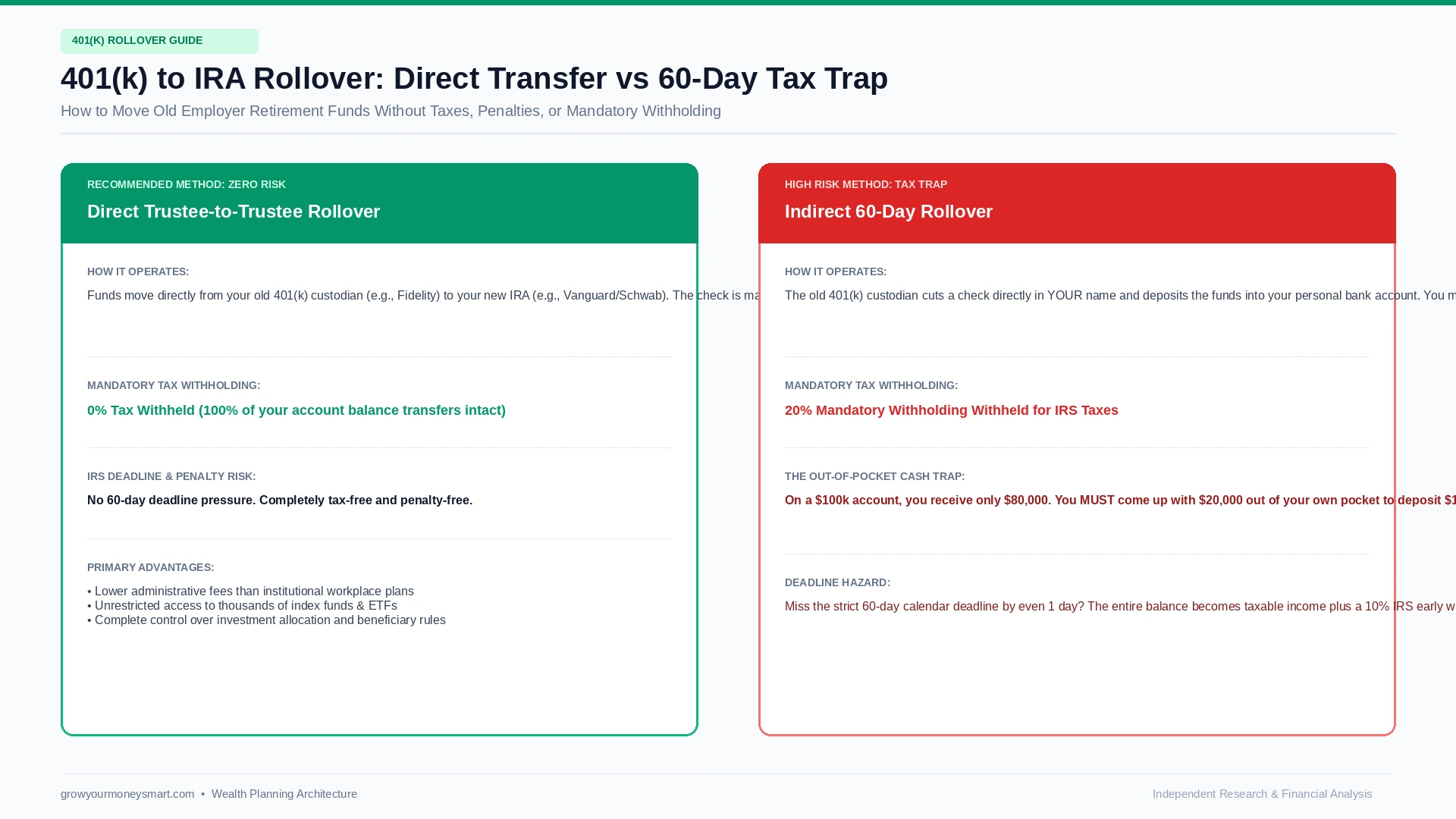
To Rollover a 401(k) to an IRA without triggering income taxes or early withdrawal penalties, you must execute a Direct Trustee-to-Trustee Rollover. In a direct rollover, your former 401(k) custodian transfers funds directly to your new IRA custodian (or issues a check made payable to the new institution FBO you). This completely avoids the IRS mandatory 20% tax withholding trap and eliminates the strict 60-day calendar deadline associated with risky indirect rollovers.
Changing jobs or transitioning into retirement is one of the most significant milestones in your professional life. Yet, amid the flurry of exit interviews, benefits transitions, and contract negotiations, one massive financial asset is frequently left behind in administrative limbo: your former employer’s 401(k) plan.
Leaving a retirement nest egg parked in an old workplace 401(k) often subjects your hard-earned wealth to bloated administrative recordkeeping fees, restricted mutual fund menus, and zero personalized support. When you decide to Rollover a 401(k) to an IRA, you gain total control over your asset allocation, dramatically cut fee drag, and unlock thousands of low-cost index funds and ETFs.
However, navigating the rollover process without a clear roadmap is fraught with tax hazards. A single procedural error—such as requesting a check in your personal name rather than a direct transfer—can trigger automatic mandatory tax withholding, premature distribution penalties, and thousands of dollars in irreversible tax losses. Here is your definitive step-by-step master guide to executing a 100% tax-free 401(k) to IRA rollover.
Your 4 Options for an Old 401(k): Strategic Comparison
When you depart an employer, you have four distinct legal choices for handling your vested retirement balance:
Video Walkthrough: How to Rollover a 401(k) to an IRA in 7 Easy Steps
Watch this step-by-step tutorial from financial expert Rob Berger detailing how to execute a direct 401(k) rollover without paying taxes or IRS penalties:
Direct vs. Indirect Rollovers: The 20% Tax Withholding Trap
The single most dangerous fork in the road during a rollover is choosing between a Direct Rollover and an Indirect Rollover. In a direct rollover, the check is made payable to your new custodian FBO you, ensuring zero tax withholding.
Suppose you have $100,000 in an old 401(k) and execute an indirect rollover:
1. Your plan custodian withholds 20% ($20,000) for the IRS and sends you a check for only $80,000.
2. Under IRS rules, you must deposit the FULL $100,000 into your new IRA within exactly 60 calendar days.
3. To complete the rollover tax-free, YOU MUST COME UP WITH $20,000 IN CASH OUT OF YOUR OWN POCKET to make up for the withheld taxes!
4. If you only deposit the $80,000 you received, the remaining $20,000 is classified as an early taxable distribution! If you are under age 59½, you will owe ordinary income taxes plus a 10% IRS penalty ($2,000) on that $20,000 shortfall!
5. Miss the 60-day calendar deadline by even 24 hours? The ENTIRE $100,000 becomes fully taxable as ordinary income plus a $10,000 penalty!
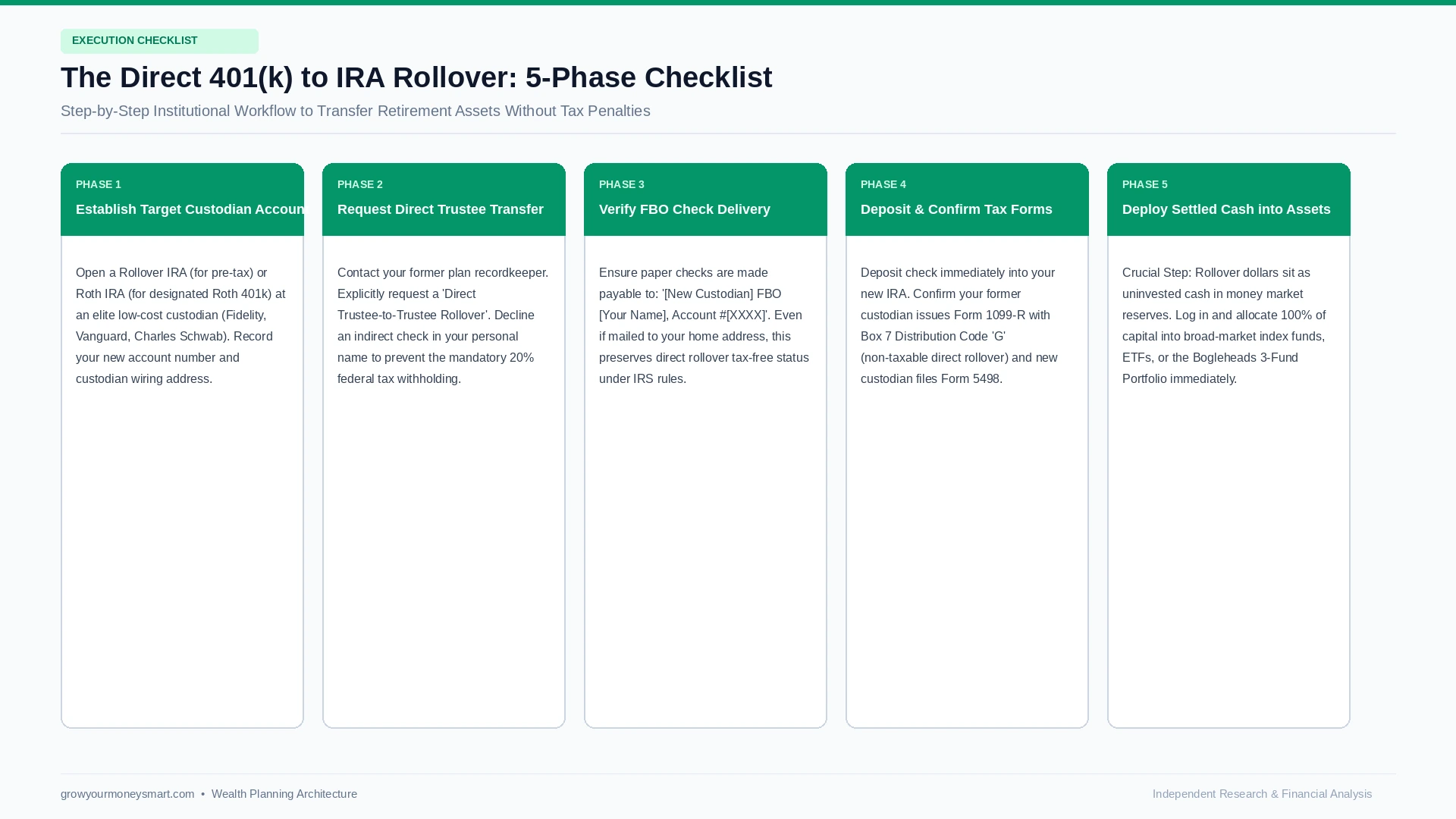
5-Step Action Checklist to Rollover a 401(k) to an IRA
Open a Rollover IRA (or Roth IRA) at an elite low-cost brokerage firm like Fidelity, Vanguard, or Charles Schwab. Note your new account number and specific wiring/deposit instructions.
Call your old plan provider (Empower, Principal, Fidelity, etc.) and state: “I have separated from service and would like to execute a direct trustee-to-trustee rollover of my 100% vested balance to my IRA.”
Ensure the check is made payable to your new custodian FBO your name. If the provider insists on mailing the check to your home address, that is fine—as long as the check is NOT payable to you personally, it remains a direct rollover.
If an FBO check was mailed to your house, forward it immediately via certified mail or mobile app check deposit to your new brokerage account.
CRITICAL STEP: Rolled-over money lands in your new IRA as uninvested cash! You must log in and manually allocate your cash into broad-market index funds, such as the Bogleheads 3-Fund Portfolio. Do not let your retirement sit uninvested in cash!
Frequently Asked Questions: Rollover a 401(k) to an IRA
No! Rollovers and annual contributions are completely separate categories under IRS rules. You can roll over $500,000 from an old 401(k) into an IRA and still contribute your full regular $7,000 annual contribution in the same tax year.
Generally, no. Most active employers prohibit rolling over 401(k) funds while currently employed. However, if your plan permits “in-service non-hardship withdrawals” (usually available once you reach age 59½), you may be allowed to roll over a portion of your funds while continuing to work.
Under the IRS Rule of 55, if you leave your job during or after the calendar year you turn age 55, you can take penalty-free distributions from that specific employer’s 401(k). If you roll those funds into an IRA, you lose this privilege and must wait until age 59½ to withdraw penalty-free.
You will receive IRS Form 1099-R from your old 401(k) custodian reporting the distribution. For a direct rollover, Box 7 will display Distribution Code “G”, which informs the IRS that the transfer was a non-taxable direct rollover. Your new IRA custodian will issue Form 5498 confirming receipt.

Jaiveer Hooda is a personal finance researcher and the founder of Grow Your Money Smart. With a background in computer engineering, he approaches money the way an engineer approaches any complex system — through data analysis, mathematical modeling, and ruthless optimization.
He built this platform on a single conviction: financial freedom is not a matter of luck. It is a system that can be designed, tested, and executed by anyone willing to follow the right blueprint. Every strategy published here is researched to the numbers, not written to the trend.
Expertise: Debt elimination · Retirement planning · Passive income · Budgeting systems
Connect: Pinterest | growyourmoneysmart.com | Contact Us