
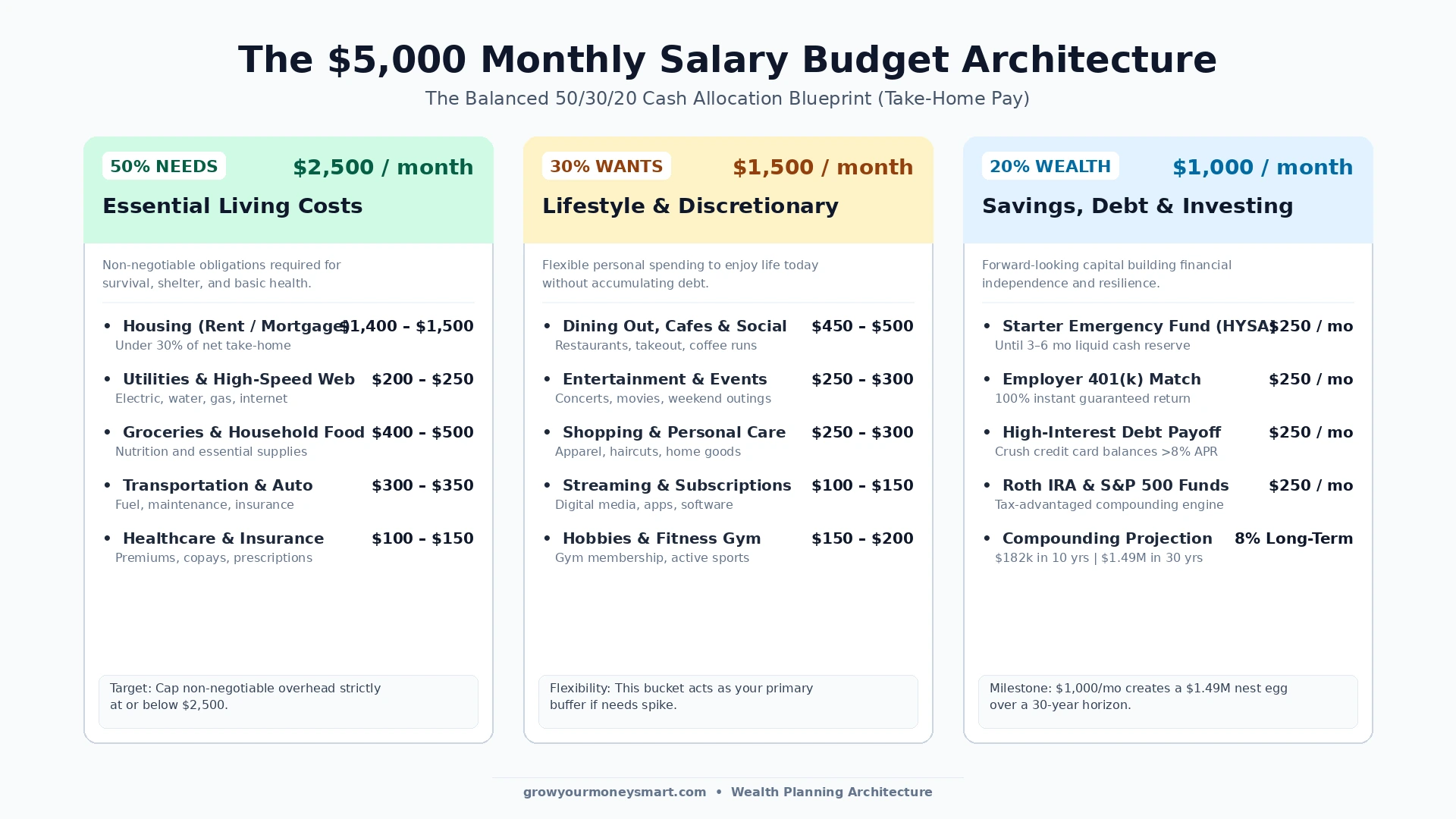
To budget a $5,000 monthly salary effectively, allocate your take-home pay using the 50/30/20 framework: $2,500 (50%) for essential needs, $1,500 (30%) for discretionary lifestyle wants, and $1,000 (20%) for debt payoff and compounding savings. Cap housing at $1,500 and automate your $1,000 wealth transfer on payday.
- Take-Home Reality: A $5,000 monthly take-home salary represents $60,000 in net spendable cash—equivalent to a $75,000 to $82,000 gross annual salary depending on state withholding and payroll deductions.
- The 50/30/20 Baseline: Allocate exactly $2,500 for mandatory needs (housing, utilities, groceries, transport), $1,500 for lifestyle wants (dining, recreation, entertainment), and $1,000 for wealth acceleration.
- The 30% Housing Rule: Cap your rent or mortgage at $1,400 to $1,500 per month to protect your cash flow from becoming housing-burdened.
- The $1.49M Compounding Engine: Investing your $1,000 monthly savings at an 8% historical index fund return compounds into $182,946 in 10 years and over $1.49 Million in 30 years.
- Reverse Budgeting: Automate your $1,000 savings and retirement transfers the day your paycheck lands so you spend only what remains, completely eliminating the paycheck-to-paycheck trap.
Earning a $5,000 monthly salary is a transformative milestone in personal finance. In the United States, bringing home $5,000 net after taxes puts $60,000 of clean, spendable cash directly into your hands each year. Depending on your state of residence and pre-tax deductions, this represents an annual gross salary between $75,000 and $82,000—comfortably surpassing the national individual median wage.
At $5,000 a month, you have moved past the bare survival phase. You have enough financial margin to live comfortably, afford quality housing, enjoy social experiences, and systematically construct a multi-million-dollar investment portfolio. Yet, a shocking number of professionals earning $5,000 per month find themselves trapped in a cycle of anxiety, wondering where their paycheck disappeared by day 25.
Without an intentional, mathematically structured capital allocation framework, lifestyle inflation silently siphons off your surplus. Rising grocery delivery tabs, creeping subscription services, and an overpriced car loan can make a $5,000 salary feel just as tight as a $3,000 income. In fact, if you recently stepped up from our $4,000 monthly salary guide or are working toward our $6,000 monthly income framework, managing this critical $5,000 bracket is where lifelong wealth habits are either forged or lost.
In this 2026 master blueprint, you will discover exactly how to budget a $5,000 monthly salary with mathematical precision. We break down the classic 50/30/20 rule, contrast three tailored lifestyle models (including High-Cost-of-Living adjustments and aggressive debt payoffs), demonstrate how a $1,000 monthly allocation compounds into $1.49M, and outline a 6-tier cash-flow waterfall roadmap. You can also calculate your personalized numbers directly using our interactive free budget calculator.
The Gross vs. Net Salary Reality: What Does $5,000 a Month Actually Mean?
Before allocating a single dollar to rent or groceries, you must establish absolute clarity: Is your $5,000 figure gross pre-tax earnings or net take-home pay? Confusing these two numbers is the single most destructive error in personal budgeting.
Here is how the math breaks down in the real world:
If your gross pay is $5,000 per month ($60,000 per year), your true net deposit will hover around $3,900 to $4,050. If that describes your financial situation, our step-by-step $4,000 monthly salary blueprint provides the exact calibrated spending limits for your bracket.
This master guide is engineered specifically for Scenario A: a clean $5,000 monthly take-home deposit landing in your bank account, giving you exactly $5,000 of deployable capital every 30 days.
The Core 50/30/20 Budget Blueprint for a $5,000 Salary
Originally popularized by Senator Elizabeth Warren in All Your Worth, the 50/30/20 framework is the gold standard of personal cash management because it balances responsible savings with realistic human psychology. Here is how your $5,000 divides cleanly across the three foundational buckets:
1. 50% for Essential Needs: $2,500 / Month
Needs represent your non-negotiable living obligations—the critical costs required to maintain shelter, nourishment, employment, and physical safety. If you were to lose your job tomorrow, these are the bills you must continue paying to survive:
- Housing (Rent or Mortgage): $1,400 – $1,500 (strictly under 30% of take-home pay).
- Utilities & Essential Services: $200 – $250 (electricity, heating/gas, water, trash, high-speed home internet).
- Groceries & Household Goods: $400 – $500 (nutritious home-cooked meals and basic cleaning supplies, excluding alcohol and takeout).
- Transportation & Auto: $300 – $350 (gasoline, routine auto maintenance, public transit passes, and car insurance).
- Healthcare & Insurance: $100 – $150 (health insurance copays, prescriptions, and dental/vision out-of-pocket costs).
- Minimum Debt Obligations: Statutory minimum payments on student loans, auto financing, or personal loans.
2. 30% for Lifestyle Wants: $1,500 / Month
Wants represent all discretionary spending that elevates your quality of life but is not strictly required for survival. The power of allocating a generous 30% ($1,500) is psychological sustainability: strict deprivation diets fail, whereas intentional guilt-free spending prevents binge splurges:
- Dining Out, Takeout & Coffee: $450 – $500 (weekend dinners, lunches with colleagues, cafes).
- Entertainment, Events & Nightlife: $250 – $300 (concerts, movies, sporting events, social outings).
- Personal Shopping & Grooming: $250 – $300 (clothing, electronics, haircuts, personal care).
- Digital Subscriptions & Streaming: $100 – $150 (Netflix, Spotify, gym apps, cloud storage).
- Hobbies, Recreation & Gym Memberships: $150 – $200 (fitness clubs, sports leagues, outdoor gear).
- Weekend Travel & Mini Vacations: $150 – $200 (savings accrual for travel adventures).
3. 20% for Wealth, Debt Payoff & Savings: $1,000 / Month
This is your financial freedom engine. The $1,000 monthly allocation transforms your labor into enduring assets that compound over time. On a $5,000 salary, saving $12,000 every single year places you in the top tier of wealth builders nationwide:
- Emergency Savings in a High-Yield Savings Account (HYSA): $250 / month (building toward 3–6 months of essential living expenses).
- Employer 401(k) Company Match: $250 / month (capturing free employer money offering a 100% instant ROI).
- High-Interest Debt Elimination: $250 / month (accelerating payments on any credit card or personal loan carrying >8% APR).
- Tax-Advantaged Roth IRA & Index Funds: $250 / month (fueling long-term equity growth in low-cost S&P 500 index funds).
3 Real-World Budget Archetypes: Choose Your $5,000 Strategy
No two financial lives are identical. A single professional in Dallas has vastly different cost structures than a renter in Chicago or someone aggressively attacking $15,000 in credit card debt. Depending on your current geography and balance sheet, choose the model that fits your immediate objective:
If you are burdened with high-interest credit card debt, our debt payoff calculator can simulate exactly how fast deploying Model B’s $1,500 monthly allocation crushes your balances.
The Compounding Mathematics: How $1,000/Month Builds a $1.49M Fortune
The single greatest advantage of a $5,000 monthly salary is the sheer dollar power of your 20% wealth allocation. Consistently redirecting $1,000 every single month into a diversified broad-market portfolio (such as total stock market index funds or S&P 500 ETFs) triggers explosive compound growth over a 10 to 30-year investment horizon.
Let’s examine the mathematical simulation assuming an 8.0% annualized compound return (the historical inflation-adjusted benchmark of the U.S. stock market over the past century):
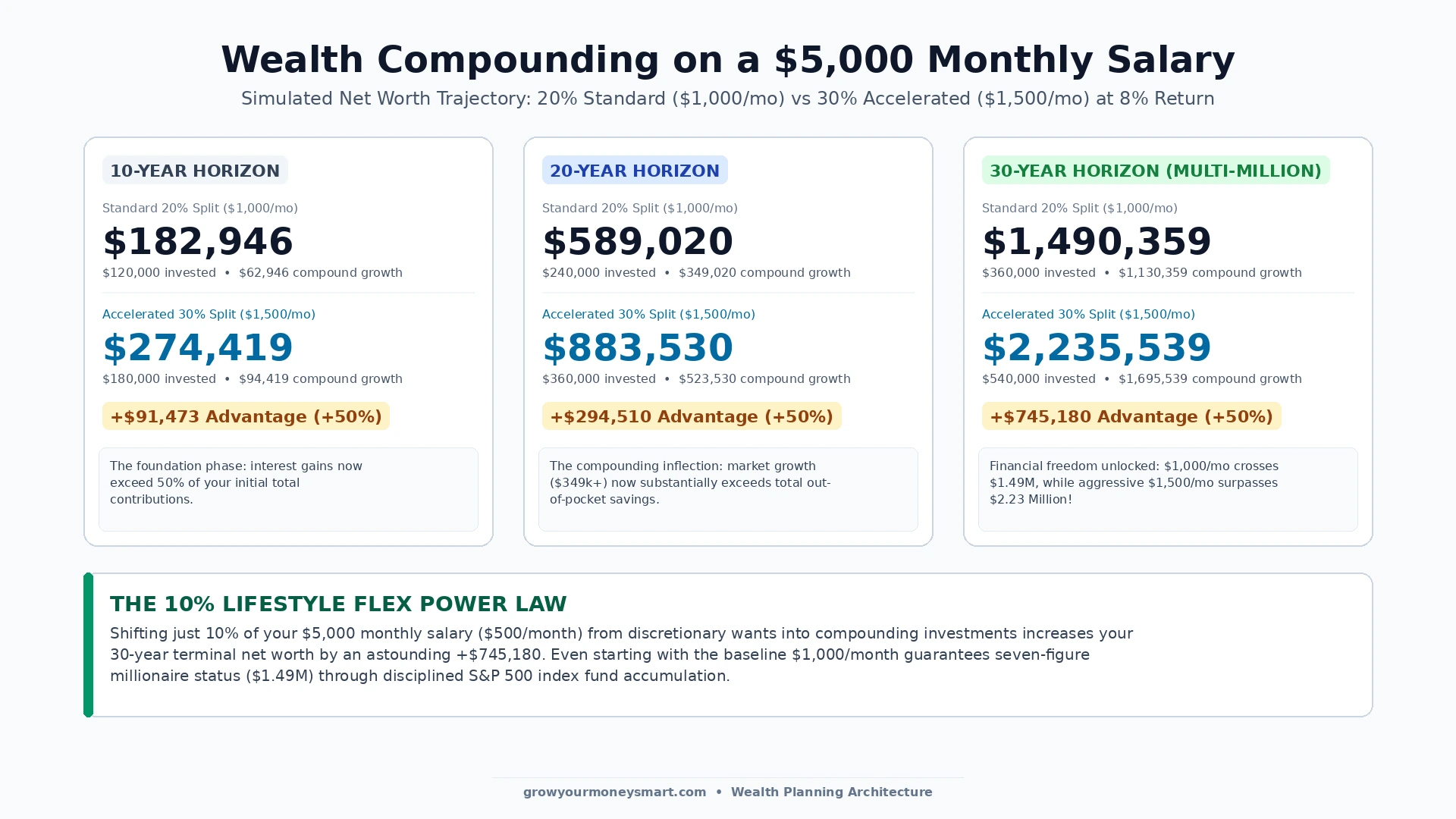
Notice the power of the 10% Shift Rule: by trimming just $500 per month from your lifestyle wants ($1,500 down to $1,000) and redirecting it into compounding index funds, your 30-year net worth explodes by an extra +$745,180. To optimize the balance between cash safety and market exposure, read our master comparison on HYSA vs. Stocks: Where to Put Your Money.
The $5,000 Cash-Flow Priority Waterfall
Knowing that you have $1,000 in monthly wealth capital is only half the battle. If you invest in the stock market while carrying a $6,000 credit card balance at 24% interest, or if you lock cash into an IRA before having an emergency buffer, an unexpected car breakdown will force you into debt. Capital must flow through a rigid 6-tier waterfall priority:
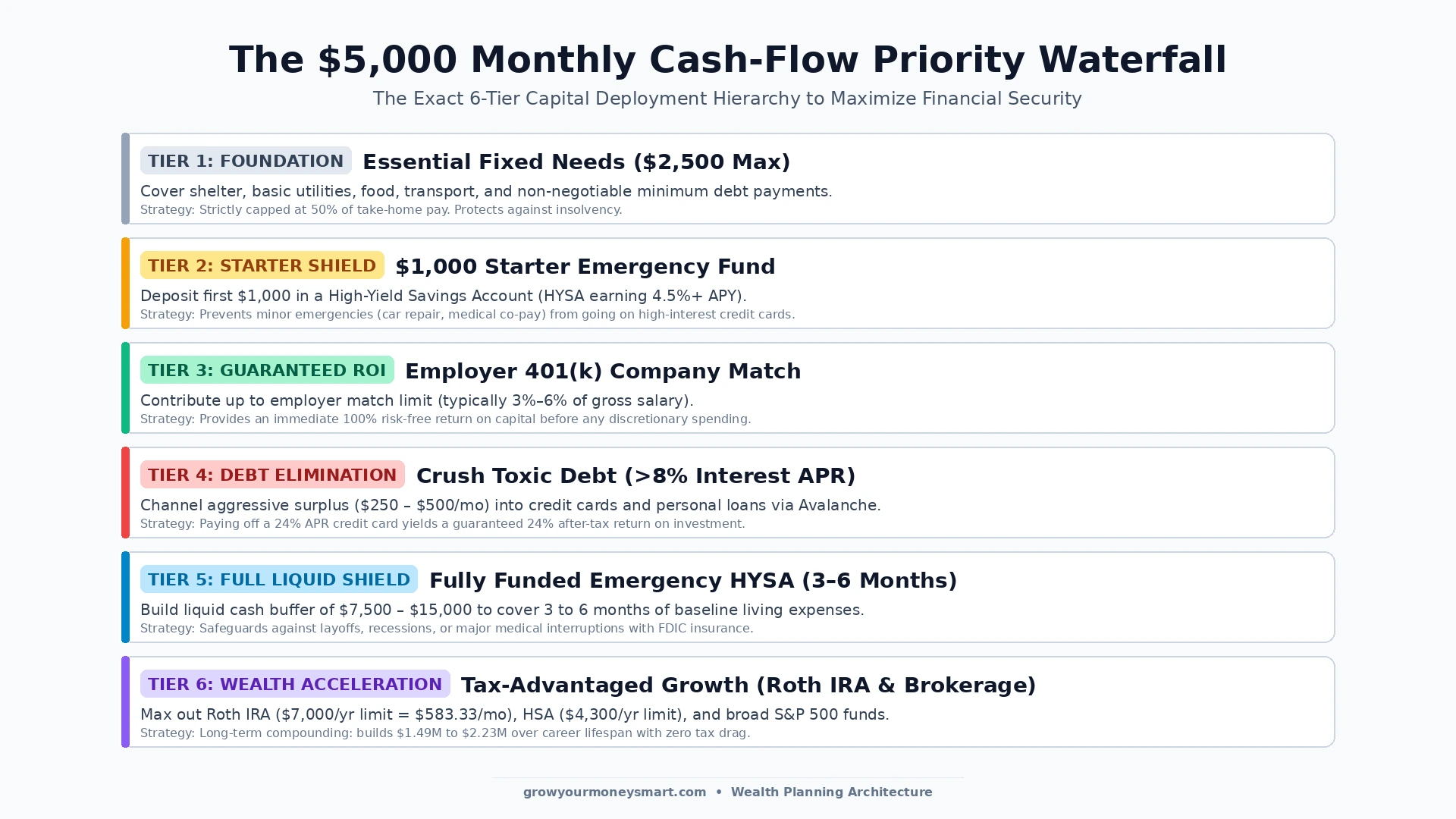
Tier 1: Essential Living Floor ($2,500 Maximum)
Fund your non-negotiable living obligations first: shelter, utilities, food, and basic transit. Cap this overhead strictly at 50% of your net salary ($2,500) to keep your baseline cost of living low and sustainable.
Tier 2: The $1,000 Starter Emergency Shield
Before paying off extra debt or buying stocks, stash your first $1,000 into an FDIC-insured High-Yield Savings Account. This micro-buffer ensures a blown tire or medical copay doesn’t derail your budget or get charged to a high-interest credit card. For a complete blueprint, read our guide on the Complete Emergency Fund & HYSA Master Guide.
Tier 3: Capture the 100% Employer 401(k) Match
If your employer provides a 401(k) match (for example, matching 100% on the first 4% of your salary), contribute up to that exact threshold immediately. A dollar-for-dollar employer match is an instant 100% risk-free return on capital that no stock or savings account can ever match.
Tier 4: Crush Toxic High-Interest Debt (>8% APR)
Direct every dollar of your remaining wealth allocation toward eliminating high-interest liabilities—such as credit cards, personal loans, and high-rate auto notes—using the Debt Avalanche method (highest interest rate first). According to regulatory consumer protection guidelines from the Consumer Financial Protection Bureau (CFPB), carrying revolving high-rate debt degrades your credit score and drains compound wealth.
Tier 5: Complete the 3 to 6-Month Emergency Safety Net
With high-interest debt eradicated, expand your cash reserve in an HYSA to cover 3 to 6 months of baseline living expenses ($7,500 to $15,000). According to deposit insurance standards set by the Federal Deposit Insurance Corporation (FDIC), bank deposits are insured up to $250,000 per depositor. You can calculate your target safety cushion with our emergency fund calculator.
Tier 6: Maximize Tax-Advantaged Compounding (Roth IRA & HSA)
With your financial fortress secure, channel your surplus into tax-advantaged accounts. Maximize a Roth IRA ($7,000 annual limit under current IRS contribution guidelines, or $583.33/month) and Health Savings Account (HSA) before directing spillover cash into low-cost index funds in a taxable brokerage account. If you need a comprehensive asset allocation strategy, explore our guide on what to do after maxing out your 401(k) and Roth IRA and our breakdown of the stages of the retirement plan lifecycle.
Expert Video Masterclass: Managing Cash Flow with the 50/30/20 Rule
To reinforce these strategic principles with visual modeling, watch this detailed educational breakdown by authoritative personal finance educator Marko at WhiteBoard Finance analyzing “How To Manage Your Money (50/30/20 Rule)”:
5-Step Action Protocol: How to Implement Your $5,000 Budget Today
Budgeting is not about willpower; it is about automation and system architecture. Follow these five sequential steps to execute your $5,000 monthly budget within 48 hours:
Step 1: Track Last Month’s Baseline Spending
Log into your bank and credit card accounts. Audit the last 30 to 60 days of transactions and categorize every expense into Needs, Wants, or Savings. Identify any hidden subscriptions, recurring memberships you no longer use, or excessive food delivery costs.
Step 2: Establish a Multi-Account Banking Structure
Operating out of a single checking account is the primary reason budgets fail. Separate your finances into three dedicated accounts:
- Account 1 (Fixed Needs Checking): Receives your $5,000 deposit. Keeps $2,500 dedicated strictly to rent, utilities, insurance, and groceries. Auto-pay all bills from here.
- Account 2 (Guilt-Free Spending Debit): Receives an automated transfer of $1,500 on the 1st of the month. Use this card for dining, entertainment, shopping, and weekend fun. When the balance hits zero, discretionary spending pauses until next month.
- Account 3 (High-Yield Savings & Brokerage): Receives an automated transfer of $1,000 on payday. Out of sight, out of mind, compounding automatically.
Step 3: Automate Your Payday Cash Transfers (Pay Yourself First)
Never save “whatever is left over at the end of the month”—because nothing is ever left over. Reverse your cash flow: schedule automated transfers to your HYSA, Roth IRA, and extra debt payments for the exact morning your paycheck is deposited. You force yourself to live on the remaining $4,000 with zero stress.
Step 4: Cap Your Housing and Auto Commitments
The two biggest wealth killers on a $5,000 salary are bloated rent and heavy car notes. Keep your total housing obligation at or below $1,500, and ensure your monthly auto payment (including insurance) does not exceed 10% of your take-home pay ($500/month). If your income varies month to month, consult our companion guide on how to budget on an irregular income.
Step 5: Conduct a 15-Minute Monthly Cash-Flow Review
On the final Sunday of each month, review your accounts. Did your grocery bill run over? Did you underspend on entertainment? Rebalance minor variances, celebrate your savings growth, and adjust next month’s allocations accordingly.
4 Dangerous Budgeting Pitfalls to Avoid on a $5,000 Salary
A $5,000 monthly take-home salary is plenty of money to live comfortably and achieve financial freedom, but it is also high enough to create an illusion of invulnerability. Beware of these four common traps:
- Trap 1: The New Car Payment Illusion: Financing a $45,000 SUV with a $750 monthly payment plus $200 insurance consumes nearly 20% of your entire take-home pay on a depreciating piece of metal. Buy reliable used vehicles in cash or keep monthly car notes under $350.
- Trap 2: Rationalizing Wants as Needs: Organic boutique grocery deliveries, premium gym memberships, and daily lattes are enjoyable, but they are discretionary wants—not survival needs. Be rigorous about what belongs in your $2,500 fixed overhead bucket.
- Trap 3: Leaving Emergency Cash in a 0.01% Checking Account: A $10,000 cash reserve sitting in a legacy brick-and-mortar bank earns pennies. In an FDIC-insured High-Yield Savings Account earning 4.5% to 5.0% APY, that same $10,000 generates $450 to $500 in passive interest every year.
- Trap 4: Lifestyle Creep After Salary Raises: When your income steps up from $4,000 to $5,000, resist the urge to immediately upgrade your apartment or lease a luxury vehicle. Channel at least 50% of any pay increase directly into your wealth-building bucket.
Frequently Asked Questions (FAQs)
Below are detailed, authoritative answers to the most common questions on budgeting a $5,000 monthly salary:
Yes. A $5,000 monthly take-home salary equals $60,000 net after taxes, which corresponds to an annual gross salary of roughly $75,000 to $82,000 depending on state tax rates. This places you above the national median individual income in the United States. In low-to-medium cost of living areas, $5,000 net provides a comfortable lifestyle and allows you to invest $1,000 to $1,500 monthly toward financial independence.
Under the 50/30/20 framework, a $5,000 monthly take-home salary is divided into: 50% for Needs ($2,500 for rent/mortgage, groceries, utilities, transportation, and healthcare), 30% for Wants ($1,500 for dining out, entertainment, hobbies, travel, and personal shopping), and 20% for Wealth ($1,000 for emergency savings in an HYSA, retirement accounts, and debt elimination).
As a rule of thumb, housing expenses (rent or mortgage plus property taxes and insurance) should not exceed 28% to 30% of your take-home pay. On a $5,000 monthly salary, your ideal housing ceiling is $1,400 to $1,500 per month. If you live in a High-Cost-of-Living (HCOL) area where rent reaches $1,800 to $2,000, you must reduce discretionary wants to keep total fixed overhead manageable.
In expensive urban markets where housing costs exceed $1,800, pivot from the 50/30/20 rule to a 65/15/20 framework. Under this model, allocate $3,250 (65%) to essential needs, compress lifestyle wants to $750 (15%), and preserve $1,000 (20%) for emergency savings and index fund investing. Never eliminate the 20% wealth bucket to subsidize inflated rent.
Your emergency fund should be calculated based on your essential living expenses, not your entire salary. Since fixed essentials equal $2,500 per month on a $5,000 budget, a 3-month baseline emergency fund is $7,500, while a comprehensive 6-month safety reserve is $15,000. Keep this money in an FDIC-insured High-Yield Savings Account (HYSA) earning 4.5%+ APY.
Follow the interest rate benchmark: prioritize any toxic consumer debt with an APR above 7% to 8% (such as credit cards or high-interest personal loans) before investing beyond the employer 401(k) match. Paying off a 24% credit card yields a guaranteed 24% after-tax return. Once high-interest debt is eliminated, deploy your $1,000 monthly surplus into tax-advantaged accounts like a Roth IRA and HSA.
Yes, absolutely. Under IRS contribution limits, the maximum annual Roth IRA contribution is $7,000 (for individuals under age 50), which requires roughly $583.33 per month. Within your $1,000 monthly wealth bucket, allocating $583.33 to a Roth IRA leaves over $416 per month to build emergency cash reserves, capture 401(k) matching funds, or invest in a taxable brokerage account.
Consistently investing $1,000 per month into broad-market index funds (like the S&P 500) earning an average 8% annualized return compounds into approximately $182,946 in 10 years, $589,020 in 20 years, and over $1,490,359 ($1.49 million) in 30 years. If you accelerate savings to $1,500 per month, your 30-year portfolio surpasses $2.23 million.

Jaiveer Hooda is a personal finance researcher and the founder of Grow Your Money Smart. With a background in computer engineering, he approaches money the way an engineer approaches any complex system — through data analysis, mathematical modeling, and ruthless optimization.
He built this platform on a single conviction: financial freedom is not a matter of luck. It is a system that can be designed, tested, and executed by anyone willing to follow the right blueprint. Every strategy published here is researched to the numbers, not written to the trend.
Expertise: Debt elimination · Retirement planning · Passive income · Budgeting systems
Connect: Pinterest | growyourmoneysmart.com | Contact Us