
A sinking fund is a strategic savings method where you save a set amount of money each month for a specific, expected future expense—such as car repairs, holiday gifts, or annual insurance premiums. Unlike emergency funds, sinking funds cover predictable costs, eliminating credit card debt traps before they happen.
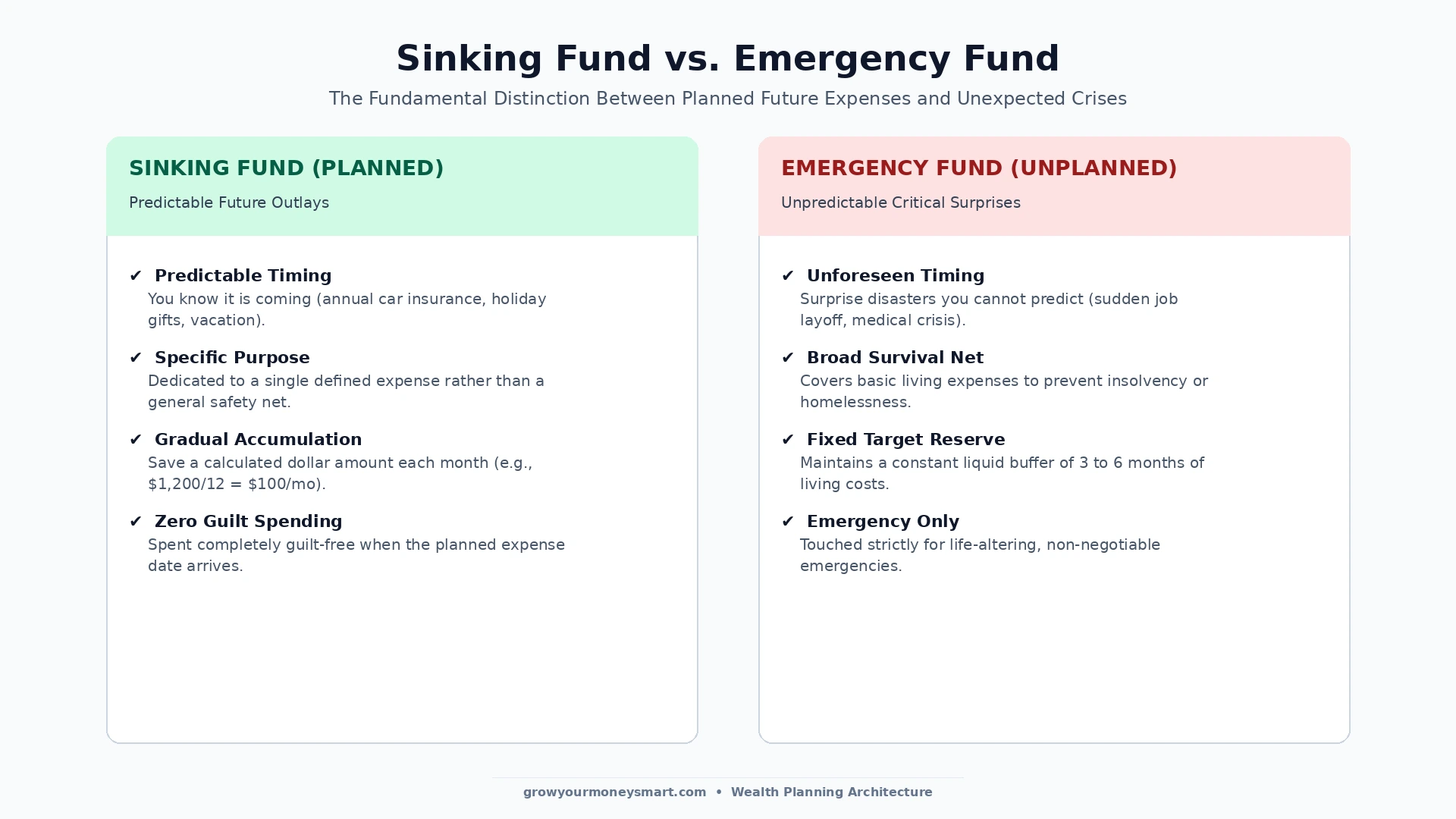
- Predictable vs. Unpredictable: Sinking funds fund known future expenses (e.g., $1,200 annual car insurance); emergency funds protect against unknown crises (e.g., job loss).
- The Monthly Formula: Divide your total target cost by the number of months until the expense is due (Target ÷ Months = Monthly Contribution).
- Prevents Credit Card Debt: By pre-funding periodic bills, you never have to put surprise tire replacements or medical deductibles on 24% APR credit cards.
- Top 8 Must-Haves: Auto maintenance, home repairs, insurance, medical copays, gifts, vacations, pets, and technology replacements.
- Keep in an HYSA: Store sinking funds in an FDIC-insured high-yield savings account using sub-accounts or “savings buckets” earning 3.00% to 4.40% APY.
Have you ever had a month where your budget was completely derailed by an “unexpected” expense—like your annual car registration, a semi-annual insurance premium, or holiday gift shopping? Here is the honest truth: none of those expenses were actually emergencies.
You knew Christmas was coming in December. You knew your car would eventually need new tires. And you knew your home insurance bill arrives every year. Yet, when these bills land without dedicated savings, people panic and drain their emergency fund or reach for a high-interest credit card. That is where a sinking fund changes everything.
In this comprehensive 2026 guide, you will master what a sinking fund is, how it differs from an emergency fund, the 8 essential sinking funds every household needs, and how to automate your cash flow seamlessly. You can also map out your monthly allocations using our interactive free budget calculator and pair it with our tested accounts in the Best High-Yield Savings Accounts Guide.
Sinking Fund vs. Emergency Fund: The Critical Difference
Confusing sinking funds with emergency funds is the primary reason budgets collapse. While both involve saving cash in an account, their functions are fundamentally distinct:
To understand the foundation of your emergency reserves, see our companion breakdown on Emergency Fund 101 and our decision framework on 3 Months vs 6 Months Emergency Funds.
8 Essential Sinking Funds Every Household Needs
To insulate your budget against life’s recurring costs, set up these eight proven sinking fund buckets:
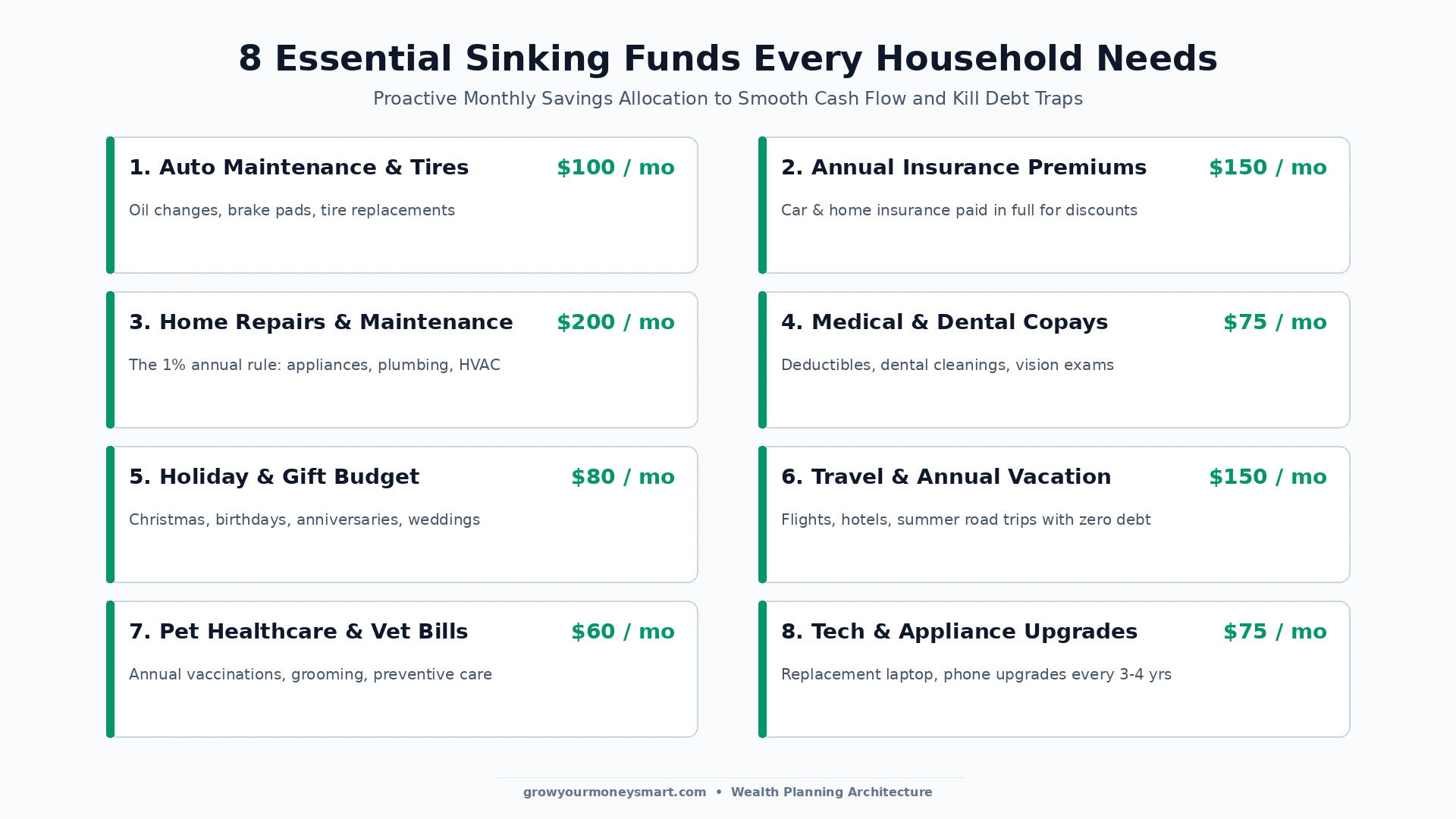
- 1. Auto Maintenance & Tires ($100/mo): Brake pads, routine oil changes, and tire replacements cost $800 to $1,500 annually. Pre-funding this avoids credit card debt when mechanics hand you a quote.
- 2. Annual Insurance Premiums ($150/mo): Auto and homeowners insurance carriers offer 5% to 12% discounts if you pay in full annually rather than monthly. A sinking fund lets you capture this discount risk-free.
- 3. Home Maintenance & Repairs ($200/mo): Apply the 1% rule: budget 1% of your home’s purchase price annually for maintenance (e.g., $3,000/yr on a $300k home).
- 4. Medical & Dental Deductibles ($75/mo): Covers out-of-pocket prescription costs, dental crowns, or eyeglasses before insurance kicks in.
- 5. Holiday & Special Occasion Gifts ($80/mo): Saving $80 per month starting in January gives you nearly $1,000 in cash by December, ending holiday debt anxiety forever.
- 6. Travel & Annual Vacations ($150/mo): Take dream family vacations knowing flights and hotels are already 100% paid for before you board the plane.
- 7. Pet Care & Vet Expenses ($60/mo): Covers annual veterinary exams, flea/tick medicine, and teeth cleaning for your dogs or cats.
- 8. Tech & Appliance Replacements ($75/mo): Laptops, smartphones, and washing machines wear out every 4 to 6 years. Funding this gradually ensures instant cash upgrades.
Expert Video Breakdown: Sinking Funds Explained Step-by-Step
For a practical guide on organizing multiple savings buckets and calculating monthly contributions for planned expenses, watch Rachel Cruze’s sinking fund tutorial:
Frequently Asked Questions (FAQs)
A sinking fund is a strategic savings strategy where you save a small, calculated amount of money each month toward a specific, predictable future expense (such as car insurance, holiday gifts, home repairs, or vacations) to avoid taking on high-interest debt.
An emergency fund is reserved strictly for unexpected, urgent disasters (like job loss or hospital emergencies). A sinking fund is created for predictable, planned future expenses where you know the cost will eventually occur.
Keep sinking funds in an FDIC-insured High-Yield Savings Account (HYSA) that supports sub-accounts or savings buckets (such as Ally Bank or SoFi). This allows you to earn 3.00% to 4.40% APY while keeping individual goals organized.
Most households maintain between 4 and 8 active sinking funds. Start with the three most common budget breakers: auto maintenance, annual insurance premiums, and holiday spending.
Divide the total estimated cost of the expense by the number of months remaining until the bill is due. For example, if your semi-annual car insurance is $600 in 6 months, you save $100 per month.
Sinking funds indirectly accelerate debt payoff by preventing new credit card debt. When an expected car repair happens, your sinking fund pays cash instead of charging your card at 24% APR.
Yes. Cash held in sinking funds is liquid capital and counts toward your total current assets and net worth, although it is earmarked for future expenditure.
No. Never invest short-term sinking funds in the stock market if the expense will occur within 1 to 3 years. Short-term market downturns could reduce your balance right before your bill is due.

Jaiveer Hooda is a personal finance researcher and the founder of Grow Your Money Smart. With a background in computer engineering, he approaches money the way an engineer approaches any complex system — through data analysis, mathematical modeling, and ruthless optimization.
He built this platform on a single conviction: financial freedom is not a matter of luck. It is a system that can be designed, tested, and executed by anyone willing to follow the right blueprint. Every strategy published here is researched to the numbers, not written to the trend.
Expertise: Debt elimination · Retirement planning · Passive income · Budgeting systems
Connect: Pinterest | growyourmoneysmart.com | Contact Us