
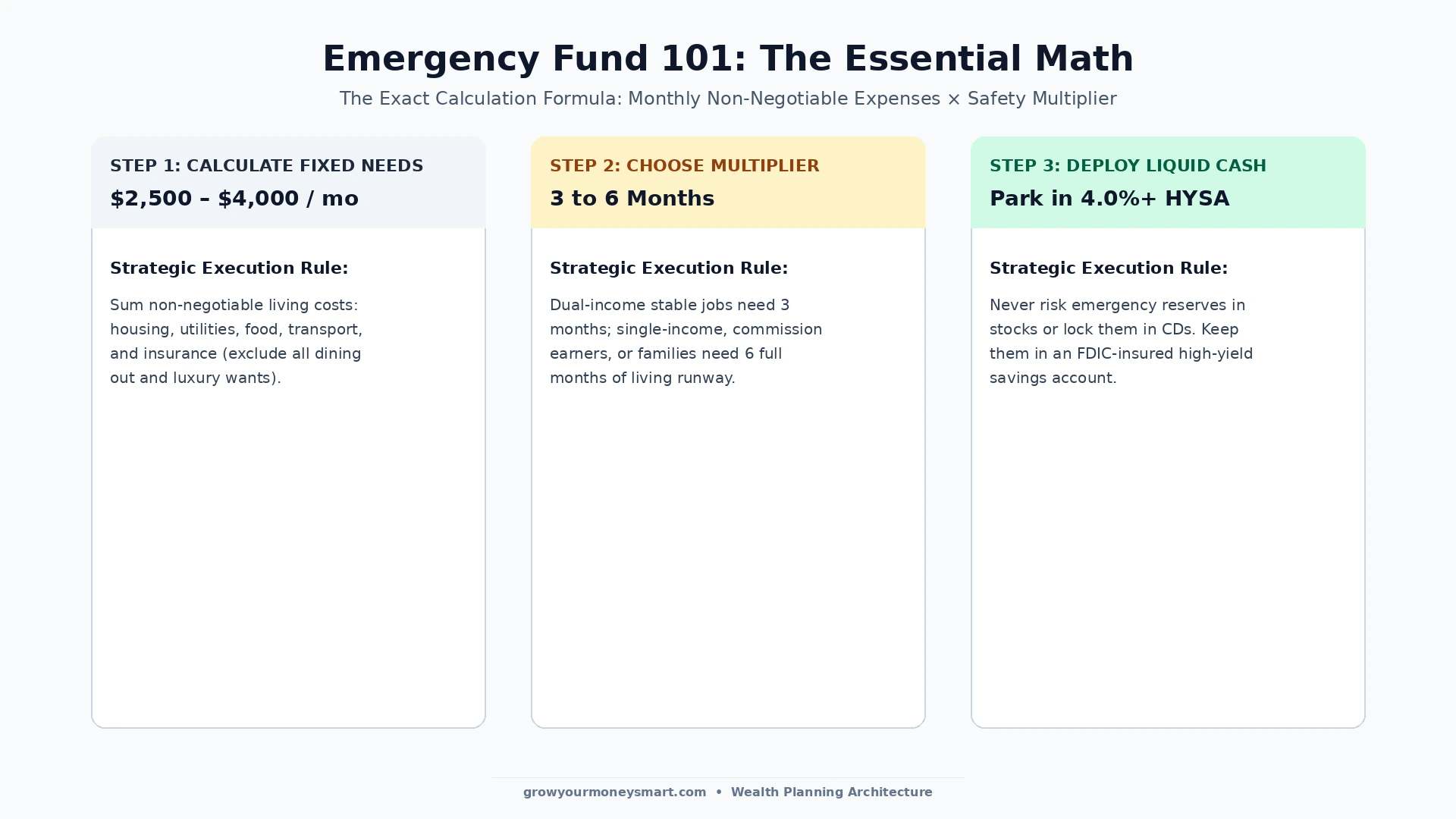
You need 3 to 6 months of essential living expenses in an emergency fund. Calculate non-negotiable costs (housing, food, utilities, transit) and multiply by 3 if you have dual incomes and stable jobs, or by 6 if you are single, commissioned, or have dependents. Store it strictly in an FDIC-insured High-Yield Savings Account.
- Expenses, Not Income: Base your target on monthly survival obligations, not your gross paycheck. Discretionary spending stops during a crisis.
- The 3 vs 6-Month Split: Stable dual-income households need 3 months ($7,500–$12,000); single earners, freelancers, and parents need 6 months ($15,000–$25,000).
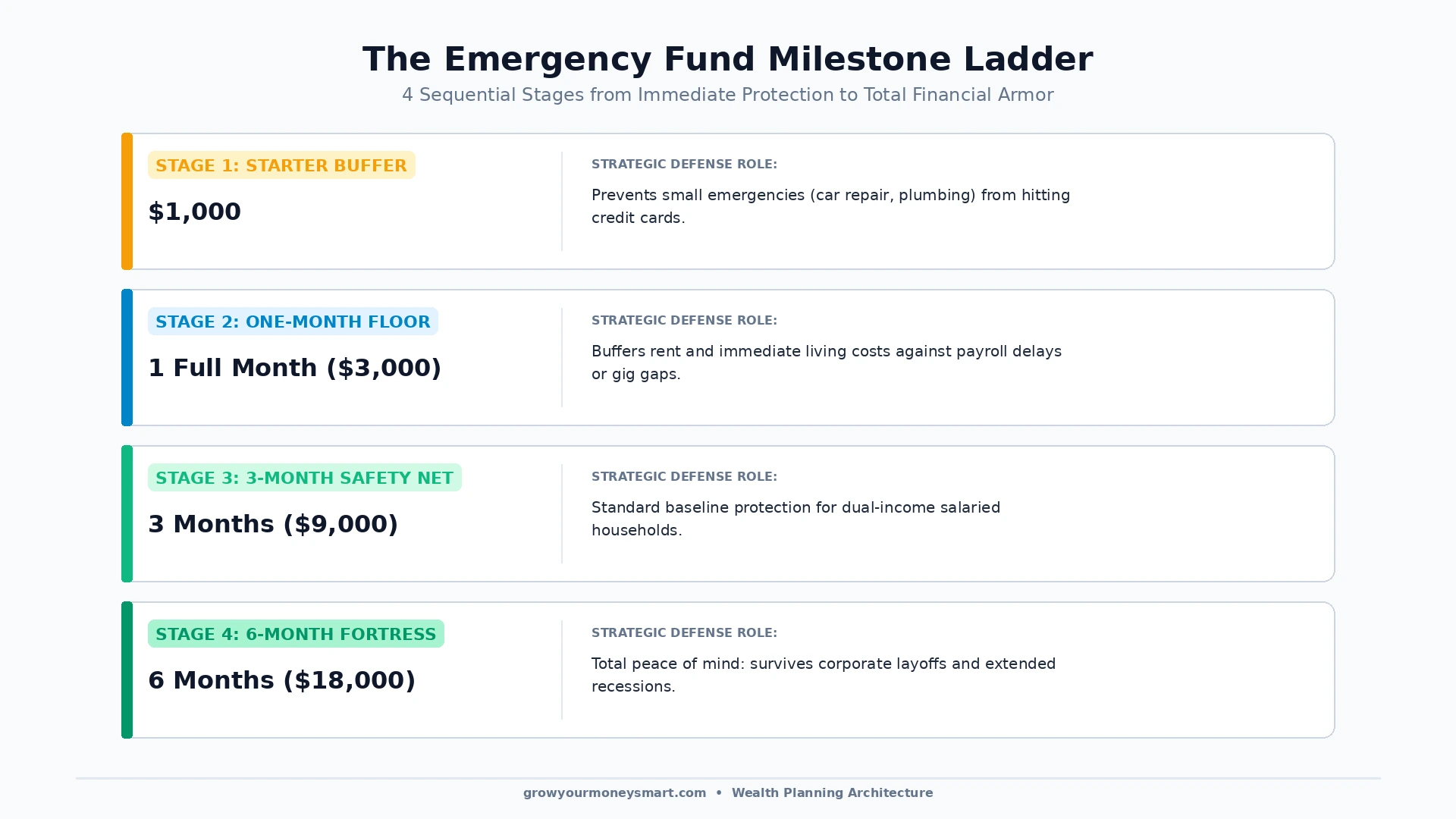
- Starter Shield First: Accumulate an initial $1,000 buffer before attacking debt to prevent unexpected repairs from going onto high-APR credit cards.
- The HYSA Home: Keep 100% of your emergency cash in a high-yield savings account earning 3.00% to 4.40% APY with full FDIC insurance backing.
- Zero Market Speculation: Never invest emergency reserves in stocks, crypto, or locked illiquid investments. Liquidity and capital safety are paramount.
An emergency fund is the financial buffer between everyday life and financial ruin. According to recent surveys by the Federal Reserve, nearly 40% of American households could not cover an unexpected $400 emergency expense without taking on credit card debt or borrowing from family.
Without cash reserves, any unexpected event—a blown transmission, a medical bill, a sudden job restructuring—becomes a crisis that drives you into high-interest debt. Whether you are budgeting on a $3,000 salary, a $4,000 salary, or a $5,000 monthly income, building a dedicated emergency fund is Step 1 of all sustainable wealth creation.
The Step-by-Step Calculation: How Much Do You Actually Need?
The biggest misconception about emergency funds is that they must replace 100% of your salary. In a real financial crisis (such as job loss), you immediately stop eating at restaurants, cancel subscription boxes, and pause retirement contributions. You only need to fund your bare-bones survival budget:
The Emergency Fund Milestone Ladder
Staring at an $18,000 savings target can feel intimidating if you are currently starting from zero. The secret is breaking the process into four sequential milestones:
If you are currently paying down consumer debt, check out our guide on Pay Off Debt vs. Save Emergency Fund to balance your debt payoff with cash safety. You can also calculate your debt elimination trajectory with our debt payoff calculator.
Where to Store Your Emergency Fund (and Where NOT To)
Your emergency fund has one singular job: to be there, in full, within 24 hours of a crisis. Its purpose is insurance, not high-return speculation:
- ✔ High-Yield Savings Account (Best Option): 100% liquid, earns 3.00% to 4.40% APY, backed by the FDIC. Check out our tested picks in the Best High-Yield Savings Accounts of 2026.
- ✔ Money Market Deposit Accounts: Similar to HYSAs, offering competitive yields with check-writing capabilities.
- ❌ Traditional Checking Account (Avoid): Earns 0.01% and mixes with daily spending, increasing temptation to overspend.
- ❌ Stock Market / Index Funds (Avoid): Recessions cause simultaneous layoffs and 20%–40% market crashes. Forcing equity liquidation during a downturn permanently locks in losses. (Read our analysis on HYSA vs. Stocks).
- ❌ Certificates of Deposit (CDs) (Avoid for Primary Buffer): Early withdrawal penalties lock up capital when you need immediate cash.
Expert Video Breakdown: How Much Emergency Cash to Save
To visualize where your money should flow first and how to build your cash buffer without sacrificing investing, watch Humphrey Yang’s step-by-step breakdown:
Frequently Asked Questions (FAQs)
Most adults need 3 to 6 months of essential living expenses saved in cash. Dual-income households with stable salaried jobs can comfortably hold 3 months ($7,500–$12,000), while single-income earners, freelancers, and parents should aim for 6 months ($15,000–$25,000).
Your emergency fund should cover your essential non-negotiable living expenses (rent/mortgage, utilities, food, basic insurance, and transit), NOT your gross income or discretionary spending.
The single best place is an FDIC-insured High-Yield Savings Account (HYSA). It pays 3.00% to 4.40% APY, carries zero market risk, and allows fast ACH transfer access.
No. Never invest your emergency fund in the stock market. If a recession causes a layoff during a 25% stock market correction, you would be forced to sell equities at a catastrophic loss.
Save a $1,000 starter emergency fund first to prevent minor emergencies from adding to your credit card balances. Then, aggressively pay off high-interest debt (>8% APR) before expanding your emergency fund to a full 3 to 6 months.
A true emergency is unexpected, necessary, and urgent—such as sudden job loss, major medical emergencies, essential car repairs required to get to work, or unexpected urgent home repairs.
You can keep a portion of a 6-month emergency fund in a CD ladder, but you must keep at least 1 to 2 months of cash in an instantly accessible HYSA to avoid early withdrawal penalties.
By following the 50/30/20 budgeting rule and allocating 20% of your net income toward savings, most households complete a fully funded 3-month safety net in 7 to 9 months, and a 6-month reserve in 15 to 18 months.

Jaiveer Hooda is a personal finance researcher and the founder of Grow Your Money Smart. With a background in computer engineering, he approaches money the way an engineer approaches any complex system — through data analysis, mathematical modeling, and ruthless optimization.
He built this platform on a single conviction: financial freedom is not a matter of luck. It is a system that can be designed, tested, and executed by anyone willing to follow the right blueprint. Every strategy published here is researched to the numbers, not written to the trend.
Expertise: Debt elimination · Retirement planning · Passive income · Budgeting systems
Connect: Pinterest | growyourmoneysmart.com | Contact Us