
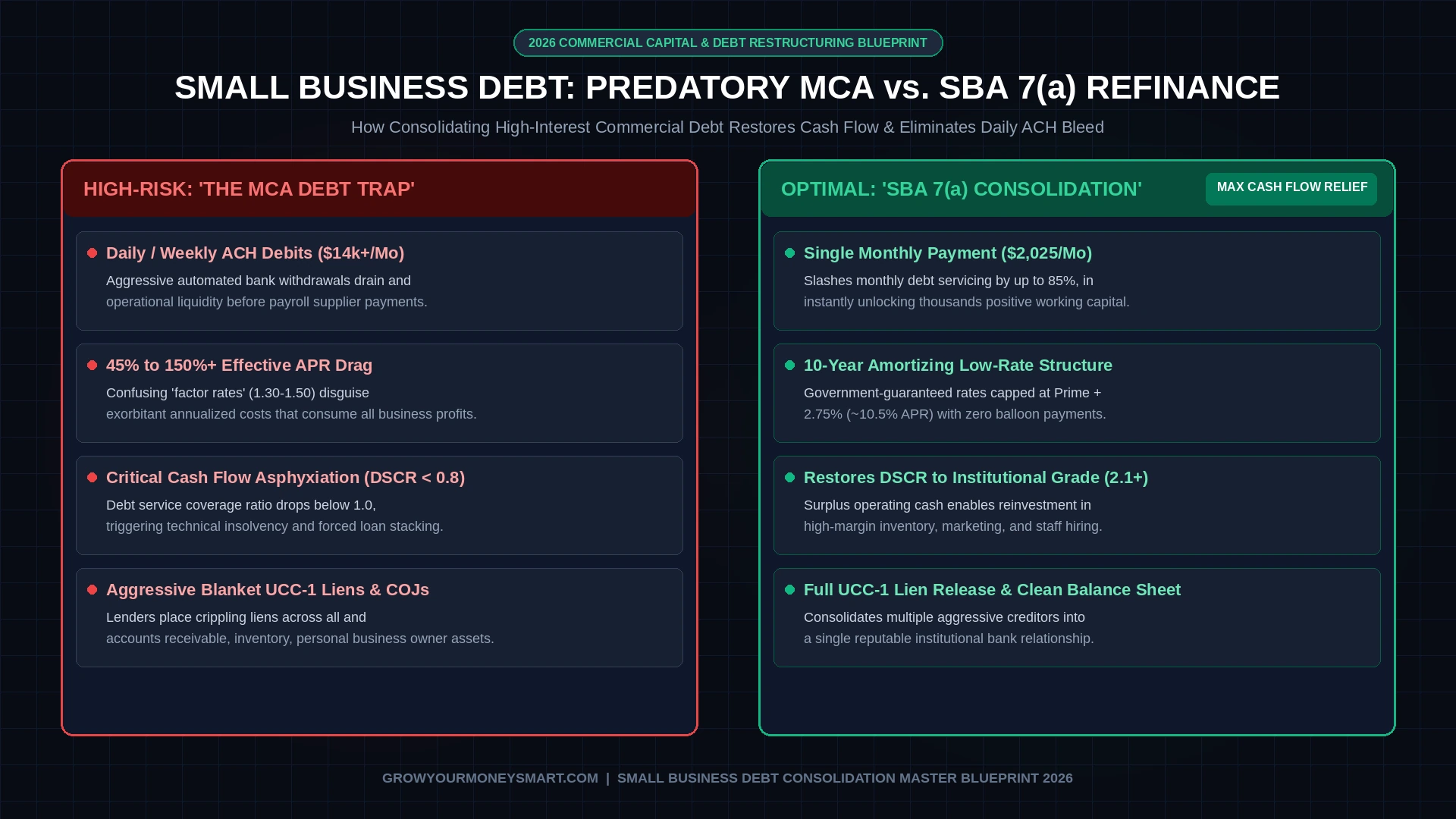
- Escape the Predatory MCA Trap: Merchant Cash Advances and short-term daily ACH loans carry disguised annualized APRs between 45% and 150%+, causing severe cash flow asphyxiation.
- Up to 85%+ Monthly Payment Reduction: Refinancing high-interest short-term debt into an SBA 7(a) 10-year term loan cuts monthly debt servicing from $20,000+ down to ~$2,025/month on a $150k balance.
- SBA 10% Cash Flow Rule: Under SBA guidelines, commercial debt refinancing is authorized if the new loan generates at least a 10% cash flow payment reduction or restructures unreasonable terms.
- Clean UCC-1 Lien Releases: Consolidating replaces multiple aggressive creditors holding blanket liens with a single institutional lender, freeing up business collateral.
- DSCR Restoration: Elevating your Debt Service Coverage Ratio from distressed levels (< 0.85) to bank-grade strength (> 2.0) restores enterprise creditworthiness and operational stability.
Maintaining positive operational cash flow is the lifeblood of any commercial enterprise. Yet across modern macroeconomic cycles—characterized by elevated benchmark interest rates, tighter regional bank underwriting, and supply chain volatility—thousands of small and medium-sized enterprise (SME) owners find themselves trapped in a vicious cycle of high-cost commercial debt. When short-term working capital shortfalls arise, business owners frequently turn to Merchant Cash Advances (MCAs), high-rate online fintech loans, and revolving credit lines.
While these financing mechanisms offer rapid capital disbursement, their hidden factor rates (often equivalent to 45% to 150%+ effective APRs) and aggressive daily or weekly automated ACH withdrawals rapidly drain operating liquidity. This destructive dynamic, known as “loan stacking,” asphyxiates business cash flow, depresses the Debt Service Coverage Ratio (DSCR), and prevents companies from purchasing inventory, making payroll, or capitalizing on revenue expansion.
Implementing institutional Debt Consolidation Strategies for Small Businesses is the definitive antidote to commercial debt distress. By restructuring multiple disorganized, high-interest obligations into a single, low-rate amortizing commercial facility (such as an SBA 7(a) or commercial bank term loan), business owners can slash monthly debt service costs by over 80%, extinguish predatory liens, and rebuild enduring balance sheet equity. Calculate your payoff trajectory with our interactive Debt Payoff Calculator and budget framework in our Household & Business Budget Calculator.
The Anatomy of Predatory Debt Stacking & DSCR Collapse
To understand why commercial debt consolidation is transformative, one must examine the mathematical mechanics of merchant cash advances and short-term alternative business loans. Unlike traditional bank loans governed by standard annual percentage rates (APR), MCAs utilize “factor rates” typically ranging from 1.20 to 1.55. On a $100,000 advance with a 1.35 factor rate, the business must repay $135,000 over a compressed 6-to-9-month term through daily automated debits.
Because the principal balance is repaid rapidly while the total fixed fee ($35,000) remains constant, the effective annualized borrowing rate frequently exceeds 75% to 120% APR. When daily debits begin eroding gross operating margins, business owners often take a second or third advance to bridge the cash deficit—triggering a catastrophic debt stack.
This debt spiral collapses the business’s Debt Service Coverage Ratio (DSCR), calculated as:
Institutional commercial lenders require a minimum DSCR of 1.25 (meaning the business generates $1.25 in operating profit for every $1.00 of debt obligations). Under stacked MCA advances, DSCR routinely plunges below 0.75, signaling imminent technical insolvency. For comprehensive debt reduction frameworks across all financial profiles, consult our master guide on Debt Management Strategies.
Commercial Debt Architecture: High-Cost Debt Stack vs. Consolidated SBA Facility
The matrix below contrasts the structural parameters of unmanaged high-interest commercial debt stacks against an optimized SBA 7(a) consolidation facility:
| Financing Parameter | Stacked MCA / Short-Term Debt | SBA 7(a) Refinanced Loan | Commercial Bank Term Facility |
|---|---|---|---|
| Repayment Frequency | Daily / Weekly ACH Auto-Debits | Single Monthly Amortizing Payment | Single Monthly Amortizing Payment |
| Effective APR Range | 45.0% to 150.0%+ (Factor Rates) | Prime + 2.25% to 2.75% (~10.5% APR) | 7.5% to 12.0% Fixed/Variable |
| Amortization Horizon | Compressed 3 to 12 Months | 10 Years (Working Capital / Refinance) | 3 to 7 Years |
| Lien Filings & Security | Multiple Blanket UCC-1 Liens + Confessions of Judgment | Single Consolidated 1st/2nd Lien Position | Standard Commercial Blanket Lien |
| Cash Flow Relief Factor | Severe Cash Bleed (Negative DSCR) | 60% to 85%+ Monthly Payment Reduction | 40% to 65% Monthly Payment Reduction |
| Prepayment Penalties | Full Factor Fee Due (Zero Rebate) | Zero Prepayment Penalties (< 15-Yr Terms) | Step-down (e.g., 3-2-1% Structure) |
Quantitative Modeling: The $150,000 Debt Consolidation Case Study
To demonstrate the mathematical power of debt restructuring, let us analyze a real-world manufacturing and distribution business carrying $150,000 in total high-rate short-term debt across three separate creditors:
Baseline Commercial Debt Profile (Pre-Consolidation):
- Creditor A (Merchant Cash Advance): $60,000 balance | 1.35 factor rate | $600/day ACH debit = $12,600 / month
- Creditor B (Fintech Working Capital Advance): $40,000 balance | 1.40 factor rate | $275/day ACH debit = $5,775 / month
- Creditor C (Revolving High-Rate Business Line): $50,000 balance | 32% APR | Interest-only = $3,075 / month
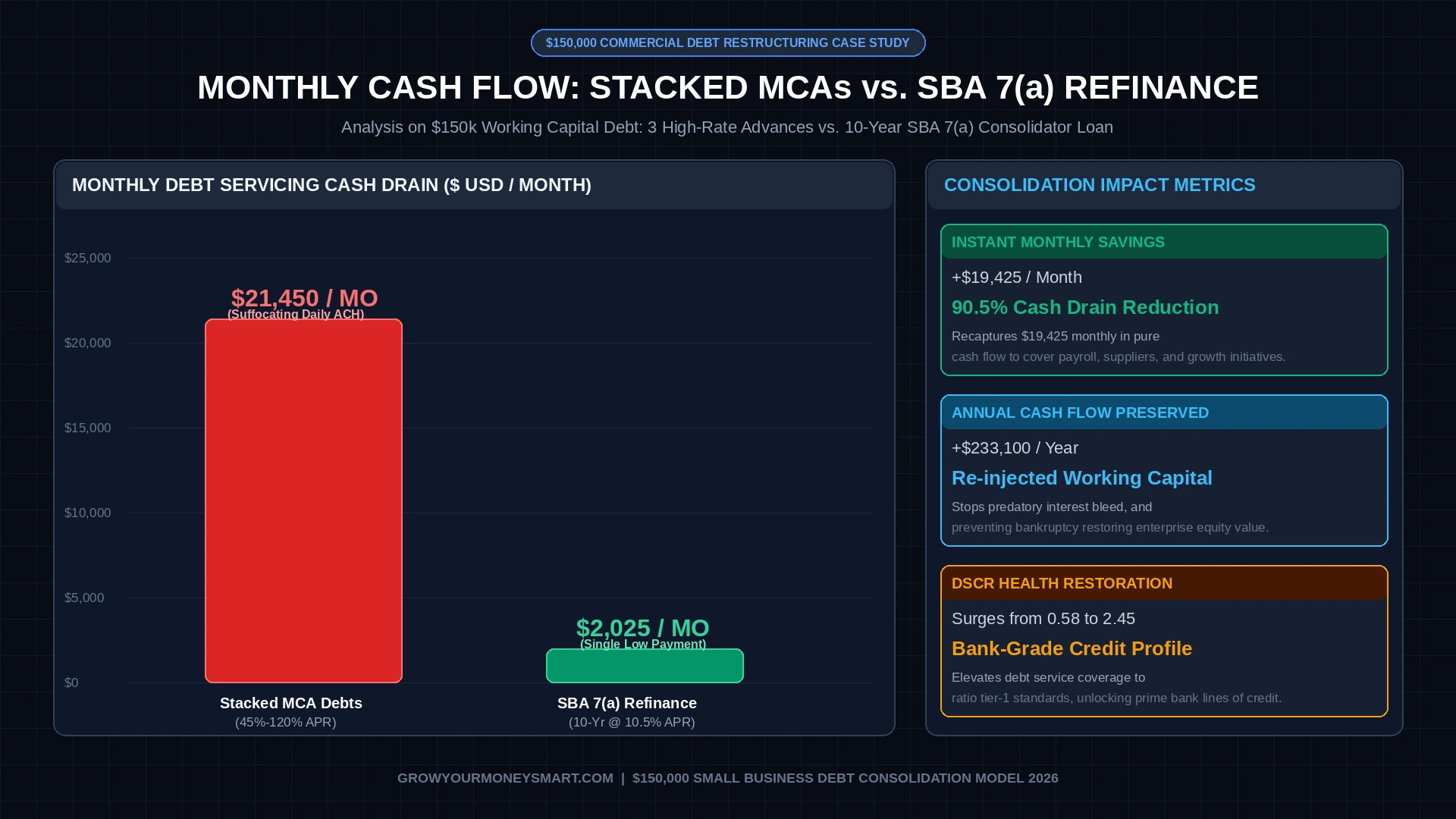
- Total Pre-Consolidation Debt Service: $21,450 / Month ($257,400 / Year)
The SBA 7(a) Refinanced Outcome:
- Consolidation Facility: $150,000 SBA 7(a) Debt Refinancing Loan amortized over 10 years at 10.5% variable APR.
- New Single Monthly Debt Payment: $2,025 / Month ($24,300 / Year).
- Net Monthly Cash Flow Recaptured: +$19,425 / Month.
- Annual Working Capital Preserved: +$233,100 / Year.
- DSCR Transformation: The company’s DSCR immediately surged from 0.58 (distressed) to 2.45 (prime bankable grade).
Safeguard your operating reserves during restructuring using our Emergency Fund Calculator.
Expert Video Breakdown: Strategic Benefits of Small Business Debt Consolidation
To examine the accounting mechanics, tax implications, and lender underwriting criteria involved in commercial debt consolidation, watch this detailed educational guide by 1-800Accountant:
The 4 Core Small Business Debt Consolidation Vehicles
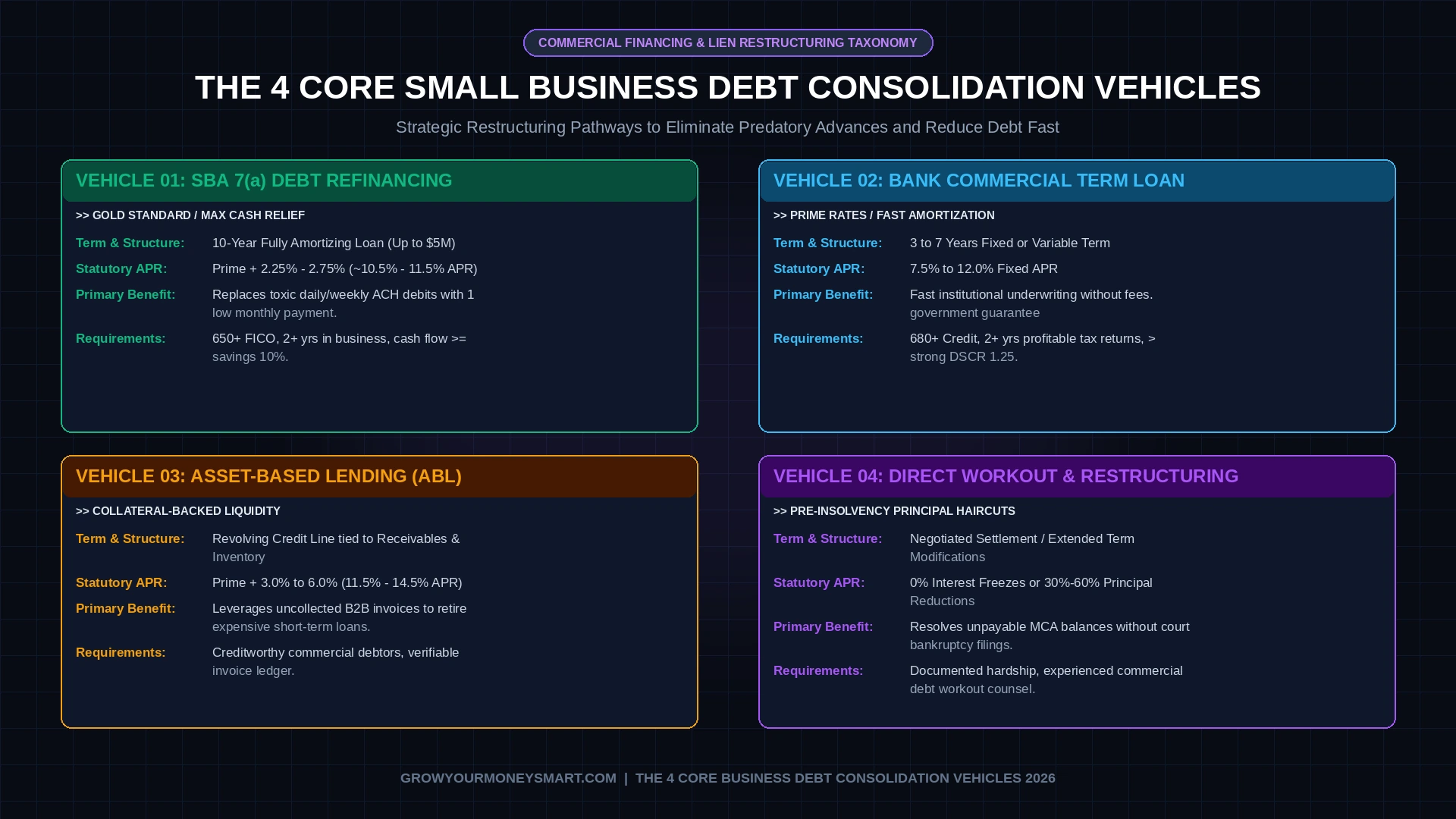
Depending on your company’s credit profile, time in business, revenue velocity, and collateral availability, four primary financing vehicles exist for commercial debt restructuring:
Detailed Financing Vehicle Analysis:
- SBA 7(a) Debt Refinancing (Up to $5 Million): The gold standard for commercial debt consolidation. Offers government-backed guarantees allowing lenders to issue 10-year amortizing working capital loans at Prime + 2.25% to 2.75%. Requires proof that the refinance provides a minimum 10% payment reduction.
- Traditional Commercial Bank Term Loans (3 to 7 Years): Prime rate financing (7.5%–12.0% APR) issued by commercial banks and credit unions. Best for established businesses with 2+ years of profitable corporate tax returns, a DSCR above 1.30, and owner personal credit scores above 680.
- Asset-Based Lending (ABL) & Invoice Factoring: Collateral-based credit lines tied to uncollected commercial B2B accounts receivable (AR), equipment equity, or verified inventory. Ideal for fast-growing businesses that lack prime bank credit scores but maintain high-quality corporate receivables.
- Direct Creditor Workout & Restructuring: Formal out-of-court commercial workouts where specialized debt counsel negotiates directly with MCA funders and private lenders. Can achieve 30% to 60% principal reductions, 0% interest freezes, or extended repayment terms without filing Chapter 11 bankruptcy.
Evaluate strategic liability philosophies in our guide comparing Debt-Free vs. Strategic Debt Approaches.
5-Phase Actionable Implementation Blueprint
Follow this structured five-phase protocol to package, negotiate, and execute a small business debt consolidation with institutional precision:
- Phase 1: Debt Schedule Diagnostic & DSCR Audit: Compile a complete Business Debt Schedule (SBA Form 2202) listing all active creditors, original loan amounts, outstanding balances, monthly/daily payment amounts, interest rates, maturity dates, and pledged collateral. Calculate your baseline DSCR.
- Phase 2: Collateral Valuation & Credit Hygiene: Review your personal credit reports across Equifax, Experian, and TransUnion, as well as business credit files (Dun & Bradstreet Paydex score). Resolve reporting errors and identify unencumbered business assets (equipment, receivables, real estate).
- Phase 3: Loan Packaging & Lender Underwriting: Assemble a comprehensive credit package including 3 years of business tax returns, 3 years of personal tax returns, YTD balance sheet, trailing 12-month P&L, and last 6 months of business bank statements. Submit applications to preferred SBA Preferred Lenders (PLP) or commercial banks.
- Phase 4: Direct Payoff & UCC-3 Lien Termination: Ensure that the consolidation lender issues direct payoff checks or wires to your existing creditors. Obtain official payoff letters and verify that each creditor files an official UCC-3 Termination Statement with the Secretary of State.
- Phase 5: Working Capital Re-Allocation & Cash Fortress: Establish strict cash governance. Direct recaptured monthly cash flow into an untouchable operating cash reserve (3 to 6 months of fixed overhead) and automate tax allocations to prevent future debt emergencies.
For household and micro-enterprise cash flow budgeting protocols, review our step-by-step tutorial on How to Budget a Monthly Income.
Critical Traps & Red Flags to Avoid in Business Debt Restructuring
Commercial borrowers frequently encounter predatory practices when attempting to manage debt. Protect your company by avoiding these major pitfalls:
- The “Reverse Consolidation” Trap: Avoid brokers who offer a “reverse consolidation” where a lender deposits funds into your account weekly to cover existing MCA debits while adding their own new daily fee. This increases total debt liability and accelerates bankruptcy.
- Confession of Judgment (COJ) Clauses: Never sign commercial loan contracts containing Confessions of Judgment, which allow predatory creditors to freeze your bank accounts without judicial notice or trial.
- Overlooking UCC-1 Lien Releases: A paid-off lender who fails to file a UCC-3 termination leaves a cloud on your company’s title, preventing future tier-1 bank financing. Demand stamped UCC-3 filings within 30 days of payoff.
- Confusing Factor Rates with Annual APR: Always translate factor rates into effective annual percentage rates (APR) using cash flow amortization tables before signing any agreement.
- Re-Leveraging Newly Freed Working Capital: Once debt is consolidated, resist taking on new short-term obligations until the consolidation loan is fully seasoned and your cash reserve target is met.
Actionable 10-Point Pre-Consolidation Checklist
Before submitting loan applications or signing restructuring agreements, verify that you have completed each of the following 10 checkpoints:
- Business Debt Schedule (SBA Form 2202) completed and reconciled against bank statements.
- Personal FICO score confirmed at 650+ (or 680+ for conventional bank financing).
- Trailing 12-month P&L and interim balance sheet prepared by a certified bookkeeper/CPA.
- Last 2 to 3 years of signed federal business and personal tax returns organized with schedules.
- Trailing 6 months of complete business checking account PDF statements gathered.
- Formal payoff verification letters requested from all existing short-term creditors.
- Proof that proposed refinancing achieves at least a 10% monthly payment reduction.
- Secretary of State active corporate good standing certificate verified.
- Copy of commercial business lease and landlord estoppel letter (if applicable) ready.
- Clear 12-month post-consolidation cash flow forecast model established.
Frequently Asked Questions (FAQs)
Below are clear, actionable answers to the most common questions small business owners ask when consolidating debt and restructuring liabilities:
Small business debt consolidation is the financial strategy of combining multiple high-interest commercial obligations—such as merchant cash advances (MCAs), short-term online loans, equipment leases, and high-rate credit lines—into a single, low-interest institutional loan (such as an SBA 7(a) or commercial bank term loan) with a longer amortization schedule and significantly reduced monthly debt servicing costs.
Yes. Under current Small Business Administration (SBA) standard operating procedures, SBA 7(a) loan proceeds can be used to refinance commercial debt, including predatory merchant cash advances, provided the new loan produces at least a 10% reduction in monthly debt payments or restructures debt that was on unreasonable terms that jeopardized the operating solvency of the business.
Consolidating short-term high-rate debt frequently reduces monthly debt servicing cash outflow by 60% to 85%. For example, refinancing $150,000 of stacked MCAs with daily ACH debits totaling $21,450 per month into a 10-year SBA 7(a) loan at 10.5% APR slashes the monthly payment to $2,025 per month, freeing up over $19,400 monthly in liquid working capital.
For SBA 7(a) debt refinancing, lenders typically look for a personal FICO score of 650+ and an FICO Small Business Scoring Service (SBSS) score of 155 or higher. Traditional commercial bank term loans usually require a 680+ credit score, whereas asset-based lenders (ABL) and invoice factoring companies focus primarily on the credit quality of your commercial receivables rather than your personal credit score.
A UCC-1 financing statement is a legal notice filed by commercial lenders with the state to register a security interest (lien) against your business assets (receivables, inventory, equipment). When consolidating debt, it is critical to obtain and file official UCC-3 termination statements from every paid-off creditor to extinguish their liens and restore a clean commercial title for your business.
MCA stacking occurs when a business takes out a second, third, or fourth merchant cash advance before paying off the initial advance. Because each lender withdraws fixed daily or weekly ACH debits directly from your merchant account, stacking rapidly consumes 100% of gross revenue, destroys operating liquidity, and leads directly to operational paralysis and insolvency.
Standard documentation includes: 1) Last 2 to 3 years of business and personal federal tax returns; 2) Year-to-date Profit & Loss (P&L) and Balance Sheet; 3) A complete Business Debt Schedule (SBA Form 2202); 4) Last 6 months of complete business bank statements; and 5) Copies of original loan agreements and payoff verification letters.
Debt consolidation dramatically improves a company’s DSCR (Net Operating Income / Total Debt Service). By extending loan amortization from a few months out to 7 to 10 years and reducing interest rates, monthly debt servicing plummets, elevating a distressed DSCR (< 1.0) back to an institutional, bank-grade level (> 1.50 to 2.50).
Commercial debt refinancing, SBA 7(a) loan terms, and working capital restructuring programs are backed by federal small business loan programs. Consult the official U.S. Small Business Administration (SBA) Official Loan Programs for statutory guidelines and consumer protections.
💼 Business & Personal Debt Acceleration Blueprints
Accelerate your commercial recovery and debt reduction with these proven financial blueprints and calculation tools:
- Consolidation Vehicles: debt consolidation loan vs balance transfer cards — comparing fixed monthly repayment terms against revolving credit options.
- Payoff Framework: debt avalanche vs snowball payoff strategies — mathematical vs psychological methods to eliminate liabilities rapidly.
- Priority Matrix: how to prioritize multiple debt obligations — allocating surplus cash flow to high-risk commercial and personal guarantees first.
- Payment Sequencing: which debt to pay off first strategy — stress-free hierarchy to sequence credit lines, vendor terms, and loans.
- Free Spreadsheet Tool: free debt snowball and avalanche spreadsheet template — downloadable Excel and Google Sheets tracker to monitor every debt payment milestone.

Jaiveer Hooda is the Lead Financial Researcher & Personal Finance Analyst at Grow Your Money Smart. Specializing in personal wealth optimization, index fund compounding, high-yield savings mechanics, and consumer debt elimination strategies. With a background in computer engineering, he applies mathematical modeling, cashflow simulations, and empirical risk analysis to evaluate personal finance vehicles and credit products. Every analysis is backed by verified regulatory disclosures, IRS tax schedules, and empirical APY compounding math.
Areas of Expertise: Personal Finance · High-Yield Savings Accounts (HYSA) · Index Funds & S&P 500 Compounding · Retirement Planning (401k/IRA) · Debt Optimization · Credit Card APR Mechanics.
Transparency & Editorial Policy: Editorial Standards | Report a Correction