
Consolidating revolving credit lines into an installment loan fixes interest rates and repayment schedules under standard consumer disclosure terms. Consult the official Consumer Financial Protection Bureau (CFPB) Debt Consolidation Advisory for statutory guidelines and consumer protections.
Expand your liability management strategies across business lines and primary mortgages:
- Commercial Debt: debt consolidation strategies for small business owners — restructuring high-interest merchant cash advances and business lines of credit.
- Mortgage Acceleration: how to pay off a 30-year mortgage in 15 years — applying structured principal paydowns to eliminate real estate interest.
- Lump Sum Dilemma: pay off mortgage early math: 3% vs 7% rates — deciding whether to prepay mortgage principal or invest in the stock market.
- Insolvency Options: debt settlement vs bankruptcy: when to file — knowing your legal safety nets when consolidation loans are unavailable.
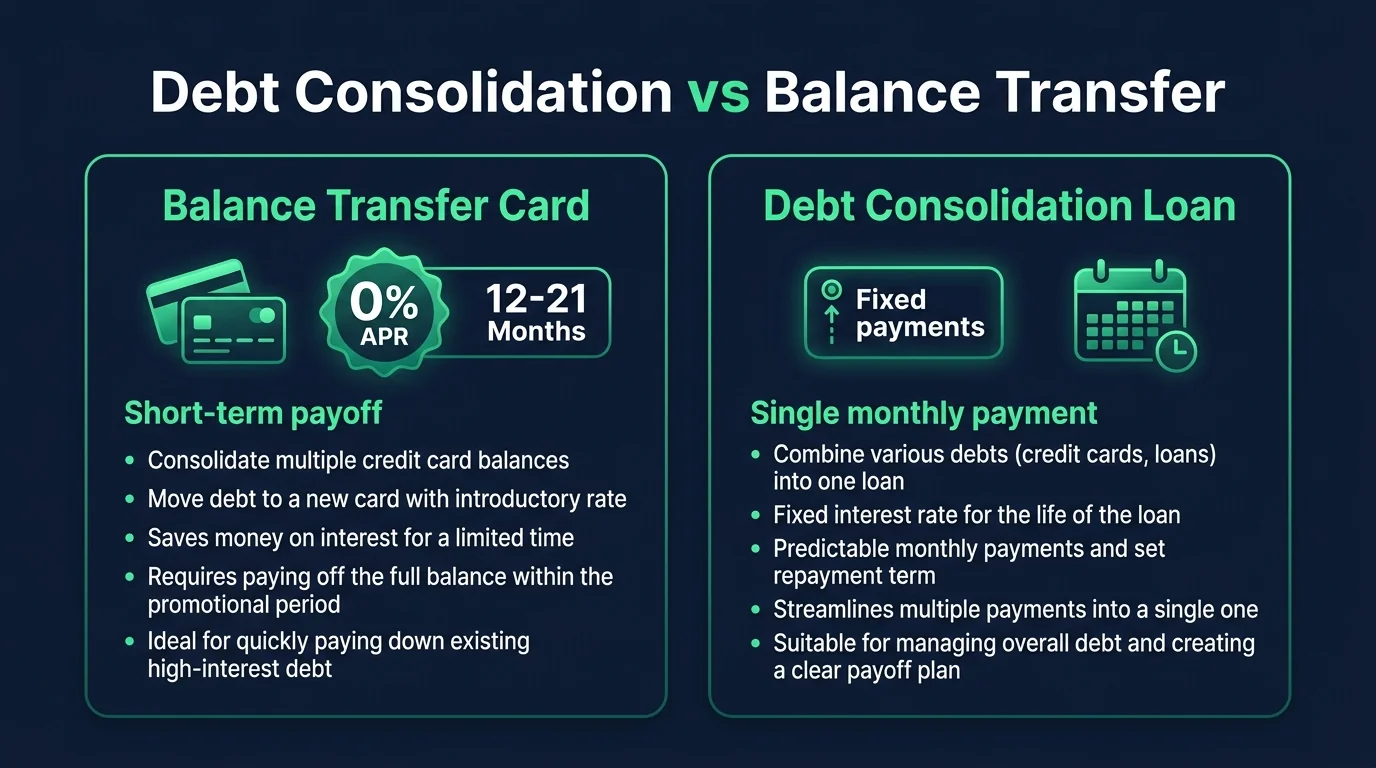
- Core Difference: A balance transfer card moves debt onto a new credit card with a 0% introductory APR for 12–21 months, while a debt consolidation loan is a fixed-rate personal installment loan that pays off multiple debts over 2–7 years.
- The Math Winner: If you can afford to pay off your entire balance within 12 to 21 months, a 0% balance transfer card is mathematically the cheapest route (costing only a 3%–5% transfer fee and $0 in interest).
- The Structure Winner: If you owe more than $15,000 or need 3 to 5 years of breathing room, a debt consolidation loan provides fixed monthly installments, a guaranteed debt-free date, and protection from post-promotional rate shock.
- Credit Score Hurdle: 0% balance transfer cards strictly require good-to-excellent credit (FICO 670+). Consolidation loans are accessible across a wider spectrum (FICO 580–750+).
- The Golden Rule: Neither tool eliminates debt—they restructure it. To achieve permanent financial freedom, you must pair these tools with strict cash flow management and stop charging new purchases on unburdened cards.
Carrying high-interest credit card debt in today’s economic climate is one of the heaviest drags on personal wealth creation. With average commercial credit card interest rates exceeding 24% to 28% APR, a staggering portion of every monthly payment is consumed by compounding finance charges rather than reducing your actual principal balance.
When you decide to break free from high-interest debt, two primary financial instruments dominate the landscape: 0% APR Balance Transfer Credit Cards and Fixed-Rate Debt Consolidation Loans. While both strategies aim to reduce borrowing costs and accelerate your debt-free timeline, they function under entirely different legal structures, cost models, and repayment dynamics.
Choosing the wrong instrument can cost you thousands of dollars in unexpected fees, trigger severe rate spikes, or trap you in a deeper borrowing cycle. In this master guide, we break down the foundational mechanics, provide side-by-side mathematical simulations on a $15,000 balance, outline a 5-step decision framework, and help you select the exact vehicle tailored to your financial profile.
Foundational Breakdown: How Each Debt Solution Operates
To evaluate which tool serves your debt reduction strategy, you must first understand how each mechanism operates under the hood.
1. What is a 0% APR Balance Transfer Credit Card?
A balance transfer credit card is a specialized revolving line of credit that offers a promotional 0% introductory Annual Percentage Rate (APR) on balances transferred from other financial institutions for a set window—typically ranging from 12 to 21 months.
When you are approved for a balance transfer card, your new card issuer pays off the outstanding balances on your existing high-interest credit cards. That total amount, plus an upfront balance transfer fee (typically 3% to 5%), becomes your new opening balance. For the duration of the promotional period, 100% of every dollar you pay above the minimum goes directly toward knocking down the principal balance with zero interest accumulation.
However, balance transfer cards have two major caveats: you must qualify for a sufficiently high credit limit to accommodate your total debt, and any balance remaining when the promotional clock expires immediately begins accruing interest at the card’s standard ongoing variable APR (often 21.99% to 29.99%).
2. What is a Debt Consolidation Personal Loan?
A debt consolidation loan is an unsecured closed-end installment loan issued by a bank, credit union, or online lender. Instead of an open line of credit, you receive a lump sum of capital that is used to pay off multiple credit cards, medical bills, or personal debts simultaneously.
In exchange, you repay the lender in fixed monthly installments over a set term (typically 24 to 84 months) at a fixed interest rate (typically 7.99% to 18.99% for prime borrowers). Because the interest rate and repayment timeline are locked in from day one, your monthly payment never changes, and you have an exact, guaranteed debt-free date.
Consolidation loans eliminate the psychological anxiety of managing multiple due dates and varying minimums, replacing them with a single predictable payment that seamlessly integrates into your monthly budget.
Head-to-Head Comparison Matrix: Features, Costs, and Eligibility
The table below provides a comprehensive architectural comparison between balance transfer cards and debt consolidation loans across every critical financial metric:
| Comparison Feature | 0% Balance Transfer Card | Debt Consolidation Loan |
|---|---|---|
| Interest Rate (APR) | 0.00% Intro APR (12–21 Months) | 7.99% – 19.99% Fixed (Prime) |
| Upfront Transaction Fees | 3% – 5% Balance Transfer Fee | 0% – 6% Origination Fee (deducted from loan) |
| Repayment Horizon | Short-Term (12 to 21 months max) | Medium to Long-Term (24 to 84 months) |
| Monthly Payment Structure | Flexible minimums (1%–2% of balance) | Strict fixed monthly amortized payment |
| Credit Score Requirement | Good to Excellent (FICO 670 – 850) | Fair to Excellent (FICO 580 – 850) |
| Credit Line / Loan Limit | Issuer-determined ($2,000 – $15,000+) | High flexibility ($5,000 – $50,000+) |
| Post-Promo Risk | High (Remaining balance jumps to 22%–29% APR) | None (Rate is locked for life of loan) |
| Credit Utilization Impact | Revolving debt stays revolving | Converts revolving debt to installment (Huge FICO Boost) |
| Eligible Debt Types | Credit cards from other banks | Credit cards, medical debt, personal loans, tax debt |
Mathematical Simulation: Repaying $15,000 in High-Interest Debt
To truly understand the financial leverage of these strategies, let us analyze a real-world case study: repaying $15,000 in credit card debt across four distinct paths.
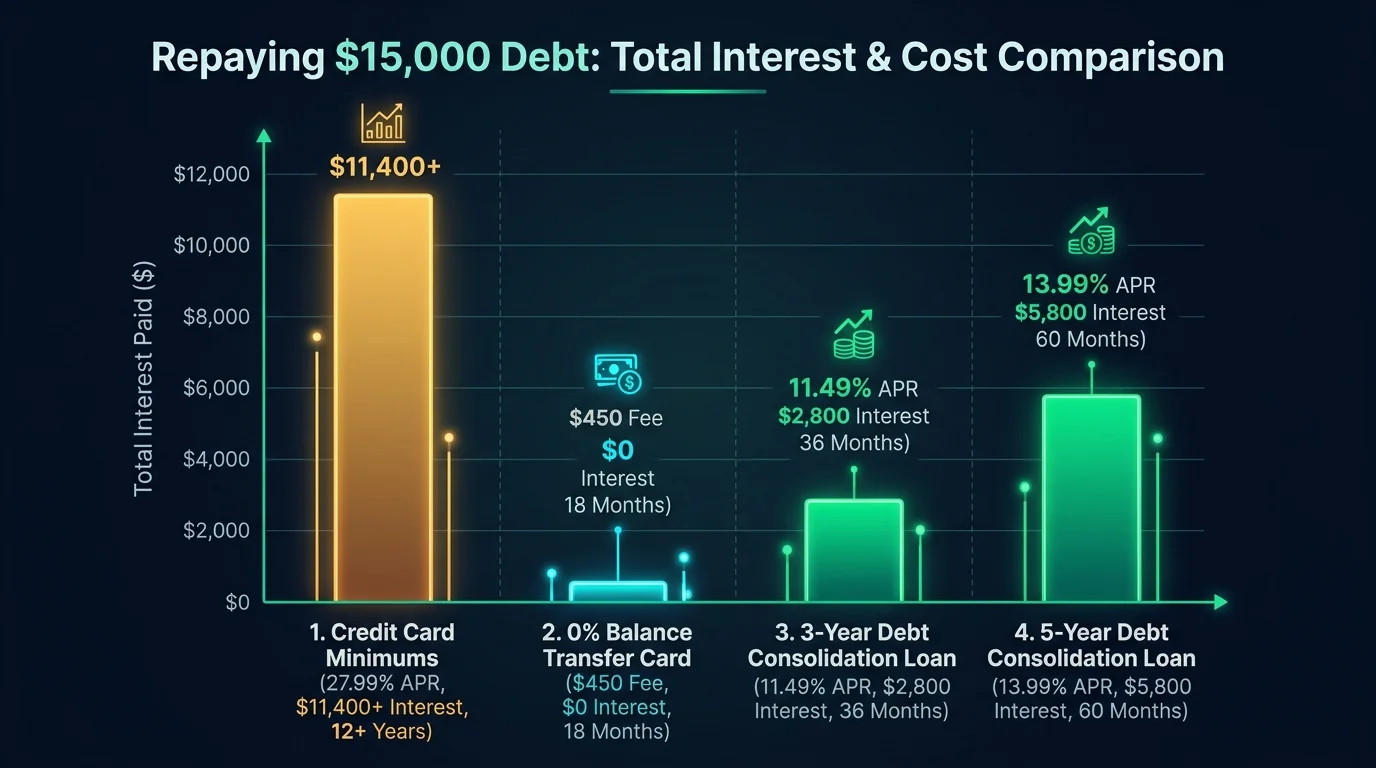
Consider the staggering mathematical disparity when comparing minimum payments against structured restructuring:
| Strategy Scenario ($15,000 Debt) | Stated APR | Monthly Payment | Payoff Time | Total Interest Paid | Total Upfront Fee | Total Cost of Debt |
|---|---|---|---|---|---|---|
| 1. Credit Card Minimum Trap | 27.99% | ~$450 (declining) | 148 Months (12.3 Yrs) | $11,468.20 | $0 | $26,468.20 |
| 2. 0% Balance Transfer Card | 0.00% (18 Mo) | $858.33 / mo | 18 Months | $0.00 | $450 (3% fee) | $15,450.00 |
| 3. 3-Year Consolidation Loan | 11.49% Fixed | $494.62 / mo | 36 Months | $2,806.32 | $450 (3% fee) | $18,256.32 |
| 4. 5-Year Consolidation Loan | 13.99% Fixed | $349.02 / mo | 60 Months | $5,941.20 | $450 (3% fee) | $21,391.20 |
Key Mathematical Takeaways:
• The 0% Transfer Card Advantage: If your cash flow permits paying $858/month, the 18-month 0% balance transfer card saves a staggering $11,018.20 compared to making minimum credit card payments.
• The Consolidation Loan Advantage: If paying $858/month is unfeasible and would strain your basic living expenses, the 3-Year Debt Consolidation loan drops your required monthly payment to $495/month while still saving you $8,211.88 in interest compared to standard credit card minimums.
To simulate your exact balance numbers and payoff timelines, use our free interactive debt payoff calculator. You can also analyze your monthly cash flow allocation using our budget calculator to determine exactly how much monthly payment your budget can sustainably bear.
Watch: Expert Walkthrough on Balance Transfers vs Personal Loans
In this comprehensive analysis from NerdWallet, personal finance experts break down the decision tree between opening a 0% balance transfer card versus taking out a fixed personal loan to consolidate debt.
The 5-Step Actionable Blueprint: How to Choose Your Optimal Strategy
Follow this step-by-step decision framework to evaluate your financial profile and execute the most cost-effective debt payoff plan:
Step 1: Audit Your Complete Debt Portfolio
List every outstanding balance, its current APR, minimum monthly payment, and issuing financial institution. Calculate your weighted average interest rate and total debt load. If your debts are scattered across multiple cards from the same bank, remember that banks will not allow internal balance transfers between their own products.
Step 2: Test Your Realistic Monthly Repayment Capacity
Divide your total debt balance by 15 or 18 (the standard duration of a 0% introductory card). For instance, $12,000 divided by 18 months equals $667/month. If your budget comfortably accommodates $667/month, a 0% balance transfer is your top contender. If your budget only allows $300 to $400/month, a 36-month or 48-month fixed consolidation loan is the structurally superior option.
Step 3: Check Your Credit Score & Pre-Qualify Without Hard Pulls
Review your FICO credit score across major bureaus. Many leading consolidation lenders and credit card issuers offer soft-pull pre-qualification tools that show your estimated interest rate, loan amount, or approval odds with zero impact on your credit score. If your credit score is in the 580–660 range, personal loans from online lenders or credit unions are much easier to qualify for than prime 0% balance transfer cards.
Step 4: Factor in All Fees (Transfer Fees vs Origination Fees)
Compare the 3%–5% balance transfer fee against the personal loan origination fee and total amortized interest. For prime borrowers, some online lenders offer $0 origination fee personal loans, making the total interest cost very competitive with balance transfer fees on shorter 24-month terms.
Step 5: Lock Down Spending & Build an Emergency Cushion
The most dangerous trap in debt restructuring is paying off revolving credit cards with a loan or transfer, and then running up fresh balances on the newly empty cards. Cut up or freeze physical cards, remove stored card numbers from digital wallets, and maintain a starter cash cushion using our emergency fund calculator and our actionable blueprint on saving your first $1,000 emergency fund.
Credit Score Impact: How Restructuring Changes Your FICO Profile
Understanding how credit reporting algorithms interpret debt restructuring allows you to protect and enhance your credit profile throughout the payoff journey.
1. Credit Utilization Ratio (30% of FICO Score):
Revolving credit utilization is the percentage of your available credit limits currently in use. When you transfer balances to a new credit card, your utilization remains in the revolving category. If the new card issues a $10,000 limit and you transfer $9,500, that individual card will report at 95% utilization, which can temporarily suppress your score.
In contrast, when you take out a Debt Consolidation Loan to pay off maxed-out credit cards, your revolving credit card balances plummet to $0. Installment debt is evaluated differently by scoring algorithms and does not count toward revolving credit utilization. As a result, borrowers often see an immediate 20 to 50+ point increase in their FICO score within 30 to 60 days of funding a consolidation loan.
2. Hard Inquiries & New Accounts (10% of FICO Score):
Applying for either product triggers a single hard inquiry, which typically shaves 3 to 5 points off your credit score for 12 months. This minor dip is swiftly eclipsed by the positive impact of consecutive on-time payments and plummeting debt balances.
3. Credit Mix (10% of FICO Score):
FICO algorithms reward consumers who responsibly manage both revolving accounts (credit cards) and installment accounts (loans). Adding an installment loan can diversify your credit mix if your file previously only contained revolving credit cards.
For a deeper dive into credit management and debt elimination strategies, review our comprehensive guides on debt management strategies and our detailed case study on how to pay off $20,000 in credit card debt fast.
When to Choose Neither: Alternative Debt Relief Options
If your total debt burden exceeds 50% of your annual gross income, or if your credit score has dropped below 580, neither balance transfer cards nor unsecured consolidation loans may be viable. In such scenarios, consider these specialized debt resolution pathways:
1. Nonprofit Debt Management Plans (DMP):
Partnering with an accredited nonprofit credit counseling agency (such as NFCC-certified agencies) allows you to consolidate payments into a single monthly disbursement. Credit counselors negotiate directly with your existing card issuers to reduce interest rates to 6%–10% and waive fees without requiring a new loan. Review our guide on how to negotiate credit card interest rates.
4. Internal Bank Hardship Programs:
If an unexpected financial crisis (job loss, medical emergency, or divorce) has severely disrupted your household cash flow, you may qualify for direct concessions from your existing card issuer. Read our comprehensive hardship programs vs debt consolidation playbook to evaluate qualification cutoffs, interest concessions, and tax implications.
2. Debt Snowball vs Debt Avalanche Self-Repayment:
If you prefer not to apply for new credit products, you can aggressively tackle debts using mathematical prioritization. The Debt Avalanche method focuses all extra cash on the card with the highest APR, while the Debt Snowball pays off the smallest balance first for psychological momentum. Explore our detailed comparison on debt-free vs having debt strategies and how to allocate earnings with our how to budget $3,000 monthly income guide.
Frequently Asked Questions (FAQs)
A balance transfer card is better if you have good to excellent credit (FICO 670+), owe less than $15,000, and have the cash flow to aggressively repay the balance within the 0% promotional window (typically 12 to 21 months). A debt consolidation loan is better if you have a larger balance, need a longer structured repayment period (2 to 7 years), want a fixed monthly payment with a guaranteed end date, or wish to consolidate non-credit card debts like medical bills or personal loans.
Both options cause a temporary, minor credit dip of 3 to 5 points due to the initial hard credit inquiry. However, both strategies significantly boost your credit score over the medium to long term by drastically lowering your revolving credit utilization ratio (for personal loans) or expanding your total available credit line (for balance transfer cards), provided all monthly payments are made on time.
Once the 0% introductory promotional period ends, the remaining unpaid principal balance begins accruing interest at the card’s standard ongoing variable APR, which typically ranges from 19.99% to 29.99%. Unlike retail store cards with retroactive ‘deferred interest’, standard bank balance transfer cards only charge interest on the remaining unpaid balance going forward.
No. Lenders and credit card issuers (such as Chase, Citi, Discover, Capital One, or American Express) do not permit balance transfers between accounts within the same banking institution. You must transfer the balance to a credit card issued by a competing financial institution.
Top-tier 0% APR balance transfer credit cards generally require a good-to-excellent FICO score of 670 to 750+. Debt consolidation personal loans have broader accessibility: prime lenders require 660+, but specialized consolidation lenders and credit unions offer fixed-rate loans to borrowers with fair credit scores between 580 and 660, albeit at higher interest rates.
Yes. Balance transfer cards typically charge an upfront transfer fee of 3% to 5% of the transferred amount (e.g., $300 to $500 on a $10,000 transfer). Personal debt consolidation loans often assess an origination fee ranging from 1% to 6% (or up to 8% for fair credit), which is usually deducted directly from the disbursed loan proceeds. Always look for lenders that offer $0 origination fees if you have strong credit.
In most cases, you should keep your paid-off credit cards open with a zero balance. Keeping the accounts open preserves your average age of credit history and maintains your overall available credit limit, keeping your credit utilization ratio low. However, if having available credit tempts you to run up new debt, closing the cards or locking them in a safe is worth the minor credit score trade-off.
Yes, with a debt consolidation personal loan you can combine credit cards, medical bills, payday loans, store financing, and other unsecured personal loans into a single monthly payment. In contrast, balance transfer cards are primarily designed for moving existing revolving credit card debt, though some issuers allow direct balance transfer checks to pay off other debts.
⚡ Commercial & Personal Debt Management Guides
Broaden your debt restructuring toolkit with these specialized financing and prioritization blueprints:
- Entrepreneur Debt Framework: Explore our guide on debt consolidation strategies for small businesses to separate personal liability from commercial cash flow.
- Minimum Payment Insights: Explore our guide on avoiding credit card minimum payment traps before choosing between a personal loan and a balance transfer card.
- Strategic Prioritization: Explore our guide on prioritizing which debt to pay off first to optimize cash flow relief versus interest savings.
Final Verdict: Choosing Your Fastest Path to Financial Freedom
Both debt consolidation loans and 0% balance transfer cards are powerful financial tools engineered to disrupt compounding interest and accelerate debt payoff. The right choice hinges on two core factors: your repayment timeline and your required repayment structure.
If you have good credit, owe an amount you can eliminate within 12 to 21 months, and possess the discipline to make aggressive monthly payments, a 0% APR Balance Transfer Credit Card delivers the highest mathematical savings by eliminating interest charges entirely.
If you owe a larger balance requiring 2 to 5 years of structured payments, prefer the predictability of a fixed monthly installment, or wish to convert high revolving utilization into an installment loan for an immediate credit score lift, a Debt Consolidation Loan is your optimal, risk-protected solution.
Whichever path you choose, remember that restructuring is the starting line, not the finish. Combine your chosen tool with disciplined spending, track your milestones, and put compounding interest to work for you rather than against you. To plan your long-term wealth building once debt-free, explore our guide on investment time horizons and our masterclass on stages of retirement plan lifecycle.
Looking for an easy way to automate your snowball or avalanche repayment plan? Download our unlocked free debt payoff Excel & Google Sheets template with pre-built formulas, KPI dashboard, and 60-month payment tracker.

Jaiveer Hooda is the Lead Financial Researcher & Personal Finance Analyst at Grow Your Money Smart. Specializing in personal wealth optimization, index fund compounding, high-yield savings mechanics, and consumer debt elimination strategies. With a background in computer engineering, he applies mathematical modeling, cashflow simulations, and empirical risk analysis to evaluate personal finance vehicles and credit products. Every analysis is backed by verified regulatory disclosures, IRS tax schedules, and empirical APY compounding math.
Areas of Expertise: Personal Finance · High-Yield Savings Accounts (HYSA) · Index Funds & S&P 500 Compounding · Retirement Planning (401k/IRA) · Debt Optimization · Credit Card APR Mechanics.
Transparency & Editorial Policy: Editorial Standards | Report a Correction