
You cannot buy the S&P 500 index directly; you invest in it by purchasing an index fund or ETF that replicates it. To start, open a tax-advantaged account (like a Roth IRA) or a taxable brokerage account with a low-cost broker (Fidelity, Vanguard, or Charles Schwab). Deposit funds and purchase shares of an ultra-low-cost fund like VOO (Vanguard S&P 500 ETF, 0.03% fee), FXAIX (Fidelity 500 Index, 0.015% fee), or SWPPX (Schwab S&P 500, 0.02% fee). Finally, activate automated recurring deposits and turn on DRIP (dividend reinvestment) to compound your wealth hands-free.
30-Second Executive Summary for Beginners
- Instant Ownership of America’s 500 Titans: A single share of an S&P 500 fund gives you fractional ownership in Apple, Microsoft, Nvidia, Amazon, Alphabet, Berkshire Hathaway, and 494 other leading corporations.
- Historical 10% Benchmark: Over the past 50+ years, the S&P 500 has produced an average annualized return of approximately 10% before inflation (around 7% after inflation).
- Fees Matter Immensely: Never pay more than 0.04% in expense ratios. On a $10,000 balance, VOO costs $3/year while FXAIX costs just $1.50/year.
- Automation Trumps Market Timing: Investing a fixed dollar amount every single month (dollar-cost averaging) consistently outperforms attempting to predict market highs and lows.
Billionaire investor Warren Buffett famously instructed that when he passes away, 90% of the cash left to his wife should be invested in a single asset: a low-cost S&P 500 index fund. He has repeatedly noted that for both novice and sophisticated investors, consistently buying a cross-section of corporate America guarantees better long-term performance than almost any high-fee hedge fund or active money manager.
Yet for a beginner, taking that first action can feel paralyzing. How do you actually buy the S&P 500? Which ticker symbol do you search for? Should you open a Roth IRA or a regular brokerage? And how much money do you realistically need to get started?
In this comprehensive master guide, we break down the complete five-step roadmap to investing in the S&P 500. We compare the top four funds head-to-head, show you exact mathematical compound simulations, and provide the exact framework to automate your portfolio. If you are still deciding between fund structures, make sure to read our companion breakdown on ETFs vs Index Funds for Beginners and verify how indexing compares to traditional funds in our Index Funds vs Mutual Funds Guide.
Comprehensive beginner walkthrough demonstrating how to open an investment account, search for S&P 500 index funds, and place your first trade.
What Exactly Is the S&P 500 and How Does It Work?
The Standard & Poor’s 500 (S&P 500) is a stock market index maintained by S&P Dow Jones Indices. Created in 1957, it tracks 500 of the largest, most profitable publicly traded companies in the United States, representing roughly 80% of the entire U.S. stock market’s total value.
To qualify for inclusion, a company cannot just be large; it must satisfy strict financial criteria:
- It must be domiciled in the United States.
- It must have an unadjusted market capitalization of at least $18+ billion.
- It must have positive reported earnings over the most recent four consecutive quarters.
- Its stock must be highly liquid, with at least 50% of outstanding shares available for public trading.
Furthermore, the S&P 500 is market-cap weighted. This means larger companies make up a proportionally larger percentage of the index. When you invest in the S&P 500, you are not dividing your money equally into $2 per company; you are investing more heavily in mega-cap leaders (like Microsoft, Apple, and Nvidia) while maintaining smaller positions in regional banks and manufacturing firms.
The 5-Step Roadmap: How to Invest in the S&P 500 Step-by-Step
Follow this exact chronological framework to move from zero to an automated S&P 500 investor in under 20 minutes:
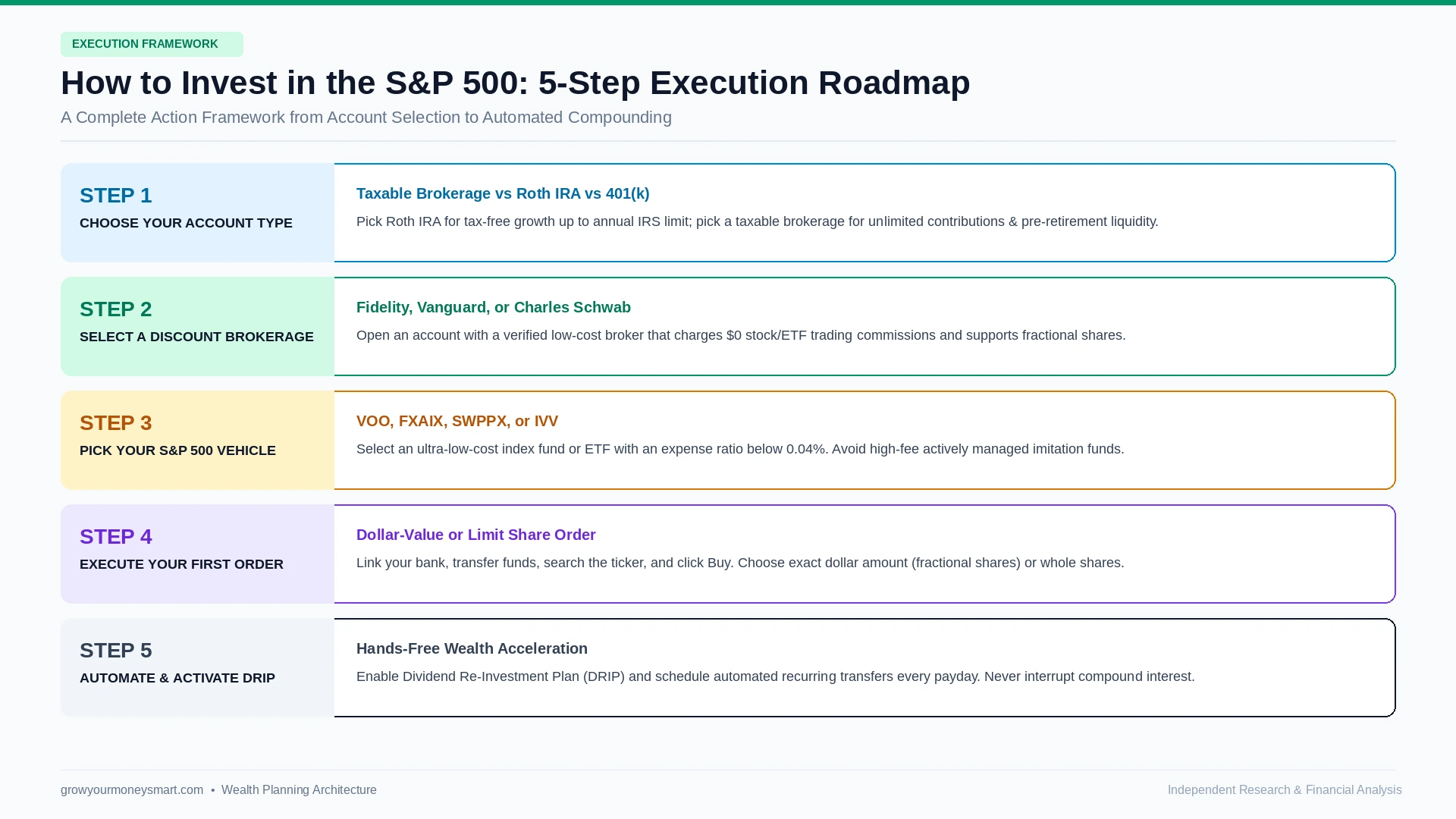
Step 1: Choose Your Account Type (Tax-Advantaged vs Taxable)
Before selecting a fund, you must decide which legal “bucket” will hold your investment. The IRS offers two primary account architectures:
- Roth IRA (Retirement Bucket): You contribute with after-tax money, your S&P 500 investments grow completely tax-free, and all withdrawals after age 59½ are 100% tax-free. If you qualify under IRS income limits, maxing out a Roth IRA should almost always come before investing in a taxable account. Learn more in our detailed Traditional vs Roth IRA Guide.
- Standard Taxable Brokerage Account (Wealth Bucket): There are zero annual contribution limits and zero withdrawal penalties. You can withdraw your money at age 28, 38, or 50 to buy a house, start a business, or retire early. However, dividends and realized capital gains are subject to taxes. If you have already maxed out your 401(k) and IRA, a taxable brokerage is your primary wealth vehicle.
Step 2: Choose a Trusted Low-Cost Brokerage
To buy shares, you need a brokerage account. Never use legacy banks or high-fee wealth advisors that charge $50 per trade or take a 1% annual management fee. The “Big Three” discount brokerages charge $0 commissions on all stock and ETF trades:
- Fidelity Investments: Top pick for beginners. Offers fractional share trading down to $1 on any ETF, exceptional customer service, and zero-fee native mutual funds (FXAIX).
- The Vanguard Group: The investor-owned pioneer. Ideal for long-term index buy-and-hold investors who want to buy Vanguard’s flagship VOO or VTI.
- Charles Schwab: Renowned for an intuitive user interface, comprehensive research tools, and their premier S&P 500 mutual fund (SWPPX) with a $1 minimum.
Step 3: Pick Your S&P 500 Index Fund or ETF
Because you cannot buy “The S&P 500” on an exchange ticker, you must buy a fund that holds all 500 stocks. You have two structural choices:
- ETFs (e.g., VOO, IVV, SPY): Trade intraday like stocks, are universally portable between brokerages, and offer superior tax efficiency in taxable accounts.
- Index Mutual Funds (e.g., FXAIX, SWPPX, VFIAX): Price once daily at 4:00 PM EST net asset value (NAV) and allow seamless automated recurring bank transfers for exact dollar amounts.
Step 4: Transfer Cash & Execute Your First Order
Once your brokerage account is open, linking your checking account takes about 3 minutes via secure bank verification. Once funds transfer, follow these simple clicks:
- Navigate to the Trade / Search bar in your brokerage app.
- Enter the ticker symbol (for example, type VOO or FXAIX).
- Select Action: Buy.
- Choose your order type: If buying an ETF during market hours (9:30 AM – 4:00 PM EST), select a Market Order (executes immediately at current price) or a Limit Order (sets a maximum price you are willing to pay). If buying an index mutual fund, simply type the exact dollar amount you wish to invest (e.g., $100.00).
- Click Review Order and tap Submit Buy Order. Congratulations—you now own a piece of America’s 500 largest businesses!
Step 5: Activate DRIP and Automate Monthly Deposits
The single biggest mistake beginners make is buying once and forgetting to maintain momentum. To build true life-changing wealth, you must turn on two automated switches inside your brokerage portal:
- DRIP (Dividend Re-Investment Plan): S&P 500 companies pay cash dividends every quarter. Switch your dividend setting to “Reinvest in Security.” Every penny of dividends will automatically purchase additional fractional shares of your fund without fees or manual effort.
- Recurring Auto-Invest: Set up an automatic transfer from your checking account every payday (e.g., $100 on the 1st and 15th). Even if you start small, our blueprint on how to start investing with $100 a month shows how modest recurring contributions compound into massive balances over time.
Top 4 S&P 500 Funds Compared: VOO vs FXAIX vs SWPPX vs SPY
While hundreds of financial products track the S&P 500, these four dominate 90% of all investor capital. Let us examine how they stack up:
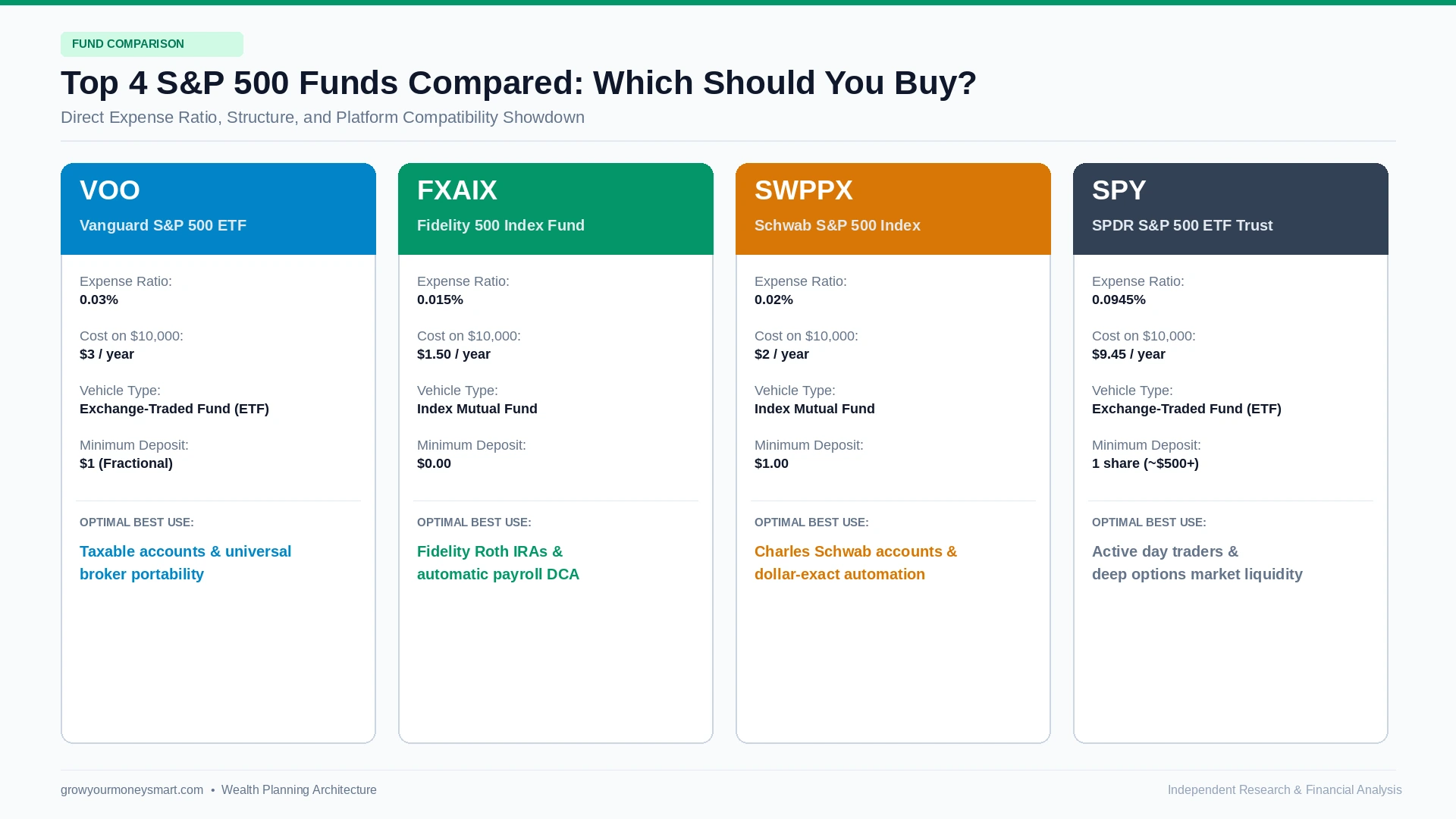
| Ticker & Fund Name | Structure | Expense Ratio | Annual Fee on $10k | Best Account / Platform |
|---|---|---|---|---|
| VOO (Vanguard S&P 500) | ETF | 0.03% | $3.00 | Taxable accounts; any brokerage |
| FXAIX (Fidelity 500 Index) | Mutual Fund | 0.015% | $1.50 | Fidelity Roth IRAs & 401(k)s |
| SWPPX (Schwab S&P 500) | Mutual Fund | 0.02% | $2.00 | Charles Schwab IRAs & taxable |
| SPY (SPDR S&P 500 ETF) | ETF | 0.0945% | $9.45 | Day traders; options liquidity |
The Compounding Math: How Much Will Your Investment Grow?
Between 1926 and 2025, the S&P 500 delivered an average annualized return of roughly 10.2%. While individual years swing dramatically—some years gain +28% while recession years can drop -18%—the multi-decade trajectory of continuous corporate innovation and dividend reinvestment is overwhelmingly positive.
Here is what happens when you invest consistent monthly sums over 10, 20, and 30 years at a hypothetical 10% average annual return:
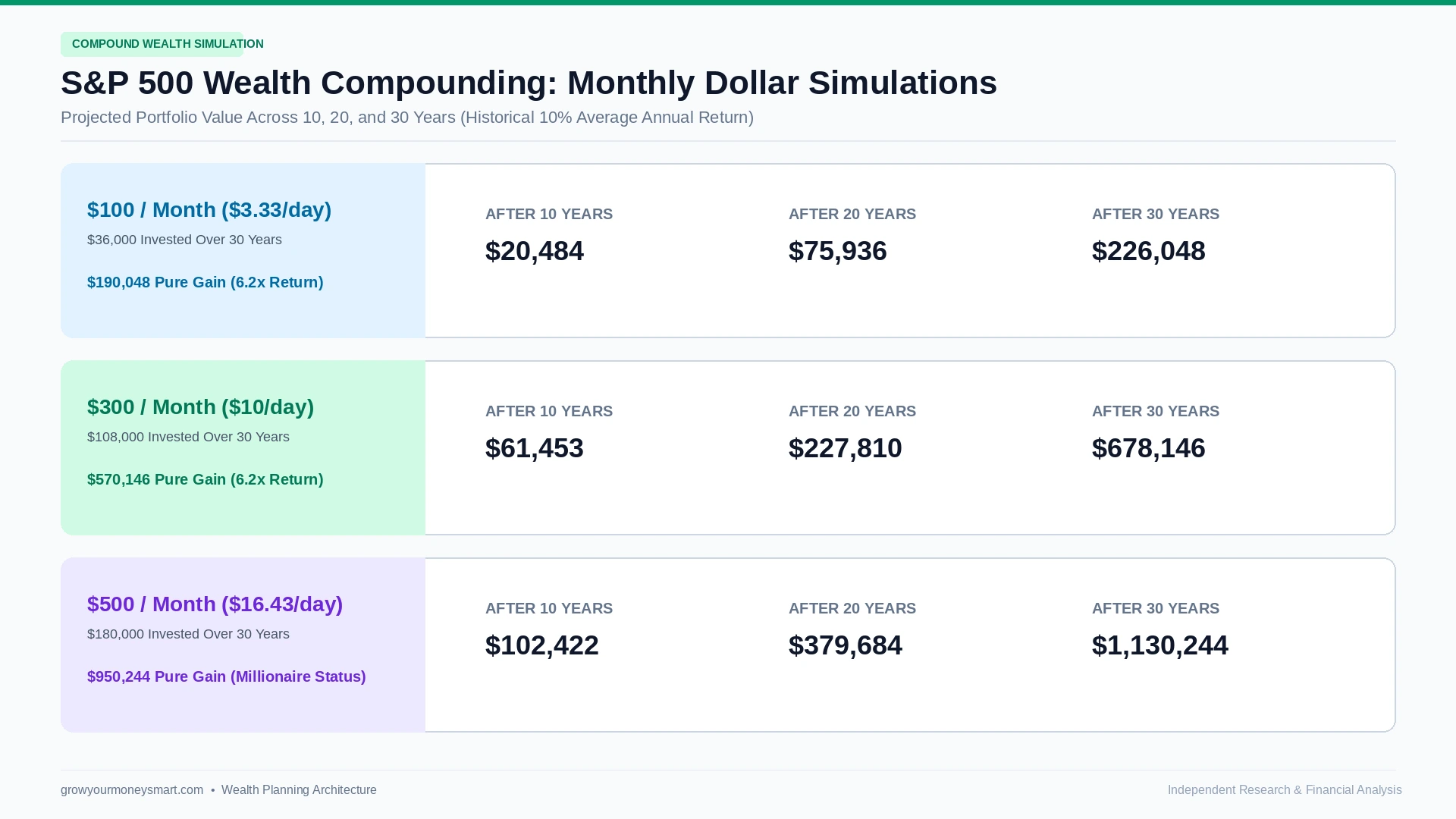
Notice the $500/month scenario: Over 30 years, you personally deposit a total of $180,000. Yet your final portfolio balance reaches $1,130,244! Over $950,000 of your total net worth is pure compound interest generated by American corporate profits while you were sleeping. This is why starting early—even with modest sums—outweighs almost any other financial decision.
4 Critical Traps Beginner S&P 500 Investors Must Avoid
Investing in index funds is conceptually simple, but human psychology makes it emotionally challenging. Guard against these four classic mistakes:
- Investing Money You Need Next Year: The stock market is an engine for long-term wealth, not short-term savings. If you need money within the next 3 years for a wedding, car purchase, or house deposit, park it in a safe, guaranteed vehicle. Compare the differences in our breakdown of HYSA vs Stock Market and secure your baseline with our Complete Emergency Fund Guide.
- Panic Selling During Normal Corrections: On average, the S&P 500 experiences a 10% pullback once every 1.5 to 2 years, and a 20%+ bear market once every 6 to 7 years. When market headlines scream panic, the worst action you can take is selling. Remind yourself that a market crash simply means the 500 best companies in America are temporarily on sale.
- Paying Excess Fees for SPY: SPY is the most heavily traded ETF on Earth, but its 0.0945% expense ratio is over three times higher than VOO (0.03%). Unless you are day-trading millions in daily volume or trading options contracts, holding SPY for 30 years wastes thousands of dollars in redundant fees.
- Ignoring Market Concentration Risk: In 2026, the top 10 companies in the S&P 500 account for over 30% of the entire index’s weight. While these tech giants (Apple, Microsoft, Nvidia, Amazon) are exceptionally profitable, investors seeking broader exposure across small-cap and international equities often pair the S&P 500 with total market or international index funds—or construct a complete Bogleheads 3-Fund Portfolio for all-weather global diversification.
Frequently Asked Questions (FAQs)
How much money do I need to start investing in the S&P 500?
You can start with as little as $1.00. Brokerages like Fidelity and Charles Schwab offer index mutual funds (like FXAIX and SWPPX) with zero minimum investment requirements, and Fidelity allows fractional share purchases of S&P 500 ETFs (like VOO) starting at just $1.
Can I buy the S&P 500 directly on an exchange?
No. The S&P 500 is an index (a statistical list of 500 companies), not an individual stock. To invest in it, you buy an index mutual fund or Exchange-Traded Fund (ETF) created by asset managers like Vanguard (VOO) or Fidelity (FXAIX) that holds all 500 stocks on your behalf.
Is VOO better than SPY for long-term investors?
Yes, decisively. VOO charges an expense ratio of 0.03% ($3 per year on $10,000), while SPY charges 0.0945% ($9.45 per year). Over a 30-year period, holding VOO saves you thousands of dollars in compounding fees. SPY is primarily designed for high-frequency institutional traders who require extreme options liquidity.
What is the average annual return of the S&P 500?
Historically, the S&P 500 has generated an average annual nominal return of roughly 10% before inflation (approximately 7% annualized after adjusting for inflation) over any rolling 20- to 30-year period since its inception in 1957.
Do I get paid dividends when investing in the S&P 500?
Yes. Most companies in the S&P 500 distribute cash dividends to shareholders. The fund collects these payments and distributes them to you quarterly (historically yielding around 1.3% to 1.6% annually). You can receive this as cash or automatically reinvest it via DRIP.
Can the S&P 500 drop to zero?
In practical reality, no. For the S&P 500 to reach zero, all 500 of America’s largest and most essential corporations (Apple, Microsoft, Walmart, ExxonMobil, JPMorgan) would have to simultaneously collapse into total bankruptcy—a catastrophic event where modern society and currency itself would cease functioning.
Should I invest in the S&P 500 or a Total Stock Market Fund (VTI)?
Both are elite choices. The S&P 500 holds 500 mega-cap companies, while a Total Stock Market fund (like VTI) holds over 3,700 companies (including mid-cap and small-cap stocks). Because both are market-cap weighted, their performance correlation is over 99%. Choosing either one and investing consistently will produce virtually identical long-term wealth.
Should I wait for a market dip before buying?
No. Academic research overwhelmingly proves that “time in the market beats timing the market.” If you are sitting on a large sum of cash and paralyzed by market volatility, see our mathematical breakdown on Dollar-Cost Averaging vs Lump Sum. Because the S&P 500 spends a substantial portion of its time hovering near all-time highs, sitting in cash waiting for a crash causes you to miss massive dividend compounding and sudden upward surges.

Jaiveer Hooda is a personal finance researcher and the founder of Grow Your Money Smart. With a background in computer engineering, he approaches money the way an engineer approaches any complex system — through data analysis, mathematical modeling, and ruthless optimization.
He built this platform on a single conviction: financial freedom is not a matter of luck. It is a system that can be designed, tested, and executed by anyone willing to follow the right blueprint. Every strategy published here is researched to the numbers, not written to the trend.
Expertise: Debt elimination · Retirement planning · Passive income · Budgeting systems
Connect: Pinterest | growyourmoneysmart.com | Contact Us