
The Three-Fund Portfolio is a legendary passive investing strategy popularized by the Bogleheads community (inspired by Vanguard founder John Bogle). It captures virtually all global financial markets using only three broad index funds: a Total U.S. Stock Market Index (e.g., VTI / FSKAX), a Total International Stock Market Index (e.g., VXUS / FTIHX), and a Total Bond Market Index (e.g., BND / FXNAX). A classic allocation for younger investors is 70% U.S. Stocks, 20% International Stocks, and 10% Bonds, requiring less than 15 minutes of annual rebalancing while beating over 90% of actively managed wealth portfolios.
30-Second Executive Summary for Beginners
- Maximum Global Diversification: Holding just three funds gives you ownership in over 11,000 worldwide stocks and thousands of high-grade government and corporate bonds.
- Near-Zero Maintenance: You never pick individual stocks, time economic cycles, or watch financial cable news. You check and rebalance your portfolio just once a year.
- Microscopic Cost Structure: With weighted expense ratios between 0.03% and 0.06%, you keep more than 99.9% of your investment compounding gains rather than paying Wall Street advisors.
- Works at Any Custodian: You can construct this portfolio seamlessly using Vanguard, Fidelity, or Charles Schwab index funds or ETFs.
In modern finance, the financial services industry works relentlessly to convince everyday investors that building wealth requires intense complexity: high-frequency options trading, expensive actively managed mutual funds, hedge-fund replication algorithms, and private wealth management fees. Yet academic research and decades of market history prove the exact opposite: simplicity outperforms complexity.
The Three-Fund Portfolio, created and championed by the independent Bogleheads community, has become the undisputed gold standard for “lazy” wealth building. It is mathematically designed to eliminate single-stock risk, minimize taxable drag, and allow you to capture global economic growth while living your life completely uninterrupted.
If you have already explored how to buy the 500 largest U.S. giants in our guide on How to Invest in the S&P 500, the 3-Fund Portfolio represents the next evolutionary step: expanding your universe to include small-cap innovators, international powerhouses, and defensive fixed income. Before diving in, ensure you understand the trading vehicle differences in our breakdown of ETFs vs Index Funds.
Financial educator Humphrey Yang breaks down the Bogleheads Three-Fund Portfolio, explaining asset allocation between total US stocks, international stocks, and bonds.
The 3 Structural Pillars: Complete Portfolio Anatomy
The entire philosophy of the 3-fund strategy is that global capital markets can be distilled down to three essential asset classes. By holding these three low-cost building blocks, you eliminate the need for dozens of overlapping specialty funds:
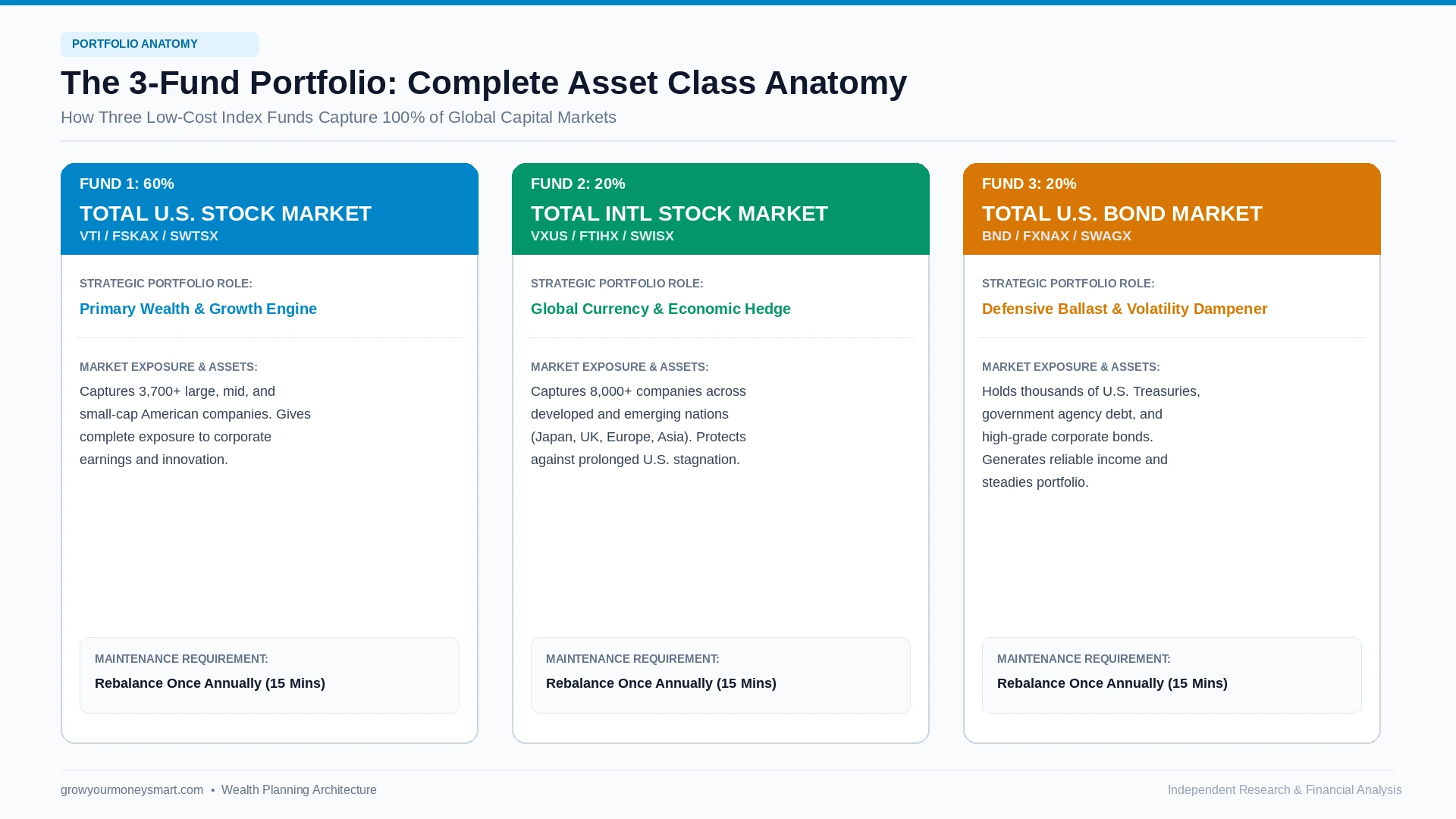
1. Total U.S. Stock Market Index (The Core Growth Engine)
While an S&P 500 fund holds 500 mega-cap companies, a Total U.S. Stock Market Index (such as Vanguard’s VTI or Fidelity’s FSKAX) holds roughly 3,700+ publicly traded companies. It encompasses large-cap giants, mid-size growth champions, and high-upside small-cap innovators. It represents the ultimate reflection of American corporate ingenuity. Because it is market-cap weighted, mega-cap companies still drive the bulk of returns, but you automatically own future industry disrupters from the moment they list on public exchanges.
2. Total International Stock Market Index (The Global Hedge)
The United States represents approximately 60% of the world’s total stock market value, meaning that 40% of all global market capitalization lies outside U.S. borders. A Total International Index (such as Vanguard’s VXUS or Fidelity’s FTIHX) invests in over 8,000 foreign companies across both developed nations (like Japan, the UK, Germany, and Switzerland) and emerging economies (like Taiwan, South Korea, and India).
Historically, domestic and international markets move in alternating multi-year cycles. When the U.S. dollar softens or domestic stock valuations become stretched, international equities frequently outperform, buffering your net worth against regional economic slumps.
3. Total Bond Market Index (The Volatility Ballast)
Stocks produce long-term compounding growth, but they are volatile. When deep recessions hit, equity markets can plunge 30% to 50%. A Total Bond Market Index (such as Vanguard’s BND or Fidelity’s FXNAX) holds thousands of investment-grade U.S. government Treasury bonds, government agency debts, and top-tier corporate bonds.
Bonds generate consistent, contractual interest income and provide essential price stability. During equity crashes, safe government bonds typically hold their value or rise, giving you the emotional confidence to stay invested and providing “dry powder” to rebalance into cheap stocks.
Brokerage Ticker Matrix: Vanguard vs. Fidelity vs. Charles Schwab
One of the greatest features of the 3-Fund Portfolio is that you do not need to switch brokerages. You can build it using the native low-cost funds of whichever major brokerage you already use:
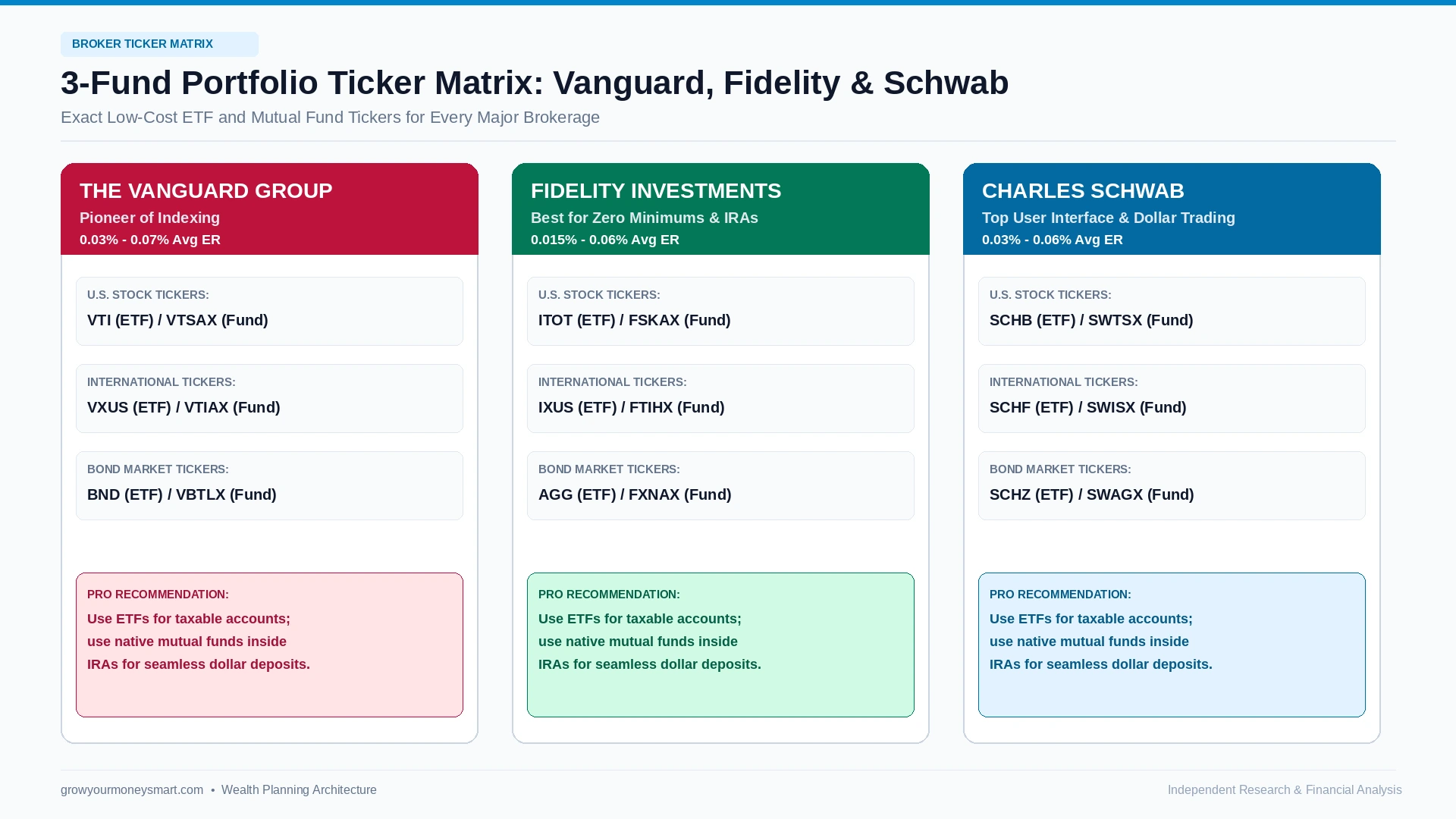
| Asset Pillar | The Vanguard Group | Fidelity Investments | Charles Schwab |
|---|---|---|---|
| 1. Total U.S. Stock | VTI (ETF, 0.03%) VTSAX (Fund, 0.04%) |
ITOT (ETF, 0.03%) FSKAX (Fund, 0.015%) |
SCHB (ETF, 0.03%) SWTSX (Fund, 0.03%) |
| 2. Total International | VXUS (ETF, 0.07%) VTIAX (Fund, 0.11%) |
IXUS (ETF, 0.07%) FTIHX (Fund, 0.06%) |
SCHF (ETF, 0.06%) SWISX (Fund, 0.06%) |
| 3. Total Bond Market | BND (ETF, 0.03%) VBTLX (Fund, 0.05%) |
AGG (ETF, 0.03%) FXNAX (Fund, 0.025%) |
SCHZ (ETF, 0.03%) SWAGX (Fund, 0.04%) |
If you are building your 3-fund portfolio inside a taxable brokerage account, use the ETF versions (VTI + VXUS + BND) to enjoy maximum tax efficiency and prevent annual surprise capital gains distributions. If you are investing inside a Roth IRA or 401(k), use the native index mutual funds (e.g., FSKAX + FTIHX + FXNAX at Fidelity) to take advantage of seamless, automated dollar-based payroll investing.
Asset Allocation by Age: The 3 Lifecycle Glidepaths
The most important personal decision in a 3-fund portfolio is setting your percentage split. Your allocation should be guided by your risk tolerance and your investment time horizon:
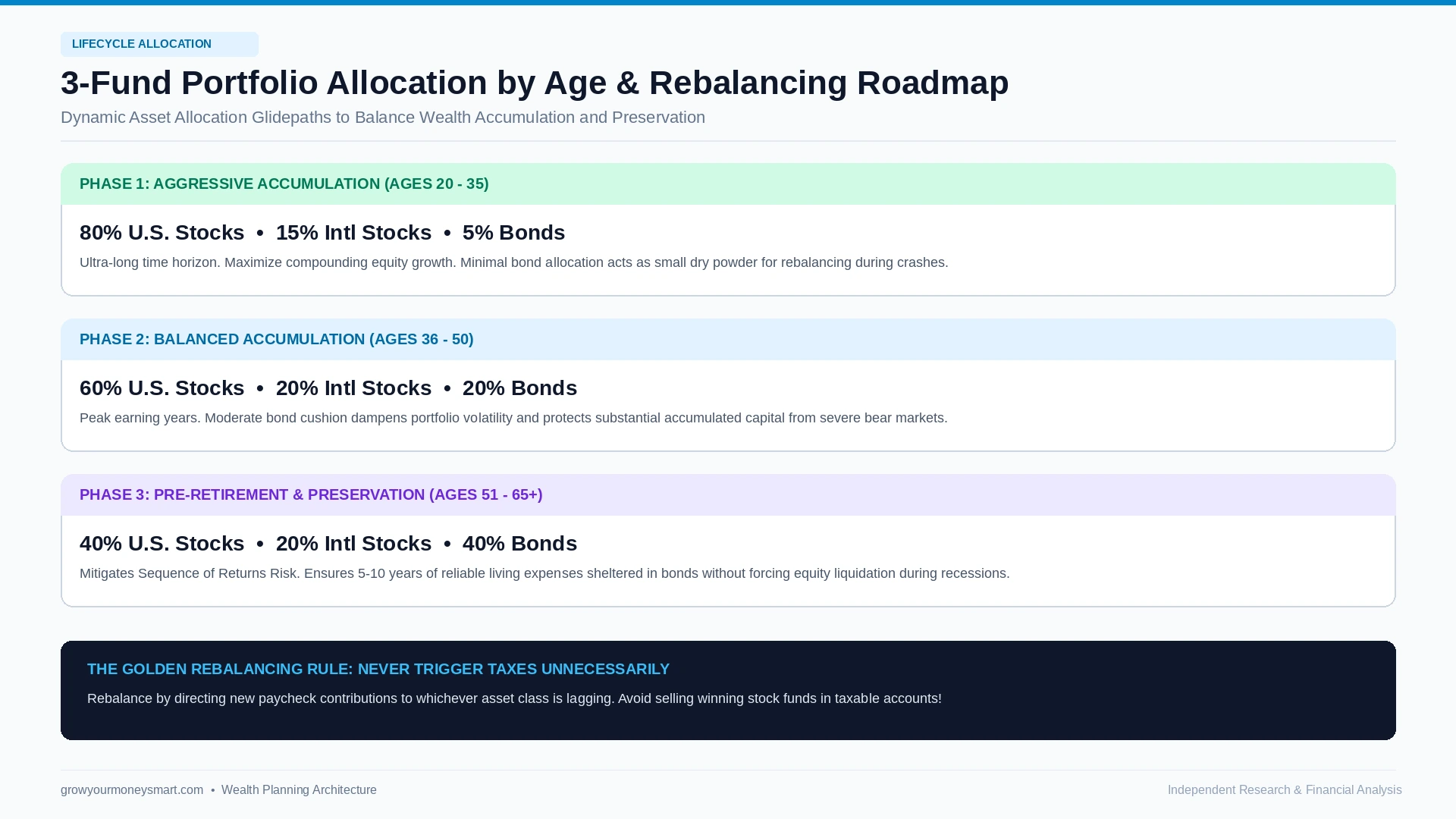
1. Aggressive Growth (Ages 20 to 35): 80 / 15 / 5
- 80% Total U.S. Stock Market
- 15% Total International Stock Market
- 5% Total Bond Market (or 0% Bonds)
With three to four decades ahead before retirement, your greatest wealth-building superpower is time. Market downturns are not risks; they are buying opportunities. A minimal 0% to 5% bond allocation keeps your capital working at maximum compounding capacity while giving you a tiny cash cushion to rebalance during deep market dips.
2. Balanced Accumulation (Ages 36 to 50): 60 / 20 / 20
- 60% Total U.S. Stock Market
- 20% Total International Stock Market
- 20% Total Bond Market
As your portfolio balance grows into six or seven figures during your peak earning years, a 50% market drop becomes emotionally and mathematically painful. Allocating 20% to high-grade bonds noticeably dampens volatility, providing reliable interest income and preserving capital while maintaining strong 80% equity exposure for continued inflation protection.
3. Pre-Retirement & Preservation (Ages 51 to 65+): 40 / 20 / 40
- 40% Total U.S. Stock Market
- 20% Total International Stock Market
- 40% Total Bond Market
When entering the retirement transition zone, your primary enemy is Sequence of Returns Risk (experiencing a severe bear market during the first five years of retirement withdrawals). A 40% bond allocation guarantees 5 to 8 years of essential living expenses safely sheltered from equity volatility, preventing you from being forced to sell depressed stocks during a recession.
How to Rebalance Like a Pro (Without Surrendering Capital to Taxes)
Over time, different assets perform at different speeds. If U.S. stocks experience a raging bull market gaining +30% while bonds remain flat, your target 80/20 allocation might drift into an 89/11 split, exposing you to unintended risk. Rebalancing restores your portfolio to your intended target.
To execute rebalancing cleanly, follow these two golden rules:
- Rebalance with New Cash Flow First (Cash Flow Rebalancing): (If you have a large windfall to deploy across your 3 funds, read Dollar-Cost Averaging vs Lump Sum.)
Never sell winning funds inside a taxable account if you can avoid it! Selling appreciated shares of VTI triggers capital gains taxes. Instead, whenever you deposit your monthly paycheck contributions, simply direct 100% of the new cash into whichever asset is currently underweight until balance is restored. - Rebalance Inside Tax-Advantaged Accounts: If a major market shift requires selling assets to rebalance, execute the trade inside your Roth IRA, Traditional IRA, or 401(k). Inside retirement accounts, switching $10,000 from stocks to bonds is 100% non-taxable. Check your allocation just once a year (for example, every December or on your birthday)—studies show that rebalancing more frequently than once a year produces lower returns due to trading friction.
Frequently Asked Questions (FAQs)
Why not just invest 100% in the S&P 500 or VTI?
A 100% U.S. stock portfolio has performed extraordinarily over the last decade, but it exposes you to 100% equity volatility and single-country economic risk. Between 2000 and 2009 (the “Lost Decade”), the S&P 500 delivered a negative annualized return, while international stocks and bonds posted solid gains. Holding all three assets ensures your wealth compounds across all economic regimes.
What is the difference between VTI and VOO in a 3-fund portfolio?
VOO tracks the 500 largest U.S. companies (S&P 500), whereas VTI tracks the entire U.S. investable market (~3,700 companies), including mid-cap and small-cap stocks. Because both are market-cap weighted, their returns are over 99% correlated, but VTI is the purer reflection of the Bogleheads philosophy because it captures total market capitalization. If you prefer high cash-flow payouts over total market indexing, examine our strategy guide on Dividend Investing for Beginners.
Do young investors in their 20s really need bonds?
Many aggressive young investors choose to hold 0% to 5% bonds. If you have a secure emergency fund (built using our Emergency Fund & HYSA Guide) and an iron stomach that will not panic during a 40% market crash, holding 0% bonds in your 20s is mathematically viable. However, even a small 5% to 10% bond holding acts as valuable dry powder to purchase cheap equities during recessions.
How often should I rebalance a 3-fund portfolio?
Rebalancing once a year (or whenever an asset class drifts more than 5% away from its target allocation) is optimal. Research by Vanguard demonstrates that rebalancing monthly or quarterly generates unnecessary transaction friction and taxable drag without improving risk-adjusted returns.
Can I use Fidelity ZERO fee index funds for this?
Yes, inside a Fidelity tax-advantaged account like a Roth IRA or Traditional IRA. You can pair FZROX (Total US, 0% ER) with FZILX (Total Intl, 0% ER) and FXNAX (Bonds, 0.025% ER). However, do NOT buy Fidelity ZERO funds in a taxable brokerage, as they cannot be transferred to other brokers via ACATS.
Where should I hold each of the three funds for tax efficiency?
Practice optimal asset location: Hold your high-growth U.S. stocks (VTI) and international stocks (VXUS) in taxable accounts (where VXUS qualifies for the Foreign Tax Credit; see What to Do After Maxing Out 401(k) and IRA). Hold your bond funds (BND) inside a Traditional 401(k) or IRA so regular bond interest distributions avoid annual income taxes.
Is a 3-fund portfolio better than a Target Date Fund (TDF)?
A Target Date Fund actually holds the same three (or four) core index funds internally and automatically rebalances for you. A DIY 3-fund portfolio gives you complete control over your exact bond percentage, allows customized asset location across accounts, and saves an additional 0.05% to 0.10% in fund management fees. See our full comparison of Robo-Advisors vs Target Date Funds to evaluate the tax trade-offs.
Can I start a 3-fund portfolio with just $100 a month?
Yes. With modern brokerages offering fractional ETF shares and $0 minimum index funds, you can effortlessly split $100 per month: for example, directing $70 to VTI/FSKAX, $20 to VXUS/FTIHX, and $10 to BND/FXNAX automatically on every payday.

Jaiveer Hooda is a personal finance researcher and the founder of Grow Your Money Smart. With a background in computer engineering, he approaches money the way an engineer approaches any complex system — through data analysis, mathematical modeling, and ruthless optimization.
He built this platform on a single conviction: financial freedom is not a matter of luck. It is a system that can be designed, tested, and executed by anyone willing to follow the right blueprint. Every strategy published here is researched to the numbers, not written to the trend.
Expertise: Debt elimination · Retirement planning · Passive income · Budgeting systems
Connect: Pinterest | growyourmoneysmart.com | Contact Us