
The primary Types of FIRE (Financial Independence, Retire Early) are defined by annual spending targets and lifestyle trade-offs: Lean FIRE (< $40,000/yr; $1M portfolio), Barista FIRE ($40,000–$60,000/yr combining part-time work with a $500k–$800k portfolio), Regular FIRE ($60,000–$100,000/yr; $1.5M–$2.5M portfolio), and Fat FIRE ($100,000–$250,000+/yr; $3.5M–$7.5M+ portfolio). All variations rely on accumulating 25× to 33× annual living expenses under the 4% to 3.3% safe withdrawal rule.
Understanding the different types of FIRE is the essential foundational step before embarking on any early retirement journey. The Financial Independence, Retire Early (FIRE) movement is not a monolithic, one-size-fits-all doctrine. While the fundamental mathematical equation—saving aggressively and investing in compounding broad-market assets—remains consistent, the actual lifestyle execution varies radically depending on your personal standard of living.
An individual seeking minimalist freedom in a low-cost rural setting requires a completely different financial engine than a family aspiring to travel internationally and maintain high-end discretionary spending. Exploring the fundamental types of FIRE empowers you to customize your savings rate, portfolio allocation, and tax strategy to your personal life goals rather than dogmatic frugality.
Whether you want to escape the corporate grind through part-time semi-retirement or build multi-generational luxury independence, here is the definitive architectural breakdown of Lean, Barista, Regular, and Fat FIRE for 2026.
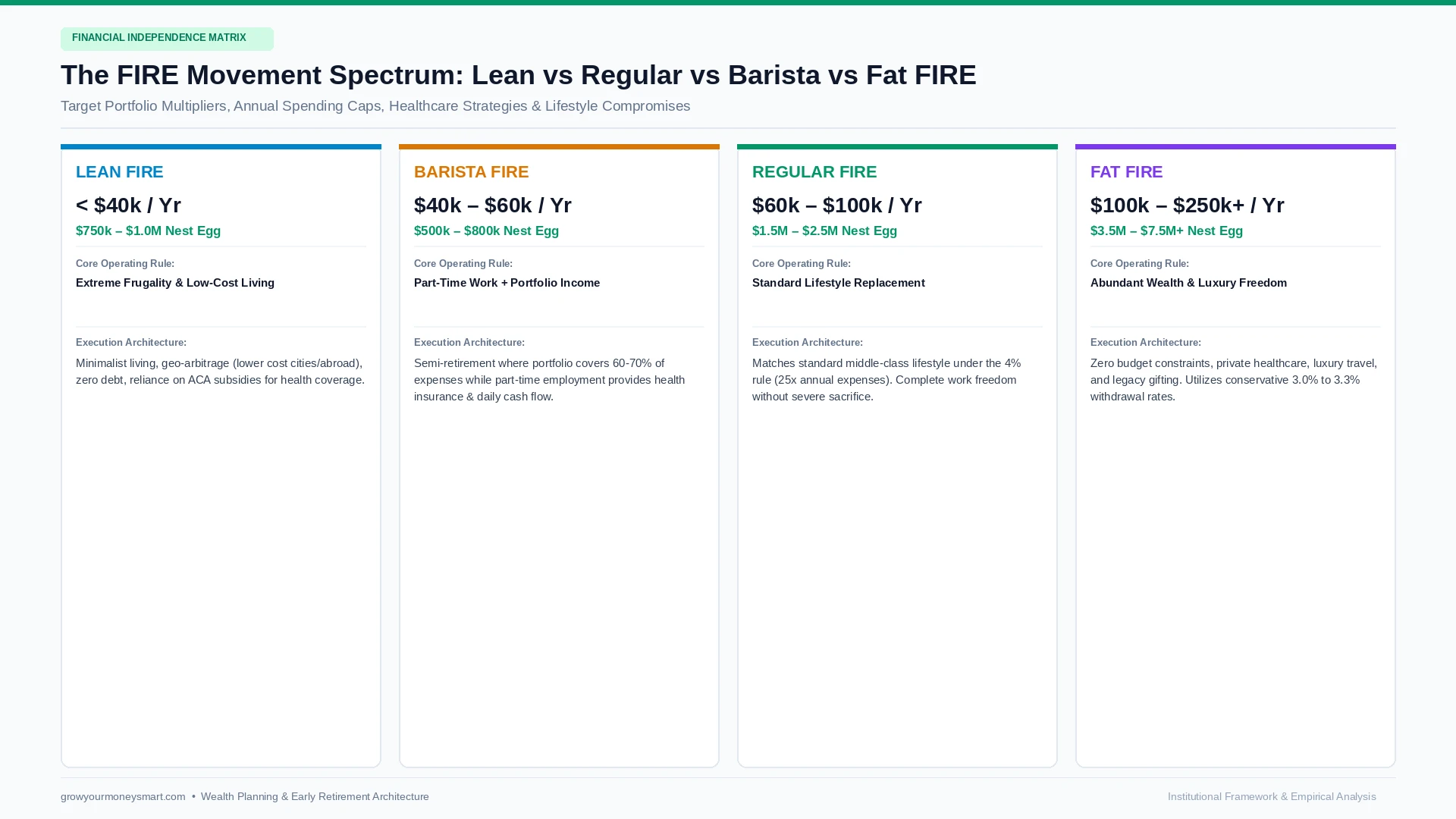
The Primary Types of FIRE: Comparing the 4 Major Pathways
To evaluate which variation of financial independence matches your personal risk tolerance and lifestyle aspirations, examine the fundamental economic metrics across the four major types of FIRE:
| FIRE Pathway | Annual Spending Target | Target Portfolio (25×–30×) | Primary Healthcare Strategy | Core Lifestyle Profile |
|---|---|---|---|---|
| Lean FIRE | < $40,000 / year | $750,000 – $1,000,000 | ACA Subsidized Coverage | Extreme frugality, low-cost region, zero debt |
| Barista FIRE | $40,000 – $60,000 / year | $500,000 – $800,000 | Employer Benefits / Part-Time | Semi-retirement, pleasant part-time work, social engagement |
| Regular FIRE | $60,000 – $100,000 / year | $1,500,000 – $2,500,000 | HSA / Private ACA Plans | Standard middle-class comfort, regular vacations, car replacement |
| Fat FIRE | $100,000 – $250,000+ / year | $3,500,000 – $7,500,000+ | Private Full-Coverage / Concierge | Abundant luxury, international travel, fine dining, legacy gifting |
1. Lean FIRE: Frugal Minimalism and Geographic Arbitrage
Lean FIRE is the original, minimalist manifestation among the types of FIRE. Adherents prioritize personal time, autonomy, and absolute freedom above material luxuries or status symbols. The target household budget is strictly capped at under $40,000 per year (often under $30,000 for single individuals).
To succeed with Lean FIRE, retirees must eliminate fixed overhead. This almost always requires owning a primary residence completely free and clear of mortgage debt or relocating to an area with exceptionally low property taxes and utility costs. In Lean FIRE, personal spending is viewed not as deprivation, but as a deliberate trade-off: spending less money directly translates to working fewer years in corporate servitude.
The Financial Math of Lean FIRE
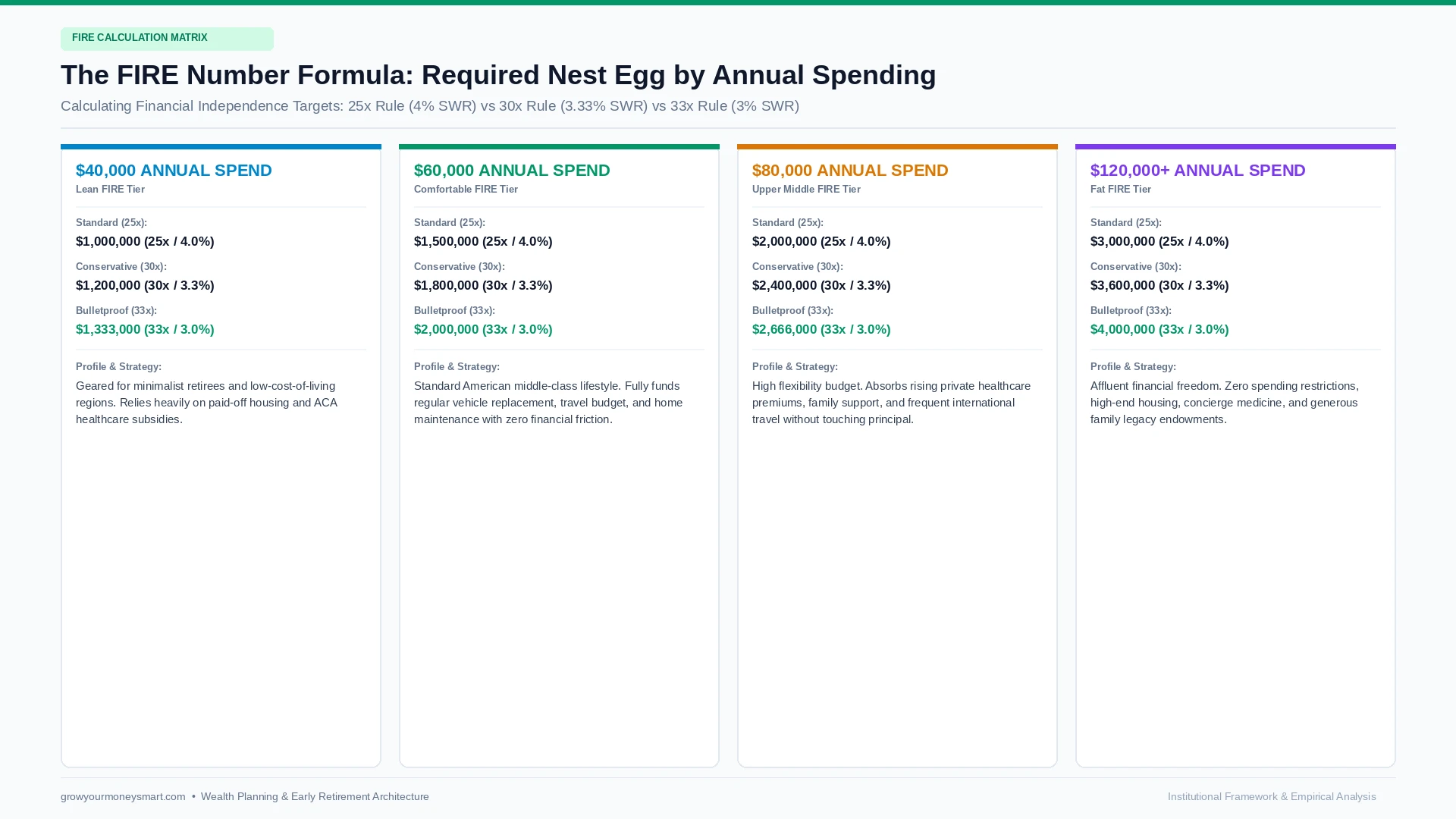
- Target Nest Egg: At a standard 4% Safe Withdrawal Rate (SWR), an annual spending target of $36,000 requires a nest egg of exactly $900,000 ($36,000 × 25).
- Conservative Buffer (3.3% SWR): For early retirees in their 30s planning for a 50-year retirement, utilizing a more conservative 3.3% withdrawal rate requires $1,090,000 ($36,000 × 30).
- Debt-Free Imperative: Carrying an auto loan, student loans, or high-interest consumer debt is fundamentally incompatible with Lean FIRE math. Fixed interest payments create structural fragility.
The ACA Subsidy Superpower (MAGI Engineering)
One of the immense institutional advantages enjoyed by Lean FIRE practitioners is the Affordable Care Act (ACA) premium tax credit structure. Because their living expenses are funded through a combination of post-tax brokerage principal and low-bracket capital gains, their Modified Adjusted Gross Income (MAGI) can be legally engineered to hover between 150% and 200% of the Federal Poverty Level ($22,000 to $30,000 for an individual).
At this income tier, Lean FIRE retirees receive massive federal healthcare subsidies and cost-sharing reductions (Silver CSR plans), yielding comprehensive health insurance with monthly premiums ranging from $0 to $60 and low maximum out-of-pocket deductibles. This single tax optimization saves thousands of dollars annually.
Key Vulnerabilities of Lean FIRE
The primary hazard of Lean FIRE is lack of budgetary flexibility. If unexpected inflation strikes, local property taxes spike, or major medical emergencies arise, there is little discretionary fat to trim from the budget. Furthermore, any severe market crash occurring in the first five years of retirement exposes the portfolio to severe sequence of returns risk.
2. Barista FIRE: Semi-Retirement and Health Benefits
Among all the types of FIRE, Barista FIRE represents a pragmatic compromise between the high-stress corporate grind and total retirement. Named colloquially after Starbucks’ historic corporate policy of offering health insurance to part-time employees working 20 hours per week, Barista FIRE involves accumulating a substantial investment portfolio that covers 50% to 70% of living expenses, while working a low-stress, enjoyable part-time job to cover the remainder and secure employer health insurance.
Barista FIRE fundamentally redefines retirement. Instead of viewing work as an all-or-nothing binary switch, it embraces work as a tool for community, purpose, and supplemental cash flow. You step away from high-stakes corporate roles where you are trading 60 hours a week for high pay, and step into flexible roles where work ends the second your shift is over.
The Financial Math of Barista FIRE
Consider a household requiring $55,000 per year in total living costs:
- Total Annual Budget: $55,000.
- Part-Time Wage Income: One partner works 20 hours per week at a community library, bookstore, or passion freelance venture, earning $22,000 gross per year plus subsidized medical coverage.
- Required Portfolio Drawdown: $55,000 – $22,000 = $33,000 per year.
- Target Nest Egg: At a 4% withdrawal rate, the required portfolio is only $825,000—shaving 7 to 10 years off the time needed to reach full financial independence compared to traditional models.
The Psychological and Health Insurance Bridge
Barista FIRE solves the two biggest anxieties faced by prospective early retirees: healthcare costs and social isolation. By maintaining an active connection to part-time work, you preserve workplace social interaction, physical activity, and daily routine without the soul-crushing politics of executive corporate life. Crucially, employer-sponsored healthcare shields your investments from catastrophic medical bills.
3. Regular FIRE: Traditional Middle-Class Independence
Regular FIRE mirrors standard middle-class suburban comfort. Retirees aim to maintain an annual expenditure between $60,000 and $100,000 without lifestyle compromises. This budget comfortably accommodates home maintenance, domestic and international vacations, dining out, vehicle upgrades, and generous gifting.
Unlike Lean FIRE, where every dollar must be accounted for, Regular FIRE provides substantial psychological comfort. You do not need to obsess over coupon clipping or think twice about booking a flight to visit family. The goal is to replicate your pre-retirement middle-class standard of living with 100% of your time under your personal control.
The Financial Math of Regular FIRE
- Target Nest Egg ($75,000 spend): $75,000 × 25 = $1,875,000 (4% SWR).
- Target Nest Egg ($90,000 spend): $90,000 × 25 = $2,250,000 (4% SWR).
- Asset Allocation: Typically structured using an institutional 3-fund portfolio (Total US Stock Market, Total International Stock Market, and Total Bond Market).
Regular FIRE provides substantial structural resilience. If an economic crisis strikes, the household can easily cut vacation or entertainment budgets by 20% to mitigate decumulation pressure, seamlessly adhering to dynamic spending guardrails.
4. Fat FIRE: Wealth, Luxury, and Generational Abundance
Fat FIRE is the elite tier among all types of FIRE. It is pursued by high-earning tech executives, founders, medical professionals, and corporate leaders who refuse to sacrifice any luxury in retirement. Annual spending ranges from $120,000 to $250,000+ per year, often located in Tier 1 high-cost metropolitan areas (San Francisco, New York, Seattle, London).
Adherents of Fat FIRE do not compromise. Their budgets include high-end dining, first-class international flights, private golf club memberships, luxury vehicle leases, top-tier private healthcare, and substantial financial support for children or grandchildren. The focus shifts from survival to wealth compounding and generational impact.
The Financial Math of Fat FIRE
- Annual Budget of $150,000: Requires a $3,750,000 portfolio (4% SWR) or $4,545,000 at a conservative 3.3% SWR.
- Annual Budget of $250,000: Requires a $6,250,000 portfolio (4% SWR) or $7,575,000 at a conservative 3.3% SWR.
- Ultra-Low Safe Withdrawal Rates: Because Fat FIRE portfolios are so massive, adherents frequently utilize conservative withdrawal rates of 3.0% to 3.3%, ensuring that the principal compounds indefinitely for generational wealth transfer.
Estate Architecture & Tax Optimization for Fat FIRE
At multi-million dollar portfolio tiers, tax minimization and asset protection become the dominant focus. High-net-worth retirees implement aggressive Roth conversion ladders, maximize their Backdoor Roth IRA allocations, and shield family wealth against probate fees and lawsuits using a revocable living trust.
How to Access Your FIRE Portfolio Before Age 59.5 Penalty-Free
The single most frequent question prospective FIRE adherents ask across all types of FIRE is: “If my money is locked inside a 401(k) and Traditional IRA, won’t I pay a 10% IRS early withdrawal penalty if I retire at age 38 or 45?”
The answer is an emphatic NO. The IRS tax code contains two fully legal, battle-tested channels designed specifically to access retirement funds early without paying a single dollar in penalties:
1. The Roth Conversion Ladder (The 5-Year Pipeline)
The Roth Conversion Ladder is the premier decumulation vehicle for early retirees. Here is the exact mechanics of how it functions:
- Upon retiring, roll over your employer 401(k) into a Traditional IRA without tax consequences via a standard 401(k) rollover.
- Each year, convert a specific portion of your Traditional IRA balance (e.g., $40,000 to $60,000) into a Roth IRA. You pay ordinary income tax on the converted sum in the year of conversion. Because you have no wage income, you can convert at the lowest 10% and 12% marginal tax brackets.
- Under IRS rules, converted Roth principal can be withdrawn 100% tax-free and penalty-free after a 5-year seasoning period.
- To bridge the first 5 years while your first conversion seasons, live off your taxable brokerage accounts, cash reserves, or Roth IRA direct contributions. Starting in Year 6, conversion tranche #1 matures and can be withdrawn completely penalty-free.
2. IRS Rule 72(t) SEPP (Substantially Equal Periodic Payments)
Under IRS Section 72(t) guidelines, the Internal Revenue Service allows you to take annual distributions from your Traditional IRA or 401(k) at any age without the 10% penalty, provided you establish a schedule of Substantially Equal Periodic Payments (SEPP) based on IRS life expectancy tables. The payments must continue for at least 5 years or until you reach age 59.5, whichever is longer.
Geographic Arbitrage: Accelerating FIRE by 10 Years
For those seeking Lean FIRE or Regular FIRE on an accelerated timeline, Geographic Arbitrage (Geo-FIRE) is the ultimate catalyst among all types of FIRE. By earning money in a high-income market and retiring to a low-cost region, your purchasing power multiplies instantaneously:
| Location Strategy | Example Destinations | Monthly Living Cost | Required FIRE Portfolio (4% SWR) |
|---|---|---|---|
| High-Cost Tier 1 US City | San Francisco, New York, Seattle | $8,000 – $12,000 / month | $2,400,000 – $3,600,000 |
| Domestic Low-Cost US Region | Midwest, Rural South, Rust Belt | $3,000 – $4,000 / month | $900,000 – $1,200,000 |
| International Expat Haven | Portugal, Spain, Mexico, Thailand | $1,800 – $2,500 / month | $540,000 – $750,000 |
A portfolio of $750,000 that would barely support Lean FIRE in Chicago or Los Angeles affords a luxurious, beachfront lifestyle in Portugal or Mexico, with high-quality private healthcare costing less than $150 per month.
Step-by-Step Strategic Framework: Choosing Your Optimal FIRE Pathway
- Track 12 Months of Precise Spending: Do not guess your annual budget. Audit every dollar spent across housing, food, transport, taxes, and entertainment. Multiply your annual expenses by 25 to find your baseline FIRE number.
- Select Your Variation: If you want to escape full-time employment within 3 years, evaluate Barista FIRE or Coast FIRE (read our dedicated guide on what is Coast FIRE). If you desire total freedom with middle-class comforts, target Regular FIRE.
- Automate Your Savings Rate: The defining variable in achieving any of the types of FIRE is not investment genius; it is your savings rate. Saving 50% of your net income allows you to reach financial independence in approximately 16.6 years; saving 65% gets you there in 10.5 years.
- Optimize Tax Accounts: Maximize workplace 401(k) matching, fund Backdoor Roth IRAs, and exploit your HSA triple tax advantage.
- Stress-Test Against Sequence Risk: Establish a 2-year cash buffer and bond tent prior to leaving the workforce to safeguard against early retirement bear markets.
To measure your progress against standard wealth targets, review our comprehensive benchmark guide on how much to save by age 30, 40, 50, and 60, or learn about safe withdrawal mechanics via the 4% rule explained.
Frequently Asked Questions: Types of FIRE
1. What are the primary types of FIRE?
The primary types of FIRE are Lean FIRE (sub-$40,000 spending; sub-$1M portfolio), Barista FIRE (part-time work covering part of living expenses with a $500k–$800k portfolio), Regular FIRE ($60,000–$100,000 spending; $1.5M–$2.5M portfolio), and Fat FIRE ($100,000–$250,000+ luxury spending; $3.5M–$7.5M+ portfolio).
2. What is the difference between Lean FIRE and Fat FIRE?
The primary difference is annual spending and portfolio size. Lean FIRE involves living frugally on less than $40,000 per year with a portfolio under $1,000,000. Fat FIRE allows for abundant luxury with annual spending of $100,000 to $250,000+ supported by a nest egg of $3.5M to $7.5M+.
3. How do you pay for healthcare after early retirement?
Early retirees utilize three primary strategies: ACA subsidized health plans (by keeping taxable MAGI low), part-time employer-sponsored healthcare under Barista FIRE, or paying for private high-deductible health plans coupled with Health Savings Accounts (HSAs).
4. Can I touch my 401(k) or IRA money before age 59.5 without penalty?
Yes. By establishing a Roth Conversion Ladder, you can convert Traditional IRA funds to Roth IRA and withdraw the principal 100% tax-free and penalty-free after 5 years. Alternatively, you can use IRS Rule 72(t) SEPP to withdraw substantially equal annual payments at any age.
5. Is the 4% rule safe for a 40-year early retirement?
William Bengen’s 4% rule was tested for a 30-year retirement horizon. For 40- to 50-year retirements, financial researchers recommend a more conservative Safe Withdrawal Rate of 3.25% to 3.5%, or adopting dynamic Guyton-Klinger spending guardrails to eliminate failure risk.
6. What is the difference between Barista FIRE and Coast FIRE?
Under Barista FIRE, your portfolio actively funds a portion of your current living expenses while you work part-time. Under Coast FIRE, your portfolio is left completely untouched to compound until traditional retirement age, and your current earnings must cover 100% of your day-to-day living costs.
7. What happens if the stock market crashes right after I retire?
This is known as sequence of returns risk. FIRE retirees insulate themselves by holding 1 to 2 years of cash reserves and 3 to 5 years in fixed income (the 3-bucket strategy) so they never have to sell equities at a loss during a market downturn.
8. Does achieving FIRE mean you never earn money again?
No. Financial independence simply means work is optional. Many FIRE retirees continue to earn money through passion projects, writing, consulting, coaching, or creative businesses—not out of financial necessity, but for fulfillment.

Jaiveer Hooda is a personal finance researcher and the founder of Grow Your Money Smart. With a background in computer engineering, he approaches money the way an engineer approaches any complex system — through data analysis, mathematical modeling, and ruthless optimization.
He built this platform on a single conviction: financial freedom is not a matter of luck. It is a system that can be designed, tested, and executed by anyone willing to follow the right blueprint. Every strategy published here is researched to the numbers, not written to the trend.
Expertise: Debt elimination · Retirement planning · Passive income · Budgeting systems
Connect: Pinterest | growyourmoneysmart.com | Contact Us