
In the legal conflict of beneficiary designation vs will, beneficiary designations legally supersede a Last Will and Testament in 100% of US probate jurisdictions. Because accounts like 401(k)s, IRAs, life insurance, and Payable-on-Death (POD) bank accounts pass via contractual law, they transfer directly to named beneficiaries without entering probate court—even if your Will explicitly states otherwise. Failing to update beneficiary forms after divorce or marriage can disinherit your intended heirs immediately.
One of the most dangerous and widespread misconceptions in modern estate planning is the belief that drafting a Last Will and Testament provides total authority over who inherits your life’s savings. Millions of diligent savers spend thousands of dollars drafting detailed wills, carefully dividing assets among children and loved ones, completely unaware that their 401(k), IRA, life insurance, and brokerage accounts might bypass their will entirely.
Understanding the strict legal hierarchy between a beneficiary designation vs will is the single most critical step in safeguarding your family against unintended disinheritance, public probate delays, and catastrophic tax consequences. In this guide, we break down contract law supremacy, reveal the four most costly beneficiary traps, and provide an actionable synchronization checklist for 2026.
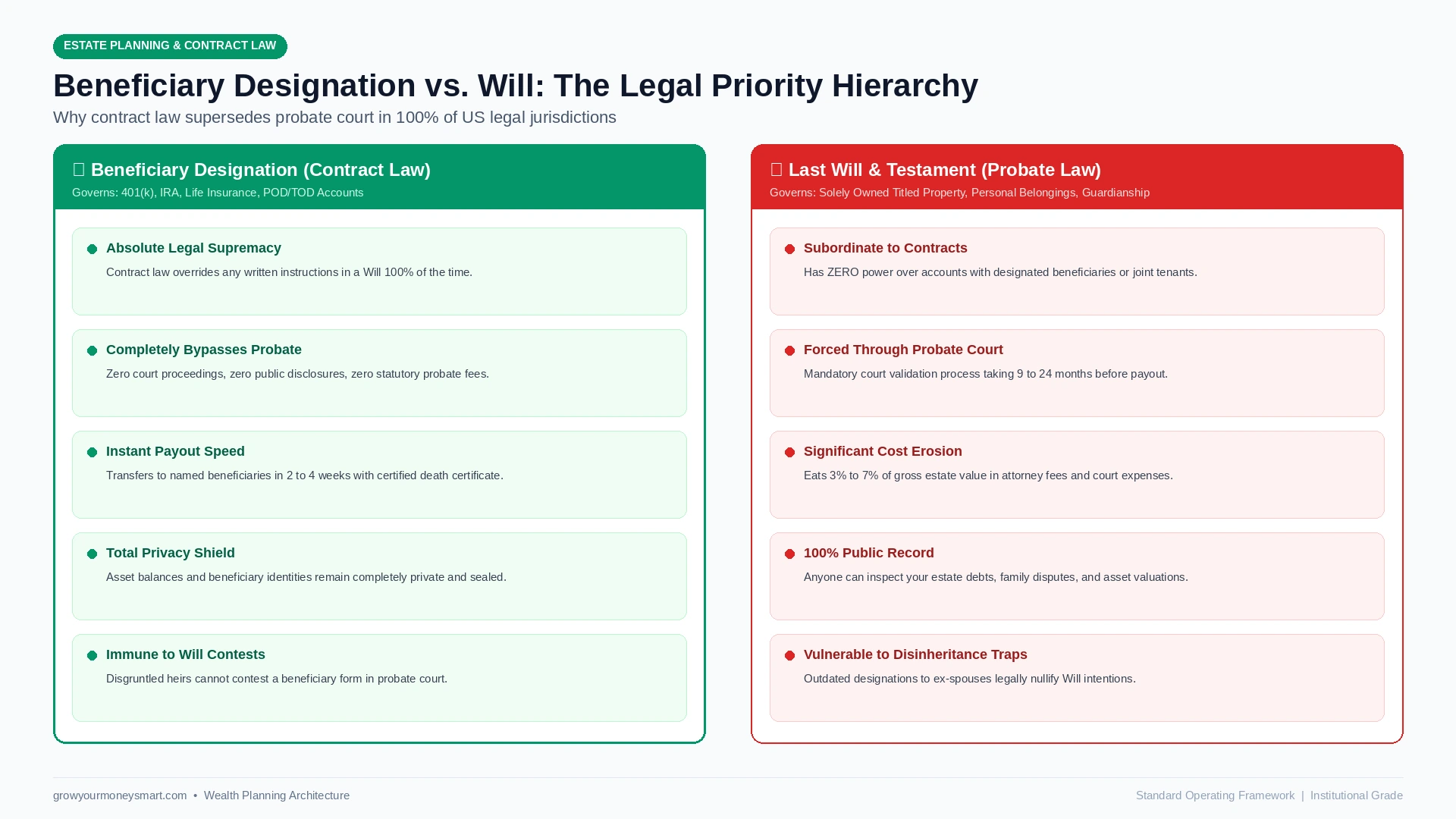
The Legal Reality: Contract Law Trumps Probate Law
To understand why a will cannot override a beneficiary designation, you must understand the distinction between two separate bodies of legal architecture:
- Contract Law (Non-Probate Transfers): When you open an account with a financial institution (Fidelity, Vanguard, Charles Schwab, or your employer’s 401(k) provider), you sign a binding contract. That contract stipulates that upon proof of death, the custodian is contractually bound to deliver account proceeds directly to the designated individual named on the beneficiary form.
- Testamentary Probate Law (Probate Assets): A Last Will and Testament is a legal document that only governs assets passing through probate court—specifically assets solely owned in your personal name without joint ownership or beneficiary forms attached.
Because contract law takes operational precedence over testamentary intent, a probate judge has zero jurisdiction over assets governed by valid beneficiary contracts. Even if your Will states: “I leave all my worldly wealth equally to my children,” but an old 401(k) form from 15 years ago still lists your former spouse or a deceased sibling, the financial custodian is legally required to cut the check to that named individual.
This dynamic operates similarly to the legal boundaries between wills and trusts. For an in-depth breakdown of private estate trusts, explore our guide on will vs living trust for retirement.
| Key Dimension | Beneficiary Designation (Contract) | Last Will & Testament (Probate) |
|---|---|---|
| Governing Legal Jurisdiction | Contract Law (ERISA / Custodial) | State Probate Court Statutes |
| Probate Court Requirement | Bypasses Probate 100% | Must Pass Through Full Probate |
| Transfer Speed to Heirs | 2 to 4 Weeks (Immediate liquidity) | 9 to 24 Months Court Delays |
| Public Disclosure & Privacy | 100% Confidential and Private | Public Court Record (Inspectable by all) |
| Vulnerability to Legal Contests | Extremely High Bar (Near Impossible) | Moderate to High (Family challenges) |
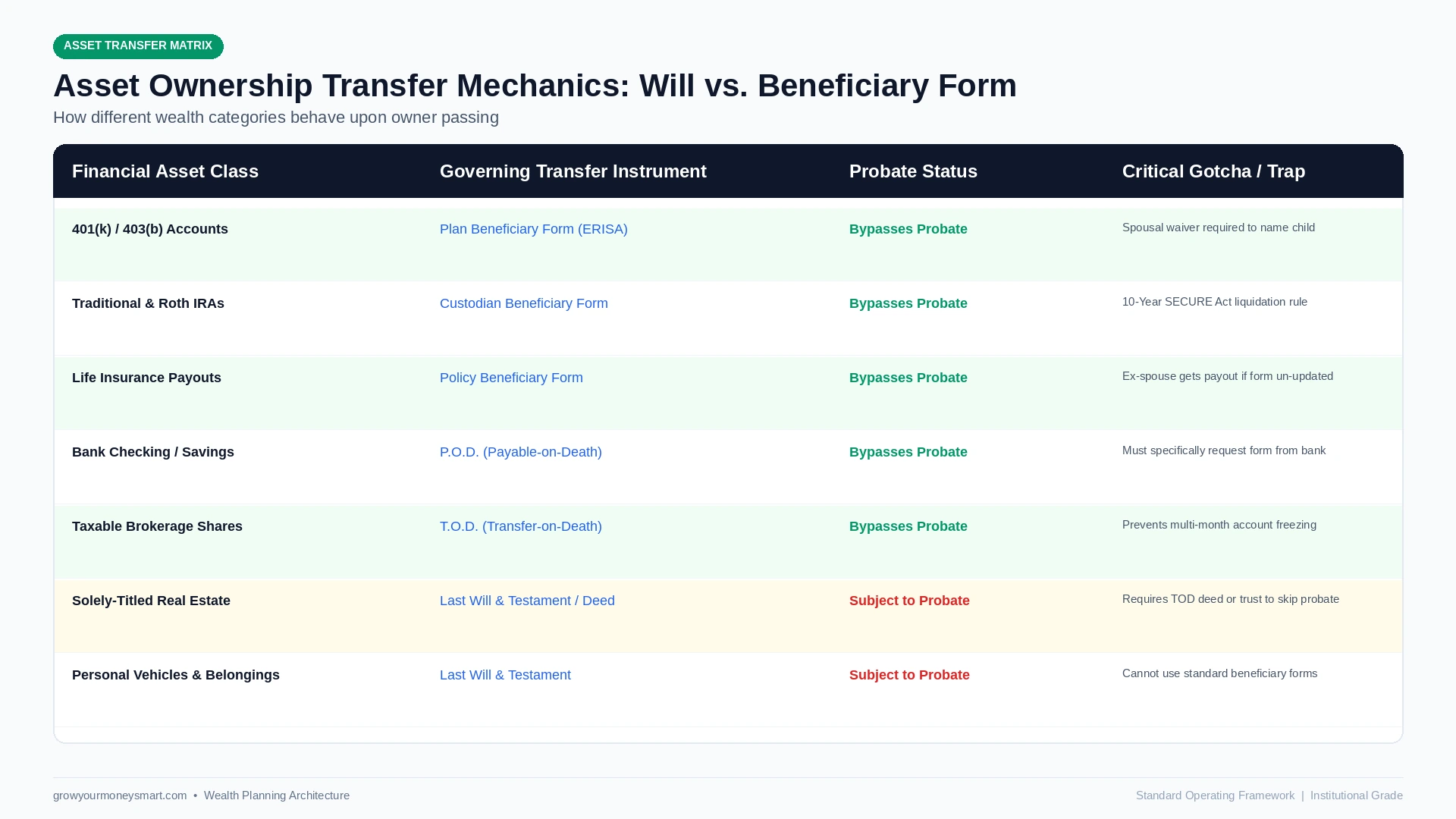
4 Costly Traps You Must Avoid
Overlooking beneficiary designations leads to devastating financial traps. Review these four critical pitfalls:
Trap 1: The Ex-Spouse Disinheritance Shock (ERISA Preemption)
Under the Supreme Court ruling in Egelhoff v. Egelhoff, federal ERISA law governs employer-sponsored retirement plans like 401(k)s and pensions, completely overriding state divorce statutes. If you get divorced and fail to execute a new beneficiary designation form removing your ex-spouse, your employer plan administrator is federally required to pay 100% of your 401(k) proceeds to your ex-spouse—even if your divorce decree or updated Will stated otherwise.
Trap 2: Naming Minor Children as Direct Beneficiaries
Financial custodians cannot legally transfer funds directly to minors under 18 or 21. If you name a minor child on your life insurance or brokerage TOD, the court will appoint a costly legal conservator to supervise the money until the child reaches legal adulthood—at which point the child receives 100% of the cash with zero restrictions. Instead, name a testamentary trust or utilize a Uniform Transfers to Minors Act (UTMA) designation. If you are balancing multi-generational estate needs, explore our framework on sandwich generation financial planning.
Trap 3: Overlooking Secondary (Contingent) Beneficiaries
If your primary beneficiary predeceases you or dies simultaneously (such as in a car accident) and you have not designated contingent beneficiaries, your account automatically defaults to your estate. This drags an otherwise protected account directly into public probate court, exposing it to creditor claims and administrative fees.
Trap 4: Per Stirpes vs. Per Capita Confusion
If you name two adult children as beneficiaries and one child passes away before you, how is the money divided? Under Per Capita, 100% of the account goes to the surviving sibling, cutting off the deceased child’s children (your grandchildren). Under Per Stirpes (by branch), the deceased child’s share flows down to their children. Always specify “Per Stirpes” if you want grandchildren protected.
For more foundational wealth strategies, see our master guide on what is retirement planning and study the full trajectory in our analysis of the stages of the retirement plan lifecycle.
Tax Implications: SECURE Act 2.0 and Inherited Accounts
The Internal Revenue Service (IRS) strictly regulates inherited retirement accounts under the SECURE Act and SECURE 2.0. Non-spouse designated beneficiaries are no longer permitted to “stretch” inherited traditional IRA distributions over their lifetime. Instead, they are subject to the mandatory 10-Year Rule, requiring the entire account to be liquidated by December 31 of the tenth year following the original owner’s death.
When inherited distributions collide with a beneficiary’s peak earning years, massive income tax brackets are triggered. To protect your heirs against this tax bomb, many retirees execute strategic Roth conversions during their early retirement window. Learn how to optimize these accounts in our tutorials on the Backdoor Roth IRA, how to rollover a 401(k) to an IRA without taxes, and managing safe distribution yields using the 4% rule explained.
The Consumer Financial Protection Bureau (CFPB) also recommends establishing Durable Financial Powers of Attorney so authorized agents can manage account beneficiary designations in the event of unexpected cognitive incapacity. To shield accumulated savings from nursing facility costs, evaluate whether long-term care insurance is worth it.
The 5-Step Annual Beneficiary Audit Checklist
- Catalog Every Account: List all 401(k)s, 403(b)s, Traditional/Roth IRAs, HSAs, life insurance policies, checking/savings accounts, and taxable brokerage accounts.
- Request POD/TOD Forms: Add Payable-on-Death (POD) tags to checking/savings accounts and Transfer-on-Death (TOD) tags to taxable investment accounts.
- Designate Contingent Beneficiaries: Ensure every single account has a 100% contingent backup in case the primary beneficiary passes away first.
- Check “Per Stirpes” Election: Select per stirpes distribution to guarantee your grandchildren are never accidentally disinherited.
- Cross-Reference with Estate Documents: Ensure your Will, Power of Attorney, and Living Trust align harmoniously with your custodial account contracts.
Also verify how spousal entitlement interacts with your broader retirement safety net by reviewing Social Security spousal benefits.
Frequently Asked Questions

Jaiveer Hooda is a personal finance researcher and the founder of Grow Your Money Smart. With a background in computer engineering, he approaches money the way an engineer approaches any complex system — through data analysis, mathematical modeling, and ruthless optimization.
He built this platform on a single conviction: financial freedom is not a matter of luck. It is a system that can be designed, tested, and executed by anyone willing to follow the right blueprint. Every strategy published here is researched to the numbers, not written to the trend.
Expertise: Debt elimination · Retirement planning · Passive income · Budgeting systems
Connect: Pinterest | growyourmoneysmart.com | Contact Us