
Long-term custodial care and nursing assistance costs represent the largest unhedged expenditure for retirees beyond basic Medicare coverage. Consult the official U.S. Administration for Community Living (ACL) Long-Term Care Benchmarks for statutory guidelines and consumer protections.
Protect your retirement nest egg against astronomical medical and assisted living costs with these resources:
- Stealth Medical Fund: HSA triple tax advantage retirement guide — investing HSA funds for 100% tax-free medical withdrawals during retirement.
- Long-Term Care Analysis: is long-term care insurance worth it in 2026? — evaluating traditional vs hybrid life/LTC policies to protect assets from nursing home fees.
- Multigenerational Planning: sandwich generation financial planning guide — managing medical care for aging parents while saving for your own retirement.
- Early Retirement Gap: how much do you need to retire at 60? — budgeting for private healthcare before Medicare eligibility kicks in at 65.
- Safe Withdrawal Math: the 4% rule safe withdrawal rate explained — stress-testing your withdrawal rate against healthcare cost spikes.
The single greatest systemic threat to modern retirement security is not stock market volatility or inflation—it is unhedged healthcare and custodial care expenses. Conventional planning models drastically underestimate out-of-pocket medical liabilities, creating catastrophic capital depletion in the distribution phase.
- The 15,000 Baseline: A healthy 65-year-old couple retiring today will spend an average of 15,000 to 95,000+ strictly on out-of-pocket medical care and Medicare premiums (excluding long-term care).
- Medicare Is Not Free: Original Medicare carries uncapped 20% coinsurance on Part B outpatient care, a ,632 per-benefit-period Part A deductible, and excludes dental, vision, and hearing.
- The Long-Term Care Trap: 70% of individuals reaching age 65 will require Long-Term Care (LTC), yet Medicare pays bash for non-skilled custodial assistance (nursing homes average 08,000+/year).
- The Defense Blueprint: Protect longevity capital by pairing Original Medicare with Medigap Plan G, funding a triple-tax-advantaged Health Savings Account (HSA), and executing hybrid asset-based LTC coverage between ages 50 and 62.
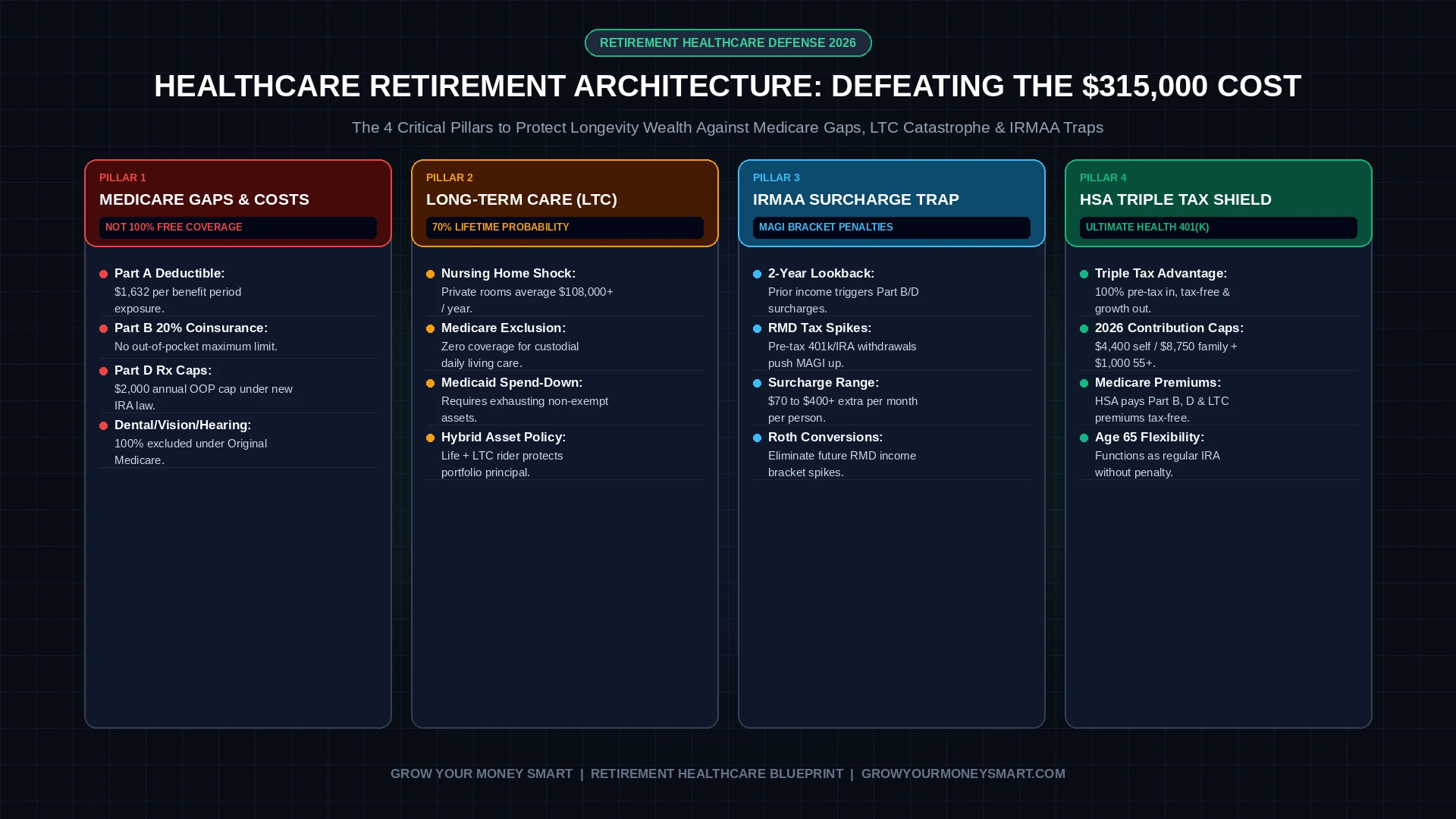
The $315,000 Elephant: Why Healthcare Is the #1 Hidden Wealth Destroyer
When retirees sit down to calculate their post-career financial runway, their budget spreadsheets inevitably focus on housing, utilities, travel, groceries, and leisure. Yet, according to empirical actuarial data published by Fidelity Investments, the Employee Benefit Research Institute (EBRI), and Vanguard, the single largest non-discretionary expenditure retirees encounter is healthcare.
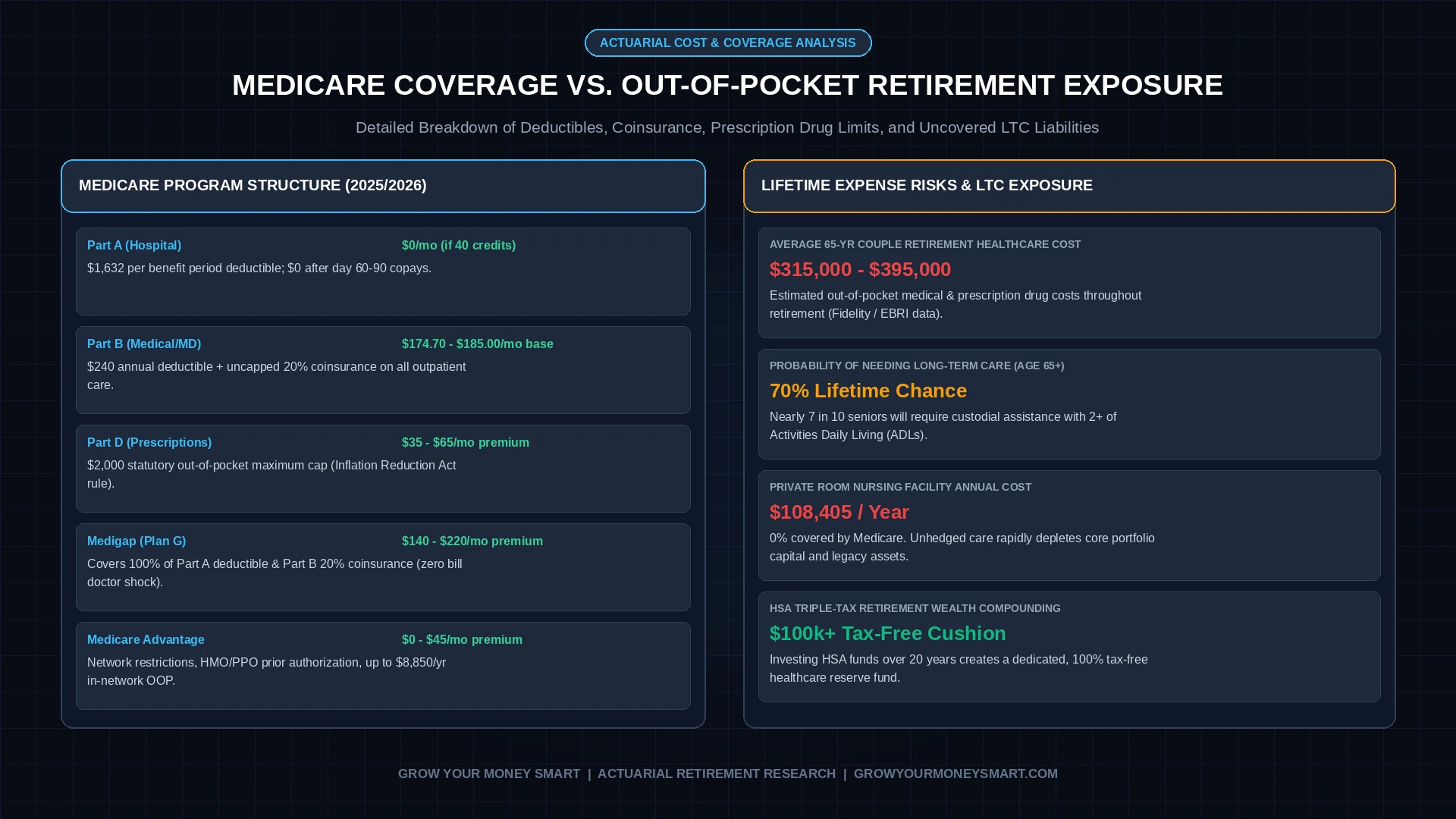
A typical 65-year-old couple retiring in 2025/2026 will need approximately $315,000 to $395,000 in dedicated after-tax savings solely to cover Medicare premiums, deductibles, copayments, and prescription medications throughout their retirement years. For single retirees, that benchmark stands at $160,000 to $195,000.
Crucially, this staggering figure completely excludes the astronomical cost of long-term custodial nursing care, assisted living facilities, or memory care units. If an unhedged chronic cognitive or physical impairment occurs, total lifetime healthcare expenditures can easily eclipse $500,000 to $750,000+, devastating the surviving spouse’s standard of living and evaporating multi-generational estate legacies.
Understanding how medical expenses compound across your distribution lifecycle is essential. To align your withdrawal timelines with healthcare cost surges, explore our master framework on the 5 Stages of Retirement Planning and model your liquid reserves using our Emergency Fund Calculator.
Deconstructing Medicare: Parts A, B, C, D & The Danger of the Uncapped 20%
A pervasive and dangerous misconception among pre-retirees is the belief that government Medicare provides comprehensive, free healthcare upon turning 65. In reality, Original Medicare functions more like catastrophic major-medical insurance riddled with statutory cost-sharing gaps, annual deductibles, and zero out-of-pocket maximum caps.
To architect a resilient retirement healthcare defense, you must understand the mechanics of the four core Medicare pillars:
- Medicare Part A (Inpatient Hospital Insurance): Premium-free for most Americans who paid Medicare FICA taxes for at least 10 years (40 quarters). However, Part A is not free at the point of care: it features a $1,632 deductible per benefit period (not per calendar year). If you are hospitalized twice in six months across separate benefit periods, you pay the $1,632 deductible twice. Hospital stays exceeding 60 days trigger steep daily coinsurance charges ($408/day for days 61–90, and $816/day for lifetime reserve days).
- Medicare Part B (Outpatient & Medical Insurance): Covers physician services, outpatient procedures, diagnostic imaging, preventative screenings, and chemotherapy. Part B requires a base monthly premium of $174.70 to $185.00+ (escalating significantly for high earners via IRMAA). After meeting an annual deductible ($240 in 2025/2026), Part B pays 80% of approved costs, leaving you responsible for the remaining 20% with NO out-of-pocket maximum. An intensive course of cancer therapy or major surgery costing $200,000 leaves you personally liable for $40,000 in out-of-pocket coinsurance without supplemental insurance.
- Medicare Part C (Medicare Advantage): Private managed-care plans (HMOs and PPOs) that bundle Parts A, B, and usually D into an all-in-one policy. While they often feature $0 monthly premiums and added perks (basic dental/vision gym memberships), they require strict in-network provider adherence, extensive prior-authorization hurdles, and carry in-network annual out-of-pocket maximum caps reaching up to $8,850.
- Medicare Part D (Prescription Drug Coverage): Standalone private drug plans covering retail medications. Under landmark provisions in the Inflation Reduction Act, Medicare Part D catastrophic coverage was overhauled to institute a strict $2,000 annual out-of-pocket prescription cap, permanently eliminating the dreaded “donut hole” coverage gap for retirees requiring high-tier brand name pharmaceuticals.
Comprehensive Insurance Matrix: Original Medicare + Medigap vs. Medicare Advantage
The strategic decision between enrolling in Original Medicare with a Supplemental Medigap Policy versus enrolling in a Medicare Advantage Plan represents one of the most consequential financial choices of your retirement. The table below provides an institutional head-to-head comparison across critical risk vectors:
| Evaluation Vector | Original Medicare + Medigap Plan G | Medicare Advantage (Part C HMO/PPO) | Unhedged / Baseline Exposure |
|---|---|---|---|
| Monthly Premium Cost | Part B ($174.70+) + Medigap ($140–$220) + Part D ($35–$50) | Part B ($174.70+) + Plan Premium ($0–$45) | Part B ($174.70+) strictly |
| Provider Network Freedom | 100% Nationwide Freedom (Any doctor accepting Medicare) | Restricted Regional HMO/PPO Networks | Any doctor accepting Medicare |
| Specialist Referrals | Zero referrals required; schedule directly | Primary Care Physician (PCP) gatekeeping required | Zero referrals required |
| Out-of-Pocket Hospital Liability | $0 (Medigap covers 100% of Part A deductible & copays) | Copays per day (e.g., $350/day for days 1–6) | $1,632+ per benefit period |
| Outpatient 20% Coinsurance | $0 (Medigap covers 100% after $240 Part B deductible) | Variable copays ($20–$50 per visit; 20% chemo/radiation) | Uncapped 20% of all medical costs |
| Annual Max Out-of-Pocket Cap | Strictly capped at Part B deductible ($240) | Up to $8,850 in-network ($13,300 out-of-network) | NO MAXIMUM LIMIT (Unlimited Risk) |
| Prior Authorization Friction | Virtually Nonexistent (Standard Medicare guidelines) | High (Frequent denials for MRIs, surgeries, and rehab) | Low |
| Ideal Wealth Profile | High net worth, snowbirds, chronic care needs, predictability | Healthy early retirees seeking low initial monthly costs | High-risk non-viable exposure |
The Long-Term Care (LTC) Shock: The 70% Probability That Threatens Your Legacy
If Medicare gaps are the elephant in the retirement planning room, Long-Term Care (LTC) is the apex predator. According to official actuarial data from the U.S. Department of Health and Human Services (HHS), 70% of adults who reach age 65 will require long-term services and support before they die, with an average duration of 3.2 years (longer for conditions like Alzheimer’s or Parkinson’s disease).
The catastrophic risk arises from an uncomfortable legal reality: Medicare pays precisely $0 for non-skilled custodial care (assistance with basic Activities of Daily Living such as bathing, dressing, eating, transferring, or supervision for cognitive decline). Medicare only covers short-term skilled nursing rehabilitation following a minimum 3-day inpatient hospital stay, capped at 100 days (with heavy daily copays starting on day 21).
Examine the current national median cost benchmarks for custodial care:
- Home Health Aide (44 hours/week): $68,640 per year (and climbing at 5.5% annually).
- Assisted Living Facility (Private 1-Bedroom): $64,200 per year.
- Nursing Home Facility (Semi-Private Room): $94,900 per year.
- Nursing Home Facility (Private Room): $108,405 per year (exceeding $140,000/year in high-cost metro areas).
Without an insurance firewall, a 3-to-5 year nursing home stay will drain $350,000 to $550,000+ directly from your liquid portfolio. Once private retirement assets are exhausted down to approximately $2,000 (the state Medicaid spend-down threshold), the retiree becomes reliant on state-administered Medicaid, sacrificing autonomy and choice over facility location and care quality. To model household budget constraints during retirement transitions, test our interactive Household Budget Calculator.
IRMAA Surcharges: The Hidden Tax Bracket Trap for High-Earning Retirees
Many diligent savers spend 30 years accumulating massive balances inside pre-tax 401(k) and Traditional IRA accounts, anticipating lower tax brackets in retirement. However, when Required Minimum Distributions (RMDs) trigger at ages 73 and 75, these forced taxable withdrawals can catapult retirees directly into the Income-Related Monthly Adjustment Amount (IRMAA) surcharge trap.
IRMAA is a federal statutory premium surcharge imposed on Medicare Part B and Part D for individuals and couples whose Modified Adjusted Gross Income (MAGI) exceeds baseline thresholds based on a 2-year tax lookback mechanism. For example, your 2026 Medicare premiums are dictated by your 2024 tax return (Form 1040 line 11 + tax-exempt interest).
| 2-Year Prior MAGI (Single Filer) | 2-Year Prior MAGI (Married Filing Jointly) | Part B Monthly Surcharge (Per Person) | Part D Monthly Surcharge (Per Person) | Annual Household Surcharge Impact (Couple) |
|---|---|---|---|---|
| ≤ $106,000 | ≤ $212,000 | $0.00 (Standard Premium) | $0.00 (Standard Premium) | $0 / Year |
| $106,001 – $133,000 | $212,001 – $266,000 | +$69.90 / mo | +$13.70 / mo | +$2,006 / Year |
| $133,001 – $167,000 | $266,001 – $334,000 | +$175.00 / mo | +$35.40 / mo | +$5,050 / Year |
| $167,001 – $200,000 | $334,001 – $400,000 | +$279.90 / mo | +$57.10 / mo | +$8,088 / Year |
| $200,001 – $500,000 | $400,001 – $750,000 | +$384.80 / mo | +$78.80 / mo | +$11,126 / Year |
| > $500,000 | > $750,000 | +$419.80 / mo | +$85.80 / mo | +$12,134 / Year |
Crossing an IRMAA cliff by even one single dollar triggers the entire annual surcharge for both spouses, instantly adding thousands of dollars in unavoidable overhead. Implementing systematic Roth conversions between age 60 (retirement) and age 63 (the 2-year lookback for age 65 Medicare enrollment) is the most powerful weapon to compress future MAGI and dodge IRMAA penalties permanently.
Expert Video Masterclass: Medicare Parts A, B, C & D Explained Step-by-Step
To visualize the intricate interactions between hospital deductibles, physician coinsurance, Medigap policies, and prescription drug formularies, watch this comprehensive educational briefing by authoritative insurance specialist Medicare Specialist – Abt Insurance Agency:
The HSA Triple-Tax Super-Weapon: How to Build a Tax-Free Healthcare War Chest
The most mathematically efficient tool in the entire Internal Revenue Code for defeating retirement healthcare costs is the Health Savings Account (HSA). While widely viewed as a basic medical reimbursement account, an HSA is actually a supercharged retirement wealth vehicle that outperforms 401(k)s and Roth IRAs due to its unique Triple-Tax-Advantage:
- 100% Tax-Deductible Contributions: Money contributed to an HSA reduces your federal, state (in 48 states), and FICA payroll taxable income in the year deposited.
- 100% Tax-Free Investment Compounding: Unlike flexible spending accounts (FSAs), HSA funds never expire. You can invest your balance in low-cost S&P 500 index funds, allowing dividends and capital gains to compound completely tax-free for decades.
- 100% Tax-Free Distributions for Qualified Medical Expenses: Withdrawals used for medical, dental, vision, hearing, prescription drugs, Medicare Part B/D premiums, and qualified Long-Term Care insurance premiums are 100% tax-free.
The “Shoebox” Strategy: If you pay out-of-pocket medical expenses during your working years with regular cash flow while allowing your HSA balance to stay fully invested in equities, you can scan and save your medical receipts in a digital archive (“the shoebox”). Decades later in retirement, you can reimburse yourself tax-free for any past medical receipt with zero time limit, creating a reservoir of completely tax-free liquid cash for retirement living!
For the 2025/2026 tax years, statutory contribution limits are $4,300 – $4,400 for self-only coverage and $8,550 – $8,750 for family coverage, plus a $1,000 catch-up contribution for individuals aged 55 and older. Maxing out an HSA over a 20-year career generates over $250,000+ in tax-free healthcare capital (assuming a 7.5% annual return), completely neutralizing the average couple’s projected lifetime medical liability.
5-Phase Actionable Implementation Roadmap to Defend Longevity Wealth
To eliminate healthcare uncertainty and protect your multi-generational estate from medical erosion, execute this disciplined 5-phase strategic blueprint:
Phase 1: Maximize HSA Compounding During Working Years (Ages 30–55)
Enroll in a qualifying High Deductible Health Plan (HDHP). Max out annual HSA contributions and immediately invest 100% of the balance into broad-market index funds rather than leaving cash in low-yield cash accounts. Pay small routine medical costs out-of-pocket and digitally catalog receipts.
Phase 2: Secure Asset-Based Long-Term Care Coverage (Ages 50–60)
Lock in long-term care protection before health conditions or underwriting restrictions emerge. Favor modern hybrid life insurance policies with LTC riders or asset-based annuity structures over legacy standalone LTC policies. Hybrid policies guarantee that if care is never needed, 100% of the tax-free death benefit passes directly to your heirs.
Phase 3: Execute Strategic Pre-65 Roth Conversions (Ages 60–63)
Between retiring from your career and turning 65, systematically convert high-balance Traditional 401(k)/IRA assets into Roth accounts up to the top of the 22% or 24% federal tax bracket. This shrinks future Required Minimum Distributions (RMDs), insulating your household from punitive IRMAA Medicare surcharges at age 65+.
Phase 4: Enroll in Original Medicare + Medigap Plan G (Age 64 & 9 Months)
During your 7-month Initial Enrollment Period (IEP), enroll in Medicare Part A, Part B, Part D, and Medigap Plan G. Medigap enrollment during this 6-month open enrollment window guarantees coverage without medical underwriting, ensuring zero exclusions for pre-existing conditions.
Phase 5: Establish Fiduciary Medical Directives & Living Trusts
Execute comprehensive estate and healthcare governance documents: Durable Financial Power of Attorney, Medical Healthcare Proxy, Living Will (Advance Healthcare Directive), and a Revocable Living Trust with clear incapacity provisions. This ensures seamless asset administration and care coordination without court probate or guardianship intervention. Learn more about navigating advisory standards in our guide on DIY vs Financial Advisor.
Frequently Asked Questions (FAQs)
Below are authoritative, actionable answers to the most vital questions retirees ask when architecting their healthcare defense:
According to actuarial studies by Fidelity Investments and EBRI, an average 65-year-old couple retiring in 2025/2026 needs between 15,000 and 95,000 in after-tax savings to cover Medicare premiums, deductibles, and out-of-pocket prescription expenses throughout retirement, excluding long-term care.
No. While Medicare Part A is premium-free for workers with 40 FICA quarters, it carries a ,632 deductible per benefit period. Part B requires a monthly premium starting at 74.70 to 85.00+ and leaves you liable for an uncapped 20% coinsurance on all doctor and outpatient services without supplemental insurance.
Long-Term Custodial Care (assistance with daily activities like dressing, bathing, and eating) is 100% excluded under Original Medicare. With private nursing facility rooms averaging 08,000+ per year, unhedged custodial care is the leading cause of late-stage retirement portfolio depletion.
IRMAA (Income-Related Monthly Adjustment Amount) is a statutory surcharge added to Medicare Part B and Part D premiums for retirees whose MAGI exceeds specific thresholds based on a 2-year tax lookback. Retirees can mitigate IRMAA through strategic Roth conversions before age 63 and Qualified Charitable Distributions (QCDs).
Original Medicare paired with Medigap Plan G offers nationwide network freedom, zero specialist referrals, and virtually eliminates out-of-pocket medical bills after paying the 40 Part B deductible. Medicare Advantage offers lower initial monthly costs but imposes restrictive networks, prior authorization requirements, and out-of-pocket maximum caps up to ,850/year.
An HSA is the only financial account offering a triple-tax advantage: contributions are 100% tax-deductible, investments grow tax-free, and withdrawals for qualified medical expenses (including Medicare Part B/D and LTC premiums) are 100% tax-free at any age.
Under the Inflation Reduction Act, annual out-of-pocket prescription drug expenses for Medicare Part D enrollees are capped at ,000 per person starting in 2025/2026, permanently eliminating the coverage gap (‘donut hole’) and shielding retirees from catastrophic drug costs.
The optimal window to secure Long-Term Care insurance (especially hybrid life insurance policies with LTC riders) is between ages 50 and 60. Applying during this window ensures lower premium lock-ins, avoids medical underwriting denials, and protects core portfolio capital.
Final Verdict: Transforming Healthcare Risk into Engineered Mathematical Security
Retirement healthcare costs are neither an insurmountable obstacle nor an unpredictable catastrophe—provided they are treated as an actuarially calculated liability rather than an afterthought. By replacing wishful thinking with a structured four-pillar defense (Medigap Plan G coverage, tax-optimized HSA accumulation, proactive IRMAA avoidance, and asset-based Long-Term Care hedging), you can successfully insulate your portfolio against the greatest systemic financial threat of the 21st century.

Jaiveer Hooda is the Lead Financial Researcher & Personal Finance Analyst at Grow Your Money Smart. Specializing in personal wealth optimization, index fund compounding, high-yield savings mechanics, and consumer debt elimination strategies. With a background in computer engineering, he applies mathematical modeling, cashflow simulations, and empirical risk analysis to evaluate personal finance vehicles and credit products. Every analysis is backed by verified regulatory disclosures, IRS tax schedules, and empirical APY compounding math.
Areas of Expertise: Personal Finance · High-Yield Savings Accounts (HYSA) · Index Funds & S&P 500 Compounding · Retirement Planning (401k/IRA) · Debt Optimization · Credit Card APR Mechanics.
Transparency & Editorial Policy: Editorial Standards | Report a Correction
2 thoughts on “Healthcare Costs: The Elephant in Retirement Planning (2026)”