
Evaluating early financial independence vs traditional retirement requires understanding capital preservation and withdrawal timing. Consult the official U.S. Securities and Exchange Commission (SEC) Long-Term Investing Frameworks for statutory guidelines and consumer protections.
Compare aggressive early financial independence with conventional retirement timelines using these guides:
- Coast Alternative: Coast FIRE explained: how to fund retirement early — achieving financial peace early without needing millions in liquid cash.
- All FIRE Models: types of FIRE: Lean FIRE vs Fat FIRE vs Barista FIRE — find the exact lifestyle and spending tier that aligns with your freedom goals.
- Distribution Rule: the 4% rule safe withdrawal rate explained — how early retirees adjust withdrawal rates for 40 to 50-year horizons.
- Classic Architecture: 5 stages of retirement planning lifecycle — the definitive roadmap for traditional 65+ retirement timelines.
- Semi-Retirement: redefining retirement: does it mean stopping work entirely? — navigating passion projects, part-time consulting, and phased retirement.
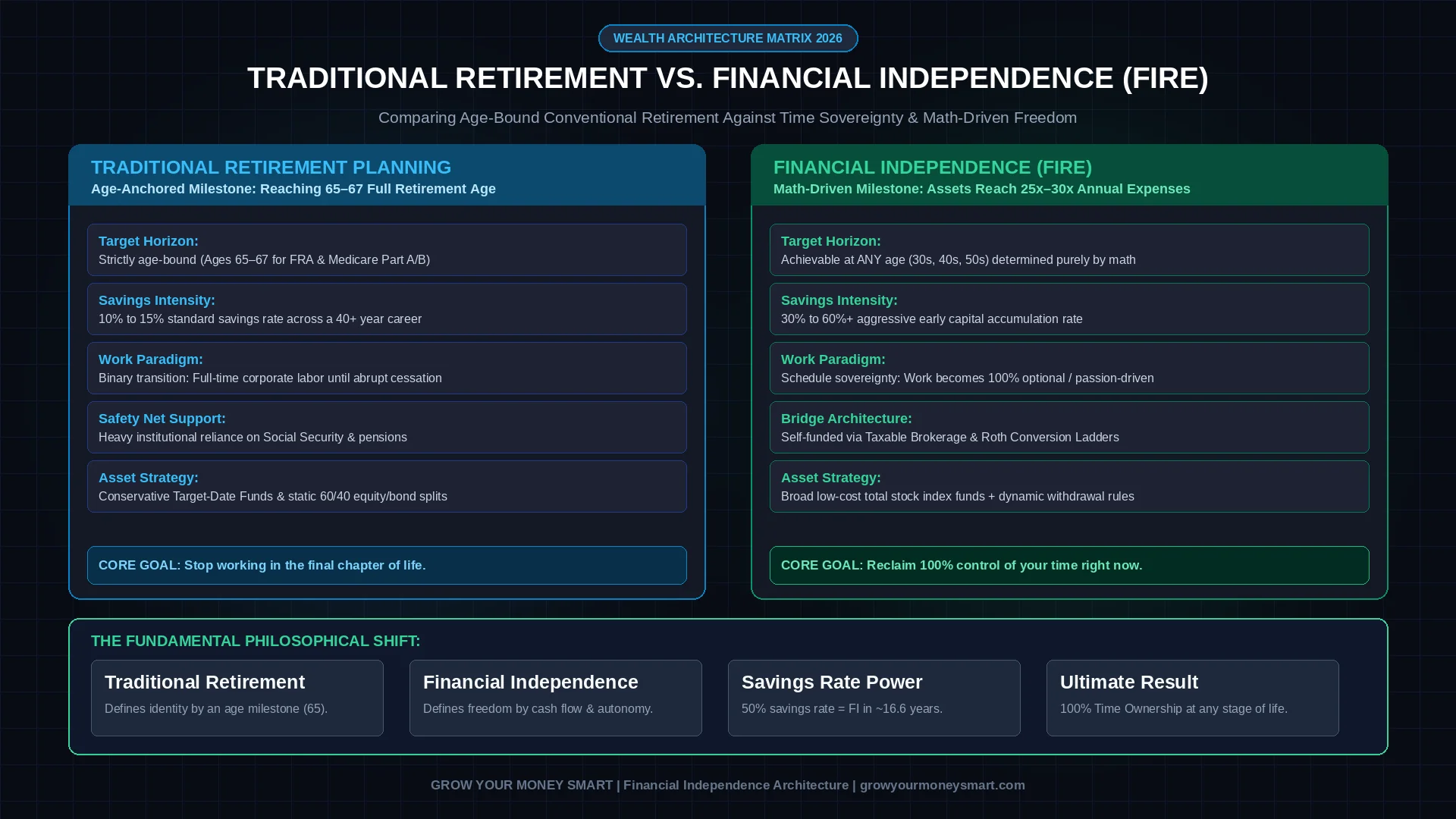
- Age vs. Math: Traditional retirement is an age-bound milestone (65–67) requiring a 40+ year career. Financial Independence (FI) is a math-bound milestone (reaching 25x–30x annual expenses) achievable at any age.
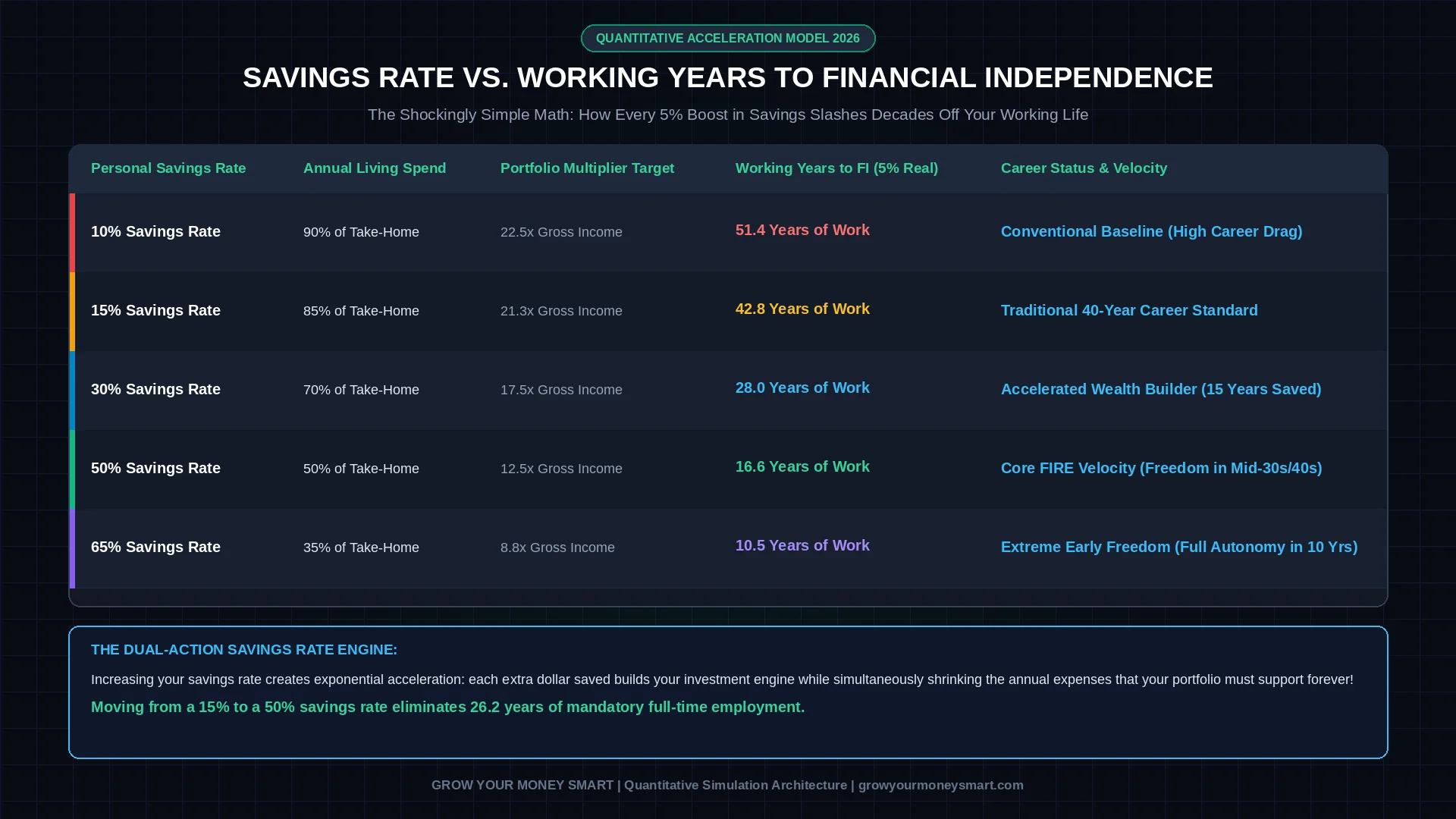
- The Power of Savings Rate: Increasing your savings rate from 15% to 50% cuts your required working career from 43 years down to just 16.6 years due to the dual-action effect of lower spending and faster compounding.
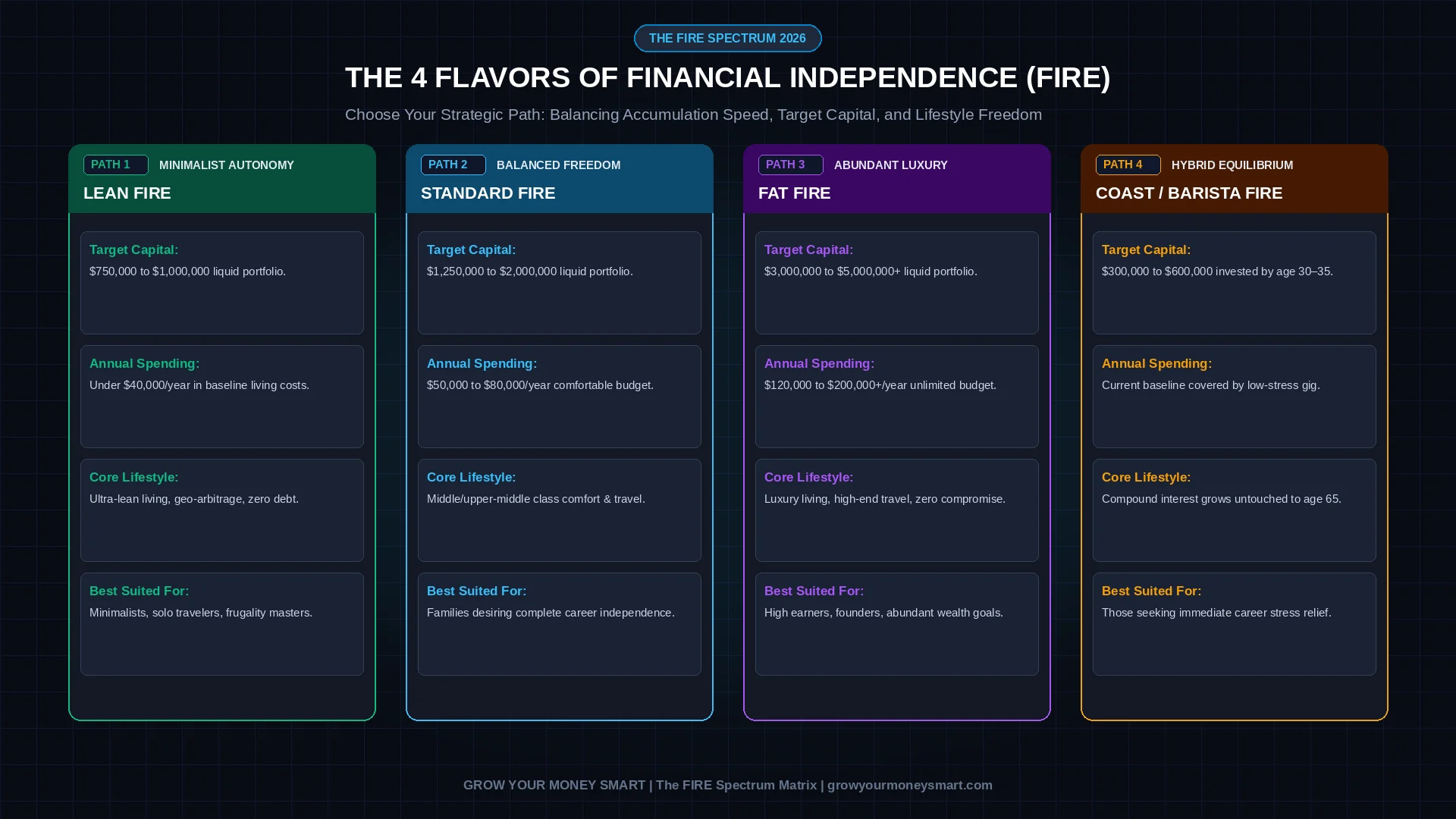
- The FIRE Spectrum: Choose between Lean FIRE (<$40k/yr spend), Standard FIRE ($50k–$80k/yr spend), Fat FIRE ($120k+/yr spend), or Coast/Barista FIRE to balance current lifestyle with future autonomy.
- Penalty-Free Early Access: FI practitioners unlock retirement funds before age 59½ using Roth Conversion Ladders, IRS Rule 72(t) SEPP schedules, and taxable brokerage bridge accounts.
For generations, the societal script for financial security followed an immutable linear path: graduate from school, work full-time for 40 to 45 years, save 10% to 15% of your paycheck into a corporate pension or 401(k), and finally step away from the workforce at age 65 or 67 when government benefits kick in. This traditional framework viewed retirement as an age-gated finish line—a reward granted only in the final quarter of life.
However, an intellectual revolution has reshaped modern wealth building. The rise of the Financial Independence, Retire Early (FIRE) movement has demonstrated that retirement is not an age; it is a mathematical formula. When your invested assets generate enough passive cash flow to permanently cover your living expenses, work ceases to be an economic obligation and becomes a 100% voluntary pursuit. To calculate your baseline living expenses and accelerate your debt-free timeline, explore our Debt Payoff Calculator and Household Budget Calculator.
Core Paradigm Comparison: Age-Bound Milestone vs. Time Sovereignty
To truly grasp the distinction between Retirement Planning and Financial Independence (FI), one must understand that they represent two fundamentally different philosophies of life, time, and money:
• Traditional Retirement (The Age Anchor): Centers on surviving a 40-year career to reach statutory milestones like Social Security Full Retirement Age (FRA) and Medicare eligibility at age 65. The transition is typically binary—going from 40+ hours of weekly labor to zero work overnight.
• Financial Independence (The Schedule Anchor): Centers on maximizing your personal savings rate and accumulating a liquid net worth equal to 25 to 30 times your annual expenses. Once achieved, you gain complete time sovereignty—the freedom to pursue passion projects, start low-risk businesses, take multi-month sabbaticals, or stop working entirely at age 32, 45, or 55.
In short, traditional retirement is about quitting work at an old age, whereas Financial Independence is about owning 100% of your time across your entire adult life. To understand how your investment time horizon dictates optimal risk, check our in-depth analysis on Investment Time Horizons.
Head-to-Head Comparison Matrix
The matrix below contrasts the core pillars of Traditional Retirement against Financial Independence:
| Strategic Metric | Traditional Retirement Planning | Financial Independence (FIRE) | Core Takeaway |
|---|---|---|---|
| Primary Target Horizon | Age 65–67 (Full Retirement Age / Medicare) | Any Age (Determined strictly by savings rate math) | FI decouples freedom from biological age |
| Target Savings Rate | 10% to 15% of gross income | 30% to 60%+ of take-home income | Higher savings rate collapses accumulation runway |
| Target Capital Multiplier | 10x–12x final salary (Rule of Thumb) | 25x–30x actual annual living expenses | FI is anchored to spending, not arbitrary income |
| Work Paradigm | Abrupt, full cessation of career labor | Optional labor, consulting, passion projects | Focuses on autonomy rather than complete idleness |
| Healthcare Architecture | Employer coverage transitioning to Medicare at 65 | ACA Health Subsidies, HSAs, & Private Direct Care | Requires deliberate pre-65 health planning |
| Account Access Strategy | Standard penalty-free access after age 59½ | Roth Conversion Ladders, 72(t) SEPP, & Taxable Bridge | Eliminates early withdrawal penalties legally |
| Safe Withdrawal Rate | 4.0% static rule (30-year horizon) | 3.25% to 3.75% dynamic guardrails (40–50 yr horizon) | Defends against extended sequence of returns risk |
The Shockingly Simple Math: Savings Rate vs. Working Years to FI
The foundational insight of the FIRE movement, popularized by mathematical financial thinkers like Mr. Money Mustache, is that your savings rate is the single most powerful variable in determining how quickly you achieve freedom. Assuming a conservative 5.0% real (inflation-adjusted) annual investment return and a 4% safe withdrawal rate, look at how the working years required collapse as your savings rate climbs:
• 10% Savings Rate: You spend 90% of your income. It takes 51.4 years of work to save enough to fund your lifestyle.
• 15% Savings Rate: You spend 85% of your income. It takes 42.8 years of work (the standard 40-year corporate career).
• 30% Savings Rate: You spend 70% of your income. It takes 28.0 years of work (saving nearly 15 years off your working life).
• 50% Savings Rate: You live on half of what you earn. It takes just 16.6 years to reach 100% financial independence!
• 65% Savings Rate: You live comfortably on 35% of income. You achieve full financial independence in just 10.5 years!
Why does this mathematical acceleration happen? Because increasing your savings rate does double duty: every dollar saved is a dollar added to your compound growth engine, and simultaneously, it permanently reduces the annual living cost that your investment portfolio must support forever! Learn how to manage variable cash flows with our guide on Budgeting on an Irregular Income.
The 4 Flavors of Financial Independence (FIRE)
Financial independence is not a rigid dogma; it exists along a flexible spectrum that allows individuals to tailor their journey to their personal lifestyle goals:
1. Lean FIRE (Minimalist Freedom):
Target Portfolio: $750,000 to $1,000,000 | Annual Spend: Under $40,000/year
Lean FIRE practitioners optimize every expense category, practice geographic arbitrage (living in low-cost-of-living regions or abroad), eliminate housing debt, and live an intentional minimalist lifestyle. This path offers the fastest exit runway from corporate labor.
2. Standard FIRE (Balanced Security):
Target Portfolio: $1,250,000 to $2,000,000 | Annual Spend: $50,000 to $80,000/year
The most common benchmark for families seeking complete independence while maintaining middle or upper-middle class living standards, dining out, hobbies, and regular family vacations without feeling budget-restricted.
3. Fat FIRE (Abundant Luxury):
Target Portfolio: $3,000,000 to $5,000,000+ | Annual Spend: $120,000 to $200,000+/year
Designed for high earners and entrepreneurs who desire financial independence without making any budgetary compromises. It easily accommodates international travel, private healthcare, luxury real estate, and major charitable giving.
4. Coast FIRE & Barista FIRE (Hybrid Lifestyle Balance):
Target Portfolio: $300,000 to $600,000 invested early (by age 30–35)
Coast FIRE practitioners front-load their investments so compound interest grows untouched to fully fund traditional retirement at 65 (read our complete breakdown on Coast FIRE explained and milestones). In the meantime, they downshift to low-stress, flexible, or part-time work (e.g. “Barista FIRE”) solely to cover everyday baseline living expenses and obtain employer health insurance.
Expert Video Walkthrough: Retirement Accounts & FI Vehicles Explained
To master the specific account structures and tax vehicles that power both traditional retirement and early financial independence, watch this comprehensive walkthrough by Certified Financial Planner and educator Humphrey Yang:
How Early Retirees Unlock Retirement Accounts Before Age 59½
A common misconception is that aggressive saving in 401(k)s and IRAs traps your wealth until age 59½. In reality, early financial independence practitioners deploy three legal, IRS-approved access strategies:
• 1. The Roth Conversion Ladder: Move pre-tax Traditional 401(k)/IRA money into a Roth IRA. After a 5-year seasoning period, the converted principal can be withdrawn 100% tax-free and penalty-free at any age. By executing recurring annual conversions, you establish a rolling pipeline of penalty-free liquidity.
• 2. IRS Rule 72(t) SEPP (Substantially Equal Periodic Payments): Under Internal Revenue Code Section 72(t), you can establish a schedule of fixed annual distributions from your IRA based on your IRS life expectancy table. As long as you maintain payments for at least 5 years or until age 59½ (whichever is longer), the 10% early withdrawal penalty is waived.
• 3. Taxable Brokerage Bridge Accounts: Holding 3 to 5 years of living expenses in a standard taxable brokerage account allows you to draw capital gains (taxed at favorable 0% or 15% rates) while seasoning your Roth ladder conversions.
Understand the broader lifecycle roadmap by reviewing our master guide to the 5 Stages of Retirement Planning.
Sequence of Returns Risk: Why FIRE Demands Dynamic Guardrails
The classic 4% Safe Withdrawal Rule was formulated based on the 1998 Trinity Study, which evaluated a 30-year distribution window. If you achieve Financial Independence at age 35 or 45, your portfolio must endure a 40- to 50-year horizon across multiple secular bear markets and inflation cycles.
To ensure near-100% portfolio survival across five decades, modern FI architects implement two critical defensive guardrails:
1. Calibrate to a 3.25%–3.50% Safe Withdrawal Rate: Lowering your initial withdrawal rate slightly provides massive structural resilience against prolonged market drawdowns.
2. Maintain a 2-Year Cash & Short-Bond Liquidity Buffer: Keeping 24 months of essential expenses in a High-Yield Savings Account ensures you never have to sell equities during sharp cyclical crashes. Protect your emergency reserves using our Emergency Fund Calculator.
2025/2026 Contribution Limits & SECURE 2.0 Accelerators
Accelerate your path to financial independence by taking full advantage of the updated IRS limits:
• Workplace 401(k), 403(b), & 457 Plans: Elective deferrals are $23,500 for 2025 ($24,500 in 2026). Standard catch-ups for age 50+ are $7,500 ($8,000 in 2026).
• SECURE 2.0 “Super Catch-Up” (Ages 60–63): Elevates the catch-up limit to $11,250 for savers aged 60 through 63.
• Individual Retirement Accounts (IRAs): Annual contribution limits are $7,000 ($7,500 in 2026) with an extra $1,000 catch-up for age 50+.
• Health Savings Accounts (HSAs): Annual limits stand at $4,300 self-only and $8,550 family coverage ($4,400 and $8,750 respectively in 2026), with a $1,000 catch-up allowance at age 55+.
• Mega-Backdoor Roth IRA: High-income savers can contribute up to the overall defined contribution limit ($70,000 in 2025; $72,000 in 2026) via after-tax non-Roth 401(k) conversions.
Frequently Asked Questions (FAQs)
Below are clear, actionable answers to the most common questions regarding the differences between traditional retirement and financial independence:
Traditional retirement is age-anchored (typically ages 65–67), requiring a 40+ year career with 10%–15% savings and an abrupt cessation of work. Financial Independence (FI) is math-anchored (reaching 25x–30x annual expenses), achievable at any age through 30%–60%+ savings rates, and focuses on time sovereignty where work becomes entirely optional.
Your savings rate has a dual effect: it increases the amount of money you invest while simultaneously reducing your living expenses. At a 15% savings rate, it takes approximately 43 years to reach FI. At a 50% savings rate, it takes only 16.6 years, and at a 65% savings rate, you can reach complete financial independence in just 10.5 years.
The four main paths are: 1) Lean FIRE (sub-$40k/yr spend, $750k–$1M target); 2) Standard FIRE ($50k–$80k/yr spend, $1.25M–$2M target); 3) Fat FIRE ($120k+/yr spend, $3M–$5M+ target); and 4) Coast/Barista FIRE (saving early to let compounding reach full target by age 65 while working low-stress jobs to cover current living costs).
Early retirees use three primary strategies: 1) The Roth Conversion Ladder (converting pre-tax IRA funds to Roth and withdrawing principal tax-free after a 5-year seasoning period); 2) IRS Rule 72(t) SEPP distributions (taking substantially equal periodic payments based on life expectancy); and 3) Utilizing taxable brokerage bridge accounts.
The original Trinity Study 4% Rule was tested for a 30-year retirement window. For an early retiree facing a 40- to 50-year horizon, financial planners recommend a more conservative Safe Withdrawal Rate (SWR) of 3.25% to 3.5%, or adopting dynamic Guyton-Klinker spending guardrails.
Early retirees utilize Affordable Care Act (ACA) health insurance marketplaces. By controlling taxable income through strategic withdrawals from Roth accounts and taxable brokerage basis, retirees can qualify for substantial Premium Tax Credits (subsidies) to keep health insurance premiums very low.
Yes. While Lean FIRE requires strict frugality, Standard FIRE and Fat FIRE focus heavily on offensive income expansion—career advancement, side businesses, and high savings rates without sacrificing quality of life.
For 2025/2026, employee 401(k) limits are $23,500 ($24,500 in 2026), IRAs are $7,000 ($7,500 in 2026), and HSAs are $4,300 self / $8,550 family ($4,400 / $8,750 in 2026), plus the SECURE 2.0 super catch-up of $11,250 for ages 60–63.
Final Summary: Reclaiming Your Ultimate Non-Renewable Resource
Money is a renewable resource; your time is not. Traditional retirement planning asks you to trade the healthiest decades of your youth and mid-life for the promise of late-stage leisure. Financial Independence flips this paradigm on its head, empowering you to optimize your savings rate, build a resilient wealth engine, and reclaim 100% ownership over your life. Whether you choose to step away from work completely or simply gain the freedom to choose how you spend each day, mastering the math of financial independence is your ultimate blueprint for lifelong freedom.

Jaiveer Hooda is the Lead Financial Researcher & Personal Finance Analyst at Grow Your Money Smart. Specializing in personal wealth optimization, index fund compounding, high-yield savings mechanics, and consumer debt elimination strategies. With a background in computer engineering, he applies mathematical modeling, cashflow simulations, and empirical risk analysis to evaluate personal finance vehicles and credit products. Every analysis is backed by verified regulatory disclosures, IRS tax schedules, and empirical APY compounding math.
Areas of Expertise: Personal Finance · High-Yield Savings Accounts (HYSA) · Index Funds & S&P 500 Compounding · Retirement Planning (401k/IRA) · Debt Optimization · Credit Card APR Mechanics.
Transparency & Editorial Policy: Editorial Standards | Report a Correction
1 thought on “Retirement Planning vs. Financial Independence (FI): Key Differences”