
- The Death of the ‘Cliff’ Retirement: The traditional binary model of abruptly stopping all work at age 65 is mathematically and psychologically flawed in today’s inflationary, high-longevity economy.
- The $30,000 Cash Flow Multiplier: Generating just $2,500/month from flexible consulting is mathematically equivalent to having an extra $750,000 in your investment portfolio under the 4% Safe Withdrawal Rule.
- Immortal Portfolio Defense: Part-time earned income lowers your portfolio Safe Withdrawal Rate (SWR) to 2.2%, virtually eliminating sequence of returns risk during initial distribution years.
- 2025/2026 SECURE 2.0 Runway: Late-career savers can leverage the $11,250 ‘Super Catch-Up’ (ages 60–63) to supercharge compounding before stepping down into semi-retirement.
- Cognitive Vitality & Purpose: Structured intellectual engagement and consulting maintain cognitive sharpness, social networks, and emotional vitality throughout multi-decade retirements.
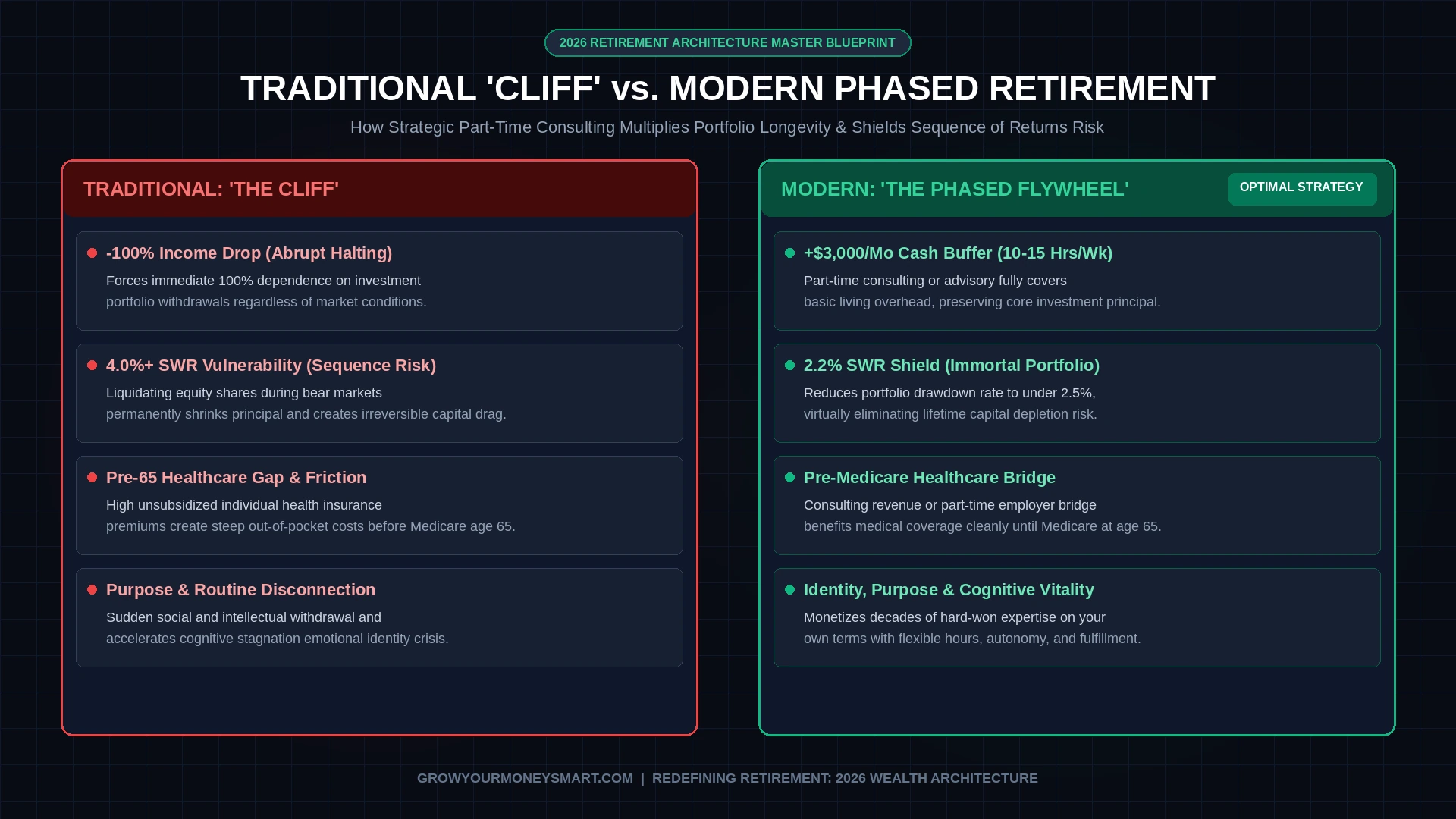
Achieving genuine, multi-generational financial freedom requires dismantling the outdated, industrial-era notion that retirement must be a binary event: 40 years of grind followed by complete, abrupt cessation of all productive activity. For decades, conventional financial dogma taught investors to work until age 65, step off the career cliff, and rely 100% on liquidating asset portfolios across an uncertain 30-year lifespan. Today, this traditional “cliff retirement” model is encountering unprecedented structural headwinds.
Mastering the strategy of Redefining Retirement means recognizing that modern longevity, evolving tax legislation under SECURE 2.0, persistent macroeconomic inflation, and desire for intellectual purpose have revolutionized retirement architecture. Instead of asking “How much money do I need to stop working forever?”, high-net-worth individuals and strategic planners are asking “How can I structure my time, skills, and capital to achieve permanent lifestyle autonomy without sacrificing cash flow security?”
Whether you are actively calculating your liability runoff with our Debt Payoff Calculator, mapping monthly cash flow using our Household Budget Calculator, or preparing for multi-decade distributions, transitioning to a modern phased retirement model safeguards your principal and transforms portfolio longevity.
Macroeconomic Realities & The Sequence of Returns Vulnerability
The single greatest mathematical threat to any retirement portfolio is Sequence of Returns Risk—the danger of experiencing a major market downturn during the first 3 to 5 years of portfolio withdrawals. When an investor completely halts earned income, they are forced to sell equities at depressed valuations to cover monthly living expenses. This crystallizes paper losses, permanently reduces the portfolio’s share count, and causes irreversible capital impairment from which the portfolio may never recover.
Consider two retirees with identical $1,000,000 portfolios who both experience an average 7.0% annualized return over 30 years. The retiree who encounters an early bear market while taking a rigid 4.5% annual distribution depletes their entire nest egg by year 22. In stark contrast, the retiree who maintains a modest $2,000 to $3,000 monthly consulting cash flow buffer leaves their equity holdings untouched during market contractions. By allowing compounding to work uninterrupted, their portfolio balance expands to over $2.8 million over the same 30-year span.
Regulatory and empirical research from the Internal Revenue Service (IRS), Securities and Exchange Commission (SEC), and leading wealth institutions confirms that maintaining a secondary cash flow stream during early retirement distribution phases dramatically widens the safe harbor margin. For deeper foundational principles on time-horizon matching, explore our master guide to Investment Time Horizons.
Comparative Architecture: Traditional Cliff vs. Modern Phased Work Models
The table below summarizes the structural differences across cash flow mechanics, risk profiles, tax efficiency, and lifestyle factors between traditional retirement and modern phased work paradigms:
| Strategic Metric | Traditional ‘Cliff’ Retirement | Modern Phased Work Model | Fractional Advisory / High-Net-Worth |
|---|---|---|---|
| Income Dynamics | -100% immediate salary drop; zero earned income | +$2,500 – $5,000/mo part-time consulting | +$5,000 – $12,000+/mo retainers & equity |
| Portfolio Withdrawal Rate | Rigid 4.0% – 5.0% annual liquidation | Ultra-defensive 1.5% – 2.2% net drawdown | 0.0% drawdown (100% funded by retainers) |
| Sequence Risk Exposure | Severe; high vulnerability to early bear markets | Insulated; living costs covered by earned cash | Immune; surplus earnings reinvested during dips |
| Pre-65 Healthcare Bridge | Unsubsidized private ACA (high out-of-pocket) | Part-time employer plan or ACA tax credits | Corporate health reimbursement & HSA buffer |
| Social Security Impact | Forced early claiming at age 62 (permanent penalty) | Delayed claiming to age 70 (+24% to +32% boost) | Delayed claiming to age 70 for maximum benefit |
| Cognitive & Purpose Index | Sudden disengagement; routine void | High autonomy, joyful intellectual engagement | Strategic mentorship, board governance, high prestige |
2025/2026 Regulatory Updates: SECURE 2.0 & IRS Contribution Limits
Navigating modern phased retirement requires strict alignment with updated statutory thresholds enacted under the landmark SECURE 2.0 Act and official IRS revenue procedures:
- Workplace 401(k) / 403(b) Elective Deferrals: The employee deferral limit stands at $23,500 for 2025 (advancing to $24,500 in 2026). Standard catch-up contributions for savers aged 50 and older remain at $7,500 ($8,000 in 2026).
- SECURE 2.0 ‘Super Catch-Up’ (Ages 60–63): Workers reaching ages 60, 61, 62, or 63 qualify for an elevated catch-up threshold of $11,250 (or 150% of the standard catch-up limit). This provides an accelerated wealth runway immediately prior to stepping into semi-retirement.
- Mandatory High-Earner Roth Catch-Up (2026 Implementation): Effective January 1, 2026, wage earners with prior-year FICA compensation exceeding $150,000 must direct all catch-up contributions into after-tax Roth accounts rather than pre-tax accounts.
- Individual Retirement Accounts (IRAs): Annual contribution limits are set at $7,000 ($7,500 in 2026) with a $1,000 catch-up allowance for individuals aged 50+.
- Health Savings Accounts (HSAs): Triple-tax-advantaged HSA limits are $4,300 for self-only and $8,550 for family coverage ($4,400 and $8,750 in 2026), plus an additional $1,000 catch-up for savers age 55+.
- Social Security Earnings Test Thresholds: For workers claiming benefits prior to Full Retirement Age (FRA), the earnings limit is $23,400 for 2025 (escalating in 2026). Once FRA is reached (age 67 for individuals born in 1960 or later), the earnings test vanishes completely with zero benefit deductions.
To optimize your wealth trajectory across each life stage, review our detailed guide on the 5 Stages of Retirement Planning.
Quantitative Modeling: The $2,500/Month Portfolio Longevity Multiplier
To illustrate why redefining retirement creates immense financial security, let us analyze a rigorous 30-year quantitative simulation comparing two identical $1,000,000 investment portfolios starting at age 60 under identical macroeconomic conditions (7.0% nominal return, 3.0% annual inflation):
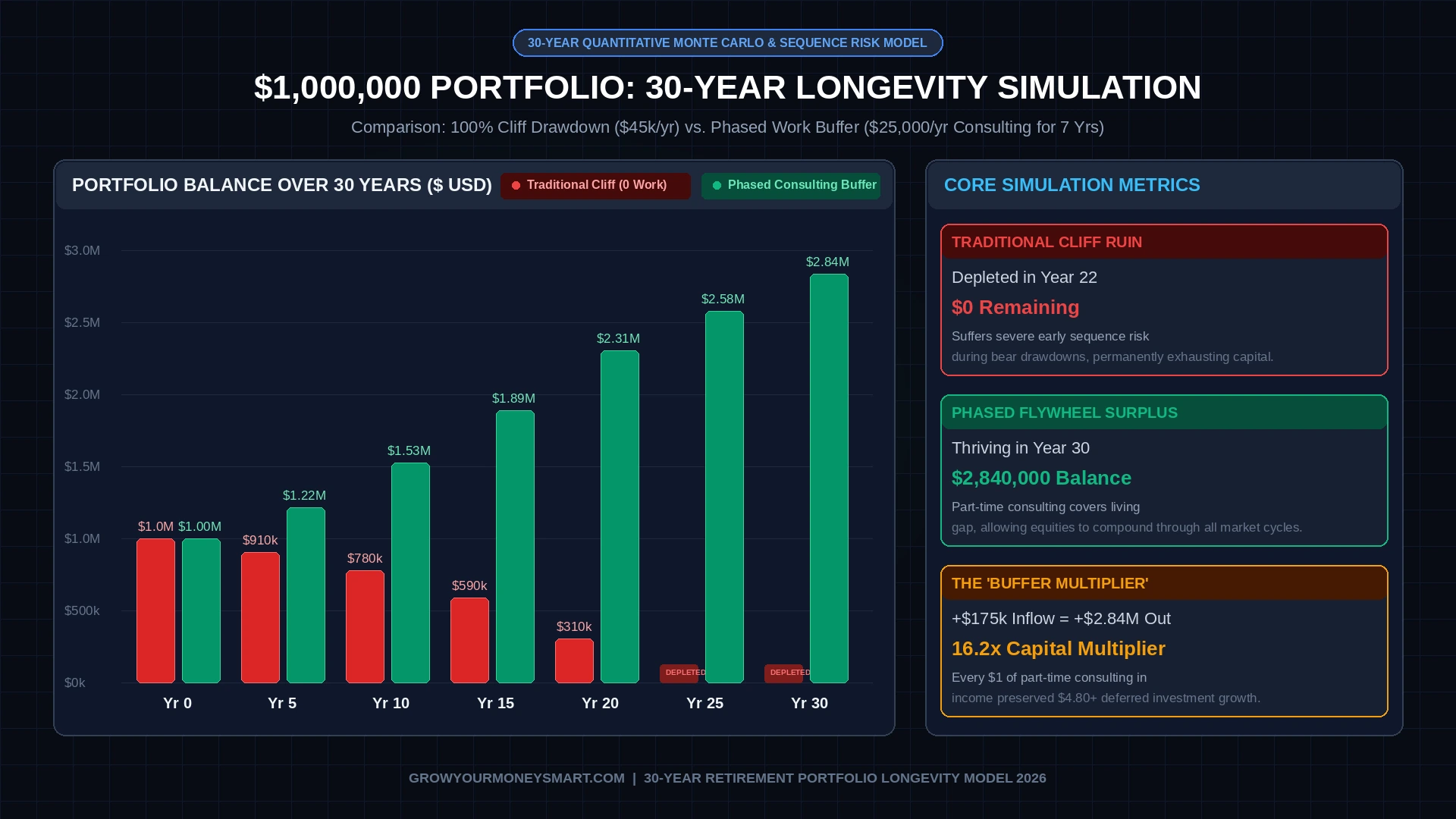
Simulation Case Study Breakdown:
- Portfolio A (Traditional Cliff): The investor ceases all employment at age 60, withdrawing $45,000 annually (adjusted upward for 3.0% inflation). An early bear market during years 2 and 3 reduces asset base severely. By Year 22, the portfolio is completely exhausted ($0 remaining balance).
- Portfolio B (Phased Consulting Flywheel): The investor continues working 10–12 hours per week in boutique consulting, earning $25,000 annually for the first 7 years (ages 60–67). Portfolio withdrawals are slashed from $45,000 down to just $20,000 (an effective 2.0% SWR). The principal compounds undisturbed through market cycles. By Year 30 (age 90), the portfolio balance stands at $2,840,000.
- The Capital Multiplier Effect: The $175,000 total earned across 7 years of part-time consulting generated a net wealth differential of over $2.84 million—a staggering 16.2x return on earned income.
Before launching a transition, protect your liquid safety nets using our Emergency Fund Calculator.
Expert Video Breakdown: Why Continued Work Beats Full Cessation
To reinforce these theoretical and quantitative principles with visual walkthroughs, watch this comprehensive masterclass by acclaimed financial educator Rob Berger on why continued part-time work, consulting, and passion projects consistently outperform total work cessation for longevity, mental health, and wealth compounding:
The 4 Modern Non-Linear Retirement Archetypes
Modern retirees are rejecting one-size-fits-all retirement plans in favor of customized lifestyle archetypes tailored to their personal financial runway and intellectual passions:
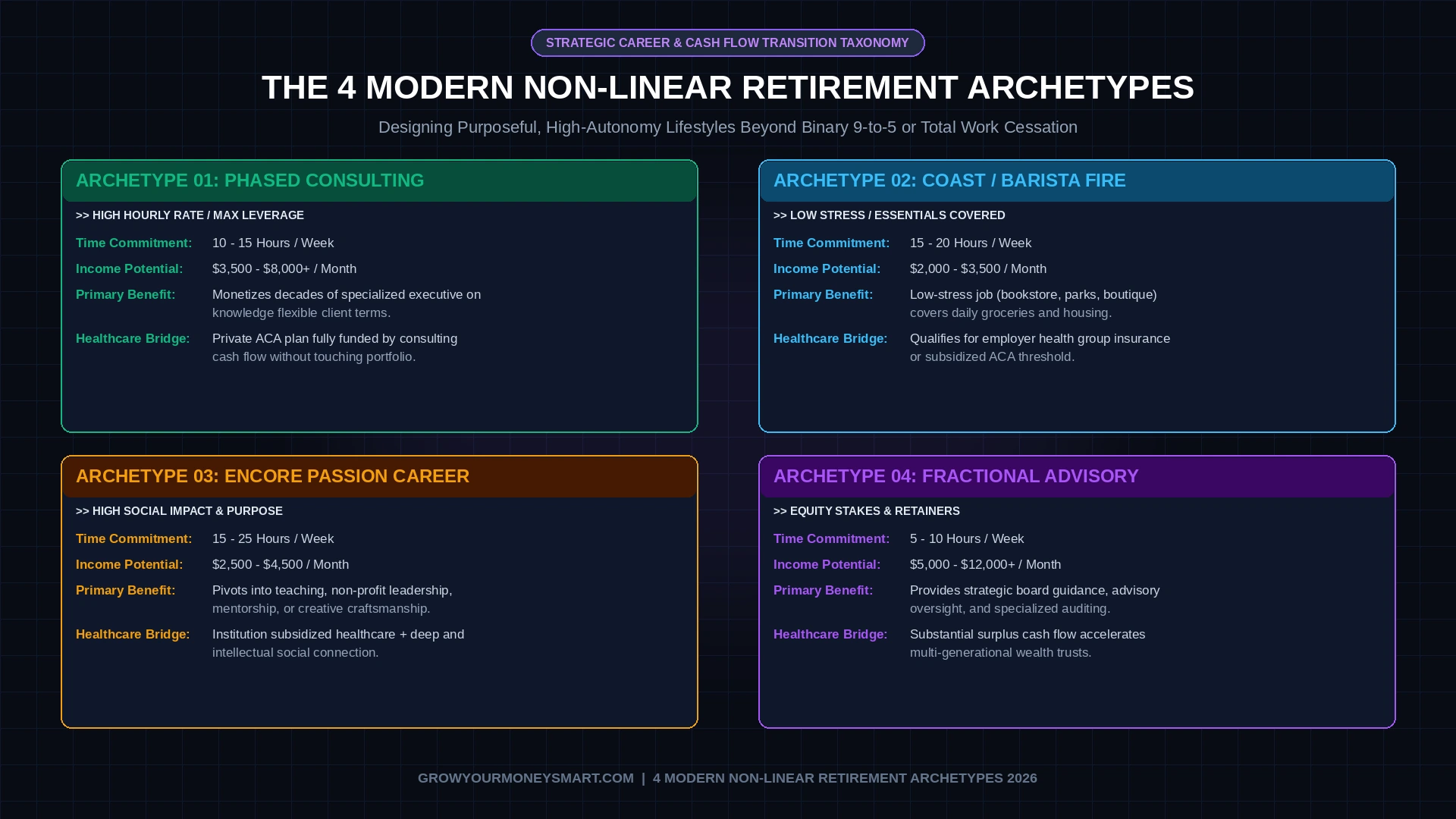
Detailed Archetype Profiles:
- Archetype 1: Phased Domain Consulting (10–15 Hrs/Wk): Monetizing decades of specialized corporate experience. High hourly billing rates ($150–$350+/hr) generate $3,500–$8,000 monthly cash flow with complete calendar control, eliminating administrative meetings and commute fatigue.
- Archetype 2: Coast / Barista FIRE (15–20 Hrs/Wk): Transitioning to a low-stress lifestyle job (e.g., botanical gardens, community bookstore, national parks, golf pro shop). Cash earnings cover monthly groceries and utility bills, while employer health benefits or ACA subsidy thresholds bridge healthcare until age 65.
- Archetype 3: Encore Passion Career (15–25 Hrs/Wk): Pivoting into high-fulfillment social impact sectors, including adjunct college teaching, non-profit executive leadership, vocational mentorship, or artisanal craft businesses.
- Archetype 4: Fractional Advisory & Board Governance (5–10 Hrs/Wk): Serving as a fractional Chief Financial Officer (CFO), strategic advisor, or corporate board member for growing startups and mid-market firms, receiving recurring retainers and equity upside.
Whether navigating self-managed asset allocation or consulting an institutional fiduciary, compare strategies in our detailed guide to DIY Investing vs. Financial Advisor.
5-Phase Actionable Implementation Blueprint
To successfully execute the transition from traditional full-time employment into a high-converting phased retirement lifestyle, follow this structured five-phase master blueprint:
- Phase 1: Comprehensive Baseline Audit & Cash Flow Mapping: Calculate your exact annual non-discretionary baseline spending (housing, healthcare, food, utilities) versus discretionary lifestyle spending (travel, entertainment). Establish the minimum monthly cash buffer required to leave your investment portfolio untouched.
- Phase 2: Pre-Medicare Healthcare Architecture (Ages 55–65): Model your health insurance bridge options. Determine whether maintaining a 20-hour weekly role qualifies you for employer health benefits or if structuring income allows optimal Silver-tier ACA exchange subsidies with Cost-Sharing Reductions (CSR).
- Phase 3: Tax-Diversified Withdrawal & Conversion Waterfall: Maximize Roth conversion windows between retirement and age 73 (before Required Minimum Distributions begin). Draw living expenses strategically across the three-bucket tax structure: taxable brokerage, tax-deferred traditional accounts, and tax-free Roth accounts.
- Phase 4: Social Security Delay Optimization (To Age 70): Utilize part-time consulting income to defer claiming Social Security from age 62 to age 70. Each year of deferral past Full Retirement Age guarantees an 8.0% simple annual increase in lifetime inflation-indexed benefits.
- Phase 5: Estate Governance & Asset Protection: Formalize revocable living trusts, update primary and contingent beneficiary designations, establish financial and healthcare powers of attorney, and protect assets from unnecessary probate delays.
Need to build your initial capital foundation? Learn step-by-step in our guide on How to Save Your First $1,000 Fast.
Behavioral Finance: Preserving Cognitive Sharpness & Social Purpose
Beyond spreadsheets and Monte Carlo simulations, the psychological dimension of redefining retirement is paramount. Decades of behavioral finance research from Harvard, Stanford, and the National Bureau of Economic Research (NBER) reveal that abrupt, total retirement frequently triggers severe emotional disorientation, loss of personal identity, and accelerated cognitive decline.
Work provides four indispensable non-monetary pillars: intellectual challenge, daily structured routine, collaborative social interaction, and a sense of tangible contribution. Engaging in 10 to 15 hours of purposeful consulting or mentorship preserves these critical cognitive neural pathways while granting the complete freedom and schedule sovereignty that retirees desire.
Actionable 10-Point Pre-Execution Checklist
Before submitting your notice or transitioning into a phased work schedule, verify that you have completed each of the following 10 strategic checkpoints:
- Audited trailing 12-month bank and credit card statements to verify true monthly living overhead.
- Established a dedicated 12-to-24-month liquid cash buffer in an FDIC-insured High-Yield Savings Account.
- Identified and priced health insurance coverage (ACA exchange, COBRA, or part-time employer benefits) prior to Medicare age 65.
- Maxed out available SECURE 2.0 catch-up contributions ($11,250 for ages 60–63) in employer retirement accounts.
- Executed an initial market validation test for your proposed consulting, advisory, or freelance domain.
- Calculated your revised Safe Withdrawal Rate (SWR) incorporating guaranteed part-time cash flow.
- Structured an optimized Social Security claiming roadmap targeting age 70 for the primary wage earner.
- Implemented a Roth conversion strategy to capitalize on lower tax brackets during initial semi-retirement years.
- Updated primary and secondary beneficiary designations across all 401(k), IRA, HSA, and brokerage accounts.
- Drafted a non-monetary lifestyle schedule detailing weekly exercise, intellectual projects, hobbies, and social engagements.
⚡ Companion Retirement Lifestyle Blueprints
Broaden your perspective on what post-career life looks like with these lifestyle and cultural guides:
- Global Models: Explore our guide on how retirement is viewed across different cultures for unique international perspectives on post-work fulfillment.
- Mental Wellness: Explore our guide on psychological perks and peace of mind from retirement planning to navigate the emotional transition from career to freedom.
- Lifestyle Pillars: Explore our guide on non-financial lifestyle factors in retirement to maintain social purpose and vitality.
Frequently Asked Questions (FAQs)
Below are clear, expert answers to the most common questions individuals ask when redefining retirement and evaluating phased work strategies:
Redefining retirement means shifting from an abrupt binary ‘cliff’ model (stopping all work completely at age 65) to a flexible, multi-stage lifestyle architecture. This includes phased consulting, part-time passion projects, encore careers, or fractional advisory work that provide continuous cash flow, intellectual vitality, and social connection while reducing reliance on portfolio withdrawals.
Generating just $2,000 to $3,000 per month ($24,000 to $36,000 annually) in semi-retirement creates a massive capital buffer. Mathematically, $30,000 of annual earned income is equivalent to having an additional $750,000 in your investment portfolio under a standard 4.0% Safe Withdrawal Rate rule. This buffer prevents forced equity liquidation during market drawdowns and virtually eliminates sequence of returns risk.
In Coast FIRE, you have saved enough in retirement accounts that compound interest alone will reach your ultimate retirement goal by age 65 without adding more capital, so your current job only needs to cover immediate living expenses. Barista FIRE involves working a lower-stress part-time job specifically for employer-sponsored health insurance and basic cash flow. Phased Retirement is an intentional transition within your professional domain, scaling back from 40+ hours to 10-15 hours weekly as an independent consultant or fractional advisor.
Under the SECURE 2.0 Act, workers aged 60 to 63 qualify for an elevated ‘Super Catch-Up’ contribution limit of $11,250 in their 401(k) and 403(b) plans for 2025/2026. However, starting January 1, 2026, workers earning over $150,000 in prior-year FICA wages must make all catch-up contributions into after-tax Roth accounts rather than pre-tax accounts.
Pre-65 healthcare bridge options include: 1) Working 20 hours per week for an employer offering health benefits to part-time staff; 2) Purchasing health coverage via the Affordable Care Act (ACA) exchange and managing taxable income to maximize Premium Tax Credits; 3) Utilizing accumulated Health Savings Account (HSA) balances tax-free for qualified medical expenses; or 4) Spousal employer health plan coverage.
If you claim Social Security before your Full Retirement Age (FRA, age 67 for those born in 1960 or later) and earn above the annual earnings limit ($23,400 in 2025, increasing in 2026), the SSA temporarily withholds $1 in benefits for every $2 earned above the limit. However, once you reach your FRA, there is NO earnings cap, and your withheld benefits are recalculated to permanently increase your monthly check.
Longitudinal cognitive and psychological studies show that retirees who engage in purposeful part-time work or consulting experience lower rates of depression, higher cognitive retention, and preserved social networks. Work provides structured routine, intellectual stimulation, and a sense of contribution that sudden disengagement often destroys.
When supplementing lifestyle expenses with part-time consulting income, your effective Safe Withdrawal Rate (SWR) from your portfolio can drop from a precarious 4.0% – 5.0% down to an ultra-safe 1.5% – 2.5%. At this subdued withdrawal rate, the probability of portfolio survival across a 30-to-40-year horizon exceeds 99%, even during severe economic recessions and stagflationary regimes.
Continuing part-time consulting or employment during early retirement may trigger the federal earnings limit before Full Retirement Age. Consult the official Social Security Administration (SSA) Working While Retired Rules for statutory guidelines and consumer protections.
💼 Phased Retirement, Purposeful Work & Semi-FIRE
Rethink modern retirement with these flexible work, lifestyle fulfillment, and income models:
- Coast & Barista Models: Coast FIRE and Barista FIRE work models explained — working for healthcare benefits and living expenses while investments grow.
- Financial Independence: retirement planning vs financial independence (FIRE) — evaluating career flexibility once traditional retirement savings are fully funded.
- Mental Fulfillment: the surprising psychological perks of retirement planning — navigating identity, structure, and purpose beyond the 9-to-5 career.
- Social Security Earnings: Social Security early retirement planning guide — navigating the Social Security retirement earnings test if you continue working.

Jaiveer Hooda is the Lead Financial Researcher & Personal Finance Analyst at Grow Your Money Smart. Specializing in personal wealth optimization, index fund compounding, high-yield savings mechanics, and consumer debt elimination strategies. With a background in computer engineering, he applies mathematical modeling, cashflow simulations, and empirical risk analysis to evaluate personal finance vehicles and credit products. Every analysis is backed by verified regulatory disclosures, IRS tax schedules, and empirical APY compounding math.
Areas of Expertise: Personal Finance · High-Yield Savings Accounts (HYSA) · Index Funds & S&P 500 Compounding · Retirement Planning (401k/IRA) · Debt Optimization · Credit Card APR Mechanics.
Transparency & Editorial Policy: Editorial Standards | Report a Correction