
Federally regulated financial institutions maintain formal hardship and workout concessions for consumers experiencing verified economic distress. Consult the official Consumer Financial Protection Bureau (CFPB) Credit Card Consumer Protections for statutory guidelines and consumer protections.
- Unadvertised Lifeline: Every major credit card issuer (Chase, Amex, Discover, Citi, BoA, Capital One) maintains an internal hardship or workout program that is not advertised on public web pages.
- Massive APR Concessions: Approval can temporarily lower your interest rate from 28%+ down to 0% to 9.99%, waive penalty fees, and reduce monthly payments to accelerate principal reduction.
- The Trade-Off: In exchange for steep interest cuts, issuers will typically freeze charging privileges or close the account to prevent additional debt accumulation.
- Proactive Action is Critical: Contact your card issuer before you default or fall 60+ days behind; banks grant significantly better workout terms to proactive borrowers who demonstrate an intent to repay.
- Compounding Math Winner: On a $12,000 balance, entering a 0% hardship plan saves over $5,840 in interest charges and cuts your debt-free timeline by more than 3 years.
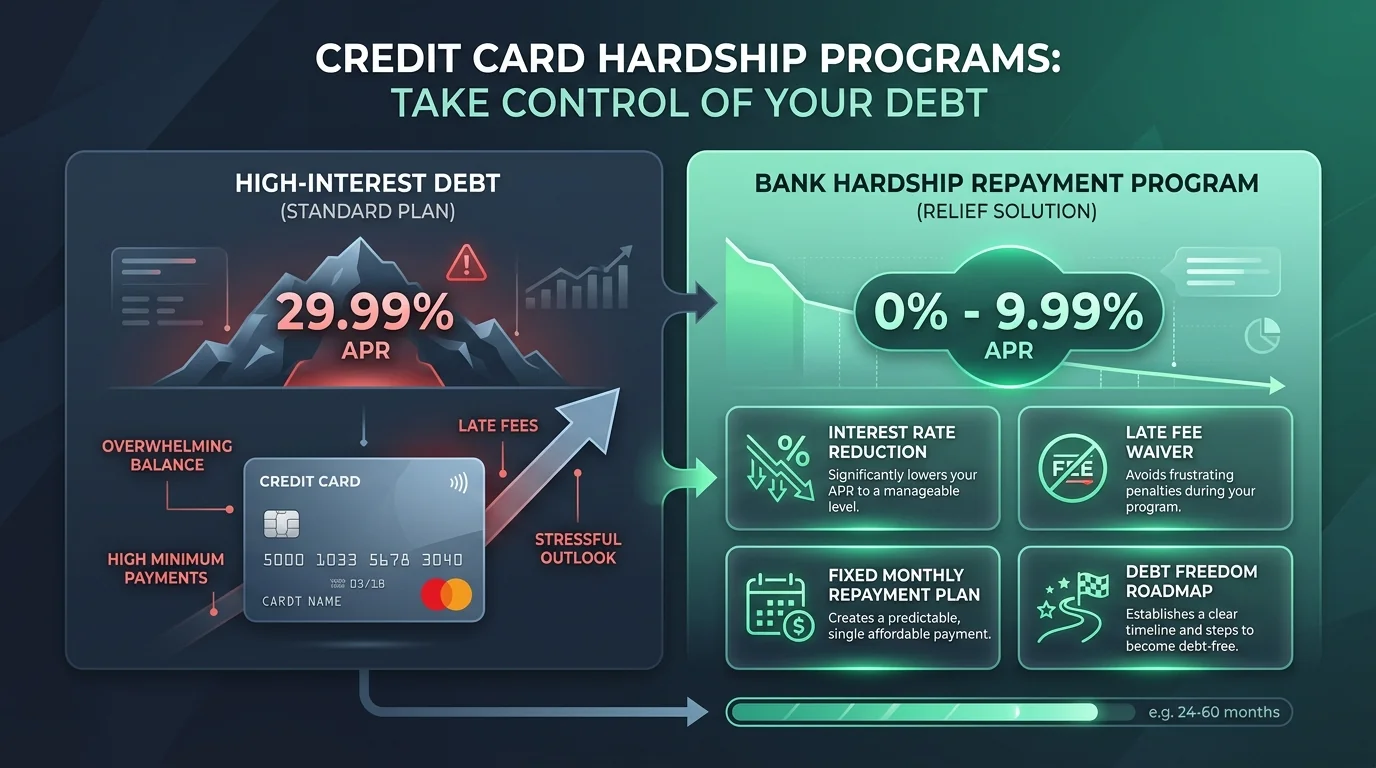
Credit card hardship programs offer an essential financial lifeline when unexpected life emergencies strike—such as sudden job loss, medical crises, divorce, or steep inflation—revolving credit card balances can rapidly transform from a manageable monthly expense into a catastrophic financial trap. With average credit card interest rates hovering between 24% and 29.99% APR, monthly minimum payments are almost entirely consumed by interest charges, leaving the underlying principal balance virtually untouched.
What most cardholders do not realize is that major financial institutions have a built-in safety valve designed specifically for this scenario: Credit Card Hardship Assistance Programs (also known as Workout Agreements or Internal Concession Plans). Through these confidential programs, banks can temporarily slash your APR to as low as 0.00% to 9.99%, waive late fees, and establish a structured fixed monthly payment plan to help you regain financial stability.
However, banks do not market these programs openly. Securing hardship relief requires knowing which departments to contact, understanding the bank’s qualification criteria, utilizing the correct conversational scripts, and weighing the trade-offs on your credit profile. In this comprehensive master guide, we break down the mechanics of credit card hardship programs, provide side-by-side policy comparisons across major card issuers, outline exact phone scripts, and demonstrate the compounding mathematical savings of interest rate relief.
What is a Credit Card Hardship Program and How Does It Work?
A credit card hardship program is a formal arrangement negotiated directly between a cardholder and an issuing bank to modify credit terms during periods of severe financial distress. Unlike third-party debt settlement companies that urge you to stop paying your bills and ruin your credit score, an internal bank hardship program is a direct, white-hat debt workout solution.
Financial institutions offer these concessions not out of benevolence, but out of rational risk mitigation. When a borrower faces unmanageable interest accumulation, the bank faces two potential worst-case outcomes: personal bankruptcy or a total debt charge-off. In either scenario, the lender often recovers zero cents on the dollar. By granting concessional interest rates and waiving penalty fees, the bank significantly increases the statistical probability of recovering 100% of the original principal balance.
Internal hardship relief generally falls into two primary structures:
1. Short-Term Financial Relief (3 to 12 Months):
Designed for temporary disruptions such as a short period between jobs or temporary medical recovery. The bank may reduce your APR to 0%–9.99%, waive monthly minimum payments for 1–3 months, or waive annual and late fees. The account is usually temporarily restricted from new charges but may be reopened once the promotional period concludes.
2. Long-Term Workout Program (24 to 60 Months):
Designed for structural life changes (long-term disability, divorce, permanent income reduction). The bank establishes a fixed amortized monthly payment over 2 to 5 years at a drastically reduced interest rate (typically 0% to 9.99%). In exchange, the credit line is permanently closed, and the cardholder agrees to make steady monthly electronic payments until the entire balance is liquidated.
Major Bank Hardship Programs: Comparison Matrix
Every major credit card issuer manages its own proprietary internal hardship guidelines. The table below details the typical concession tiers, APR reductions, and program rules across the top national credit card issuers in 2026:
| Credit Card Issuer | Typical Hardship APR | Program Duration | Account Status During Program | Hardship Department Contact |
|---|---|---|---|---|
| American Express | 0.00% – 9.99% | 12 to 48 Months | Frozen or Closed (Optima card offered post-payoff) | 1-800-528-4800 (Ask for Financial Hardship) |
| Discover | 0.00% – 6.99% | 6 to 12 Months (Renewable) | Temporarily Suspended (Can be reinstated upon completion) | 1-800-347-2683 (Customer Assistance Dept) |
| Chase Bank | 2.00% – 9.99% | 12 to 60 Months | Permanently Closed for full workout plans | 1-800-955-9060 (Payment Solutions Team) |
| Citi (Citigroup) | 0.00% – 9.99% | 12 to 60 Months | Frozen (Temporary) or Closed (Long-term) | 1-800-388-2200 (Account Services) |
| Bank of America | 4.00% – 9.99% | 12 to 60 Months | Account Closed to new charges | 1-800-732-9194 (Credit Assistance Team) |
| Capital One | Case-by-case fee waivers & fixed plans | 3 to 12 Months | Frozen during relief window | 1-800-227-4825 (Special Assistance) |
If your credit card issuer is reluctant to negotiate an internal workout program, you can also consider restructuring debt via fixed personal installment loans or balance transfers. Review our complete playbook on debt consolidation vs hardship programs, our in-depth comparison on debt consolidation vs balance transfer and our strategic framework for how to negotiate credit card interest rates.
Mathematical Impact: How Hardship APR Slashes Payoff Timelines
To demonstrate the transformative power of credit card hardship programs, let us analyze a mathematical simulation of a cardholder carrying a $12,000 credit card debt balance under three distinct repayment scenarios.
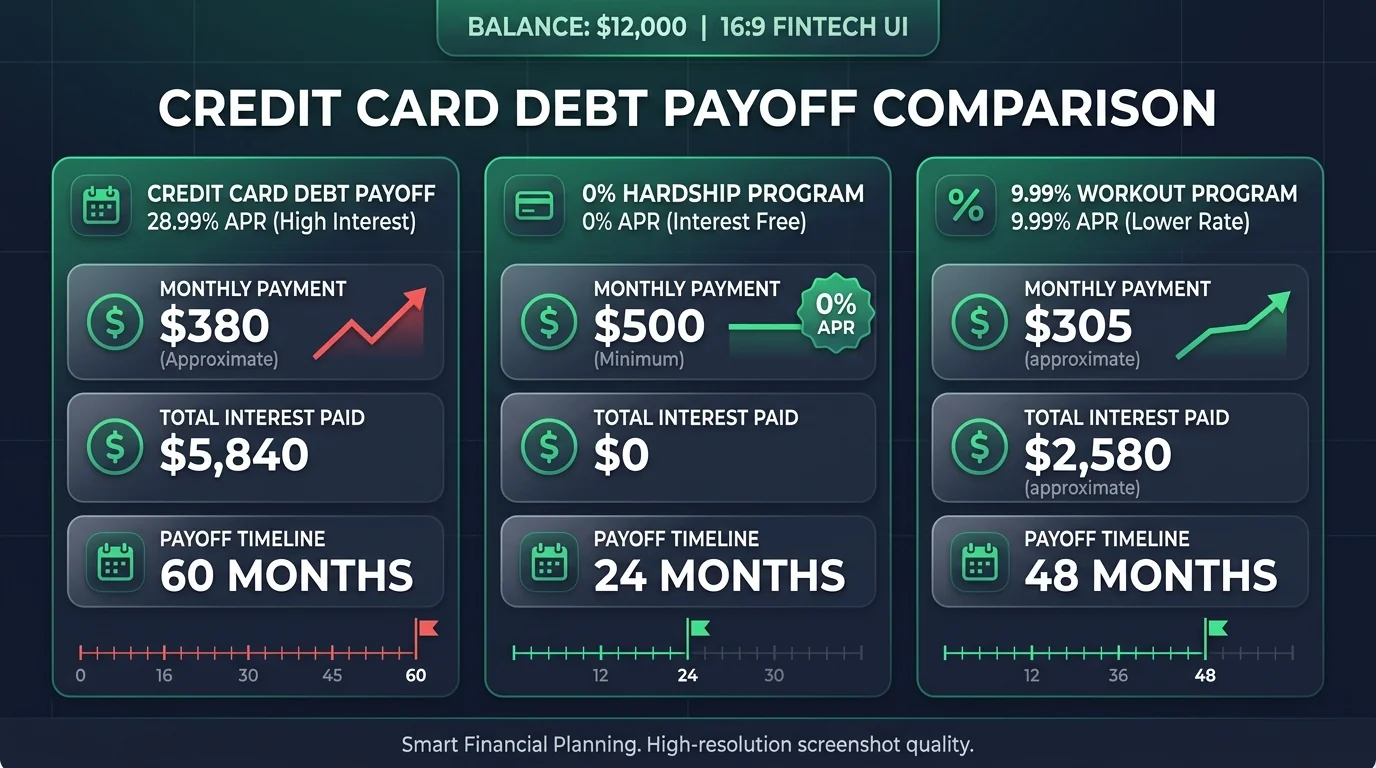
Under a standard commercial interest rate of 28.99% APR, monthly finance charges amount to approximately $289.90 per month in pure interest on a $12,000 balance. If the cardholder makes a fixed monthly payment of $380, only $90.10 goes toward reducing the principal balance.
When the card issuer enrolls the account in a 0.00% Hardship Relief Plan with a $500 monthly payment, 100% of every dollar reduces the balance directly, wiping out the entire $12,000 debt in exactly 24 months with $0 in total interest paid.
| Repayment Scenario ($12,000 Balance) | Stated APR | Monthly Payment | Payoff Timeline | Total Interest Paid | Total Cash Saved |
|---|---|---|---|---|---|
| 1. Standard High-APR Minimum Path | 28.99% APR | $380 / mo | 60 Months (5 Yrs) | $5,840.40 | $0 (Baseline) |
| 2. 9.99% Bank Workout Agreement | 9.99% APR | $305 / mo | 48 Months (4 Yrs) | $2,580.20 | +$3,260.20 |
| 3. 0% Bank Hardship Program | 0.00% APR | $500 / mo | 24 Months (2 Yrs) | $0.00 | +$5,840.40 |
To calculate your personalized monthly payment breakdown and test payoff timelines across various balance amounts, utilize our free interactive debt payoff calculator. Pair your debt elimination with structured cash management using our budget calculator to identify additional monthly savings.
Watch: Expert Walkthrough on Negotiating Debt Relief
Bestselling personal finance author Ramit Sethi breaks down the psychological frameworks and phone scripts required to negotiate interest rate reductions, fee waivers, and repayment plans directly with financial institutions.
The 5-Step Actionable Blueprint to Qualify for a Hardship Program
Securing approval for a bank’s most favorable hardship tier requires careful preparation and disciplined communication. Follow this 5-step operational blueprint before dialing your card issuer:
Step 1: Document Your Legitimate Financial Hardship
Banks evaluate hardship requests based on concrete, verifiable life events. Gather supporting documentation before you call:
• Loss of Employment: Layoff notice, severance documentation, or unemployment benefit statements.
• Medical Crises: Itemized hospital bills, surgical invoices, or doctor’s disability notes.
• Income Reduction: Recent pay stubs showing reduced working hours or commission drops.
• Divorce / Separation: Legal filings or separation agreements impacting household income.
Step 2: Calculate Your Exact Disposable Cash Flow
The representative will conduct a comprehensive Income and Expense Assessment over the phone. Know your exact net monthly income and essential living expenses (rent/mortgage, utilities, groceries, transportation). Calculate the exact dollar amount you can realistically afford to pay each month toward the card balance (e.g., $250/month). Never promise an unrealistic payment that you cannot sustain.
Step 3: Call the Specific Hardship or Assistance Department
Do not rely on frontline customer service agents, who are primarily trained on routine balance inquiries. Call the main customer service number and immediately request: “Please transfer me to your Internal Hardship, Special Assistance, or Account Solutions Department.”
Step 4: Use the Proven Word-for-Word Hardship Script
Deliver your situation with honesty, clarity, and determination to repay the debt:
“Hello, my name is [Your Name]. I am calling because I have experienced an unexpected financial hardship due to [job loss / medical emergency / sudden income drop]. I value my long-standing relationship with [Bank Name] and I am fully committed to paying back 100% of my outstanding balance. However, under my current interest rate of [Current APR, e.g., 28.99%], the finance charges make it mathematically impossible for me to reduce the principal on my current income.
I am proactively reaching out today to enroll in your internal hardship assistance program or workout plan. Based on my budget, I can commit to a fixed payment of $[Affordable Amount, e.g., $300] per month if [Bank Name] can temporarily lower my interest rate to 0% or a single-digit rate and waive ongoing fees while I repay this debt.”
Step 5: Review the Terms and Secure Written Confirmation
Before agreeing to the plan, ask the representative to clarify all critical terms:
• What is the exact new interest rate and how many months will it remain active?
• Will the card account be temporarily suspended or permanently closed?
• How will the account be reported to the credit bureaus (Equifax, Experian, TransUnion)?
• What happens if the promotional period expires before the balance reaches zero?
• Request a formal copy of the hardship agreement via email or postal mail and set up automated payments to guarantee you never miss a deadline.
Credit Score Impact: What Happens to Your Credit When You Enter Hardship?
One of the most frequent concerns borrowers face is how enrollment in a credit card hardship program impacts their FICO credit score. The reality involves a nuanced trade-off between short-term credit utilization and long-term financial preservation:
1. Credit Bureau Reporting Codes:
Enrolling in a hardship program is not classified as a default or collection account. However, banks may report a special notation code to credit bureaus, such as “Paying under a partial or modified payment agreement.” While scoring models do not deduct heavy points specifically for this text notation, third-party lenders reviewing your raw credit report for a mortgage or auto loan will see that you negotiated modified terms.
2. Credit Utilization Ratio Spike:
When a bank freezes or closes your credit card account upon hardship enrollment, your total available credit limit drops. If you owe $10,000 on a card that is now closed with a $0 credit limit, scoring models may calculate that specific card at 100% credit utilization until the balance declines, creating a temporary 20 to 45 point dip in your FICO score.
3. Hardship vs. Missed Payments and Bankruptcy:
It is essential to view credit score impact in perspective. A 30-day late payment drops a credit score by 60 to 110 points. A 90-day delinquency, charge-off, or Chapter 7 bankruptcy obliterates 150 to 240+ points and remains on your credit file for 7 to 10 years. In contrast, a hardship program preserves your on-time payment history (which makes up 35% of your FICO score) and allows your score to rebound swiftly as your debt balance decreases.
For more strategies on debt restructuring and credit preservation, review our comprehensive guides on debt management strategies and our case study on how to pay off $20k in credit card debt fast.
Alternative Debt Relief Solutions: Comparing Your Options
Severe Delinquency Alternative: If your accounts have already entered late-stage delinquency (90+ days past due) and your bank refuses to enroll you in a hardship program, explore negotiating debt settlement yourself if hardship is denied to settle balances for 40% to 50% without paying exorbitant third-party fees.
If your bank denies your hardship request, or if you hold multiple credit cards across four or five different lenders, individual hardship programs may be cumbersome to coordinate. Consider these alternative debt relief pathways:
1. Nonprofit Debt Management Plans (DMPs):
Working with an accredited nonprofit credit counseling agency (such as member agencies of the National Foundation for Credit Counseling – NFCC) allows you to consolidate all your unsecured debts into a single monthly payment. Credit counselors possess pre-established agreements with all major banks to reduce interest rates to 6% to 10% and waive fees across all your cards simultaneously.
2. 0% APR Balance Transfer Credit Cards:
If you still maintain a good credit score (FICO 670+), you can transfer high-interest balances to a 0% intro APR balance transfer card for 12 to 21 months, paying only a 3% to 5% transfer fee. Explore our guide on debt consolidation vs balance transfer.
3. Self-Directed Debt Payoff (Avalanche vs Snowball):
If you have stable income and prefer not to alter account terms, use the Debt Avalanche method (focusing payments on the highest APR first) or Debt Snowball method (paying off the smallest balance first for psychological wins). Read our breakdown on debt-free vs having debt strategies and how to allocate monthly income with our how to budget $3,000 monthly income guide.
4. Emergency Fund Cushion:
Before aggressively paying off debt, always establish a starter cash safety net to avoid falling back into credit card dependence. Use our emergency fund calculator and read our actionable guide on saving your first $1,000 emergency fund on a low income.
Frequently Asked Questions (FAQs)
A credit card hardship program is a special, unadvertised concession offered directly by credit card issuers to borrowers experiencing severe, verifiable financial distress. It temporarily lowers your interest rate (often to 0%–9.99%), waives penalty fees, and sets up a manageable fixed monthly payment to help you pay off debt without defaulting.
Yes, several major issuers (such as American Express, Discover, and select credit unions) have internal workout tiers that reduce APR to 0.00% for 6 to 12 months, or 6.00% to 9.99% for 24 to 60 months. However, approval for a true 0% rate is reserved for severe documented hardship cases and is granted at the bank’s internal discretion.
Enrolling does not directly add a negative delinquency mark if your payments remain on time. However, the bank will typically freeze or close your credit line, which lowers your total available credit limit and may spike your credit utilization ratio, causing a temporary credit score drop. However, this dip is far less damaging than missed payments, charge-offs, or bankruptcy.
In the majority of cases, yes. To prevent cardholders from accumulating additional debt while receiving concessional interest rates, banks usually freeze charging privileges or permanently close the account upon enrollment in a multi-year workout plan.
Qualifying hardship events include involuntary job loss or reduction of income, sudden medical emergencies and high out-of-pocket healthcare expenses, divorce or legal separation, natural disasters, or the death of a primary household earner.
Hardship programs typically fall into two categories: short-term relief plans lasting 3 to 12 months (offering temporary APR cuts and fee waivers), or long-term full workout plans lasting 24 to 60 months (offering fixed low APRs until the total balance is completely paid off).
A bank hardship program is arranged directly with an individual card issuer for that single account. A Debt Management Plan (DMP) is coordinated through an accredited nonprofit credit counseling agency (such as NFCC), consolidating all your credit cards across multiple banks into one structured payment with pre-negotiated interest rate concessions.
Missing even a single payment while enrolled in a hardship program almost always results in immediate cancellation of the agreement. The bank will revoke your concessional interest rate, restore your original high APR (e.g., 28.99%+), reinstate late fees, and may accelerate collection proceedings.
Final Verdict: Taking Control of Your Debt with Bank Hardship Relief
Credit card hardship programs represent one of the most powerful, underutilized debt relief tools available to consumers. By eliminating the aggressive drag of compounding 28%+ APR interest, hardship programs allow every dollar you pay to attack your principal balance, transforming years of financial stress into a clear, predictable path to debt freedom.
If you are struggling under the weight of high credit card payments, do not wait for payments to become delinquent. Pick up the phone, reach out to your issuer’s financial assistance department, and request the interest rate relief you need to reclaim your financial future.

Jaiveer Hooda is the Lead Financial Researcher & Personal Finance Analyst at Grow Your Money Smart. Specializing in personal wealth optimization, index fund compounding, high-yield savings mechanics, and consumer debt elimination strategies. With a background in computer engineering, he applies mathematical modeling, cashflow simulations, and empirical risk analysis to evaluate personal finance vehicles and credit products. Every analysis is backed by verified regulatory disclosures, IRS tax schedules, and empirical APY compounding math.
Areas of Expertise: Personal Finance · High-Yield Savings Accounts (HYSA) · Index Funds & S&P 500 Compounding · Retirement Planning (401k/IRA) · Debt Optimization · Credit Card APR Mechanics.
Transparency & Editorial Policy: Editorial Standards | Report a Correction