
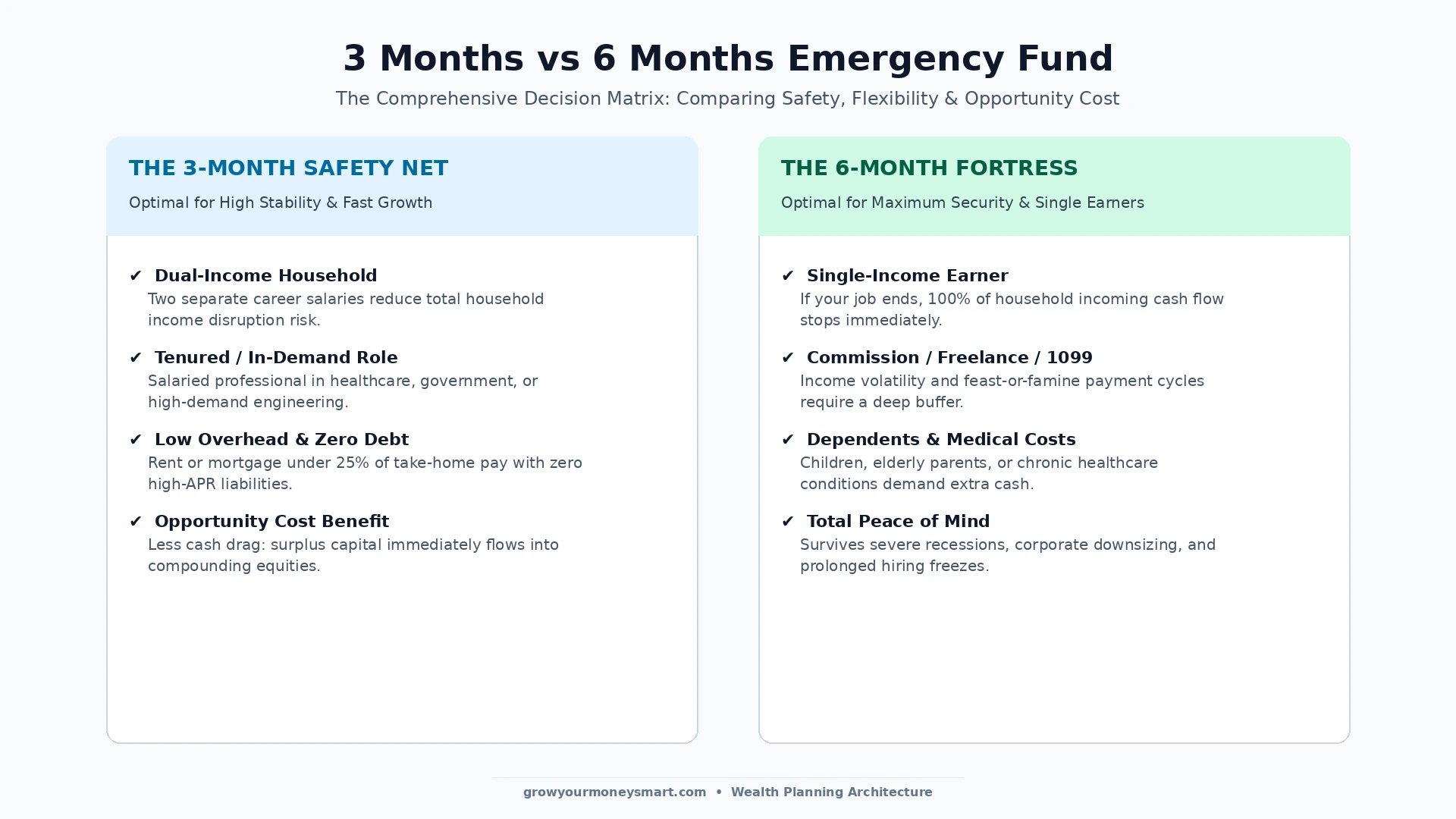
Choose a 3-month emergency fund if you are in a dual-income household with stable salaried jobs, rent under 28% of income, and have no dependents. Choose a 6-month fund if you are a single earner, work on commission or freelance, have children, or carry high fixed debt. Keep all reserves in an FDIC-insured HYSA.
- The Core Trade-Off: A 3-month fund minimizes cash drag, allowing more capital to compound in equities. A 6-month fund maximizes psychological peace and survival duration during prolonged recessions.
- 3-Month Sweet Spot: Best for dual-income couples, high-demand tech/healthcare careers, low fixed overhead, and renters with flexible leases.
- 6-Month Requirement: Essential for sole household providers, freelance/1099 contractors, homeowners with older properties, and families with children.
- Beware of Cash Drag: Keeping 12+ months of cash in savings costs thousands in lost stock market compounding over a 10-year career.
- The Hybrid Strategy: Secure 3 months first, then split surplus cash 50/50 between expanding toward 6 months and funding a Roth IRA.
One of the most fiercely debated questions in personal finance is deceptively simple: Should you save 3 months or 6 months of living expenses in an emergency fund?
Traditional finance advice frequently throws around generic rules of thumb without considering your individual career stability, family structure, or debt load. Saving too little leaves you vulnerable to a catastrophic debt spiral if a layoff strikes during a recession. However, saving too much introduces insidious cash drag—trapping tens of thousands of dollars in cash yielding 3.00% to 4.00% while missing out on 8.0%+ annualized stock market index returns.
In this guide, we provide the definitive 2026 decision matrix to determine your exact emergency fund target, evaluate the math of opportunity cost, and outline the optimal transition protocol. For fundamental account setup, see our Complete Emergency Fund & HYSA Master Guide and our review of the Best High-Yield Savings Accounts of 2026.
The 3 Months vs. 6 Months Decision Matrix
To identify your ideal target, audit your household across five fundamental risk vectors:
If you fall cleanly into the left column, holding 3 months of essential expenses ($7,500 to $12,000) is mathematically optimal. If you match two or more characteristics in the right column, protecting your family with a full 6-month reserve ($15,000 to $25,000) is essential.
The Opportunity Cost: Understanding Cash Drag
While cash provides emotional comfort, holding excess cash carries a real, measurable cost. When interest rates normalize, cash in savings accounts trails behind equity index compounding:
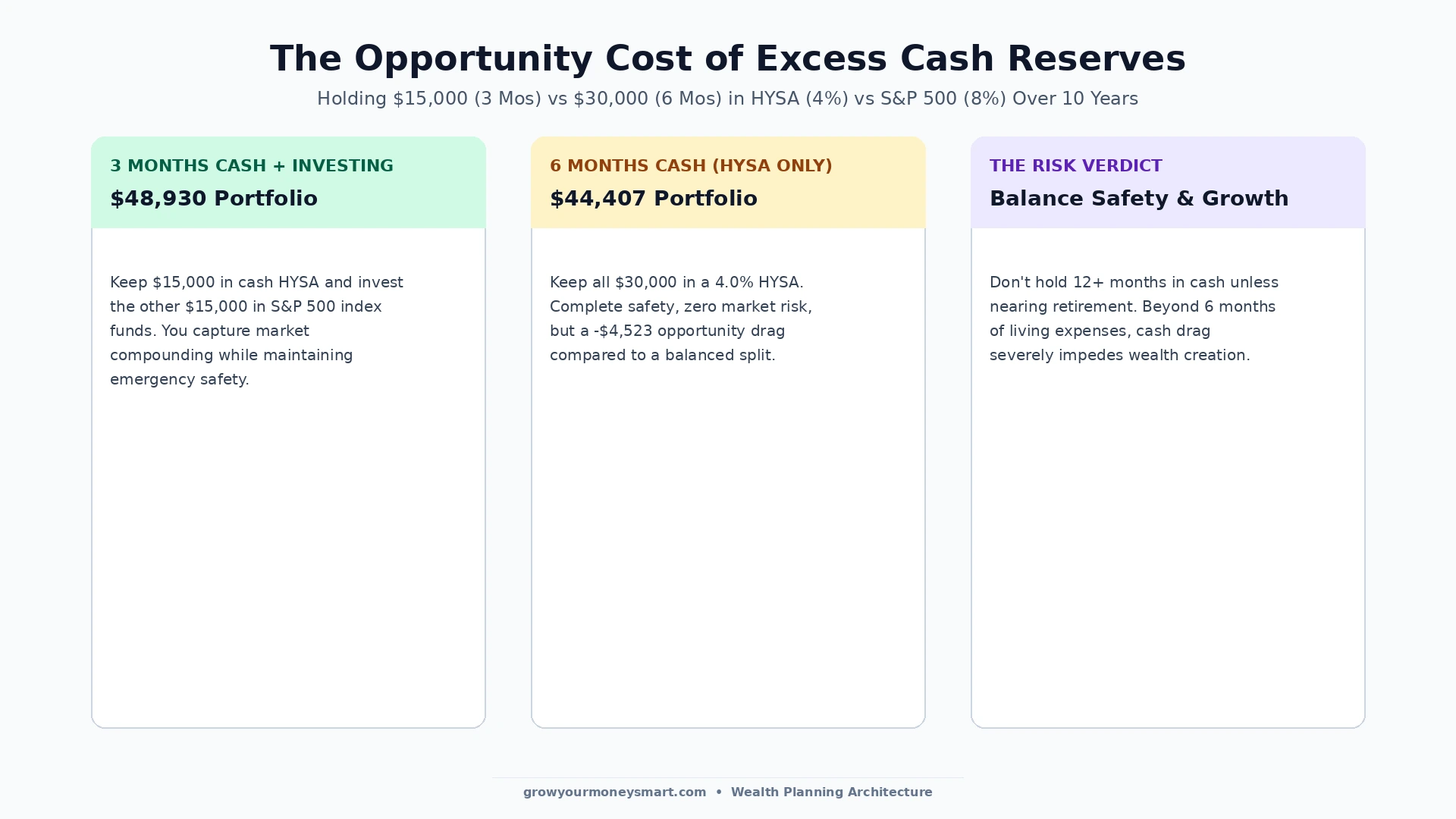
Consider an investor holding $30,000 total. Keeping the entire $30,000 in a 4.00% HYSA produces approximately $44,407 over 10 years. In contrast, keeping a disciplined 3-month fund of $15,000 in an HYSA and deploying the other $15,000 into broad S&P 500 index funds (earning an 8.0% historical compound return) grows into $48,930. That represents over $4,500 in additional net worth while preserving a substantial liquid safety cushion.
To explore the mechanics of balancing cash liquidity with market equities, study our comprehensive analysis on HYSA vs. Stocks and our foundational guide on Investment Time Horizon.
The Hybrid Compromise: How to Scale from 3 to 6 Months
If you want the security of a 6-month emergency fund but don’t want to forfeit long-term stock market compounding, follow the Hybrid 50/50 Escalation Rule:
- Phase 1: Focus 100% of your savings capacity on reaching a 3-month baseline emergency fund in an HYSA. Pause aggressive investing beyond employer 401(k) matching.
- Phase 2: Once your 3-month foundation is locked, split your monthly surplus 50/50. Direct 50% toward building months 4 through 6 of your emergency fund, and invest the remaining 50% into a Roth IRA or low-cost index funds. (Learn more in our guide on how to max out a 401(k) and Roth IRA).
- Phase 3: Once you reach the full 6 months, shift 100% of your wealth allocation into compounding investment vehicles and long-term financial independence. (See our guide on the stages of the retirement plan lifecycle).
Expert Video Breakdown: 3 Months vs 6 Months Emergency Reserves
To understand the psychological and mathematical differences between a lean 3-month fund and a conservative 6-month safety net, watch The Financial Diet’s guide:
Frequently Asked Questions (FAQs)
Yes, 3 months is sufficient if you are part of a dual-income household where both partners work stable salaried jobs, rent or mortgage costs are under 28% of income, you have no dependents, and you carry zero high-interest debt.
You should maintain a 6-month emergency fund if you are a single-income earner, support children or elderly dependents, work on commission or freelance contracts, work in a volatile industry with long hiring cycles, or own an older home with frequent maintenance needs.
Cash drag occurs when you hold excessive cash in savings accounts rather than investing in productive assets like stocks or real estate. Because cash yields lower long-term returns than equities, holding more than 6 to 9 months of cash reduces your 20-year net worth.
Yes. Holding 12 to 24 months of living expenses in cash (unless you are within 2 years of retirement) incurs substantial opportunity cost. Over 10 years, an extra $30,000 kept in cash rather than index funds forfeits thousands in compound returns.
Once you reach a 3-month baseline, you do not have to pause all investing. Split your monthly savings allocation 50/50: direct half to expanding your emergency fund to 6 months and half into your Roth IRA or 401(k).
No. Credit cards and home equity lines of credit (HELOCs) are debt facilities, not cash savings. During major economic recessions, banks frequently slash credit lines and freeze HELOCs exactly when borrowers need them most.
Keep your entire liquid emergency reserve in an FDIC-insured High-Yield Savings Account (HYSA) paying 3.00% to 4.40% APY. This ensures maximum capital protection while outpacing traditional bank rates.
Once you have reached your 3 or 6-month target, redirect 100% of your wealth-building cash flow into tax-advantaged retirement accounts (Roth IRA, 401(k), HSA) and taxable brokerage index funds.

Jaiveer Hooda is a personal finance researcher and the founder of Grow Your Money Smart. With a background in computer engineering, he approaches money the way an engineer approaches any complex system — through data analysis, mathematical modeling, and ruthless optimization.
He built this platform on a single conviction: financial freedom is not a matter of luck. It is a system that can be designed, tested, and executed by anyone willing to follow the right blueprint. Every strategy published here is researched to the numbers, not written to the trend.
Expertise: Debt elimination · Retirement planning · Passive income · Budgeting systems
Connect: Pinterest | growyourmoneysmart.com | Contact Us