
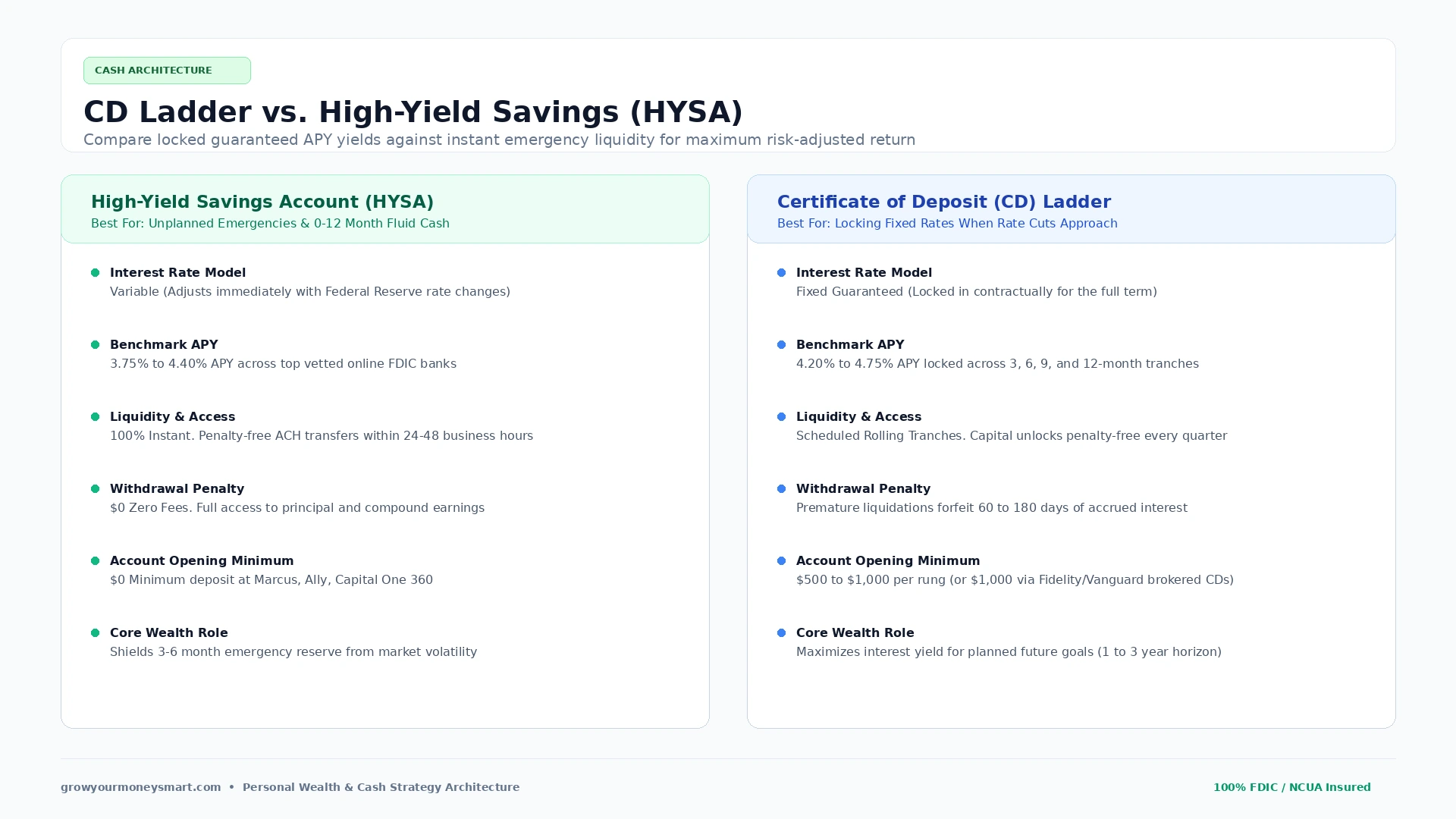
A High-Yield Savings Account (HYSA) provides 100% liquid cash access with a floating variable yield (currently 3.75%–4.40% APY), making it the mandatory foundation for your 3–6 month emergency reserve. Conversely, a CD Ladder divides your savings into staggered terms (3, 6, 9, 12 months) to lock in guaranteed fixed APY rates (up to 4.75%), completely shielding your money against Federal Reserve rate reductions while generating rolling quarterly liquidity.
As the Federal Reserve recalibrates interest rate benchmarks through 2026, cash savers face a critical wealth dilemma: keep emergency money in a variable high-yield account where APY yields can drop overnight, or lock into Certificates of Deposit (CDs) at the expense of instant liquidity.
1. The Structural Architecture: CD Ladder vs. HYSA
Both instruments are backed by FDIC insurance up to $250,000 per depositor, per institution (or NCUA for credit unions), providing zero risk of principal capital loss. However, their internal interest rate dynamics and accessibility models serve completely distinct phases of financial planning.
| Feature & Metric | High-Yield Savings (HYSA) | Staggered CD Ladder |
|---|---|---|
| Interest Rate Structure | Variable: Changes immediately when the Federal Reserve adjusts the federal funds rate. | Fixed Guaranteed: Locked in stone for the entire contractual term (3 to 60 months). |
| Liquidity & Cash Access | 100% Instant (Penalty-free ACH transfers in 24–48 hours). | Scheduled Rolling Tranches (Cash unlocks every 3, 6, or 12 months). |
| Early Withdrawal Penalty | $0 Zero: Withdraw principal and earned interest whenever desired. | Forfeiture: Premature withdrawal costs 60 to 180 days of accrued interest. |
| Fed Rate Cut Vulnerability | High: Yields fall as soon as central banks loosen monetary policy. | Zero (Immunized): Your locked APY is protected until the CD maturity date. |
| Minimum Deposit Barrier | Usually $0 (e.g. Marcus, Ally, Capital One 360). | $500 to $1,000 per rung (or brokered CDs via Fidelity/Vanguard). |
2. Expert Video Analysis: Where Cash Earns the Most Now
To see real-world portfolio numbers on fixed cash allocation, watch this comprehensive walkthrough by veteran financial planner Rob Berger analyzing HYSAs, CD ladders, and Treasury bills:
3. How a 4-Tranche CD Ladder Works in Practice ($20,000 Simulation)
The traditional objection to Certificates of Deposit is that your hard-earned capital is trapped behind an early withdrawal penalty lockbox. A CD ladder permanently solves this psychological barrier through mathematical tranche diversification.
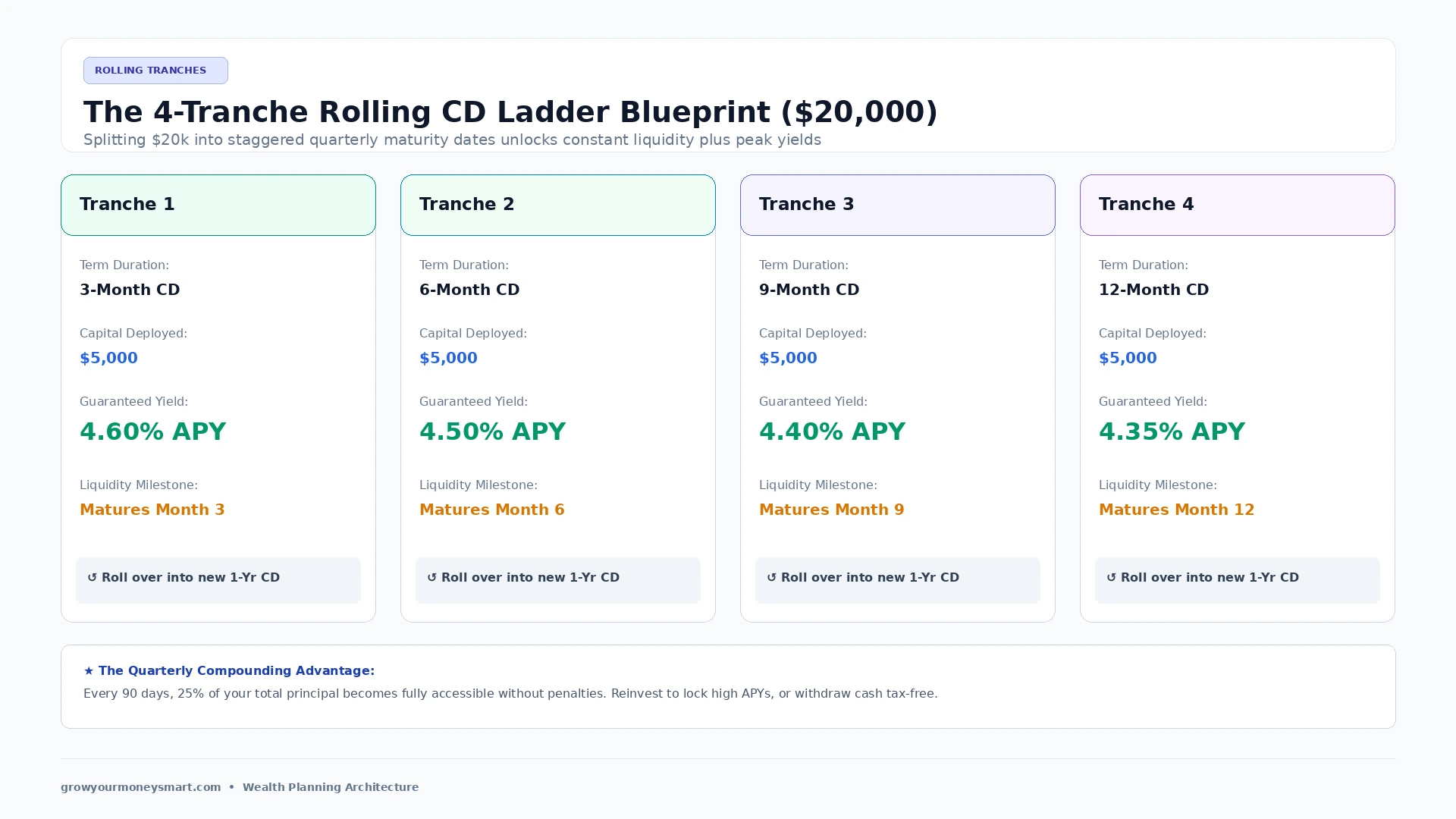
Suppose you have $20,000 in liquid capital earmarked for medium-term goals. Instead of placing the entire $20,000 into a single 12-month CD, you divide it into four equal $5,000 rungs:
- Rung 1: $5,000 in a 3-Month CD (Yielding 4.60% APY). Matures in 90 days.
- Rung 2: $5,000 in a 6-Month CD (Yielding 4.50% APY). Matures in 180 days.
- Rung 3: $5,000 in a 9-Month CD (Yielding 4.40% APY). Matures in 270 days.
- Rung 4: $5,000 in a 12-Month CD (Yielding 4.35% APY). Matures in 360 days.
The Compounding Flywheel: In Month 3, Rung 1 matures. If you do not require emergency cash, you roll that $5,000 plus accrued interest into a brand new 12-month CD. In Month 6, Rung 2 matures and rolls into another 12-month CD. Within one calendar year, you hold four 1-year CDs paying higher long-term yields, yet 25% of your total capital matures penalty-free every single quarter.
4. The Time Horizon Allocation Matrix (CD vs. HYSA vs. S&P 500)
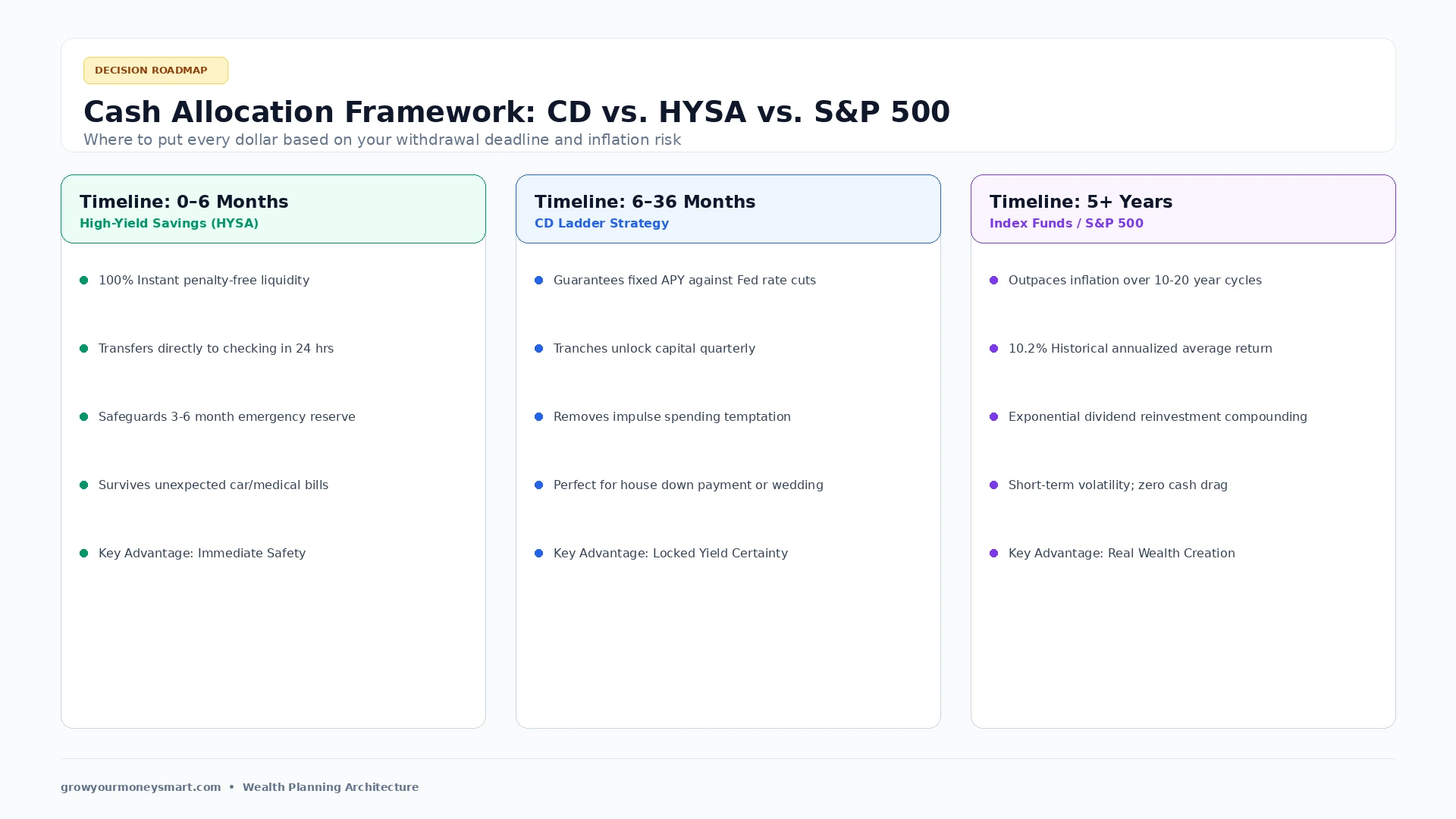
Deciding between fixed cash instruments and equity markets depends on a single non-negotiable metric: your specific expenditure timeline. For deep dive analysis on asset longevity, read our comprehensive guide on understanding your investment time horizon.
The Golden Rule of Cash Allocation:
- 0 to 6 Months: Keep 100% in our vetted best high-yield savings accounts to maintain an ironclad, penalty-free safety net. If you are starting from scratch, follow our blueprint on how to save your first $1,000 fast.
- 6 to 36 Months: Allocate into a CD Ladder or Brokered Treasury Bills. Perfect for home down payments, tuition, or planned automobile purchases. Track your progress with our free monthly budget spreadsheet and net worth tracker.
- 5+ Years: Avoid cash drag entirely. Dollar-cost average into diversified broad-market index funds like the S&P 500 or Total Stock Market index to overcome purchasing power erosion. See our analysis on HYSA vs Stocks in 2026.
5. Tax Efficiency: Conventional CDs vs. Brokered CDs vs. T-Bills
A critical blind spot that most affiliate personal finance blogs omit is the state and local income tax drag on interest payments according to official IRS Tax Topic 403 on Interest Income:
- Bank CDs & HYSAs: Interest earned is taxed at your ordinary marginal income tax rate at both the Federal and State/Local levels. If you reside in high-tax jurisdictions (such as California, New York, or New Jersey), a 4.50% headline APY can compress below 3.00% net of taxes.
- Brokered CDs via Brokerages: Offered through platforms like Fidelity, Charles Schwab, and Vanguard. Brokered CDs can be traded on the secondary market prior to maturity without paying bank penalty fees, though their market value fluctuates inversely with interest rates.
- Treasury Bills (T-Bills): Short-term government securities (4, 8, 13, 26, 52 weeks) backed by the full faith and credit of the U.S. government. Crucially, T-Bill interest is 100% exempt from state and local income taxes, often beating both bank CDs and HYSAs on an after-tax equivalent yield basis.
If you are managing consumer liabilities alongside cash reserves, ensure you eliminate high-interest revolving credit first. Check our rankings for the best 0% APR balance transfer credit cards, learn to calculate balance transfer fees vs interest saved, or calculate payoff speed using our debt avalanche vs snowball strategy guide.
6. Frequently Asked Questions: CD Ladders vs. HYSAs
What are the main differences between a CD ladder and a HYSA?
A High-Yield Savings Account (HYSA) pays a variable interest rate that fluctuates with Federal Reserve policy changes, but offers 100% liquid cash access without penalties. A CD ladder divides funds across staggered Certificates of Deposit (e.g., 3, 6, 9, 12 months) to lock in fixed guaranteed rates, immunizing your returns against falling interest rates while providing quarterly liquidity.
Which is better for an emergency fund: CD ladder or HYSA?
An HYSA is the uncontested gold standard for your primary emergency fund (3 to 6 months of living expenses). Emergencies require instant, penalty-free access. A CD ladder should only be used for secondary emergency buffers or planned medium-term purchases where you won’t need to break tranches early.
Do CD ladders pay more than high-yield savings accounts?
In a falling interest rate environment, CD ladders significantly outperform HYSAs because you lock in peak APYs (up to 4.75%) before bank savings rates drop. However, during rising rate cycles, HYSAs automatically adjust upward without locking your money into outdated yields.
What happens if I need money from a CD ladder early?
If you liquidate a CD before maturity, the bank imposes an early withdrawal penalty, usually costing between 60 to 180 days of simple interest. Your original principal remains protected, but accrued yield is partially surrendered.
Can you lose money in a CD ladder or high-yield savings account?
No. As long as you deposit funds in FDIC-insured banks or NCUA-insured credit unions, your capital is guaranteed up to $250,000 per depositor, per institution. Neither account carries stock market volatility risk.
How much money do you need to start a CD ladder?
Most online banks require $500 to $1,000 per CD. Constructing a 4-rung ladder typically requires $2,000 to $4,000. Alternatively, brokered CDs through discount brokers allow $1,000 tranches with zero transaction commissions.

Jaiveer Hooda is the Lead Financial Researcher & Personal Finance Analyst at Grow Your Money Smart. Specializing in personal wealth optimization, index fund compounding, high-yield savings mechanics, and consumer debt elimination strategies. With a background in computer engineering, he applies mathematical modeling, cashflow simulations, and empirical risk analysis to evaluate personal finance vehicles and credit products. Every analysis is backed by verified regulatory disclosures, IRS tax schedules, and empirical APY compounding math.
Areas of Expertise: Personal Finance · High-Yield Savings Accounts (HYSA) · Index Funds & S&P 500 Compounding · Retirement Planning (401k/IRA) · Debt Optimization · Credit Card APR Mechanics.
Transparency & Editorial Policy: Editorial Standards | Report a Correction