
The Federal Deposit Insurance Corporation (FDIC) provides standard coverage of $250,000 per depositor, per insured bank, for each account ownership category. You are not restricted to $250,000 per bank. By strategically structuring account ownership categories (single accounts, joint accounts, revocable trusts, and IRAs), a married couple can legally insure over $1,000,000 to $2,000,000+ at a single banking institution with 100% full backing of the U.S. government.
- The Core Formula: Coverage is calculated per depositor, per insured bank, per ownership category—NOT simply per person.
- Joint Account Superpower: A joint account provides $250,000 in coverage per co-owner, totaling $500,000 in protection for that account alone.
- Trust Account Scaling: Revocable trust accounts (including Payable on Death / POD designations) insure up to $250,000 per unique beneficiary (up to 5 beneficiaries, or $1.25M per owner).
- Multi-Million Cash Networks: Deposit sweep networks like IntraFi (CDARS) allow individuals and businesses to insure tens of millions of dollars across hundreds of chartered banks with a single login.
Following high-profile regional bank failures in recent years, depositors have become keenly aware of a critical reality: Deposits exceeding the standard $250,000 limit become uninsured creditors of a failed bank.
However, widespread confusion remains regarding how the FDIC rules are actually structured. Many depositors mistakenly believe they must open accounts across four or five different banks to protect $1,000,000 in cash. In reality, understanding the official FDIC ownership categories allows you to safely insure multi-million-dollar cash positions with absolute legal protection.
How FDIC Insurance Really Works: The Golden Rule
Under federal statute (12 U.S.C. 1821(a)), the FDIC provides up to $250,000 in insurance backing backed by the full faith and credit of the United States Government. Crucially, this coverage applies:
“Per Depositor, Per Insured Bank, Per Ownership Category”
This means that if you hold funds in different legal ownership categories at the same financial institution, each category receives its own separate $250,000 insurance limit. What qualifies as an insured deposit? Checking accounts, savings accounts, high-yield savings accounts, money market deposit accounts, and certificates of deposit (CDs).
The 5 Core FDIC Ownership Categories
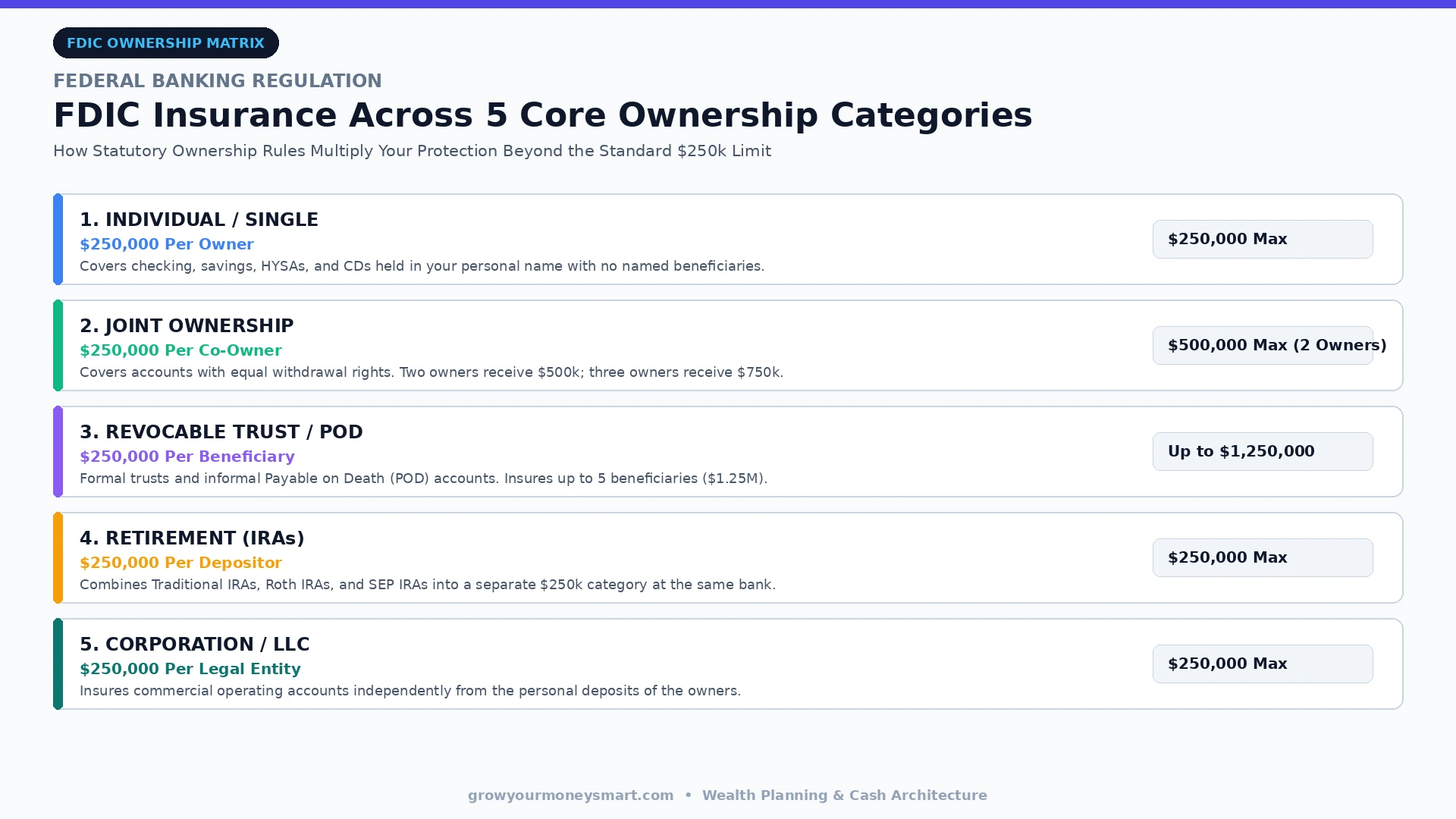
To maximize coverage, you must understand the five primary personal ownership categories recognized by the FDIC:
| Ownership Category | Coverage Formula | Maximum Insured Limit Example |
|---|---|---|
| 1. Single Accounts | $250,000 per owner | $250,000 total |
| 2. Joint Accounts | $250,000 per co-owner | $500,000 for 2 owners ($750k for 3) |
| 3. Revocable Trust / POD | $250,000 per unique beneficiary | Up to $1,250,000 per owner (5 beneficiaries) |
| 4. Certain Retirement (IRAs) | $250,000 per owner for all IRAs | $250,000 total (Traditional + Roth combined) |
| 5. Business / Corporation | $250,000 for separate legal entity | $250,000 separate from personal accounts |
Tactical Blueprint: How a Married Couple Can Insure $1,000,000+ at a Single Bank
By leveraging ownership categories, a married couple (e.g., Alex and Jordan) can legally protect $1,000,000 in cash deposits at one single bank without opening accounts at competitor institutions:
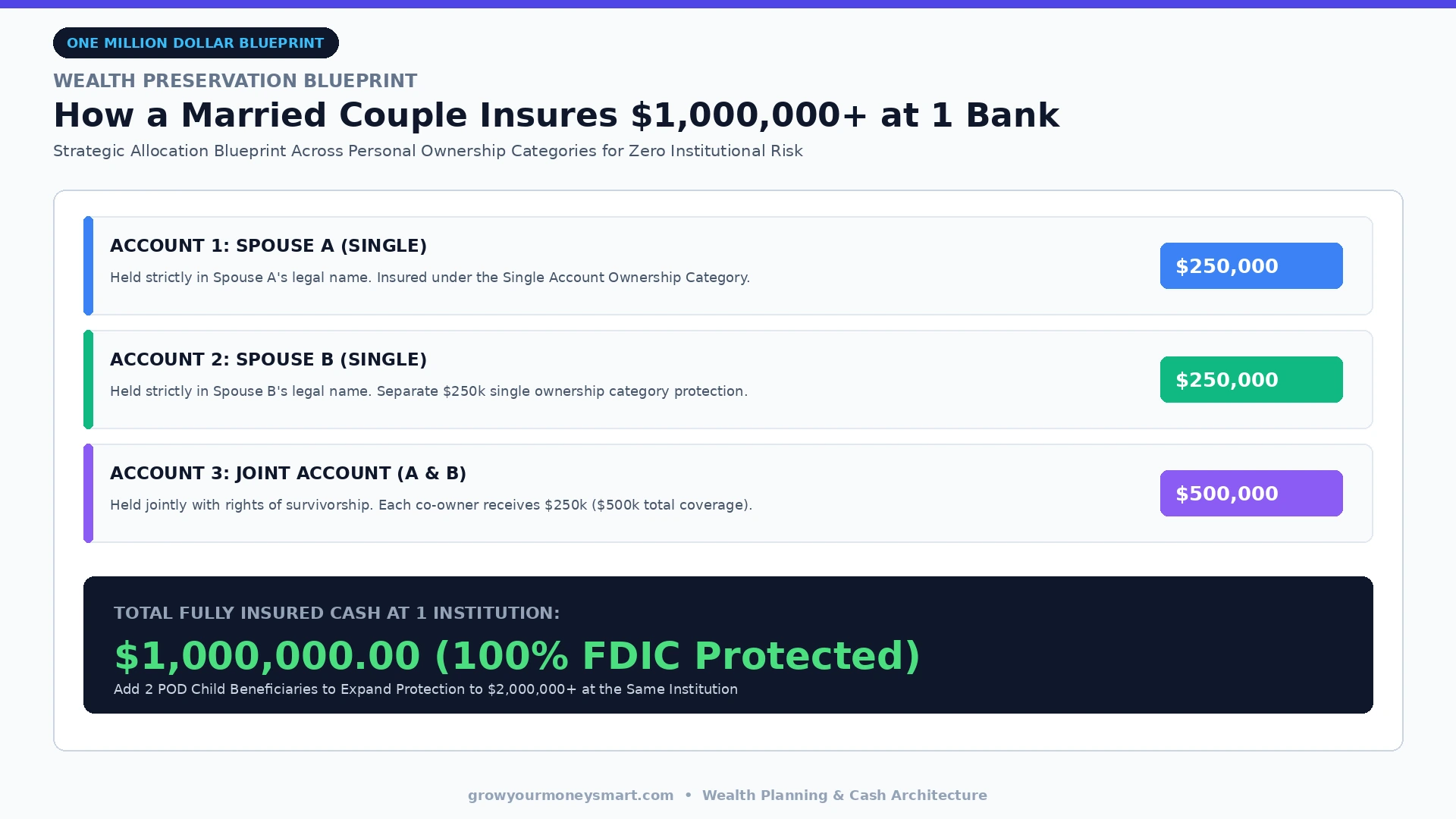
Here is how the $1,000,000 allocation structure works in practice:
- Account 1 (Alex – Individual): $250,000 in an HYSA in Alex’s name alone. Insured under the Single Ownership category ($250k coverage).
- Account 2 (Jordan – Individual): $250,000 in an HYSA in Jordan’s name alone. Insured under Jordan’s separate Single Ownership category ($250k coverage).
- Account 3 (Alex & Jordan – Joint): $500,000 in a Joint Savings account or a rolling CD ladder. Because joint accounts provide $250,000 per co-owner, the entire $500,000 is 100% insured.
Total Insured Cash at 1 Bank: $1,000,000.00. If the couple designates two children as Payable on Death (POD) beneficiaries on their revocable trust accounts, their legal FDIC insurance limit at that exact same bank expands to $2,000,000.
Advanced Protection: IntraFi Network (CDARS) & Cash Sweep Programs
For high-net-worth households and businesses holding $5 million to $50 million+ in cash, manually managing dozens of bank relationships is an administrative nightmare. To solve this, major banks and fintech platforms utilize Deposit Sweep Networks, most notably the IntraFi Network (formerly known as CDARS / Promontory):
- How It Works: You deposit $5,000,000 with your primary participating bank. The bank’s software automatically breaks your funds into increments below $250,000 and sweeps them across 20+ chartered member banks in the network.
- Full Federal Protection: Because each sub-deposit sits at a different FDIC-insured bank, 100% of your multi-million-dollar balance receives full federal insurance backing.
- Unified Banking Experience: You receive a single consolidated monthly statement, one tax form (1099), and manage your capital through a single login.
Fintech cash management accounts (such as Wealthfront, Betterment, and SoFi) utilize similar proprietary sweep programs, providing depositors with up to $2,000,000 to $8,000,000 in FDIC coverage seamlessly. Learn more in our emergency fund & HYSA master guide.
Frequently Asked Questions: FDIC Insurance Limits
Final Verdict: Protecting Your Wealth
Protecting large cash reserves does not require financial gymnastics. By mastering ownership categories and utilizing sweep networks, your capital remains completely shielded from institutional insolvency while generating peak yields in the best high-yield savings accounts.

Jaiveer Hooda is the Lead Financial Researcher & Personal Finance Analyst at Grow Your Money Smart. Specializing in personal wealth optimization, index fund compounding, high-yield savings mechanics, and consumer debt elimination strategies. With a background in computer engineering, he applies mathematical modeling, cashflow simulations, and empirical risk analysis to evaluate personal finance vehicles and credit products. Every analysis is backed by verified regulatory disclosures, IRS tax schedules, and empirical APY compounding math.
Areas of Expertise: Personal Finance · High-Yield Savings Accounts (HYSA) · Index Funds & S&P 500 Compounding · Retirement Planning (401k/IRA) · Debt Optimization · Credit Card APR Mechanics.
Transparency & Editorial Policy: Editorial Standards | Report a Correction