
To automate your savings, practice ‘Pay Yourself First’: split your payroll direct deposit so 20% routes straight into an FDIC-insured 4.0%+ HYSA and Roth IRA on payday. Put fixed living bills on automated full-balance payment, and spend only the remainder on a separate debit card.
- Willpower Is Flawed: Trying to manually save “whatever is left at the end of the month” fails 95% of the time. Automation removes emotional friction completely.
- The Payday Split: Use payroll split deposits to divert 20% of your net pay to savings before you ever see the money in checking.
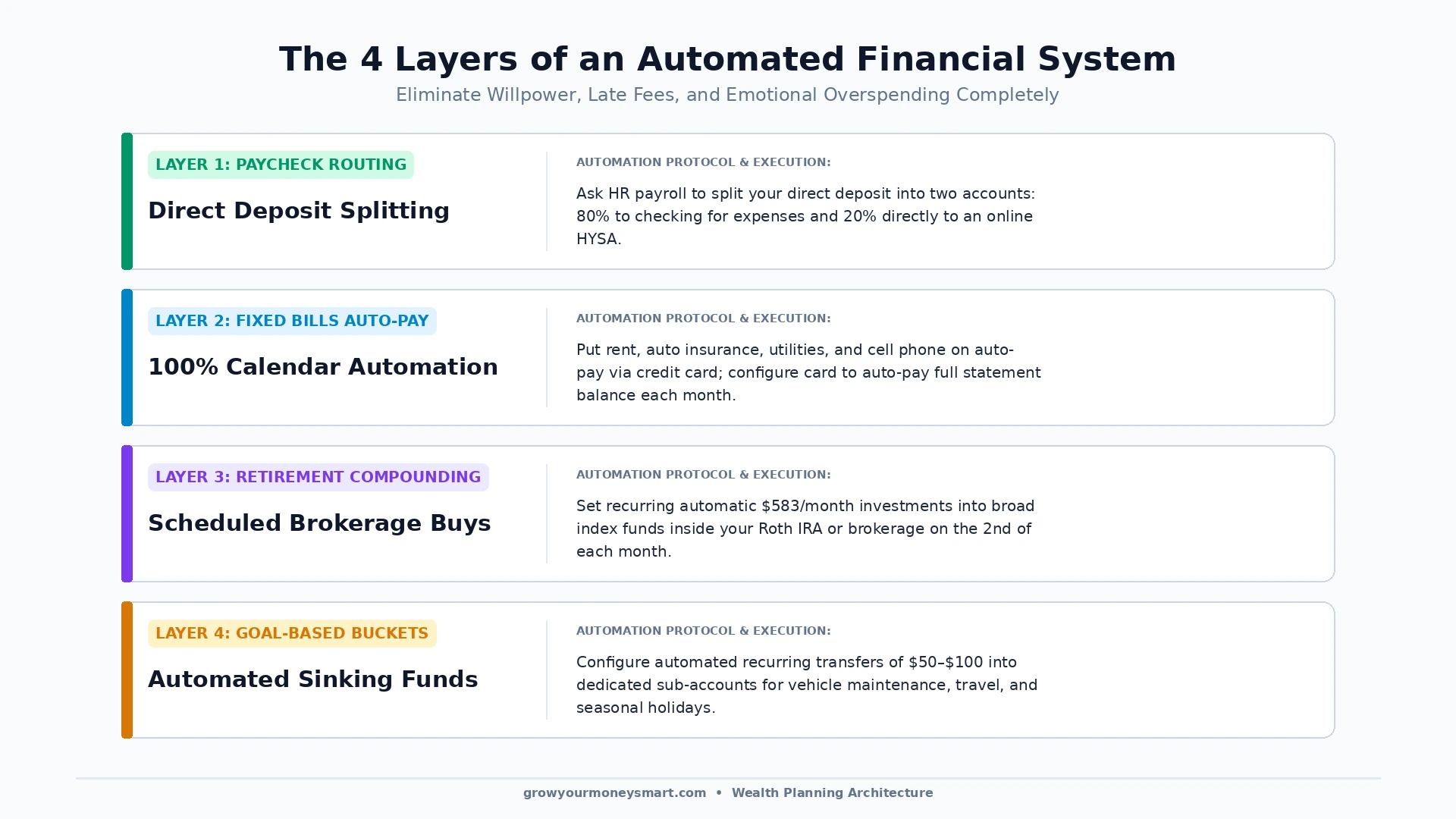
- The 4-Layer System: 1) Direct deposit routing, 2) Fixed bill calendar auto-pay, 3) Automated index fund investing, and 4) Sinking fund sub-accounts.
- Zero Fee Execution: Never pay $3 to $5 monthly app fees. Use native recurring bank ACH transfers for 100% free automation.
- The 1-Month Buffer: Keep a permanent $1,000 cash cushion in your bill checking account to guarantee you never trigger an overdraft fee.
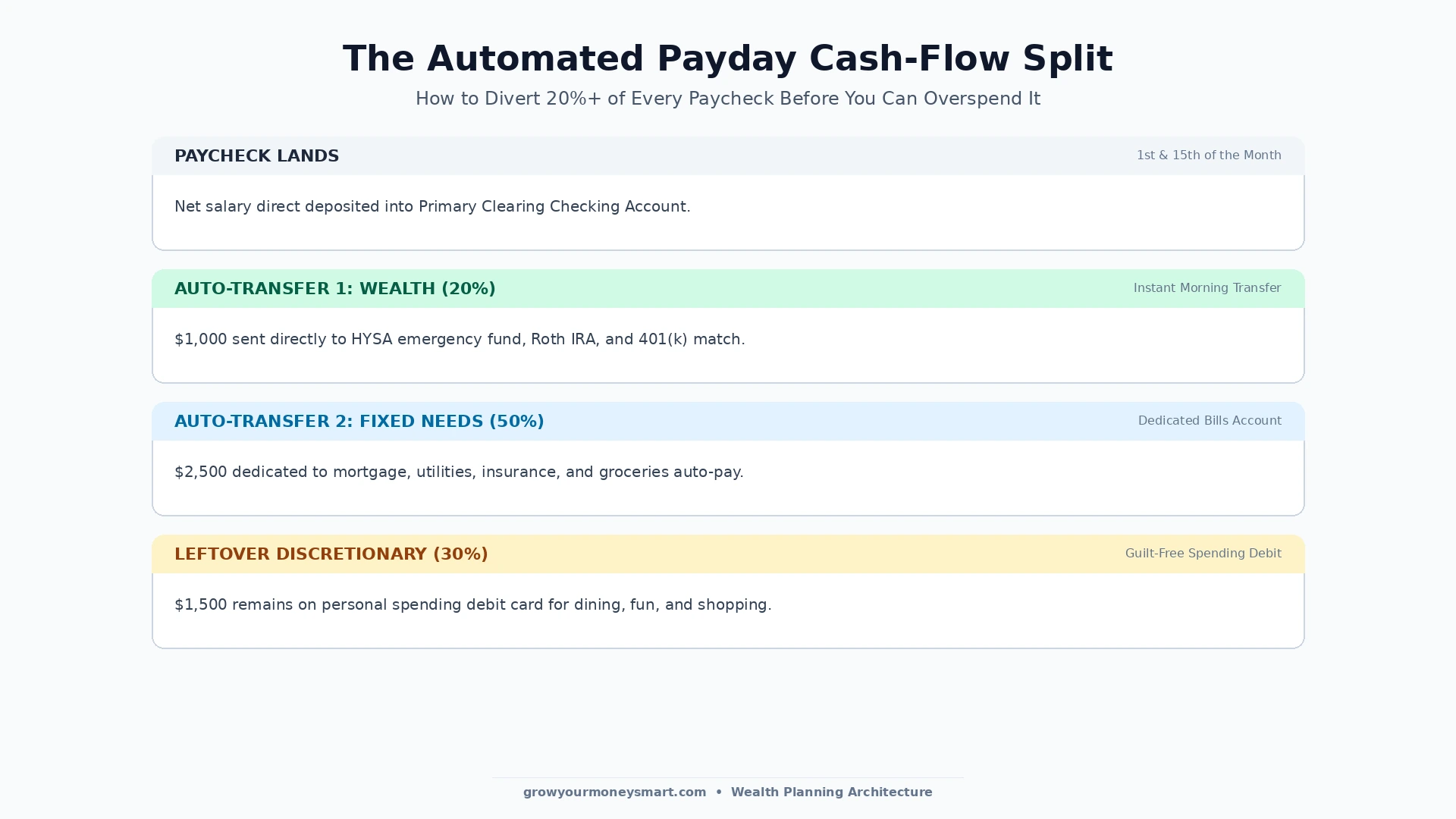
The single greatest reason personal budgets fail is not a lack of financial knowledge, high inflation, or low income. Budgets fail because they rely on human willpower.
Every time you tell yourself, “I will save whatever is left in my checking account at the end of the month,” lifestyle inflation silently intervenes. A spontaneous dinner with friends, a flash online sale, or grocery delivery upgrades slowly erode your balance. By the 28th of the month, your savings surplus has vanished into thin air.
Wealthy individuals and disciplined investors don’t rely on willpower. They build an automated financial machine. By reversing your cash flow and practicing the timeless rule of “Pay Yourself First,” you force yourself to save 20%+ of your income without ever lifting a finger.
Whether you earn a $3,000 salary, a $4,000 salary, or a $5,000 monthly income, this 2026 blueprint details how to construct a hands-free banking ecosystem that eliminates financial stress forever. You can also calculate your exact percentage splits using our interactive free budget calculator.
The 4 Pillars of a Hands-Free Financial System
A truly hands-free personal finance architecture operates across four distinct sequential layers:
Layer 1: Direct Deposit Paycheck Splitting
Most employers allow you to split your paycheck across multiple direct deposit accounts through your payroll portal. Instruct HR to direct 80% of your net pay to your primary checking account and 20% directly into an online High-Yield Savings Account. By separating wealth at the source, you never suffer the psychological pain of moving money out of checking.
Layer 2: Fixed Living Costs on 100% Calendar Auto-Pay
Set up automatic payments for rent/mortgage, utilities, car insurance, internet, and student loans. For credit cards, enable “Auto-Pay Full Statement Balance” on the due date. This ensures you never pay a single penny in credit card interest or late fees while improving your credit score automatically.
Layer 3: Automated Retirement Compounding
After your paycheck lands, set up a recurring automated monthly transfer to your Roth IRA (e.g., $583.33/month to max out your $7,000 annual limit under current IRS rules). Configure your brokerage (such as Vanguard or Fidelity) to automatically execute purchase orders for total stock market index funds or S&P 500 ETFs on the 2nd business day of the month.
Layer 4: Goal-Based Sinking Fund Buckets
As explained in our guide on What Is a Sinking Fund?, configure automated recurring transfers of $50 to $150 per month into dedicated sub-accounts for auto maintenance, holiday gifts, and annual vacations. When life happens, the cash is already waiting.
Expert Video Breakdown: Automating Your Personal Finances
To see an exact visual demonstration of setting up direct deposit splits, sub-savings accounts, and hands-free transfers, watch New York Times bestselling author Ramit Sethi:
Frequently Asked Questions (FAQs)
Automating your savings means setting up scheduled, electronic transfers that automatically move money from your paycheck or checking account into savings and investment accounts on payday without requiring manual willpower.
Pay Yourself First is a budgeting strategy where you route a fixed percentage of your income (such as 20%) into savings, debt elimination, and investments the very morning you get paid, before spending on discretionary lifestyle wants.
Yes. If your income fluctuates, automate based on your lowest historical baseline month (e.g., $3,000/month) and manually sweep 50% of any surplus into savings during high-earning months.
Yes, provided you maintain a 1-month cash buffer in your primary bills checking account to prevent overdraft fees, and review your statements monthly for billing errors.
Follow the 50/30/20 rule: automate at least 20% of your take-home pay into emergency savings, retirement accounts, and extra debt payoff.
You need three primary accounts: 1) A primary checking account for fixed bills, 2) An FDIC-insured High-Yield Savings Account for emergency funds, and 3) A tax-advantaged retirement account (like a Roth IRA) for automated index fund investing.
Some third-party micro-investing apps charge monthly subscription fees ($3–$5/month). You can achieve 100% of these automations completely free by using standard bank scheduled recurring transfers.
You can prevent overdrafts by linking your checking account to an HYSA with free overdraft protection, or by maintaining a permanent $500 to $1,000 checking account cash cushion.

Jaiveer Hooda is a personal finance researcher and the founder of Grow Your Money Smart. With a background in computer engineering, he approaches money the way an engineer approaches any complex system — through data analysis, mathematical modeling, and ruthless optimization.
He built this platform on a single conviction: financial freedom is not a matter of luck. It is a system that can be designed, tested, and executed by anyone willing to follow the right blueprint. Every strategy published here is researched to the numbers, not written to the trend.
Expertise: Debt elimination · Retirement planning · Passive income · Budgeting systems
Connect: Pinterest | growyourmoneysmart.com | Contact Us