
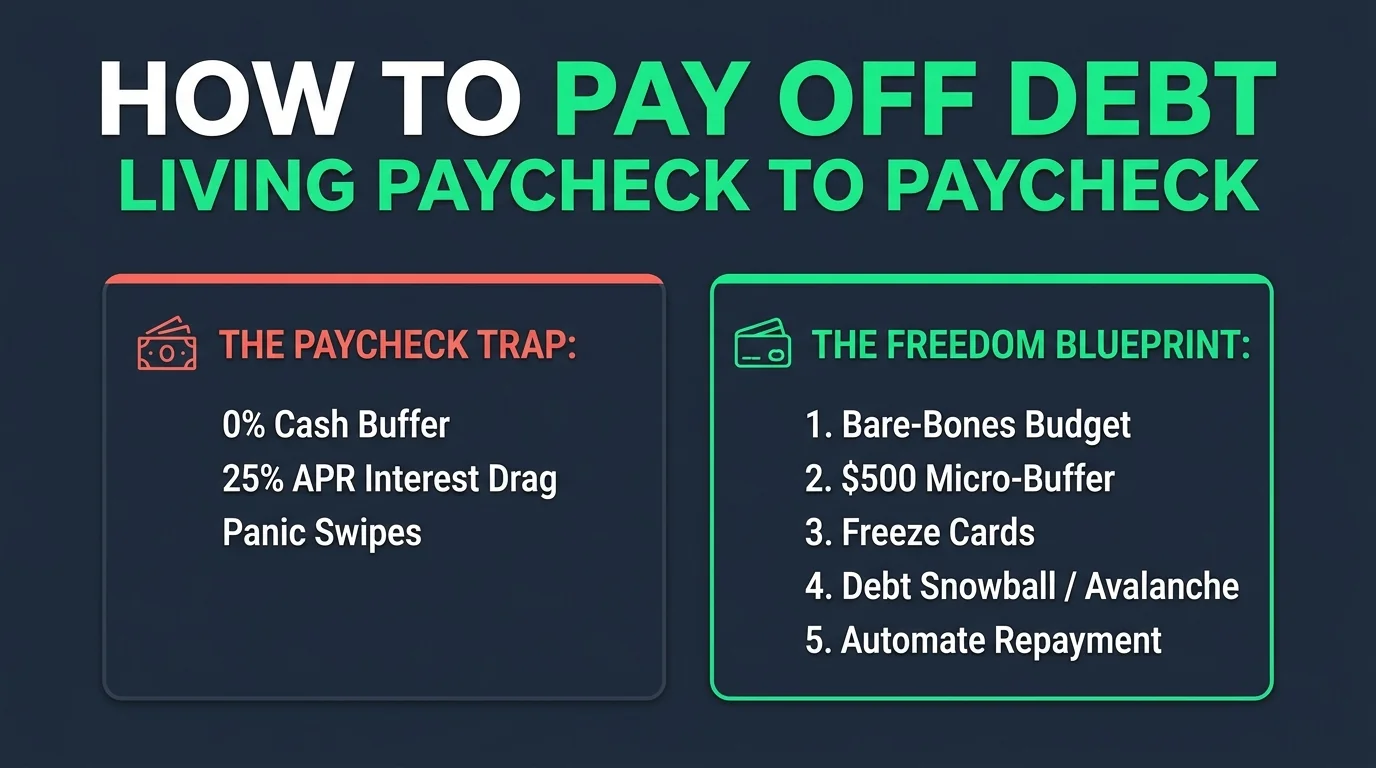
- The Margin Trap: Living paycheck to paycheck while carrying debt is rarely an income-only problem; it is a cash flow timing and interest drag crisis. When 25%–29% APR eats your disposable income, you must manufacture margin before attacking principal.
- The $500 Micro-Buffer Rule: Never send 100% of your spare pennies to credit card companies without a $500 to $1,000 cash reserve. Without this starter shield in a high-yield account, the next minor flat tire immediately forces you back into debt.
- Stop the Bleeding Instantly: Remove saved credit cards from digital wallets (Apple Pay, Amazon). You cannot drain a flooded basement while the faucet is still running at full blast.
- Micro-Margin Compounding: Finding just $100/month via a bare-bones spending audit collapses an 18-year credit card repayment timeline down to just 3.2 years, saving over $12,700 in toxic interest.
- Staged Payoff Sequencing: Use the Debt Snowball to score rapid psychological wins on your smallest balance, or the Debt Avalanche to minimize mathematical interest loss. Model your trajectory with our interactive debt payoff calculator.
The Paycheck-to-Paycheck Debt Cycle: Why Standard Advice Fails
According to recent Federal Reserve and consumer finance data, over 60% of American households live paycheck to paycheck, with credit card balances topping record highs and average APRs surpassing 24%. When every single dollar of your bi-weekly paycheck is spoken for before it even hits your checking account, generic financial platitudes like “just pay double the minimum” or “cut back on morning lattes” feel utterly detached from reality.
When you are stretched to the absolute financial limit, carrying high-interest consumer debt creates a vicious psychological and financial treadmill:
- Compounding Interest Drag: Minimum payments barely touch your principal balance. A $15,000 credit card balance at 24.99% APR generates nearly $310 per month in pure finance charges alone, consuming money that should be feeding your family or building wealth.
- The Zero-Liquidity Vulnerability: When checking account balances hover near zero between paydays, an unexpected $400 utility spike or car repair triggers immediate panic, forcing you to swipe the card again and erasing weeks of progress.
- Cash Flow Timing Mismatches: When fixed bills (rent, auto loans) are due on the 1st of the month, but paychecks arrive on alternating Fridays, overdraft fees and late penalties compound the damage.
Breaking this trap requires a realistic, mathematically proven margin-creation framework. In this 2026 guide, you will learn the exact 5-step operational blueprint to stabilize your cash flow, build a defensive cash buffer, halt interest accumulation, and eliminate debt permanently—even if you currently have zero extra cash at the end of the month.
Paycheck-to-Paycheck Debt Strategies: Strategic Comparison Matrix
When resources are tight, choosing the correct debt strategy determines whether you achieve permanent financial freedom or burn out within 60 days. Here is how the four primary debt payoff approaches perform on a zero-margin budget:
| Strategy Metric | Minimum Payments Only | Debt Snowball (Smallest Balance) | Debt Avalanche (Highest APR) | The 2026 Micro-Margin Blueprint |
|---|---|---|---|---|
| Core Philosophy | Pay mandatory minimums across all cards. | Attack smallest dollar balance with micro-surplus. | Attack highest interest rate card first. | Staged cash flow buffer + negotiated APR + micro-bursts. |
| Payoff Speed | Extremely Slow (15 to 25+ years). | Fast psychological momentum (2 to 4 years). | Mathematically fastest (1.8 to 3.5 years). | Optimal: Accelerates rapidly as monthly payments vanish. |
| Total Interest Cost | Devastating (Often 100%–150%+ of original principal). | Moderate (Slightly higher interest than Avalanche). | Lowest possible total interest paid. | Minimized: Combines rate reduction with accelerated principal paydown. |
| Relapse & Shock Risk | Critical: 100% chance of new debt on emergency. | Moderate if no emergency buffer exists. | Moderate if large balances delay early wins. | Near Zero: Protected by a dedicated starter cash cushion. |
| Best Suited For | Those with zero strategy (Must avoid). | Overwhelmed debtors needing quick emotional wins. | Disciplined, analytical budgeters. | Anyone living paycheck to paycheck on a tight income. |
Mathematical Simulation: The Compounding Power of Micro-Margins
Many individuals believe that unless they have an extra $500 or $1,000 each month, making extra debt payments is useless. This is one of the most destructive misconceptions in personal finance. Because revolving credit card interest compounds daily, even a tiny micro-payment directed straight to principal drastically short-circuits the amortization curve.
Consider a realistic case study of a household earning $3,500 net monthly income carrying $15,000 in credit card debt across 3 cards at an average 24.99% APR:
| Repayment Scenario | Monthly Payment | Time to Debt Freedom | Total Interest Paid | Total Money Saved |
|---|---|---|---|---|
| Scenario A: Minimum Payments Only | $450/mo (Declining) | 18.5 Years (222 mos) | $16,840 | $0 (Baseline Trap) |
| Scenario B: +$50 Micro-Margin | $500/mo (Fixed) | 4.4 Years (53 mos) | $6,110 | Saves $10,730 & 14.1 Years |
| Scenario C: +$100 Micro-Margin | $550/mo (Fixed) | 3.2 Years (38 mos) | $4,120 | Saves $12,720 & 15.3 Years |
| Scenario D: +$250 Accelerated Margin | $700/mo (Fixed) | 2.1 Years (25 mos) | $2,480 | Saves $14,360 & 16.4 Years |
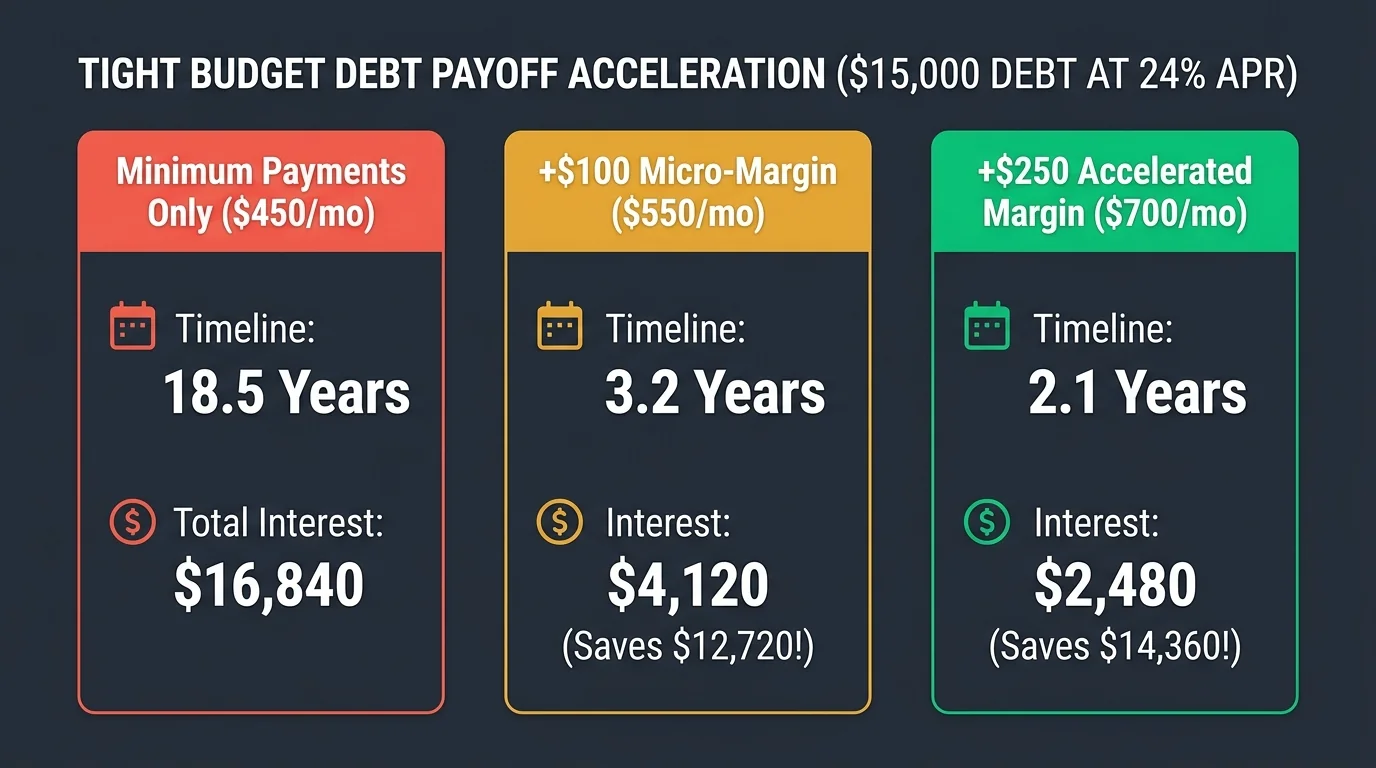
As demonstrated in the simulation, scraping together just $100 in extra monthly cash flow cuts your debt timeline by more than 15 full years and eliminates over $12,700 in pure interest waste. You can test your personal balances and interest rates using our free debt payoff calculator.
The 5-Step Actionable Blueprint to Pay Off Debt When Living Paycheck to Paycheck
Follow this exact chronological framework to escape the paycheck cycle without putting your family’s basic needs at risk:
Step 1: Secure the “Four Walls” & Fix Paycheck Timing Mismatches
Before sending a single extra penny to lenders, you must protect your foundational survival needs—often called the Four Walls: Food, Utilities, Shelter (Rent/Mortgage), and Basic Transportation. If you are struggling on a moderate income, review our guide on how to budget a $3,000 monthly income to see a line-by-line breakdown.
Next, eliminate artificial paycheck stress by synchronizing your billing calendar. Call your utility companies, auto lenders, and credit card issuers to shift your payment due dates so that half of your bills fall right after your first paycheck of the month, and the remaining half fall after your second paycheck. This simple 15-minute phone call prevents mid-month bank account droughts and eliminates overdraft fees.
Step 2: Build a Non-Negotiable $500 to $1,000 Micro-Buffer
The number one reason people fail to get out of debt while living paycheck to paycheck is premature aggressive repayment. If you have $0 in savings and throw every spare dollar at debt, a blown tire or medical co-pay immediately forces you to swipe your credit card again. This creates emotional despair and restarts the debt cycle.
Pause all extra debt payments and pay only the minimums until you accumulate a $500 to $1,000 starter emergency fund in a separate High-Yield Savings Account. Check our step-by-step tutorial on how to save your first $1,000 on a low income to build this cushion in under 45 days. Use our emergency fund calculator to establish your long-term safety target.
Step 3: Freeze Credit Card Usage & Negotiate APRs
You cannot empty a sinking boat while water is still pouring in over the sides. Take immediate action to stop creating new debt:
- Remove Cards from Digital Wallets: Delete stored payment methods from Amazon, Target, Uber Eats, and Apple Pay to introduce friction into your spending impulses.
- Call Creditors for Hardship Reductions: Contact your credit card issuers’ retention or hardship departments. Ask for a temporary APR reduction or enrollment in an internal repayment plan. Many major banks can reduce a 28% APR down to 9%–12% for 12 to 24 months if you demonstrate tight cash flow. Review our detailed guide on debt management strategies and hardship programs.
- Evaluate 0% APR Balance Transfers: If your credit score is still above 660, moving high-interest balances to a 0% promotional card halts interest accumulation entirely for 15 to 21 months, allowing 100% of your payments to crush principal.
Step 4: Manufacture Margin via Micro-Budgeting & Found Money
When living paycheck to paycheck, margin is not found—it is manufactured. Conduct a forensic 90-day bank audit to locate hidden cash leaks:
- Subscription Cull ($30–$80/mo): Cancel recurring streaming apps, forgotten gym memberships, and cloud storage subscriptions.
- Insurance Shopping ($40–$120/mo): Compare auto and renter’s insurance policies or raise your deductible slightly to immediately lower monthly premiums.
- Selling Unused Household Items ($200–$500 one-time): List electronics, unused tools, designer clothes, and old furniture on Facebook Marketplace to generate an instant lump-sum debt payment.
- Micro-Side Hustles ($150–$300/mo): Allocate 3–5 hours per week to gig economy tasks (grocery delivery, pet sitting, freelancing) with 100% of earnings routed directly to your target debt.
Track every dollar using a customized zero-based budget with our free interactive budget calculator.
Step 5: Execute Sequential Payoff & Snowball Freed Cash Flow
Once your starter cash cushion is secured and you have freed $75 to $200 in monthly margin, unleash your chosen repayment method:
If you choose the Debt Snowball, list all your debts in ascending order of balance. Pay minimums on all accounts except the smallest debt. Throw your entire monthly margin at that smallest balance until it hits zero. Once eliminated, take its entire minimum payment plus your margin and roll it into the next smallest balance. As each debt falls, your monthly firepower expands exponentially.
For an in-depth strategic analysis of whether to prioritize debt elimination or cash preservation at different stages, explore our cornerstone guide on paying off debt vs saving an emergency fund.
Expert Video Walkthrough: Fastest Way to Pay Off Debt on Low Income
For visual learners navigating tight household budgets, personal finance author George Kamel breaks down realistic, actionable tactics to eliminate credit card balances rapidly without feeling deprived:
Psychological Pitfalls & How to Avoid Relapse
Eliminating debt on a tight income is as much a mental battle as a mathematical one. Watch out for these three dangerous cognitive traps:
- Frugality Fatigue: Slashing every enjoyable expense leads to burnout. Keep a tiny, guilt-free $20–$30 monthly line item for simple pleasures (e.g., family movie night pizza) to maintain long-term stamina.
- The Windfall Trap: When tax refunds, work bonuses, or cash gifts arrive, resist the urge to upgrade your lifestyle. Direct 80% to debt principal and 20% to your emergency fund buffer.
- Comparing Your Journey to Others: Everyone starts with different circumstances, cost of living, and obligations. Focus solely on your month-over-month debt balance reduction. When evaluating whether to hire professional assistance, read our comparison on DIY financial planning vs hiring a financial advisor.
Frequently Asked Questions (FAQs)
Below are clear, expert answers to the most urgent questions about paying off debt while living paycheck to paycheck:
When cash flow is zero, you must manufacture margin through two levers: temporarily trimming non-essential recurring expenses (subscriptions, discretionary dining, renegotiating car insurance) and generating temporary micro-income (selling household clutter, 3–5 hours of weekly gig work). Freeing even $50 to $100 per month cuts debt repayment timelines by years.
Always build a $500 to $1,000 starter emergency fund before making extra debt payments. Without this starter cash reserve, unexpected car repairs or medical co-pays will force you back onto high-interest credit cards, restarting the debt cycle. Once the starter fund is locked in, aggressively attack high-interest debt.
For individuals living paycheck to paycheck, the Debt Snowball (paying smallest balance first) is often superior because eliminating small accounts quickly frees up their minimum monthly payments, providing immediate breathing room in your monthly cash flow and huge psychological momentum.
Yes. Most major credit card issuers have internal customer hardship programs that can lower your APR from 25%+ down to 6%–12% for 12 to 36 months, or waive late fees if you agree to close or freeze the account during structured repayment.
Debt consolidation or a 0% APR balance transfer card can save thousands in interest, but only if you have resolved the underlying spending habits and stopped using credit cards. If your credit score is too low to qualify, explore non-profit credit counseling through the NFCC instead of risky predatory loans.
Never sacrifice your employer 401(k) match, as an employer match delivers an immediate 50% to 100% return on your money. However, you should temporarily pause voluntary retirement contributions above the match until toxic high-interest credit card debt is fully eliminated.
Contact all service providers and lenders to adjust your due dates across the month so half fall after your first paycheck and half after your second paycheck. Additionally, maintain a $100 to $200 buffer in your checking account specifically as a transaction cushion.
With minimum payments only, it typically takes 15 to 25 years. However, by establishing a starter buffer, negotiating APRs, and applying just $100 to $200 in monthly micro-margins, most households eliminate $10,000 to $20,000 in consumer debt within 24 to 36 months.
Calculating your exact debt-to-income (DTI) ratio is critical for understanding financial risk and qualifying for favorable loan terms. Consult the official Consumer Financial Protection Bureau (CFPB) Debt-to-Income Guidelines for statutory guidelines and consumer protections.
⚡ Cash Margin & Debt Elimination Resources
Escape the paycheck-to-paycheck trap faster by pairing debt reduction with starter cash buffers and automated systems:
- Starter Buffer: saving your first $1,000 emergency starter fund — protecting yourself against unexpected emergencies so you stop relying on credit cards.
- Paycheck Budgeting: living paycheck to paycheck survival budget guide — step-by-step cash flow allocation for tight monthly budgets.
- Avoid Interest Traps: credit card minimum payment calculator and true cost — see how paying only minimums extends debt for decades.
- Systematic Repayment: debt avalanche vs snowball payoff strategies — choosing the optimal mathematical method to wipe out balances.
- Interactive Calculator: interactive debt payoff calculator — calculate your exact debt-free timeline with customized monthly payments.

Jaiveer Hooda is the Lead Financial Researcher & Personal Finance Analyst at Grow Your Money Smart. Specializing in personal wealth optimization, index fund compounding, high-yield savings mechanics, and consumer debt elimination strategies. With a background in computer engineering, he applies mathematical modeling, cashflow simulations, and empirical risk analysis to evaluate personal finance vehicles and credit products. Every analysis is backed by verified regulatory disclosures, IRS tax schedules, and empirical APY compounding math.
Areas of Expertise: Personal Finance · High-Yield Savings Accounts (HYSA) · Index Funds & S&P 500 Compounding · Retirement Planning (401k/IRA) · Debt Optimization · Credit Card APR Mechanics.
Transparency & Editorial Policy: Editorial Standards | Report a Correction