
Facing overwhelming unmanageable debt is one of the most agonizing financial pressures an individual or household can experience. When minimum monthly payments outstrip your take-home pay and aggressive collection notices begin flooding your mailbox, you inevitably arrive at a critical fork in the road: Debt Settlement vs Bankruptcy. Both pathways offer a mechanism to eliminate unpayable unsecured balances, but they operate under completely distinct legal frameworks, financial realities, tax consequences, and long-term credit trajectories.
- Legal Standing: Debt settlement is an unregulated, voluntary out-of-court negotiation where creditors can refuse to cooperate and can still sue you. Bankruptcy is a federal court injunction backed by federal law that legally compels creditor compliance.
- Immediate Protection: Filing bankruptcy triggers an instant Automatic Stay halting all collection calls, lawsuits, bank levies, and wage garnishments. Debt settlement provides zero legal shielding during the negotiation runway.
- IRS Tax Treatment: Discharged debt in Chapter 7 and Chapter 13 bankruptcy is 100% tax-exempt under Section 108 of the Internal Revenue Code. Forgiven debt in settlement is treated as taxable income (IRS Form 1099-C), creating substantial surprise tax bills.
- Total Out-of-Pocket Cost: Chapter 7 bankruptcy discharges 100% of eligible unsecured debt for a fixed filing/attorney fee (~$2,000–$2,500). Debt settlement typically costs 40%–60% in principal settlements plus 15%–25% in company fees plus taxes, often costing 2x to 5x more than bankruptcy.
- Credit Score Trajectory: While Chapter 7 notes remain on credit reports for 10 years and settlement notes for 7 years, bankruptcy eliminates your debt-to-income (DTI) ratio on day one, allowing disciplined borrowers to rebuild to a 700+ FICO score within 18–24 months.
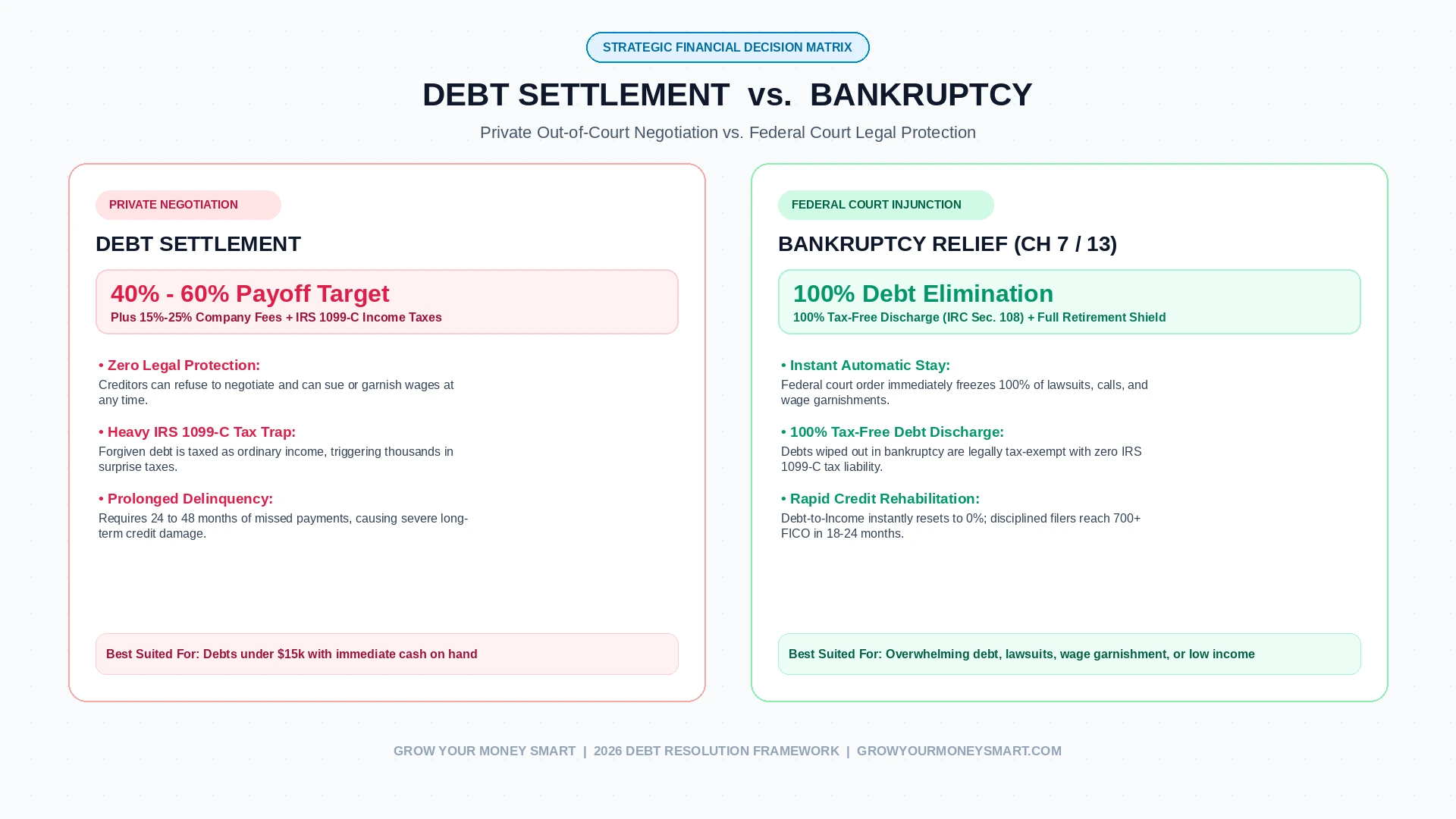
Understanding Debt Settlement vs Bankruptcy: Private Bargaining vs Federal Law
To make the right choice between debt settlement and bankruptcy, you must first understand the structural machinery powering each option. Conflating these two approaches is a dangerous mistake that costs distressed borrowers tens of thousands of dollars in unnecessary fees, compounding interest penalties, and unexpected tax liabilities.
What is Debt Settlement (and How Does It Actually Work)?
Debt settlement is a purely private, voluntary negotiation process between you (or a third-party for-profit debt settlement company) and your unsecured creditors (such as credit card issuers, personal loan providers, and medical billing agencies). The stated goal is convincing creditors to accept a single lump-sum payment—typically 40% to 60% of your total outstanding balance—in exchange for marking the debt as “settled in full” or “paid for less than original balance.”
However, creditors have zero legal obligation to negotiate with you while you are paying on time. Consequently, most debt settlement programs instruct you to intentionally stop paying your monthly minimums and instead deposit monthly funds into a dedicated escrow account. Over a period of 12 to 36 months, as your accounts enter extreme delinquency (90 to 180+ days past due), the settlement company uses accumulated cash to negotiate settlements one creditor at a time.
During this multi-year delinquency window, your credit score plummets severely, late fees and default interest rates (often 29.99%+) compound rapidly, and collection agencies intensify their demands. Crucially, because there is no court involvement, aggressive creditors can—and frequently do—file legal debt collection lawsuits, obtain court judgments, and seize funds directly from your bank account or wages before any settlement can be reached. If you are trying to evaluate your ongoing monthly cash flow before making a choice, modeling your spending in our interactive budget calculator is an indispensable first step.
What is Bankruptcy (and How Does Federal Protection Work)?
Bankruptcy is a formal legal proceeding conducted entirely under the jurisdiction of the United States Federal Bankruptcy Court, governed by Title 11 of the United States Code and official U.S. Federal Courts Bankruptcy Guidelines. Unlike debt settlement, bankruptcy does not rely on a creditor’s willingness to cooperate. Once a bankruptcy petition is filed, the federal court assumes jurisdiction over all your assets and liabilities, and federal law dictates how your debts are treated.
For individual consumers, personal bankruptcy primarily takes one of two distinct forms:
1. Chapter 7 Bankruptcy (Liquidation / Fresh Start): Known as straight bankruptcy, Chapter 7 allows qualifying debtors with income below their state’s median to wipe out 100% of eligible unsecured debts (credit cards, medical bills, personal loans) in as little as 4 to 6 months. Generous state and federal statutory exemptions protect essential assets such as primary home equity, retirement accounts (401k, IRA, pension funds are 100% protected under federal law), vehicles, and personal clothing, ensuring the vast majority of consumer filers surrender zero assets.
2. Chapter 13 Bankruptcy (Wage Earner’s Reorganization Plan): Designed for individuals with steady income who exceed the Chapter 7 Means Test or wish to halt a home foreclosure, Chapter 13 reorganizes your debts into a court-supervised 3-year or 5-year repayment plan. You pay a single consolidated monthly amount determined by your disposable income rather than the full debt balance. At the completion of the 36 to 60-month plan, any remaining unpaid unsecured balances are formally discharged tax-free.
Head-to-Head Comparison Matrix: Debt Settlement vs Bankruptcy (Chapter 7 & 13)
The matrix below contrasts the legal, financial, tax, and operational mechanics across all three debt resolution pathways under current 2026 statutory guidelines:
| Evaluation Metric | Debt Settlement (Private) | Chapter 7 Bankruptcy | Chapter 13 Bankruptcy |
|---|---|---|---|
| Governing Authority | Private contract negotiation | Federal Bankruptcy Court | Federal Bankruptcy Court |
| Creditor Cooperation | Voluntary (creditor can refuse) | Legally mandated by federal order | Legally mandated by federal order |
| Lawsuit Protection | Zero protection; lawsuits continue | Immediate Automatic Stay halts all suits | Immediate Automatic Stay halts all suits |
| Wage Garnishment Halt | No legal power to stop garnishment | Instant mandatory court injunction | Instant mandatory court injunction |
| Typical Resolution Time | 24 to 48 months | 4 to 6 months | 36 to 60 months (fixed plan) |
| Forgiven Debt Tax (1099-C) | Taxable as ordinary income | 100% Tax-Exempt (IRC Sec. 108) | 100% Tax-Exempt (IRC Sec. 108) |
| Administrative Fees | 15% to 25% of enrolled balance | $338 court fee + attorney fees | $313 court fee + trustee % + legal |
| Impact on Credit Report | Delinquency notes for 7 years | Public record for 10 years | Public record for 7 years |
| Asset Protection | No statutory asset exemptions | Protected up to statutory exemption limits | 100% asset retention via repayment plan |
| Retirement Protection | Creditors can pursue unprotected savings | 100% ERISA 401(k)/IRA protection | 100% ERISA 401(k)/IRA protection |
Financial Simulation: The True Out-of-Pocket Cost on a $50,000 Debt Balance
Many consumers mistakenly believe that debt settlement is cheaper because it avoids legal court fees. In quantitative reality, when you factor in settlement company success fees and IRS Cancellation of Debt (COD) income taxes, debt settlement is often the most expensive relief option available. Let us analyze an exact mathematical simulation of an individual carrying $50,000 in unsecured credit card debt across all three relief pathways:
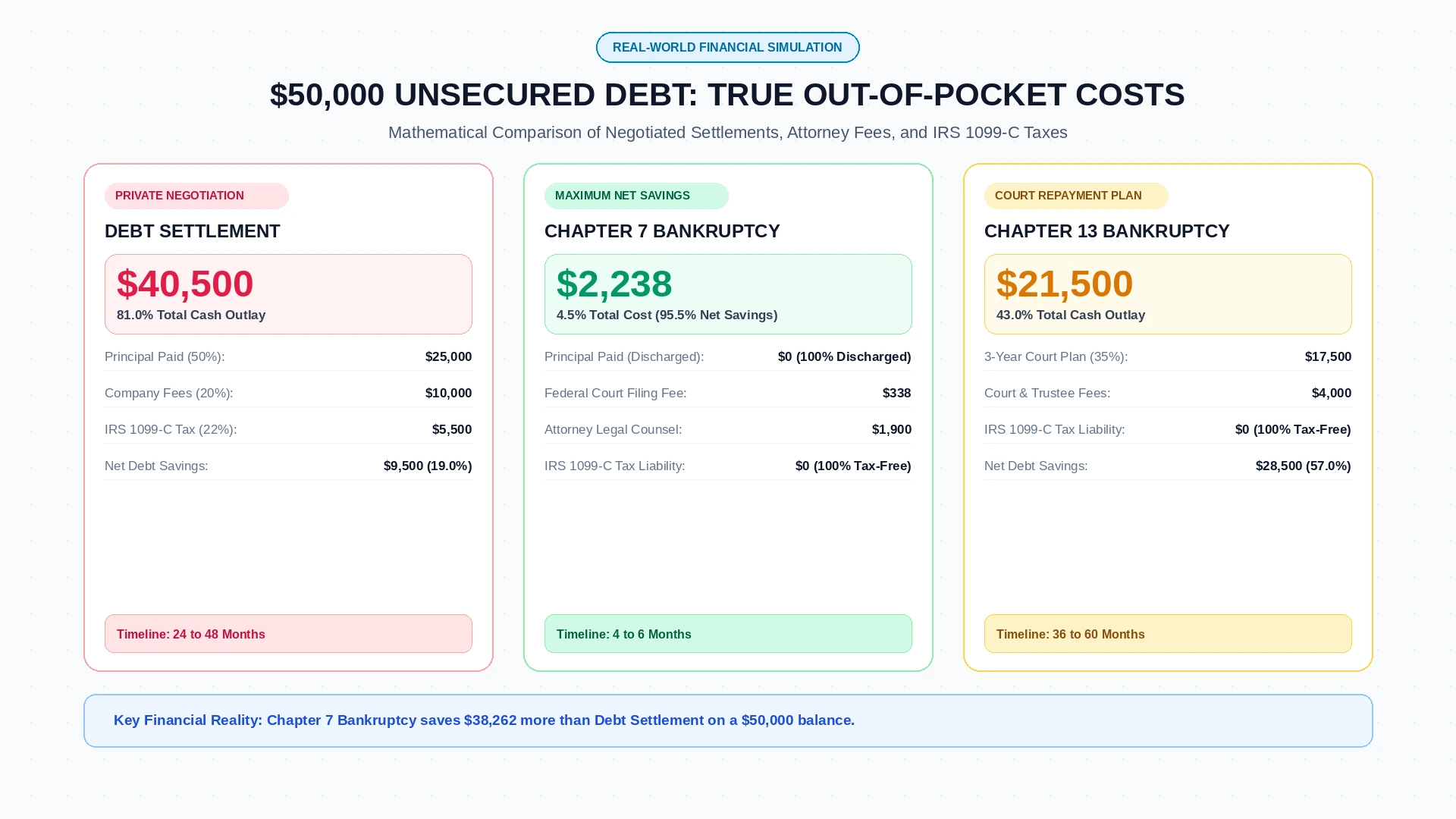
| Cost Breakdown Item | Debt Settlement (50% Target) | Chapter 7 Bankruptcy | Chapter 13 (35% Repayment) |
|---|---|---|---|
| Original Enrolled Debt | $50,000 | $50,000 | $50,000 |
| Principal Amount Paid | $25,000 (50% negotiated) | $0 (100% Discharged) | $17,500 (35% court-ordered) |
| Service / Legal Fees | $10,000 (20% of $50k) | $1,900 (Attorney) + $338 (Court) | $3,687 (Legal/Trustee) + $313 (Court) |
| IRS 1099-C Tax Bill (22% rate) | $5,500 (Tax on $25k forgiven) | $0 (Federal Tax Exemption) | $0 (Federal Tax Exemption) |
| Total Out-of-Pocket Cash | $40,500 | $2,238 | $21,500 |
| Effective Debt Relief Savings | $9,500 (19.0% net savings) | $47,762 (95.5% net savings) | $28,500 (57.0% net savings) |
| Timeline to Debt Freedom | 36 to 48 months | 4 to 6 months | 36 to 60 months |
As demonstrated in this simulation, resolving $50,000 through private debt settlement ultimately costs the consumer $40,500 in real cash outlays after settlement payments ($25,000), corporate fees ($10,000), and federal income taxes ($5,500). In contrast, Chapter 7 bankruptcy delivers a complete, unencumbered discharge for just $2,238 total. Understanding these mathematical realities before choosing a strategy is essential; explore our detailed debt management strategies guide to evaluate structured payoff options if your balance is still manageable.
The Hidden Danger of Debt Settlement: The IRS 1099-C Tax Trap
One of the most catastrophic oversights in consumer debt settlement is the Cancellation of Debt (COD) tax liability. Under Internal Revenue Code Section 61(a)(11) and IRS Publication 4681 on Canceled Debts, the federal government classifies any forgiven, canceled, or settled debt balance exceeding $600 as ordinary taxable gross income. When a credit card issuer agrees to accept $15,000 on a $35,000 balance, they write off $20,000 and report that amount to the IRS via Form 1099-C.
If you are in the 22% federal tax bracket and reside in a state with a 5% state income tax rate, that single settlement triggers a $5,400 unexpected tax bill due the following April. While the IRS provides a statutory insolvency exclusion via Form 982 (excluding canceled debt to the extent your total liabilities exceeded total assets immediately prior to cancellation), proving insolvency requires exhaustive documentation, real estate appraisals, and complex tax filings.
In stark contrast, debts discharged through federal bankruptcy proceedings are categorically exempt from gross income under Internal Revenue Code Section 108(a)(1)(A). Whether the bankruptcy court discharges $20,000 or $2,000,000 in liabilities, you will never receive a 1099-C tax penalty from the IRS. This distinction alone makes bankruptcy mathematically superior for borrowers with substantial unsecured debt balances comparing debt settlement vs bankruptcy.
Credit Score Realities: Delinquency Spirals vs Clean Slate Rebuilding
A widespread financial myth suggests that debt settlement is “better for your credit score” than filing for bankruptcy. In real-world credit reporting analytics, this assumption is fundamentally flawed.
The Multi-Year Debt Settlement Credit Decay
When you enter a debt settlement program, you must stop paying creditors for 12 to 36 months to build up negotiating leverage. During this extended timeframe, each enrolled creditor logs monthly 30-day, 60-day, 90-day, 120-day, and 180-day late payment marks across Equifax, Experian, and TransUnion. Accounts are eventually charged off, sold to aggressive third-party debt collectors, and reported as active collections.
Even after a settlement is successfully executed, each tradeline is marked with negative remarks such as “Settled for less than full balance” or “Account legally settled.” These derogatory marks remain on your credit report for 7 years from the original delinquency date, keeping your Debt-to-Income (DTI) and utilization metrics crippled throughout the multi-year negotiation process.
The Bankruptcy Discharge Rebound Trajectory
Bankruptcy undoubtedly causes an immediate, sharp drop in your FICO score (typically 130 to 200 points if you had good credit before filing). However, the moment your Chapter 7 or Chapter 13 discharge order is entered:
1. Every single discharged debt is updated on your credit files to $0 balance and “Discharged in Bankruptcy.”
2. Your revolving credit utilization drops to 0% overnight.
3. Your Debt-to-Income ratio resets to zero, instantly making you an attractive candidate for structured credit rebuilding.
4. Within 6 months of discharge, securing a secured credit card allows you to establish positive on-time payment history.
Empirical credit data reveals that disciplined filers routinely achieve FICO credit scores of 680 to 720+ within 18 to 24 months post-discharge, qualifying for standard FHA and conventional mortgages within 2 to 4 years. For practical steps on structuring your foundational savings buffer during recovery, review our blueprint on how to save your first $1,000 and calculate your baseline reserve with our emergency fund calculator.
When Should You Choose Debt Settlement?
While bankruptcy offers superior legal and tax protections for deeply insolvent individuals, debt settlement can be a viable, strategic option under specific conditions:
1. You Have Immediate Lump-Sum Cash Available: If you recently received an inheritance, bonus, or proceeds from selling non-essential assets, you can negotiate directly with creditors for an immediate 40% to 50% payoff without enduring multi-year delinquency.
2. Your Total Unsecured Debt is Under $15,000: For smaller debt amounts, the legal and court costs of bankruptcy ($2,000+) represent a significant percentage of the total debt, making direct negotiation more cost-effective.
3. You Hold Substantial Non-Exempt Assets: If you own valuable investment properties, luxury vehicles, or large taxable brokerage accounts that exceed your state’s bankruptcy exemption limits and would be liquidated by a Chapter 7 trustee, out-of-court settlement allows you to retain those assets.
4. Your Career Forbids Bankruptcy Filings: Certain security clearances, professional licenses (such as FINRA/SEC registered broker-dealers, specialized military roles, or high-level fiduciary positions) carry stringent restrictions regarding personal bankruptcy public filings.
5. Your Income Far Exceeds the Chapter 7 Means Test: If high income prevents Chapter 7 qualification and a Chapter 13 plan would require 100% repayment of principal over 5 years, private settlement may achieve a lower total principal payout.
When Should You File for Bankruptcy vs Debt Settlement?
Filing for bankruptcy is the mathematically and legally superior choice when comparing debt settlement vs bankruptcy under any of the following critical indicators:
1. You Are Facing Pending Lawsuits or Wage Garnishment: The moment a creditor files a summons or obtains a judgment, only the federal Automatic Stay can instantly freeze court proceedings and stop wage garnishments.
2. Your Total Unsecured Debt Exceeds 50% of Your Annual Gross Income: When credit card and personal loan balances exceed half your annual earnings, standard repayment schedules become statistically impossible to complete.
3. Your Income is Below Your State’s Median: Qualifying for Chapter 7 under the Means Test provides an immediate, 100% debt discharge in 4 to 6 months with zero tax liability and minimal filing costs.
4. You Face Foreclosure or Vehicle Repossession: Chapter 13 bankruptcy instantly halts sheriff sales and repossession tow trucks, allowing you to cure mortgage arrears over a comfortable 36 to 60-month schedule.
5. You Need Absolute Legal Finality: Bankruptcy provides a permanent federal court injunction making it a federal crime for discharged creditors to ever attempt collecting, contacting, or suing you again.
Actionable Step-by-Step Execution Blueprint
Before signing a contract with any debt relief company or filing legal petitions, follow this rigorous 5-step E-E-A-T validated protocol:
Step 1: Conduct a Comprehensive Balance Sheet and Cash Flow Audit
List every outstanding liability, interest rate, monthly minimum payment, and creditor status. Compare your total debt burden against your net household income using our dedicated debt payoff calculator and evaluate your lifestyle expenses against our monthly budget guide.
Step 2: Calculate Your Chapter 7 Means Test Eligibility
Check the official U.S. Trustee Program census data for your state and household size. If your trailing 6-month gross income falls below the state median, you qualify for full Chapter 7 liquidation without secondary expense testing.
Step 3: Schedule a Free Consultation with a Local Bankruptcy Attorney
Nearly all reputable, licensed consumer bankruptcy attorneys offer a free 30 to 60-minute initial case evaluation. They will review your local court exemptions, verify asset protection thresholds, and confirm whether Chapter 7 or Chapter 13 is suitable. Learn more about professional guidance in our DIY vs financial advisor comparison.
Step 4: Beware of Upfront Fee Debt Settlement Scams
Under Federal Trade Commission (FTC) Telemarketing Sales Rules (16 CFR Part 310), it is strictly illegal for any debt relief company to collect upfront fees before negotiating and settling a debt. If a debt settlement company demands retainer fees or charges upfront administrative setup costs, report them immediately and disengage.
Step 5: Execute and Establish Post-Relief Wealth Architecture
Once your debts are discharged or settled, immediately establish disciplined cash management habits. Transition into long-term financial security by reading our comprehensive analysis on debt-free living vs strategic borrowing.
Expert Video Walkthrough: Debt Settlement vs Bankruptcy Strategies
To reinforce these strategic principles with visual modeling, watch this detailed educational breakdown by authoritative debt relief analysts at Ascend Finance on “Debt Settlement vs. Bankruptcy: Which is the BEST in 2026?”:
Frequently Asked Questions (FAQs)
Below are clear, actionable answers to the most common questions distressed consumers ask when evaluating debt settlement vs bankruptcy:
Yes. Debt settlement is completely voluntary and provides zero legal shielding. Creditors retain the full legal right to file lawsuits, obtain default court judgments, and garnish your wages or bank accounts at any point during your settlement program before a signed agreement is finalized.
No. Under Section 108 of the Internal Revenue Code, debts discharged in federal bankruptcy are 100% tax-exempt. You will not receive a Form 1099-C and owe zero federal or state cancellation of debt income taxes, unlike private debt settlement.
In the vast majority of consumer Chapter 7 cases, filers lose no assets. State and federal statutory exemption laws protect substantial equity in primary residences (homestead exemptions) and personal vehicles (motor vehicle exemptions), provided your mortgage and car loan payments remain current.
Chapter 7 bankruptcy is remarkably fast, typically reaching a final permanent discharge order within 4 to 6 months of initial filing. In contrast, for-profit debt settlement programs require 24 to 48 months of active delinquency and ongoing cash accumulation.
Yes. Under federal ERISA laws and the Bankruptcy Abuse Prevention and Consumer Protection Act (BAPCPA), 100% of ERISA-qualified retirement plans (401k, 403b, pensions) and up to $1.51 million in Traditional/Roth IRAs are completely exempt from creditors and bankruptcy trustees.
You can qualify for an FHA or VA home loan within 2 years following a Chapter 7 discharge (or 1 year of on-time payments during Chapter 13). Conventional Fannie Mae and Freddie Mac loans require a 4-year waiting period post-discharge.
Federal student loans are generally not eligible for private settlement programs. In bankruptcy, discharging student loans historically required proving ‘undue hardship’ under the Brunner Test. However, modernized DOJ/Department of Education guidance has significantly streamlined student loan discharge procedures for eligible distressed borrowers.
Chapter 7 is ideal if your income is below your state’s median and you have minimal non-exempt assets, allowing a fast 4-month clean slate. Chapter 13 is designed for higher earners, homeowners fighting active foreclosure, or individuals seeking to protect significant non-exempt assets via a 3 to 5-year repayment plan.
Final Expert Verdict on Debt Settlement vs Bankruptcy
Deciding between Debt Settlement vs Bankruptcy is fundamentally an objective mathematical and legal calculation rather than an emotional dilemma. For borrowers with manageable debts under $15,000, available lump-sum cash, and protected careers, direct out-of-court settlement can achieve effective compromise while avoiding public bankruptcy court records.
However, when unsecured liabilities become truly insurmountable, threatening your family’s financial stability, pending litigation, or wage garnishment, federal bankruptcy protection remains the gold standard in consumer economic defense. By delivering immediate court protection, 100% tax-free debt elimination, total retirement asset preservation, and a rapid springboard to credit rehabilitation, bankruptcy fulfills its statutory purpose: granting honest, overburdened Americans a genuine, unburdened financial fresh start.
⚖️ Debt Relief, Insolvency & Restructuring Frameworks
Before finalizing your decision between debt settlement and legal bankruptcy, explore these essential relief alternatives and calculation tools:
- DIY Negotiation: settling credit card debt yourself without debt agencies — negotiate directly with creditors for 40% to 60% balance reductions without third-party fees.
- Hardship Assistance: formal credit card hardship programs — request reduced APR or temporary interest freezes directly from your bank.
- Strategic Acceleration: debt avalanche vs snowball payoff strategies — evaluate whether systematic repayment can eliminate balances before insolvency.
- Large Balance Payoff: aggressive 0,000 credit card payoff blueprint — structured milestones to crush large revolving debt.
- Interactive Calculator: interactive debt payoff calculator — compare payoff schedules, total interest costs, and debt-free dates.

Jaiveer Hooda is the Lead Financial Researcher & Personal Finance Analyst at Grow Your Money Smart. Specializing in personal wealth optimization, index fund compounding, high-yield savings mechanics, and consumer debt elimination strategies. With a background in computer engineering, he applies mathematical modeling, cashflow simulations, and empirical risk analysis to evaluate personal finance vehicles and credit products. Every analysis is backed by verified regulatory disclosures, IRS tax schedules, and empirical APY compounding math.
Areas of Expertise: Personal Finance · High-Yield Savings Accounts (HYSA) · Index Funds & S&P 500 Compounding · Retirement Planning (401k/IRA) · Debt Optimization · Credit Card APR Mechanics.
Transparency & Editorial Policy: Editorial Standards | Report a Correction