
Across global cultures, retirement is divided between Western individualism (self-funded 401(k) accounts and independent living), Eastern collectivism (filial piety, multigenerational households, and family eldercare), and Nordic social solidarity (universal state pensions with collective risk-sharing). While Western retirees view retirement as a reward of full leisure, cultures such as Japan anchor post-work life in Ikigai—meaningful lifelong community contribution. Today, demographic shifts are forcing worldwide systems to adopt hybrid models combining personal investing with cultural support networks.
Retirement is not a universal human concept; it is an economic and cultural invention. In Western financial discourse, retirement is frequently reduced to a quantitative math puzzle: hitting your “FIRE number,” maintaining a 4% safe withdrawal rate, and maximizing tax-advantaged accounts. However, examine retirement across different continents, and you quickly realize that culture—not just currency—dictates how humanity approaches aging, wealth distribution, and post-work identity.
While an American retiree may measure success by their 401(k) balance and a condo in a sunbelt retirement village, a Japanese elder might view complete disengagement from work as a fast-track to cognitive decline, seeking purpose through Ikigai. Meanwhile, in South Asia and Latin America, institutional nursing care remains culturally taboo, replaced by multi-generational households where grandparents provide crucial family stability. Understanding how retirement is viewed across different cultures reveals profound blind spots in modern financial planning and provides a master blueprint for building a resilient, purpose-driven third act of life.
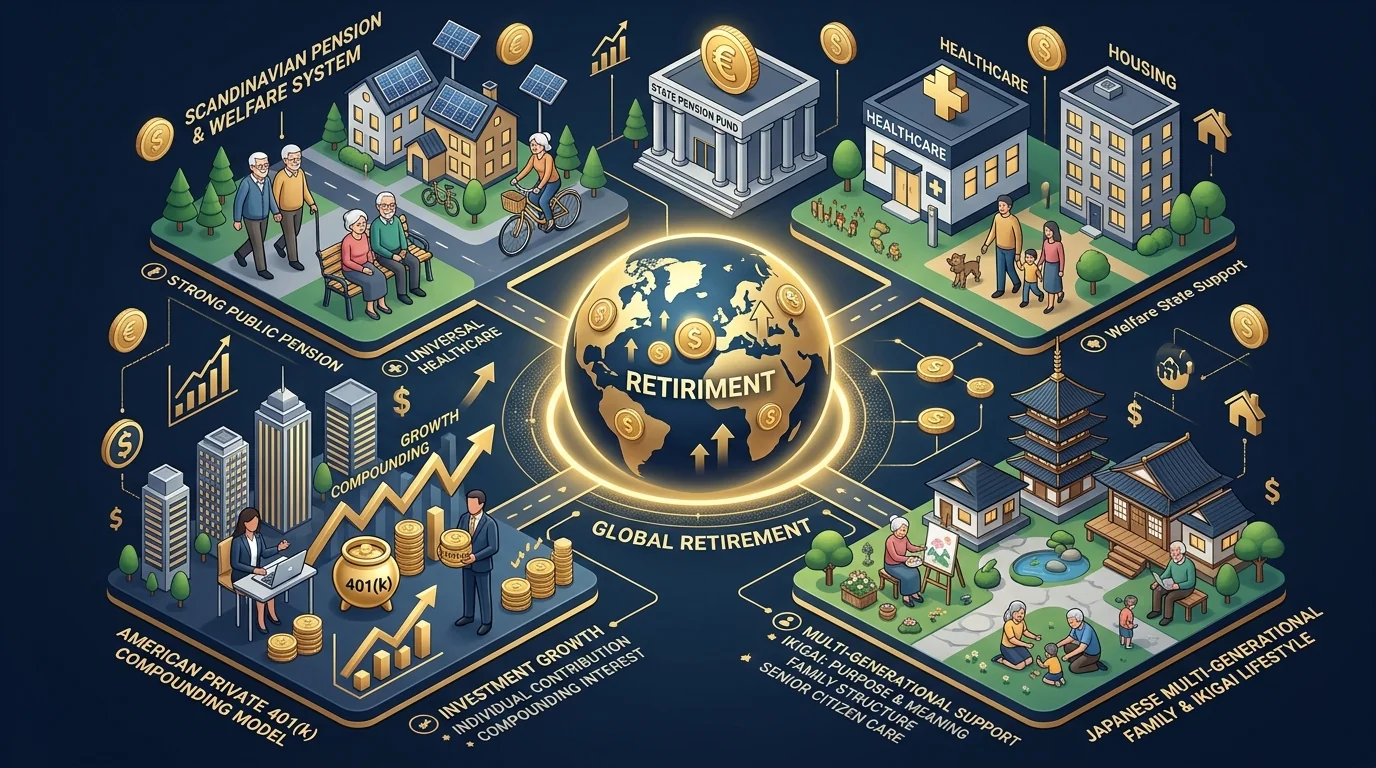
Core Comparison: Global Retirement Paradigms Across Continents
To grasp the vast philosophical and practical divergence in retirement around the world, review the structural matrix below comparing the world’s major cultural archetypes:
| Cultural Region | Core Philosophical Foundation | Primary Financial Engine | Living & Care Model | Post-Work Identity |
|---|---|---|---|---|
| Western / Anglo (US, UK, Canada) | Individual self-reliance & personal autonomy | Defined Contribution (401k/IRA/Super), private equities | Independent living, 55+ active adult communities, assisted care | Leisure, travel, complete cessation of labor |
| East Asian (Japan, China, Korea) | Filial piety (Xiao) & societal contribution | Modest public pension + intergenerational family support | Multigenerational households (San-sedai), family co-living | Ikigai (purpose in life), phased flexible work |
| Nordic / Dutch (Netherlands, Denmark) | Social democracy, collective risk-sharing | Universal basic state pension + mandatory occupational funds | High-grade subsidized communal & municipal care | Civic engagement, cultural pursuits, high work-life balance |
| Latin America & Mediterranean | Familismo (family central to economic survival) | Informal familial safety nets, property, cash remittances | Extended family co-residence; nursing homes widely rejected | Active grandparenting, household governance, community anchor |
| Middle Eastern & North African | Religious duty & patriarchal/matriarchal stewardship | Direct family business continuity, physical real estate, gold | Patriarchal family compound, complete adult-child caregiving | Senior family advisory role; moral and legal council |
1. Western Individualism: The Self-Funded “Clean Break” Model
In the United States, the United Kingdom, and Canada, retirement is treated as an individualized contract. Following the gradual dismantling of corporate defined-benefit pensions over the past four decades, the entire burden of longevity risk has shifted onto the worker’s shoulders. Navigating this shift requires mastering the 5 stages of retirement planning lifecycle to avoid premature portfolio depletion.
The Western paradigm is distinguished by three distinct cultural pillars:
- The Concept of the “Golden Years”: Retirement is framed as earned leisure—travel, hobbies, and disengagement from corporate stress. The cultural goal is total independence; relying on adult children for financial or physical support is frequently viewed as personal failure or an unacceptable burden.
- Institutional Living Facilities: Because self-reliance is prized, older adults often transition into active 55+ planned communities, assisted living, or skilled nursing facilities funded by private long-term care insurance or out-of-pocket savings.
- Financial Reliance on Capital Markets: The Anglo-Saxon model relies heavily on private capital growth through 401(k) accounts, IRAs, and Australia’s Superannuation guarantee. However, relying purely on market returns exposes savers to systemic market volatility, making supplementary personal retirement savings essential.
The Hidden Western Dilemma: While the Western model champions unmatched personal freedom, it carries a severe psychological drawback: the loneliness epidemic. When career identity disappears overnight, retirees who have not developed non-financial interests experience elevated rates of depression and cognitive decline.
2. East Asia: Filial Piety, Multigenerational Duty, and the Wisdom of Ikigai
In East Asian societies—specifically China, Japan, and South Korea—retirement dynamics are historically rooted in Confucian philosophy, specifically the foundational virtue of filial piety (Xiao). Under this framework, children incur a moral and financial obligation to support their parents in old age as reciprocity for being raised.
Japan’s Longevity Secret: The Ikigai Philosophy
Japan boasts the highest proportion of centenarians and oldest median population on Earth. Yet, the Japanese language historically had no direct equivalent for the Western concept of “retirement” as complete cessation of effort. Instead, life past 60 is steered by Ikigai (生きがい)—loosely translated as “that which gives life meaning and purpose.”
Rather than seeking an abrupt cliff-edge retirement, millions of Japanese seniors participate in the country’s national network of Silver Jinzai Centers (Silver Human Resource Centers), undertaking part-time community mentorship, artisanal work, gardening, and cultural guidance. This active engagement validates modern insights on redefining retirement beyond stopping work entirely, proving that phased involvement preserves cognitive longevity.
The Intergenerational Squeeze in China & Korea
While traditional multigenerational living remains the cultural ideal, rapid modernization has introduced severe friction. In China, the demographic legacy of the former One-Child Policy created the daunting “4-2-1 phenomenon”—where a single working adult child may be responsible for supporting two aging parents and four grandparents. This massive pressure mirrors the financial squeeze felt by millions in the sandwich generation juggling dual elder and child care.
3. Nordic & Western Europe: The Social Welfare Solidarity Model
If the American system represents private accumulation and the Asian system represents familial duty, the Nordic and Northwestern European model (Denmark, the Netherlands, Norway, Sweden) represents the pinnacle of societal solidarity.
Year after year, the authoritative Mercer CFA Institute Global Pension Index rates the Netherlands, Iceland, and Denmark as possessing the world’s top “Grade A” retirement systems. How do they achieve this?
- The Quasi-Mandatory Occupational Pillar: In the Netherlands, industry-wide collective bargaining agreements ensure that over 90% of employees are enrolled in industry-backed, non-profit pension funds that pool investment risk across generations.
- Universal Basic State Pensions: Denmark’s Folkepension provides a baseline standard of living to all citizens who meet residence criteria, decoupling basic survival in old age from stock market performance.
- Retirement as a Civic Right: Unlike the US, where workers constantly debate whether they can afford healthcare before Medicare at age 65, European universal healthcare eliminates the single largest financial wildcard in retirement planning.
Expert Video Walkthrough: The World’s Best & Worst Pension Systems
To examine empirical data on how global pension models compare across adequacy, sustainability, and integrity, watch this breakdown by financial analysts at Bloomberg Television:
Key Takeaways from Global Pension Index Research:
- Grade A Systems (Netherlands, Iceland, Denmark): Combine universal state safety nets with robust, mandatory workplace pensions with low asset management fees.
- Grade C+ Systems (United States, United Kingdom): Strong capital markets, but severely hindered by unequal coverage, voluntary participation, and lack of lifetime income annuitization options.
- The Longevity Challenge: Across every developed nation, birth rates below replacement level (2.1 births per woman) are forcing statutory retirement ages higher (from 65 toward 67-70).
4. Latin America & The Mediterranean: Familismo & The Golden Age of Community
In Mediterranean cultures (Spain, Italy, Greece) and across Latin America (Mexico, Brazil, Colombia), retirement is woven into the fabric of the community. In these regions, placing an elderly parent into a long-term care institution is widely considered a failure of family honor.
This dynamic is fueled by Familismo—a core cultural value where family interests supersede individual preferences:
- Multigenerational Wealth Synergy: In Italy and Spain, adult children frequently live in family-owned properties well into their 30s. In exchange, aging grandparents manage domestic logistics, cook daily meals, and care for grandchildren—effectively saving the family thousands of dollars annually in professional childcare expenses.
- Informal Real Estate & Cash Economies: Rather than allocating 80% of net worth into paper stock market assets, families prioritize freehold residential property. Owning a paid-off family home acts as the ultimate multi-generational insurance policy against economic downturns.
- Daily Public Socialization: In Spain, the tradition of the evening Paseo (stroll) through town plazas keeps retirees physically active, integrated into mixed-generation neighborhoods, and insulated from social isolation.
To understand how community and social connectivity directly influence lifespan, review our strategic breakdown of the 4 non-financial lifestyle pillars of retirement.
The Great Global Pivot: Why Every Culture Is Adopting Hybrid Models
No cultural model remains static. Across the globe, economic and demographic pressures are forcing traditional paradigms to evolve rapidly:
- Demographic Inversion: Because fertility rates have collapsed across Europe and East Asia, pay-as-you-go government pensions and pure family-care models are experiencing unsustainable financial strain. Many countries are reviewing their Social Security and early retirement age policies.
- The Rise of Individual Accounts in Asia: In response to lengthening lifespans, Asian governments are aggressively promoting individual retirement accounts—such as Japan’s expanded NISA (Nippon Individual Savings Account) and India’s National Pension System (NPS)—teaching populations to embrace equity market compounding.
- Western Adoption of Community Co-Housing: Faced with soaring eldercare costs, Western retirees are increasingly turning to co-housing cooperatives and multi-generational floor plans, borrowing wisdom from Mediterranean and Asian living models.
To guard your wealth against rising life expectancies across any jurisdiction, explore our comprehensive guide on planning for retirement longevity and multi-decade distribution.
5 Actionable Lessons You Can Steal from Global Retirement Cultures
Regardless of where you live or what passport you hold, integrating the best practices of global retirement cultures will make your wealth plan vastly more resilient:
- 1. Cultivate Your Ikigai Before Quitting Work (From Japan): Never retire “away” from something; always retire “to” something. Define at least two passion projects, part-time consulting channels, or community volunteering endeavors before transitioning out of your primary career.
- 2. Automate Institutional Savings Discipline (From the Nordic Model): Treat your retirement contributions as non-negotiable payroll deductions. Mirror the Dutch model by systematically capturing 15% to 20% of your earnings into low-cost, broadly diversified index funds every month.
- 3. Build Multi-Generational Family Financial Capital (From Latin & Asian Cultures): Foster open family discussions regarding long-term care preferences, estate governance, and property preservation. Proactive family alignment eliminates probate delays and unnecessary nursing home expenditures.
- 4. Diversify Beyond a Single Public Benefit (From the Three-Legged Stool): Never assume any federal public pension will fully cover your lifestyle. Review the timeless principles of the three-legged stool of retirement income—combining social benefits, personal investing, and guaranteed lifetime cash flow.
- 5. Prioritize Social & Physical Mobility (From the Mediterranean): Protect your longevity by investing in daily physical activity and face-to-face neighborhood connections. Wealth without health and community yields an empty retirement.
Frequently Asked Questions (FAQ)
Which country has the best retirement system in the world?
According to the annual Mercer CFA Institute Global Pension Index, the Netherlands, Iceland, and Denmark consistently achieve “Grade A” ratings. Their systems achieve unmatched sustainability and adequacy by combining a universal state pension floor with quasi-mandatory, non-profit workplace pension funds managed at near-zero administrative costs.
How does Eastern retirement differ fundamentally from Western retirement?
Western retirement prioritizes personal independence, leisure, and self-funded private investment accounts (such as 401(k)s and IRAs), often utilizing independent living facilities. Eastern retirement traditionally centers on filial piety, multigenerational living arrangements, and ongoing community integration rather than total disconnection from productive life.
What is the Japanese concept of Ikigai in retirement?
Ikigai translates to “a reason for being.” In Japan, retirement is not viewed as an abrupt halt to all productive activity, but rather a transition into purposeful, flexible community work, artisanal craft, or social mentorship. This daily sense of purpose is medically credited as a primary reason for Japan’s exceptional longevity.
Why are nursing homes less common in Mediterranean and Asian cultures?
In Mediterranean and Asian cultures, strong ethical values—such as Familismo and Confucian filial piety—regard caring for aging parents as a sacred family duty. Placing elders in institutional facilities is often viewed with social and moral stigma, prompting families to favor multigenerational co-residence.
How are demographic changes challenging traditional family retirement support?
Collapsing birth rates, urban migration, and rising cost-of-living have created severe demographic imbalances (such as China’s 4-2-1 structure). With fewer adult children available to support an expanding elderly cohort, traditional family safety nets are under intense economic strain, driving higher demand for personal investment accounts.
What is Australia’s Superannuation model?
Australia operates a mandatory employer-funded retirement scheme called “Superannuation.” Employers must contribute a mandatory minimum percentage (currently 11.5% to 12%) of an employee’s earnings into a tax-advantaged investment fund, producing one of the highest median retirement balances in the world.
Can adopting a hybrid retirement approach improve financial freedom?
Yes. Combining Western financial tools (compound stock market index funds and tax-advantaged accounts) with Eastern and Mediterranean lifestyle principles (maintaining purposeful phased work and strong family/community ties) provides both financial independence and superior psychological fulfillment.
Final Expert Takeaway: Redesigning Your Retirement Journey
Examining how retirement is viewed across different cultures teaches us that financial net worth is only half the retirement equation. The most fulfilled retirees worldwide are not those who simply sit on a golf course or isolate themselves in luxury; they are individuals who balance compound investment growth with enduring human connection, purpose-driven activity, and mutual intergenerational respect.
By blending Western capital velocity with Nordic institutional discipline and Eastern/Mediterranean communal warmth, you transform retirement from an uncertain finish line into your life’s most enriching chapter.

Jaiveer Hooda is the Lead Financial Researcher & Personal Finance Analyst at Grow Your Money Smart. Specializing in personal wealth optimization, index fund compounding, high-yield savings mechanics, and consumer debt elimination strategies. With a background in computer engineering, he applies mathematical modeling, cashflow simulations, and empirical risk analysis to evaluate personal finance vehicles and credit products. Every analysis is backed by verified regulatory disclosures, IRS tax schedules, and empirical APY compounding math.
Areas of Expertise: Personal Finance · High-Yield Savings Accounts (HYSA) · Index Funds & S&P 500 Compounding · Retirement Planning (401k/IRA) · Debt Optimization · Credit Card APR Mechanics.
Transparency & Editorial Policy: Editorial Standards | Report a Correction
Thanks for all of the labor on this blog. Ellie enjoys participating in investigation and it is easy to understand why. All of us learn all about the lively means you give advantageous guides on your web blog and therefore invigorate participation from other people on the situation plus my girl is undoubtedly understanding a whole lot. Take advantage of the remaining portion of the new year. You’re conducting a good job.
Thank you, Graciela! I truly appreciate your thoughtful feedback. It’s great to know the blog is helping you and your family learn and engage.
I’m extremely impressed with your writing skills as well as with the layout on your blog. Is this a paid theme or did you modify it yourself? Either way keep up the excellent quality writing, it is rare to see a great blog like this one nowadays..
Thank you, Ollie! I appreciate your feedback. The layout and content are something I’ve worked hard on, so it’s great to know it’s making a positive impact.